Showing posts with label 'vernacular'. Show all posts

19 March 2018

Coffee Break: thoughts on Stuart Freedman's pictures of Indian Coffee Houses

The Palaces of Memory: Tales from the Indian Coffee House is Stuart Freedman's visual journey of urban India.


The Indian Coffee House, Kollam (now closed), 2013

When Stuart Freedman first arrived in Delhi in the mid-90s, it felt overwhelming. "I'd been to Pakistan, I'd been at the siege of Kabul, but India was something else," laughs the British photographer, now a veteran of many visits. "When I needed a break from the relentless push and pull of the city, I'd go to the Coffee House and be quiet. It was a refuge." But it wasn't till about 2010 that he picked up his camera inside one of them. Soon after, on assignments in Jaipur and Kolkata, he ended up photographing the Indian Coffee Houses there. "Then I knew it was a book," says Freedman, in Delhi for the Indian launch of his photo-exhibition and accompanying book, The Palaces of Memory: Tales from the Indian Coffee House (Tasveer/ Dauble, 2017).

If you grew up in urban India before liberalisation, the Coffee House, or at least the idea of it, is likely to have been part of your coming of age. Set up by the British government in the 1930s as a response to the Depression-era decline in coffee exports, the India(n) Coffee House chain did much more than create a local demand for the beverage. Its outposts across India became places where middle-class people met, to drink coffee, yes, but also to discuss politics and poetry and the day's gossip, to meet classmates after class or colleagues after work, or to conduct a romantic rendezvous in a place that offered anonymity but also safety. In short, to do all those things that not many places in the 20th century Indian city yet enabled, and to do so in a public place, inexpensively.

Yet, while the Coffee House experience captured something of modern western urbanity, it also represented India's unabashed, wholehearted claiming of it. Here, we produced our own version of modernity: where the coffee came in white ceramic cups (with saucers) but the kettles were aluminium; where you might cut up a mutton cutlet with a knife and fork but happily eat sambar-vada with your hands. Palaces of Memory does the much-needed job of making us look afresh at these remarkable places in our midst, their unpretentious formica tables and faded Gandhi-Nehru images offering a magical window into a vanished past. As the post-liberalisation city around it grows ever more brash and shiny, the more the Coffee House seems like a holdout: the last surviving outpost of what Amit Chaudhuri's 'Prologue' calls a "deliberately, almost jealously protected austerity".

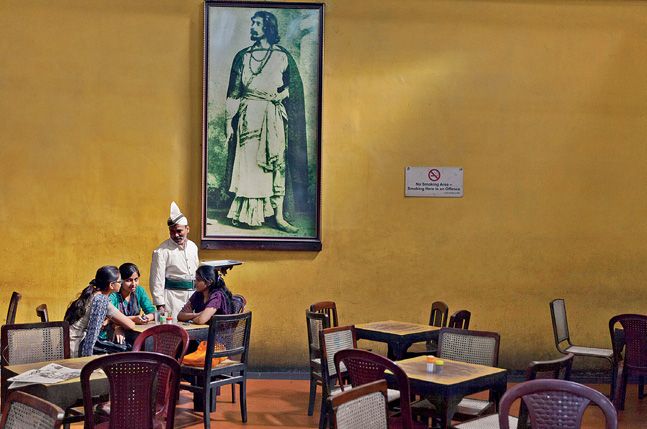
A waiter serves schoolgirls beneath a portrait of Rabindranath Tagore in the Indian Coffee House, Kolkata, 2013

Freedman's images do not shy away from this plainness, or signs of age: the peeling walls, the fraying pockets of uniforms, the blackened switchboards, table legs balanced in empty Amul cheese tins. But his gaze is affectionate, forgiving, even celebratory. Even a fly sitting in a bowl of sugar seems innocuous, yet another visitor to the Coffee House who hasn't been turned away. "I'm not romantic about India, the nonsense about elephants and maharajas. But there is a romance about what the Coffee Houses allow people to do. You can sit all afternoon with a cup of coffee and no one's going to tell you to leave," Freedman says. "I'm from Hackney, from a working class background. The Coffee House became this kind of translation device for me because I saw the same people there as in the cafes at home."

Of course, Coffee Houses are not all the same. "South Indian ones have much more substantial food," says Freedman. And one Coffee House might cater to different constituencies: retired old men, college students, middle-aged couples or a family on a ritual outing, young lovebirds. But what all these people are likely to have in common is that they are lower middle class.

Men sit and talk in the Indian Coffee House, Baba Kharak Singh Marg, New Delhi, 2010

Freedman is clearly drawn to places that democratise leisure. If England's greasy spoon cafes summon up an era of post-war rationing that he didn't quite witness, his book on another dying British institution, the Eel, Pie and Mash shop, "is really about [his] past" and "that section of London's working class that feels dislocated". He has also photographed the cafes of Cairo "as a way to examine the Egyptian revolution". Does he see Indian Coffee Houses as resisting the neoliberal economy? "Modern cities privatise space," Freedman agrees. "Places where people gather and are not monetised like Starbucks are places where people discuss. And discussion is dangerous to the state. Indira Gandhi knew this; she closed the Coffee House during Emergency, saying it was seditious."

Indian Coffee House, Chandigarh, India, 2013

What also makes the Indian Coffee Houses unique is that they are worker-run. In the 1950s, after the Coffee Board decided to privatise 43 outlets and fired many employees, the workers formed cooperative societies and persuaded the management to let them run the outlets.

Freedman's many superb portraits of waiters and kitchen staff are testament to the wonderful sense of ownership that pervades the Coffee Houses as a result. In one image in Palaces, a frail old man in a dhoti sits with his back to a man in collared shirt and trousers. As they raise their identical cups of coffee to their lips, one has the sense of a world in perfect balance, something sadly missing in the world outside.

21 May 2015

Interview: Shamsur Rahman Faruqi

"Urdu was a neglected language, damned as 'foreign' or 'Pakistani'": The renowned writer SR Faruqi speaks about fiction, criticism, translation and the litfest craze, in an interview published in Scroll.


Shamsur Rahman Faruqi is among modern Urdu's most renowned voices, both as a critic and as a fiction writer. His critical ouevre includes a pathbreaking four-volume study of the poet Mir Taqi Mir, and another influential four-volume work on Urdu's rambunctious romance epic, the Dastan-e-Amir Hamza. His fiction is also highly acclaimed, and he is somewhat unique in having been his own translator into English. He speaks on how he began writing, moving from fiction to criticism, translating from Urdu to English, and his experience of the Urdu and English literary spheres.

Could you tell me a bit about when and how your fiction first began to be published? Was it in literary journals, or newspapers/magazines, or was it directly in book-form? 

I am known generally as a critic, but I began as a fiction writer in Urdu. I wrote stories from a very early age and got some of them published in Urdu literary magazines. (More rejections, as I remember, than acceptances.) I wrote a short novel when I was about 15 or a bit more. The year must have been 1950, or early 1951. I was lucky to get it published in a four instalments in a literary magazine published from Meerut (Merath). 

I saved neither the manuscript (I wrote it twice), nor the issues in which it was published. I am not sorry that I didn't preserve anything, because I am quite ashamed of it now. I was young and I believed that I was older than my years, and full of confidence that I knew about most things in the world.

I don't think I had any ambitions to write in English. Getting my work printed in minor Urdu magazines was as much as I could manage at that time.

There is a strong tradition of literary discussion in Urdu. Would you say that book reviews, media coverage and/or literary awards in Urdu helped you gain readers? 

Yes, Urdu literary culture is perhaps the most self-aware among the literary cultures that I am acquainted with. But I am not sure that reviews, favourable or unfavourable, help gain readers in my literary culture. Those who want to read will read. An adverse review could damage a book of poems – though even that is doubtful – but there as many kinds of fiction as there are kinds of readers, almost. So whatever you write can get published, given a degree of luck.

Popular publishing (there was, and is some money in it), or what is now called 'pulp fiction' needs no publicity, no reviews. 'Literary' fiction in Urdu was almost always backed some established parameters – fiction about women, about the life and problems and struggles of rural folk, about the urban blue collar type, so on. When I began writing, the parameters most solidly established were those set up by the Progressive Movement. I somehow fought shy of becoming one of them.

In mid-twentieth century, when I was trying to become a writer, there were no awards, no prizes, no media coverage for Urdu. The Progressives got some media coverage in some of the liberal left wing popular magazines like the weekly Urdu Blitz. That was all.

Urdu at that time was a neglected language, a language damned as 'foreign' or 'Pakistani'. The cultural supremacy that it enjoyed over most of northern India at the time of independence dissolved and disappeared very quickly.

Why  – and when – did you decide to start translating your own work from Urdu to English? 

As I said a minute ago, I had no intention, no hope, no ambition to set up as a writer in any language other than Urdu. Indian writing in English was confined to a few 'privileged' writers, long established and unchallenged. Even G.V. Desani's remarkable novel All About H. Hatterr (1948) attracted no attention in India. Ahmed Ali's Twilight in Delhi (1940) had attracted attention in Progressive circles because Ahmed Ali at that time was a leading light of the Progressive movement. Setting up as a writer in a 'backward' and maligned language like Urdu was itself a big challenge in the 1950's and early 1960's. And I certainly didn't imagine that my writing in Urdu was rich or strong enough to merit being translated in English, or any modern Indian language. In fact, those things were so far and so much below (or above) my horizon that they didn't cause me any concern at all.

I wasn't really interested in translating my fiction into English. Penguin had a plan to get it translated into English and all the major modern Indian languages. A fairly competent translator was found for Hindi but no translator could be found for English. My daughters, who are the most faithful of my followers, were sure that I was the best person to do the translation. They kept after me and I decided to make the translation just to get them off my shoulders. After the novel, it was quite obvious to everyone, including me, that the stories deserve me as their translator.

But you had translated your work into English before this?

About the same time that I wrote my novella, say in early 1951, I wrote a short story. It was about the oppression suffered by innocent, harmless people in the Soviet regime. One of my teachers, who read the manuscript, said: 'This reads like a story written by some major writer!' Foolishly, instead of thanking him, I replied sheepishly that indeed I was the author. I don't remember if I published the story somewhere, but I saved a copy, and in 1953-1954, when I was reading English for my M.A. from the University of Allahabad, I translated the story into English and submitted it to the Professor in charge of the University magazine. Somewhat to my surprise, he accepted the story and printed it in the magazine for 1953-54.

I didn't save the Urdu, nor did I save the English version, far less keep a copy of the Magazine. I regarded the whole matter as just one of those things. I had no intention to set up as a writer in English, either through translations of my own stories, or writing directly into English.

The Urdu title of the story was Surkh Andhi. I translated it as 'The Scarlet Tempest.' My Professor made no change in the title, but I later realized that Shakespeare (perhaps in Richard II) had 'crimson tempest' and I was a fool not to have thought of it myself, or borrowed it from Shakespeare. Well, that was the end of my foray into translating my own work (or even writing stories) for I soon found that I could do better service to Urdu as a critic.  

Do you think the interest and readership for English translations of Indian literature has increased in the last five years, and if so, why do you think it is happening?

Certainly, the readership has grown manifold over the last decade or so. The sub-continent is now a major market for literature in English, translated from the Indian languages or composed directly in English. The main reason for this is the unprecedented and extraordinary prestige – almost universal – of the sub-continental writing in English. The other reason is the growth of Indians who are only fluent in English. The third reason, I think, is the increased awareness among us of the literature being written in modern Indian languages. Some of the interest trickles down to pre-modern literatures too.

How was the reception to the English edition of your books different from the response your fiction has received in the Urdu press?  

The reception in all the languages – Urdu, Hindi, English, was warmer than I should have expected. In Urdu, there were only three unfavourable reviews, two of them on 'moral' grounds, that the novel projects a 'prostitute' as the central character. In English and Hindi, the reviews and opinions can be described as fulsome. the media coverage in English was rather more extensive than in Urduor Hindi, for obvious reasons. And the Urdu circles were already aware of my stories, so the novel came more as natural sequel than as a discovery. In English and Hindi the sense of wonderment was greater.

How would you compare Urdu literary award functions – and litfests, if they exist – to the ones that you have attended where the audience is largely English-speaking? 

The Urdu award or book launch functions are always formal and small, and the audience is kind of pro-forma. Litfests are something else again. The atmosphere is cordial and the audience well informed when the festival is held in an Urdu speaking or Urdu knowing location, like Karachi or Chandigarh. But festivals like Jaipur have deteriorated into politics, showbiz, celebrity-catching, so forth. And they're too big to be enjoyed really. I was fortunate in Jaipur merely because the people who came to hear me were generally aware of the novel, and some of them knew it in Urdu as well.

As an acclaimed writer in your own language and literary universe, can you comment on what it was like to be treated as a new 'discovery' at the national level, when
The Mirror of Beauty came out in English? 

I don't know if my appearance in English should be described as a 'discovery at the national level.' In any case, I was and am quite happy to be known as an Urdu writer and India is too big a country for me to have illusions about a 'national' status. I was not unknown in non-Urdu circles, especially English and Hindi. Now the opening in English fiction has given me another space. But nothing more.

Your writing was now routed via English: did that feel strange in any way? Were there misreadings when people read your work, but lacked contextual understanding? Did English readers offer any new perspectives, from which new insights emerged?

I am not sure that there were miscommunications, or that the English window on my work felt strange or outlandish. I have spent a very great part of my life reading English, so the language is not really alien to me.And having written criticism in English (or translated my work from the Urdu into English), I felt quite comfortable. I have translated a good bit of my poetry in English too and have been fortunate in having good translations of my poetry made by really competent native speakers of English too. And since I was the author and also the translator, I had no qualms about sacrificing or trading off. 

In effect, I wrote the novel and the stories as original English works and many readers told me that as they read the novel they felt that they were reading an Urdu work, and still, the English didn't sound alien. I don't know if this could have happened if someone else translated my fiction into English. As for new insights, I feel the English readers found the world of my fiction so fascinating, the characters so compelling that they didn't need to find new perspectives. I think it became more a matter of identifying with the new, almost alien world depicted there.  

Would you say that English translations of your work have made it part of a 'national' conversation in a way that was not true earlier?

That's something that I can't really comment upon. It's possible that the novelty of the fiction and also its familiarity at some subliminal level enabled it to be welcomed. But 'national conversation' is something that I can't even aspire to.

What, for you, have been the pros and cons of being translated into English? 

I think the availability of a text in another language is something that should be always desirable.

What are your thoughts on Marathi writer Bhalchandra Nemade's recent comments, dismissing Indian writing in English? Nemade has been quoted as saying Don’t make English compulsory, make its elimination compulsory”. What do you think the role of English ought to be in our literary lives, more generally? 

I haven't given much thought to Bhalchandra's observations. I personally would be happier if we wrote in our own languages. But the social and cultural situation in our country is such that Indian writing in English seems to have become part of our literary scene and is well set to remain so for quite some time.
I respect Bhalchandra Nemade, and can see his point. I would be happier to see English playing a smaller, not larger role in the Indian literary culture. But literature is produced by human beings and human beings can't but be part of a social culture. And the social culture at present seems too favourable to English.

9 May 2015

Why English Matters

How translation from Indian languages to English is giving regional literature a dedicated new readership, turning linguistic rivals into potential allies

“Tamil was a major factor for my fame within Tamil Nadu; but it was only after the translation in English that Salma rose to different heights,” says the Tamil poet and novelist Salma, whose Irandam Jamangalin Kathai, about the world of women in a Tamil Muslim community, was published in Lakshmi Holmström’s translation as The Hour Past Midnight. The novel was longlisted for the DSC Prize in 2011, and sold over 3,000 copies (roughly 5,000 in Tamil, says her publisher, Kannan Sundaram of Kalachuvadu). Shamsur Rahman Faruqi may have long been the brightest star of the Urdu literary world, but to the Indian reader in English, he really only appeared on the horizon with the publication of The Mirror of Beauty(2013), his own translation of his magnum opus Kai Chand Thay Sar- e-Aasmaan (2006). KR Meera’s Aarachar might have won coveted Malayalam honours like the Vayalar, Odakkuzhal and Kerala Sahitya Akademi awards, and sold close to 50,000 copies—but it was only with its translation into English as Hangwoman (2014), that the book entered literary conversation outside of Kerala, applauded for its startlingly ambitious take on life, death, sex and the media through the eyes of a young Kolkata woman appointed executioner, and for J Devika’s effervescent translation. And so it goes.

Many regional language writers have only received national recognition late in their lives, because of translation into English. “Before the award, I was known as ‘a leading writer from Kerala’... When I won the Crossword Book Award in 1999, the press qualified me as ‘a leading Indian writer’,” says M Mukundan (Crossword website), whose Kesavan’s Lamentations won in the translation category in 2006. This is, of course, testament to an unfair linguistic landscape where English has an easier claim on the national. But it warrants greater scrutiny. If, as Marathi writer Bhalchandra Nemade and Indian English novelist Aatish Taseer would have it, English has squeezed the life out of Indian languages —“English is encroaching upon the innocence of children,” Nemade said, in an interview on Scroll; ‘How English Ruined Indian Literature’ is the title of Taseer’s New York Times opinion piece—why does English publishing seem more enthusiastic than ever in directing the many streams of that literature towards us, in translation? If this were a pessimistic critical theory paper, one might argue that the very impulse towards translation is preservationist, and things can only be preserved when they’re dead. But however seductive this idea of embalming might be, literature in the other Indian languages seems anything but corpse-like. And yet, being translated into English seems to afford writers in even the most thriving of these literary languages—Bangla, Malayalam, Hindi, Urdu, Marathi—a new lease of life.

Writer KR Meera, whose Malayalam novel Aarachar was translated to great success as Hangwoman
Because those of us who live in India but read only in English have grown dead to these languages; translation is the jadui kathi, the magic wand through which we might awake to their pleasures. English has turned us into Sleeping Beauties, and now only English can rouse us. And because whatever Nemade might wish for, neither our history nor the market allow for a clean separation between English and regional language cultures. A dedicated and growing community of Indian readers in English—while not exactly huge yet—is keen to read regional language literature (and read about it), while Indian language readers are often influenced by the ‘buzz’ English can create around authors.

Translation lists at HarperCollins India and Penguin Books India have certainly increased both in number and variety over the last five years. Penguin brought out 22 translations in 2013, 20 in 2014, and has 23 on the 2015 publication schedule. “We now publish an average of 20 titles in translation: five contemporary fiction titles and 15 classics (a mix of fiction, drama, poetry, memoir),” says Penguin’s managing editor R Sivapriya, who heads its translations list. “The numbers must have been half that in 2012.” Minakshi Thakur, who heads the same list at Harper, concurs: “We used to do five to six titles, this year onwards we’ll have 10 to 12. Earlier most publishers would only do classics, but we want to work with writers who are working now; [build] a list of future classics.” Penguin’s recent successes include a book as contemporary as Sachin Kundalkar’s 2006 Marathi novel Cobalt Blue, which sold over 2,000 copies in Jerry Pinto’s 2013 translation, and one as grand and dastan-like as The Mirror of Beauty, which sold 5,000 copies in 1,000-page hardback.

At the more academic end of the spectrum, too, the translation list at Oxford University Press has seen 10 percent annual growth since 2009. It now stands at 125 titles from 18 languages, including less-represented literatures like Dogri (Shailender Singh’s Hashiye Par (For a Tree to Grow) and Tamil Dalit writing like Cho. Dharman’s Koogai: The Owl (translated by Vasantha Surya). But this is still a niche readership, and the slow rate of growth makes publishing solely translations unsustainable. The independent Katha Books, which pioneered translations from the Indian languages, has shifted its focus to translations of children’s books.

                                                   +++

In a country as multilingual as India, translation has often been the only medium for a Malayalee reader to read the work of a Bengali writer, or an Oriya reader to discover a Kashmiri poet. Most readers in each of these linguistic communities have historically read translations in their mother tongue. Perhaps literary flows, even then, were somewhat unidirectional: I can’t keep track of the Biharis and Malayalees I know whose literarily-inclined parents grew up reading Sarat Chandra Chatterjee and Tagore in Hindi and Malayalam translations respectively, but I would be hard put to name any Bengali readers who read Hindi or Malayalam writers (they did read Russian and English classics in Bangla). But as the Indian upper middle classes have grown more monolingual, reading almost entirely in English, it is mainstream English publishers who must take on the task of bringing a multifarious Indian literature to these readers. In SR Faruqi’s words, the rising readership for English translations is attributable to “the growth, in geometrical proportions, of Indians who... sadly enough, have no real claim to any other language”.
Sankar, author of the Bangla bestseller Chowringhee, which has also done extremely well in English translation.
Sometimes an older translation in another language still serves as a route to English. Khushwant Singh and Vikram Seth had both read Sankar’s Bangla bestseller Chowringhee in a Hindi translation, and their admiration for this chronicle of life at a 50s Calcutta hotel was partially responsible for Penguin’s agreeing to publish Arunava Sinha’s English translation, according to both Sankar and Sinha. Today, while Hindi remains an important link language between readers in North India and writers elsewhere, at least some Hindi publishers’ decisions about translations may be routed through English. Aditi Maheshwari, translations head at the Hindi publishing house Vani Prakashan, stresses Vani’s commitment to translating directly from the original language, whether it be Herta Müller’s German or KS Sethumadhavan’s Malayalam. But it is hard to deny the role of English (publishing and media) in foregrounding a potentially translatable writer, such as Tamil’s Perumal Murugan.

Many Indian language writers cannot but recognise the unfortunately disproportional power English wields, knowing the only way to deal with it is to make it work for them, as much as possible. But writers from languages with a strong critical culture and a large literary readership can often experience a gulf between that vibrancy of exchange and their reception in English.
Chandrakanta, whose acclaimed Hindi novel Ailan Gali Zinda Hai was
shortlisted for the 2012 DSC Prize in translation, as A Street in Srinagar


“Within Hindi, there’s a rich conversation my work and I are part of, though not without its politics and prejudices,” says Hindi writer Geetanjali Shree. “English took me to other forums [but I soon saw the] lag between the interest in English in translation and English in original.” Her 2001 novel Tirohit appears in Rahul Soni’s attentive translation as The Roof Beneath Their Feet (HarperCollins, 2013). “Some 60 people have done research on my books [before any translation], colleges have held discussions. For Katha Satisar (2005), I got ten Hindi literary prizes, including the Vyas Samman and Mahatma Gandhi Samman,” agrees the Hindi writer Chandrakanta, author of this acclaimed historical take on Kashmiri Hindus, which Zubaan publishes later this year as A Saga of Satisar. Her intimate account of life in a Srinagar neighbourhood, Ailan Galli Zinda Hai (1986), was shortlisted for the 2012 DSC Prize as Zubaan’s translation, A Street in Srinagar, but has not even sold 2,000 copies. “How is it possible that a novel that has been recognised, does not sell? Perhaps Satisar will do better.”
While Hindi’s literary universe, for example, was (and is) perfectly able to provide a launching pad for a serious writer such as herself, Shree concedes that its “being older” means it “has still to update its training in events, awards, markets”. Yet vastly more copies are sold of a successful book in most Indian languages than in English. Benyamin’s novel Aadujeevitham, a spare, arresting account of one man’s brutal experience as a labourer in the Gulf, sold over one lakh copies across a hundred editions in Malayalam, according to its author. Translated lucidly into English by Joseph Koippally as Goat Days, the book is also one of Penguin’s greatest successes— but with 10,000 copies. Even Chowringhee, with over 30,000 copies sold in English, barely compares with the 100,000 copies its author ascribes to Bengali sales (not counting the huge pirated edition sales in Bangladesh, as he reminds me). And while Hangwoman gave Aarachar and its author a new visibility, only 2,000 hardback English copies have sold till date. Of course, any comparison of sales figures must acknowledge that English books are priced much higher.

“I hope we help the writers with their ambitions, I think we do, but not as much as they deserve,” says Sivapriya. “It requires enormous effort to train the gaze of the English reader on them.” Thakur agrees, admitting, “It is still a struggle to sell out 3,000 copies of most titles”, but adding, “That’s the case with most original English [literary] fiction too.” Bhima: Lone Warrior, Gita Krishnankutty’s 2013 translation of Randamoozham, Malayalam giant MT Vasudevan Nair’s classic telling of the Mahabharata from Bhima’s perspective, has sold 6,000 copies, she says. “The epic still sells, retellings do well in our market. Translate anything [to do with] Satyajit Ray and it’ll do very well. [Take] our 14 Stories project, stories by various writers that Ray made into films—that’s the kind of book which goes on to backlist well.”

Controversy of any kind works wonders for sales, in any language. Taslima Nasreen’s Lajja, banned in Bangladesh and inciting death threats, is one of Penguin’s highest selling translations, with 30,000 copies sold till date. And in a bitter irony, Murugan’s novel One Part Woman, which became the focus of a moral censorship campaign that forced the author to give up writing, has sold nearly 10,000 copies. The independent publisher Zubaan Books sold almost 7,000 copies of Urvashi Butalia’s translation of Baby Halder’s candid memoir of life as a domestic servant, A Life Less Ordinary. Penguin’s other successes from before 2012 are all 20th century classics in their original languages: Shrilal Shukla’s Raag Darbari, Manto’s Bitter Fruit, Tagore’s stories and poems, Bhisham Sahni’s Tamas.

                                                   +++

Often, however, English’s ripple effect bears little connection to sales. Meera’s Yellow is the Colour of Longing (2011) was long-listed for the Frank O’Connor prize and short-listed for the Crossword award, but did not sell beyond the first print run of 2,000. Being translated, however, brought Meera national exposure, with glowing reviews across the English media and speaking engagements at literature festivals, from Jaipur to Chandigarh, Odisha to Goa, held on a scale that most regional literatures cannot yet muster funds for. The publicity that an English translation receives sometimes triggers fresh interest in the original linguistic community. “If a book is awarded nationally or internationally, it gets more attention [from local readers],” says Benyamin.

Meera and Benyamin both believe the English media covers literature more than Malayalam, and Benyamin, like Sankar, thinks reviews in English are fairer. “A Malayalee reader would believe a bookshop owner more than a critic,” says Benyamin. “English reviews were well-researched and positive, maybe because my book was already famous.”

“Through English, I rediscovered my Bengali readers,” agrees Sankar, long dismissed as middlebrow by Bengali critics. “I never had any good reviews [in Bangla. But] some Bengali readers think, if it’s translated by Penguin, and getting rave reviews in London, maybe they should read it.”

For writer Uday Prakash, English translation has helped lift his work out of what he sees as Hindi’s insular, non-risk- taking, institutionally corrupt world, and made it part of ‘world literature’. “When I wrote Peeli Chattri Wali Ladki, I was attacked and abused in the Hindi world. But Jason Grunebaum’s English translation, The Girl with the Golden Parasol, got me to Penguin and then to Yale University Press.”
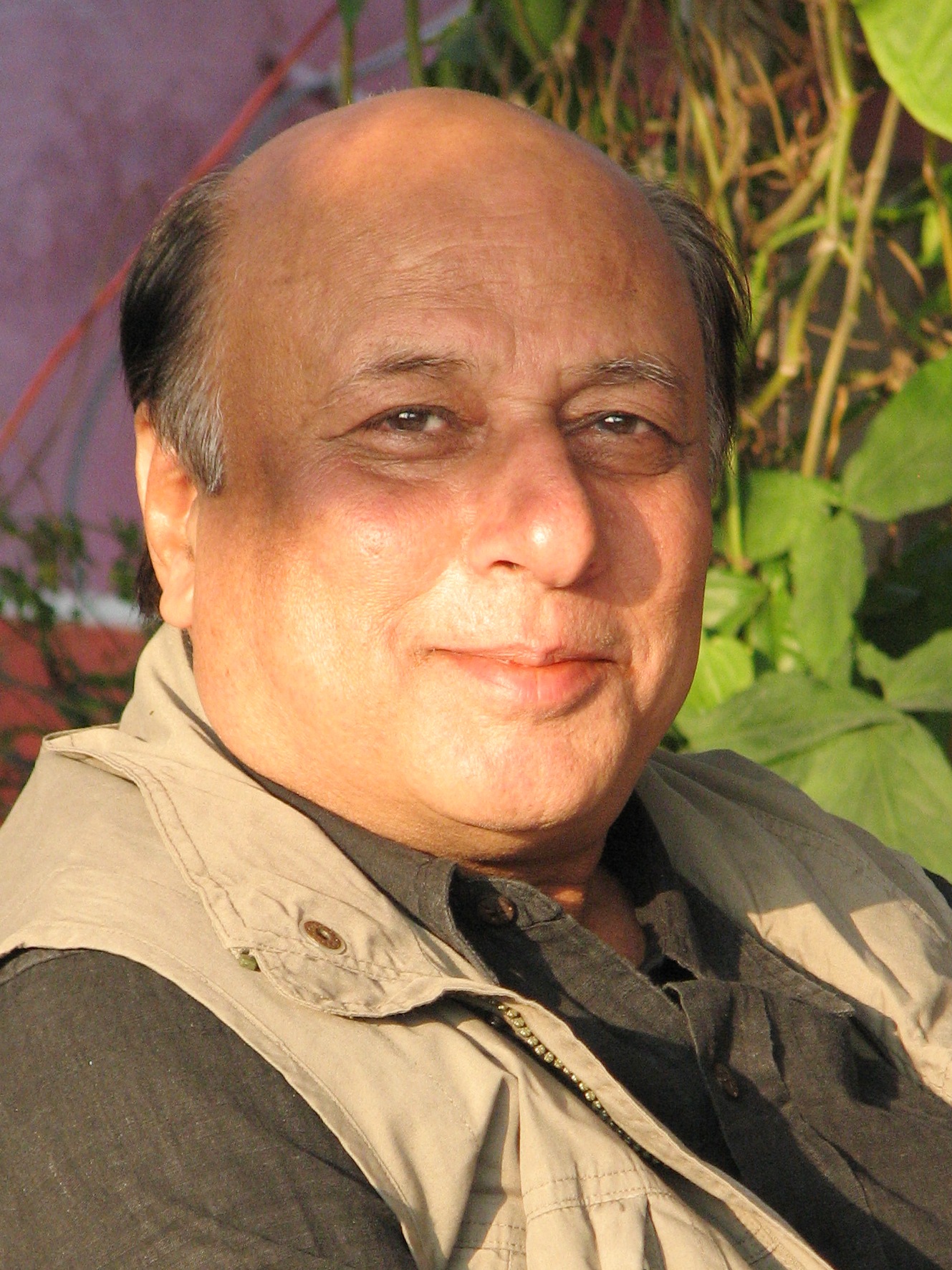
Hindi writer Uday Prakash, whose provocative books
have had many different translators over the years,
from Jai Ratan to Jason Grunebaum
Yet English translation is no panacea. Much depends on quality, the publisher’s interest and distribution channels. “Older translations of my work, like Jai Ratan’s [one of India’s most prolific translators], were targeted at an Indian English reader, and could not travel abroad. Jason is young, and a fiction writer himself; his translation reflects how language in America has changed,” Prakash adds.

English translation does not guarantee exposure. Although she gained an Indian English readership as early as 2000, after academic Nita Kumar translated her 1997 novel Mai into English for Kali For Women, Geetanjali Shree insists that her writing continues to be routed through Hindi. “Serious readers of my works, such as Annie Montaut, Alessandra Consolaro, Vasudha Dalmia and Francesca Orsini are advanced scholars keen to promote Hindi literature in the West. I am known in Russia and Poland because of Hindi!”

Certainly, Euro-American academic networks have been crucial in spreading regional Indian literature, providing the focused language training and university presses needed to support high-quality literary translation. Hindi departments in the USA, for instance, have produced such wonderful translators as Grunebaum and Daisy Rockwell, who has translated the late Hindi writer Upendranath Ashk.

But how far have translations to English travelled? Over the five years that the DSC Prize has been awarded at the Jaipur Literature Festival, only six out of the 29 shortlisted titles have been translations (UR Ananthamurthy’s Bharathipura and A Street in Srinagar in 2011, Uday Prakash’s The Walls of Delhi in 2013, Anand’s Book of Destruction and Goat Days in 2014 andThe Mirror of Beauty in 2015). None has won yet.

All of this is not to ignore that several regional language cultures inhabit positions of superiority with regard to some others: think of Hindi with regard to Urdu, or at a very different angle, to Bhojpuri. English may not be able to speak to this (though it has brought Dalit writers like P Sivakami, Urmila Pawar and Ajay Navaria some welcome attention). But it seems to me difficult to stand either with Nemade, denying that this collective landscape has been forever altered by a flood called English, or with Taseer—taking a position higher and safer than everyone else, and then bemoaning the flood. Bilinguality—reading in at least one Indian language besides English—is one way to withstand the waters. But translation, even in English, if we do more of it and better—while acknowledging that the ground is not level—can let the monolingual reader into several languages. For many of us, it might be the most feasible way to grow some roots.


(Published in Open magazine this week, under another title.)

5 May 2015

Speaking in Tongues

My Mirror column for 3 May, 2015: 

Why are we so resistant to subtitled films, instead of pouring our efforts into improving their quality and reach?


Mani Ratnam's film, O Kadhal Kanmani, was released in Delhi with subtitles.
Most people, when asked if they read translated books, are likely to say no. Yet, anyone who grew up reading in English has probably read Hans Christian Andersen (originally Danish) and the Brothers Grimm (originally German). They're quite likely to know Heidi and The Swiss Family Robinson - both Swiss-German classics, one from 1880, the other 1812 - not to mention Alexandre Dumas's The Three Musketeers (serialised 1844), and Antoine de Saint-Exupery's The Little Prince (1943), both from French. And The Adventures of Pinocchio, first published in Italian in 1883. And those who grew up in 1980s India are certain to have encountered books from the USSR (hands up, everyone who knows Dunno and his friends, or Baba Yaga the witch and Vasilisa the Beautiful!). 

And these are just the most obvious examples. Given how much of what we read as children was translated, how have we managed, as adults, to nurse a grudge against translated books? Who came up with the depressing notion that they're somehow "good for us" (read: no fun)? It's not an easy question, and there could be many answers. Maybe children are, despite appearances, more open to the unfamiliar than adults? Maybe children's books have less dense description, or simply less text, so translations are easier? 


Whatever the reason for most people's reluctance, it carries over to movies. Most people greet with utter shock the idea of watching a film in a language they don't speak. Or at least think of it as enormously hard work (repeat: no fun). Last month, two perfectly sensible, widely-read people responded to my recommendation of Court with a dubious "But it's in Marathi, no? Accha, it's subtitled?" Also last month, a Tamil gentleman seated next to us during a screening of O Kadhal Kanmani practically fell out of his chair upon learning that we did not speak Tamil. But that was precisely why I was so glad when Mani Ratnam's latest film, which my Twitter and Facebook couldn't seem to stop discussing, released in Delhi with subtitles: how often I've missed a big Tamil release because Delhi theatres ran an unsubtitled version. 


So yes, I don't watch a film if I have no way of knowing what the characters say. In that sense, I totally disagree with someone like Rakeysh Omprakash Mehra, who once dismissed my question about the impact of English on the making of Hindi cinema by declaring that cinema "transcends language". I think language matters in cinema, just as it does in life. But just as in life, while you might not want to live forever in a place where you don't know the language, surely you can't let that stop you from travelling to new places? I've always been an anti-dubber (I hate the weird sense of cultural overlay: the invariably overdone intonations, the mismatched accents - perhaps this is how some people think of translation). But I'm a subtitled film fan. 


I see subtitles as giving me access to a world I wouldn't otherwise enter - but like a polite, well-spoken guide, providing commentary unobtrusively, not drowning out the voices of the locals. If you know the original language, of course, subtitles will always be unsatisfying: like my Tamil-speaking friend who spent the interval telling me how OKK's subtitles were doing no justice to the romantic banter. And because subtitling is often done on a tight budget, many films eat up their characters' words, like that lazy interpreter who speaks one sentence to the speaker's four. (Even the otherwise exemplarily subtitled Court labelled some perfectly intelligible policewomen talking in Hindi as "Indistinct Chatter".) 


The writer and filmmaker Nasreen Munni Kabir, veteran subtitler of some 600 Hindi films (into English and French), is one of the few who've managed to not just specialise in subtitling but be credited for it. She told me that BBC's Channel Four, with which she works, re-subtitles every Hindi film it screens, because the existing ones are usually so dreadful. Another sort of creative response to bad subtitles is that of Bollywood blogger Beth Watkins, who runs a joyously crowdsourced tumblr called "Paagal Subtitles": recent prizewinning entries include "According to the post-modem report" (Holiday, 2014) and "I am surrounded by duckheads" (Mardaani, 2014). 


Watch enough subtitled films and you will swiftly acquire the art of reading while also taking in the image. The only time I'm distracted by subtitles is when I don't need them, or they're in a language I don't know. But there can be unexpected pay-offs: two episodes' worth of House of Cards with French subtitles taught me more conversational French than a semester at Alliance Francaise. 


Of course, as with anything language-related in India, there's the usual elephant in the room: subtitles are only ever provided in English. I have never seen subtitles in any other Indian language -- whether it be for regional language cinema on Doordarshan (or more recently, on Lok Sabha TV), any film festival screening from Kolkata to Trivandrum, or the rare commercial release with subtitles, like OKK or Court, or the much-discussed subtitling of the "Urdu-heavy" Dedh Ishqiya in cities like Bangalore. Although I've long been pleasantly surprised by the varied audience at the International Film Festival of Kerala (and was appalled at Adoor Gopalakrishnan's desire to screen IFFK registrants for knowledge of English), Kerala's level of English-literateness does not extend to most of India. I cannot but agree with film critic Mihir Pandya's long standing suggestion that the government should fund the subtitling of all National Award-winning films each year, into all major languages. That would be a start. How else, really, will we ever listen to each other, outside the tiny echo-chamber of English?

24 June 2014

Post Facto -- Vernacular Claims: Malgudi, Modi and the Vox Populi

My most recent Post Facto column, for the Sunday Guardian:

A still from Malgudi Days
algudi Days had only to re-appear on YouTube for me to immediately surrender my afternoon to its warm, nostalgic embrace. The first episode of the 1987 TV series inaugurates the war between school ruffian Mani and posh new boy Rajam. Our unheroic hero, Swami, admires them both. Rajam, son of the town's police chief, comes to school in a spotless khaki uniform complete with matching cap, exuding a hauteur that many, including Swami, can only gaze upon in wonder. Clearly Rajam is the prince of this grubby schoolboy world, and his royal mien invites strong reactions.
But what Mani objects to is not Rajam's clothes, car, high marks or light eyes – it is his language. "Saala Rajam ka bachcha. Apne aap ko Angrez samajhta hai," he says, glaring into the distance as the object of his hatred disembarks from his chauffeur-driven vehicle. Our Shankar has more marks than Rajam, says Mani, but he doesn't speak English "hang-tang karke", with "firangi nakhre". But this is a British colonial universe, and it is also quite clear that much of the weight of Swami's father's letter to the headmaster lies in its impeccable English.
From Class I to Class VIII, I studied at a girls' school in Calcutta. It wasn't even a convent, but it was unremarkable to have teachers walk in and interrupt classroom conversations with the plummily-delivered injunction, "Girls, girls. No speaking in the vernacular." And this was an old-school school, which took language learning seriously. Bengali and Hindi were compulsory and you weren't let off for being — or pretending to be — unable to speak them, as you might in some fashionable schools today. In some ways, the vernacular is possibly worse off now than in Swami's times.
Structures of power embed themselves in language. Consider the word "vernacular" itself. The dictionary starts with a neutral "the standard native language of country or locality", but moves on to "the vulgar tongue of the masses." And "native or indigenous (opposed to literary or learned)". By the time you reach the etymological origin: "from Latin vernaculus, 'domestic, native' (from verna, 'home-born slave')", you can literally see English sitting fatly on the "vernaculars", squashing them with its weight.
uch airtime and newsprint has been recently devoted to what Prime Minister Modi's speechifying in Hindi will mean for our status as a world power. I'm not sure the world is that interested. But within India, Modi's choice of Hindi makes his speeches accessible to a much wider cross-section than Gujarati on one hand and English on the other might have done. A shift in Hindi's status — away from "vernacular" — is welcome. But the danger is that a language that feels so threatened by English might want to use this moment to flex its muscles — against other vernaculars? There are those waiting in the wings to renew that age-old controversial rashtrabhasha argument. And certainly, the reports congratulating the Congress's Mallikarjun Kharge for delivering his verbal set downs to the Treasury benches "in chaste Hindi despite being from the Southern state of Karnataka", or the AIADMK's V. Maitreyan for giving his fellow Rajya Sabha members "a pleasant surprise" by speaking in Hindi, would seem to suggest a political recognition that the linguistic ground is shifting.
Also language, it seems to me, has implications far beyond realpolitik. Certain ways of thinking and feeling are embedded deep within language. Would Kharge have used those Kaurava-Pandava analogies if he were speaking in English? I doubt it. Would Modi have said "temple of democracy" in English? Anointing Parliament "lokatantra ka mandir", calling it "pavitr" (pure, connoting sacredness): these linguistic choices connect seamlessly to touching his forehead to the ground as he entered Parliament — idioms most Indians watching would recognize as religious respect.
But even more than the implicit religiosity, I was struck by the register in which the Prime Minister chose to address the question of women. "Nayi sarkaar desh ke gareebon ko samarpit hai, desh ke koti-koti yuvakon ke liye samarpit hai, aur maan-sammaan ke liye tarasti hamari maa-behenon ke liye samarpit hai," said Modi. Sure, he could have said this in English, too. But try it: "The new government is dedicated to the country's poor, to the country's crores of youth, and to our mothers and sisters, aching for respect." Youth and the poor belong to "the country". Women are "our mothers and sisters". By casting women not as citizens, but in familial roles, Modi's words also implicitly transform his "hum" — "we" — into an audience of men. Women, meanwhile, are pushed into a position of "tarasna" — tarasna in Hindi is used mostly in a romantic context to indicate yearning, a kind of aching desire, sometimes the earth's desire for rain. An appeal tailored to a male citizenry, delivered in an idiom it understands — an act of communicative genius, or a depressing reminder of that Wittgensteinian thought: the limits of our language are the limits of our world?
Swami and Friends was written in English. And yet, when Shankar Nag — a Kannada actor and director, active in Marathi theatre — made the Doordarshan television series, he did so in Hindi. Later, it was also telecast in Telugu. On YouTube, there is a version in Tamil, in which a real-life Swami would have spoken. Lakhs of people in India who remember Swami fondly today would not know him if Nag hadn't broken the English barrier. And yet, Narayan made those acute observations on the linguistic politics of English in English. Clearly, we can be sensitive to political nuance in any language — and tone-deaf in any, too. It just depends on whom we want to speak to.