Showing posts with label public art. Show all posts

10 November 2020

Art For the Binge-Watcher

A quick wrap of the current art scene for India Today magazine:

Virtual platforms are breaking the barriers of social distancing with new ways of exhibiting art

'The Half Of It', a painting from Nityan Unnikrishnan's upcoming solo show, It Is Getting Louder,
opening on Nov 13, 2020 at Chatterjee and Lal Gallery, Mumbai

You might think that visual artists have had it better than most during the Covid-propelled lockdown, and you would be right. Most artists work alone, and display only needs to shift from the clean white 3D cube of the art gallery to the 2D rectangle of the digital screen. So even as the lockdown left a series of shuttered shows in its wake, many galleries rose to the challenge. One exciting development has been In Touch, a digital platform created collaboratively by galleries across India (Artintouch.in/).


Edition 4 of In Touch, which runs till November 10, includes Rustom Siodia’s little-seen 1920s and ’30s watercolours on the Chatterjee and Lal site, Kanu Gandhi’s astonishingly intimate photographs of the Mahatma on PhotoInk, Dhruvi Acharya’s arresting pandemic-inspired work at Nature Morte, and Buddhadev Mukherjee’s marvellously humorous human figures, playful studies in scale, at Mirchandani + Steinruecke. Chemould Prescott Road is showing Lavanya Mani’s ‘Game of Chance’, mixing science with miracles and omens in a manner perfect for a pandemic year. In ‘Miraculous Sights 2’, a town floats into the sea aboard a ship, which itself hovers over the scaly back of a submarine creature. In the hypnotic ‘Portents’, a gigantic red flower opens a bleeding glass eye to a world buffeted by strange animal-headed comets.

In Touch’s on-screen display is effective: you can see a chosen artwork as it might look on a wall (with a virtual chair for scale) and zoom in. I wish, though, that more galleries had done what Gallery Espace has with Manjunath Kamath’s dream-like pastiches, to identify sections of each work for higher-resolution reproduction. It feels like a privilege to have his strange, vivid imagination enlargeable on one’s private screen: a pile of books in flames as an elephant grazes placidly in a field outside, a television splashing into a bathtub, an angel approaching a Mumbai taxi, or a giraffe a buffet.

Others, too, have made efforts online. The Kiran Nadar Museum of Art has a superb virtual tour. Kolkata’s CIMA has a new website. The uncertainty of recent months seems to have pushed the artistic process into the foreground. Mumbai’s Tarq Gallery is presenting Garima Gupta’s notes and sketches from the Southeast Asian wildlife trade, “unarchived fragments of a conflict that is pushing us into a war with the very world we inhabit”. Nature Morte offers up a downloadable colouring book by Acharya, while Kolkata’s Emami Gallery has devised a virtual flipbook. The flipbook is a great format both for Prasanta Sahu’s Suburban Shadows (see below) and Aroh, a group show that came out of Emami’s open call for lockdown work by young artists (I particularly liked Arindam Sinha’s ‘Marking’, Arpita Akhanda’s ‘Hung Up On the Past’ and Jahnavi Khemka’s ‘Lockdown 1’). Finally, the digital crossing of geographical limits allowed us to view, sitting in India, 35 sketches from the late great modernist Ram Kumar’s 1960s and ’70s notebooks on Art Basel’s Online Viewing Rooms.

But while the hushed silences and ‘no touching’ rules of the gallery may feel only a step away from the literal untouchability of a virtual display, an aura still clings to the work of art in the era of digital reproduction. Three of the five shows to look out for this month, at DAG and Art Heritage Galleries in Delhi, and at Chatterjee and Lal in Mumbai, are open for offline visitors.
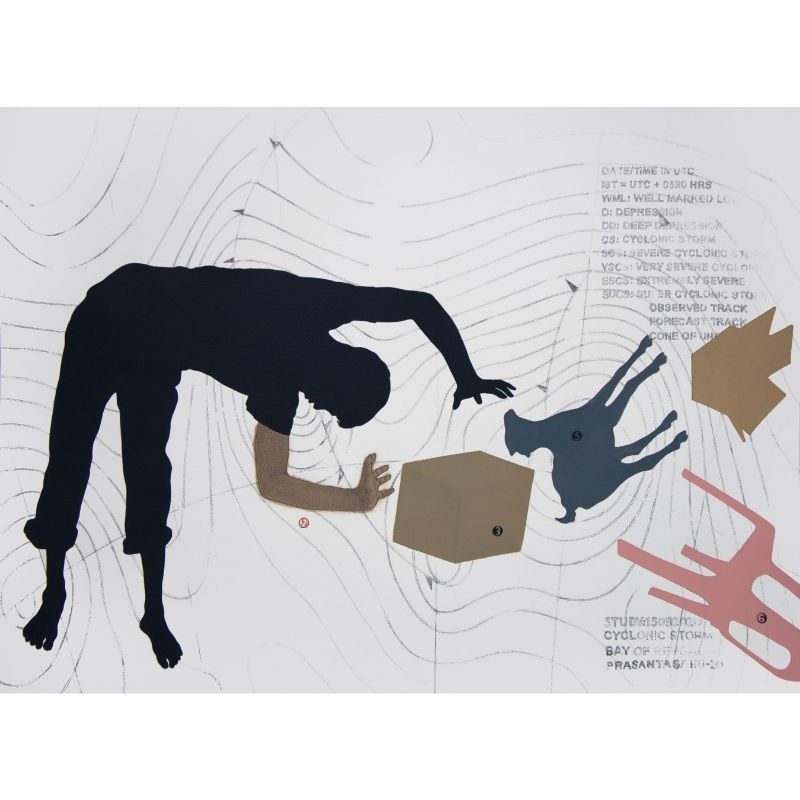
From Prasanta Sahu's ongoing show 'Suburban Shadows', online on the website of Emami Art Gallery, Kolkata

ART RESTART: Five art events to keep an eye out for

Nityan Unnikrishnan’s solo show It is Getting Louder, showing at Mumbai’s Chatterjee and Lal gallery from November 13 to January 2, feels very much like India right now. The acrylic images on khadi spill over with people: reading, eating, dreaming, waiting. The other set of the images, graphite on muslin or bamboo fibre paper, are abstract, filled with black and white forms which could be anything: masts, mountains, plants, porcupines. All that unites them is their jaggedness.

Art Heritage Gallery, Delhi, together with Kolkata’s Seagull Foundation, is showing The Self Portrait, a show of early and rare woodblock prints, sketches and watercolours by the late K.G. Subramanyan, who died in 2016, aged 92. They aren’t all depictions of the artist: watch out for ‘Jangpura Women’ (1950), and many striking untitled linocuts and litho prints of seated women. Open by appointment till December 15.

DAG’s The World Will Go On, on view online since October 25, will be open to visitors at The Claridges, Delhi, between November 2 and 12. Highlights include a 1980 Raza, an M.F. Husain Hanuman, Nandalal Bose’s ‘Diwali’, and one of Krishen Khanna’s bandwalla images.

Prasanta Sahu’s Suburban Shadows, on the Emami Gallery website till November 30, visibilises the links between rural and urban through his studies of food and farming: a lettuce in a shopping cart, vegetables sprouting from human limbs, a bhindi as skeleton, shadows of the labouring body.

Five Million Incidents, a set of public art interventions funded by the Goethe Institute, has been reconceptualised in digital form. Visit Goethe.de/ins/in/en/ver.cfm to join the imaginary chatroom of Ranjana Dave’s Age Sex Location, add to Sultana Zana’s Fieldness, a collaborative digital archive of time spent in nature in the city, or log in to play Shraddha Borawake’s virtual game Chaat Meets... A New World Order on November 7.

 Published in India Today magazine, 8 Nov 2020. (Two separate links)

3 September 2009

An Auto Sonata

TRISHA GUPTA meets the man who made the sound of Delhi’s auto-rickshaws part of the India Art Summit

IT’S A regular Saturday in New Delhi’s Connaught Place. A post-lunch crowd ambles along, window-shopping. The soft murmur of afternoon traffic on the Inner Circle is slowly turning into a louder buzz. Suddenly, above the cars, buses, auto-rickshaws and taxis comes a series of honks – sharp and staccato ones followed by a long, low-pitched tone. A cavalcade of flag-embellished auto-rickshaws is turning past E Block, honking in choreographed unison. Passers-by stop to look, someone tries to hail one, while one autowallah waves as he drives past. Things are already odd enough, but then a white man in yellow pyjamas darts nimbly into the street, holding up a hand as if to stop the traffic. It takes a minute to realize that he’s only taking a photo.

The pyjama-clad man is Geert-Jan Hobijn, and the honking autos are his idea. Hobijn is known in international music circles as the founder of Staalplaat Soundsystem, an Amsterdam-based initiative that he began with friends in 1982. Staalplaat (Dutch for steelplate; ‘plaat’ also means disc, thus record) has a reputation for supporting weird and wonderful sounds, “expanding the boundaries of what we call ‘music’”. One piece Hobijn remembers fondly was inspired by Dadaist poetry: a voice repeating ad infinitum the phrase, “The minister regrets these statements”, removing one syllable each time round so the sound becomes less intelligible and more abstract. Another was an Austrian yodeling song, cut up and reassembled. “This was before digital editing,” he points out.

Staalplaat is now a forum for sound artists, an organisation network with a music label, an e-zine, a radio program, a shop and a distribution company and Hobijn has moved from being a dogged releaser of other people’s quirky sounds to creating his own. “In 2000, I began making music with objects not usually seen as ‘musical’ – vacuum cleaners, kitchen mixers, tumble dryers.” In 2005, a museum in the north German city of Kiel invited him to “use the building as an instrument”. The idea of an increase in scale was exciting, but not easy. “You can’t bang on a building, or drill holes in it.” What he finally created involved moving soundboxes, some placed on children’s tricycles. “People could hear thuds and sirens, but couldn’t see where they were coming from. Of course, the Germans thought it was about the war,” Hobijn smiles wryly.

HOBIJN ISN’T keen on art being message-y: “Like this 48C festival you had in Delhi, it was too political, too environmental for me. I’d say, leave that to Greenpeace.” Yet his work is clearly connected to what’s around him. “Man’s first compositions were based on the birds. But now we are alienated from the sounds around us, ‘noise’, we call it. As a contemporary urban person, I want to make music from these sounds.” When he arrived in Delhi last October to do a residency with Khoj, the first thing that struck him was the traffic. “That’s the sound of Delhi. Of most modern cities, actually. Only here, it’s louder.” He decided to take the city’s chaotic sounds and overlay them with something seemingly similar, but actually structured and discrete. The performance involved remotely triggering the horns of 30 auto-rickshaws as they moved around the concentric circles of Connaught Place, creating a “moving sound choreography”. “When you hear a single horn, you think: that’s loud! When you hear 30 horns in synch, you think: hmm, why isn’t that louder? I just want to make people listen differently.”


From Tehelka Magazine, Vol 6, Issue 35, Dated September 05, 2009

6 January 2009

Column - Welling Up


Between the Lines

In the back of the Delhi Public Library is a garden. Or is it one? There is not much by way of grass, no benches to sit on, and even in this season, when the city’s roundabouts bloom with municipal vigour, no flowers. Sprawled across the non-existent lawn, like some swooning elephant, is a mammoth piece of machinery. I walk closer to inspect this strange beast. That’s when I finally see the faded foundation stone embedded in the wall behind – declaring the Open Air Reading Room now open. 1984.

The Delhi Public Library was set up under a UNESCO pilot project for public libraries. The iconic building with the arched pink façade is an uneasy receptacle for Nehruvian dreams of knowledge as freedom. The frayed old books are packed into their shelves, forced to stand up straight in their tired blue uniforms. Only the shiny covers of magazines announce newness. 1951.

Last week, walking into the Water Diviner, Sheba Chhachhi’s installation for the 48c public art ecology project, I enter a kind of vault below the library. There, in the bowels of the building, are more tired blue books… but no longer standing. Piled in dusty heaps on every level of this stepped well-like basement, they seem to have finally come to rest. As I descend through the cobwebbed half-light, there is a long rectangular light box with a map of Shahjahanbad on which water channels are marked in blue. It turns out this space was once a swimming pool for British officers. The lion’s head fountain at the entrance to this room is part of that avatar. 1905?

A man enters the installation with his friend and comes up to the white-uniformed 48c volunteer. Aap zara samjhayengi, yeh kya hai? The girl speaks of water, how our urban ancestors kept it close to their hearts, and how it has disappeared from our lives. She points out the blue strips in the lit-up map. The man nods sagely. Then his gaze travels down the steps to the screen at the bottom, on which you can see an elephant floating underwater. He blinks involuntarily. It’s dead.

Above, in the auditorium half an hour later, Sohail Hashmi tells us about a well not far from where we sit, from which he drank cool, sweet water, up until the late 1970s. One of some six hundred public wells that once supplied water to Shahjahan’s city. He speaks of the neher that ran through Chandni Chowk, shaded by trees that got chopped down after they were seen to have shielded the men who shot Lord Hardinge. And how Daryaganj got its name from the canal that used to run down its centre. This is the first time I’ve attended a talk about Delhi, in Delhi, that hasn’t been in English. There are several glimmers of recognition in the audience. That city gate, it no longer exists. Where does the name Farashkhana come from? How do I find that well you mentioned? Aisi koi kitab hai, jisse hamein knowledge mil sakti hai? People are asking about an inhabited place, not a mere space of history. Amid the dead water channels, above these entombed book chambers, something is beginning to flow.

This column appeared on the back page of Time Out Delhi, Vol. 2 Issue 20, Dec 26 - Jan 8, 2008.