Showing posts with label biography. Show all posts

20 September 2020

Shelf Life -- Dr Jekyll and Mr Hyde: Measuring Civilisation

Shelf Life is a monthly column I write on clothes in books.

In RL Stevenson’s Dr Jekyll and Mr Hyde and Alberto Manguel's Stevenson Under the Palm Trees, clothing makes us human

Banner: Poster for a theatrical adaptation of Strange Case of Dr Jekyll and Mr Hyde.

When a literary character becomes part of the language, you know that the writer – that strange solitary creature delivering into print the outpourings of her mind – has caught something in the zeitgeist that needed expressing. 'Strange Case of Dr Jekyll and Mr. Hyde', thought up by Robert Louis Stevenson when Longman's Magazine requested a ghost story for their 1885 Christmas Special, first gained popularity as a “shilling shocker” or “penny dreadful”, a novel of crime or violence sold cheaply. Soon it seemed the Victorian parable par excellence – the respectable Dr Jekyll whose secret sinful side walks the streets as the evil Mr. Hyde was a fitting fictional allegory for an era of repressed feeling. But the “Jekyll and Hyde” idea acquired much wider resonance, the temptation of immorality striking a chord with anyone who has ever hidden a part of themselves from society, or suppressed their transgressive desires.

Book covers of RL Stevenson’s Strange Case of Dr Jekyll and Mr Hyde over the years.

Stevenson's writing may seem long-winded to the 21st century reader, but it is spare, offering detailed descriptions only when necessary to his narrative – the feel of the neighbourhood in which Hyde is first seen, the spatial arrangements of Dr Jekyll's house. Since we never hear of Dr Jekyll's clothes, we assume they were appropriate for a Victorian gentleman of the sort Dr Henry Jekyll, M.D., D.C.L., L.L.D., F.R.S. undoubtedly was. But when the book's narrator, the doctor's old friend and lawyer Mr Utterson, is called upon to break into his laboratory, the “still twitching” body he finds there is “dressed in clothes far too large for him, clothes of the doctor's bigness”. Another eyewitness account describes Hyde's clothes as being “of rich and sober fabric” but “enormously too large for him in every measurement—the trousers hanging on his legs and rolled up to keep them from the ground, the waist of the coat below his haunches, and the collar sprawling wide upon his shoulders.” The effect, says Dr Lanyon, “would have made an ordinary person laughable” – but here the sense of evil makes laughter impossible.

Integral to Stevenson's tale is the idea of Dr Jekyll, described by his butler as “a tall, fine build of a man”, shrinking into a dwarf-like creature when he sheds his good qualities. The Jekyll and Hyde story influenced many future narratives of duality, the most popular of which might be the Incredible Hulk, a favourite Marvel Comics superhero. Writer-editor Stan Lee, who first created the Hulk in 1962, says he was inspired by Stevenson's story alongside Mary Shelley's Frankenstein's monster. Like the violent Mr. Hyde, the Hulk is an animalistic alter ego who takes shape when a respectable man of science – Jekyll, Bruce Banner – is overwhelmed by uncontrollable emotions. But instead of becoming smaller, the Hulk turns into a giant, his muscular green body ripping the mousy Banner's ordinary clothes to shreds.

Cover, The Incredible Hulk #1 Marvel Comics (May, 1962).

What is common to these visions of the hero's metamorphosis into something not quite human, though, is that his clothes no longer fit him. And shedding one's clothes is, in some ineffable way, to drop the veneer that keeps one human.

The writing of Jekyll and Hyde has been the subject of its own mythology. Stevenson wrote it while convalescing in the British seaside town of Bournemouth. In one version, it originated as a nightmare. Some have spoken of a first draft that Stevenson burnt after his wife Fanny said his story had “missed the allegory”, while his stepson Lloyd Osbourne has described him as coming downstairs in a fever to read half a first draft aloud. His later biographers have claimed he wrote it under the influence of cocaine, or a fungus called ergot.

Whatever the truth of these narratives, Stevenson certainly led an interesting life. Having fallen in love with Fanny – an American woman ten years older than him, with three children – in 1875, he travelled with her before and after their marriage in 1880. Stevenson and Fanny and their children travelled the South Seas for three years before settling down in 1890 on a plot of 400 acres he bought on a Samoan island, taking the native name Tusitala – 'Teller of Tales'. This was where he died in 1894. 

A book cover for the superbly inventive, deceptively simple Stevenson Under The Palm Trees.

The writer Alberto Manguel has crafted Stevenson's last Samoan years into a stunning little novella called Stevenson Under the Palm Trees (2002), mixing the known biographical facts with a disturbing reimagining that is perhaps a fitting tribute to Stevenson's own fevered mind – in particular, to Jekyll and Hyde. And here again, clothes come to the forefront. The nakedness of the Samoans is repeatedly contrasted to the buttoned-up world of Stevenson's Scottish childhood, his mother's stiff, lace-edged dresses to the sun-soaked softness of the Samoan matrons. Stevenson is well-loved in Samoa, his public persona perfectly at peace with the islanders' own comfort in their skin. But is it possible, asks Manguel's haunting story, that a lovely young girl's barely covered body arouses his basest instincts? Has the idea of nakedness seeped into our minds so deeply as 'uncivilised' that we dehumanise those without clothes? By making clothes the measure of civilisation, it is our gaze that reveals itself as bestial.

Published in The Voice of Fashion, 17 Sep 2020

8 June 2020

Book Review: Lost in translation

This review of a new book on Sahir Ludhianvi and his poetry was commissioned much before the lockdown. It finally appeared in print this week, in India Today magazine's now-restored Leisure Section.


Sahir Ludhianvi was among India’s most talented Urdu poets. After joining the film industry in 1950, he also became one of the most popular. If you’ve grown up with Hindi film music, you’re likely to know many of Sahir’s poems, even if you don’t know they’re his. You might know the multi-religious “Allah tero naam, ishwar tero naam, Sabko sanmati de bhagwaan” from Hum Dono or the critical-nostalgic “Yeh mahalon yeh takhton yeh taajon ki duniya” from Pyaasa. You might have sung one of his immortal love songs, from the irresistible “Yeh raat yeh chaandni phir kahan” (Jaal, 1952) or the wistful “Chalo ik baar phir se ajnabi ban jaaye hum dono” (Gumraah, 1963), all the way to “Kabhi kabhi mere dil mein khayaal aata hai”, an early Sahir poem around which Yash Chopra crafted his 1976 romantic classic Kabhie Kabhie. Nearly 40 years after his death, it is high time that Sahir was attentively translated, analysed, studied.

But Surinder Deol’s Sahir: A Literary Portrait does not deserve to bask in the late lyricist’s reflected glory. Deol, who left India in 1983 to work at the World Bank in Washington, DC, now lives in Maryland. Other than his most recent book, The Urdu Ghazal: A Gift of India’s Composite Culture, he has previously published a novel, a collection of poems and a book-length rendering of Ghalib’s poetry into what he calls “American free verse” (The Treasure, 2014). I have not read these other books. But Deol’s translations of Sahir are lacklustre at best and often distressingly unpoetic. He is painfully literal, and even then, not always accurate. “Sard jhonkon se bhadakte hain badan mein shole,/ Jaan legi yeh barsaat kareeb aa jao” becomes, in Deol’s inexplicable rendition, “Cold flames, hot flames engulf my body,/ This downpour will end my life./ Come up to me!” Meanwhile the crisp simplicity of “Chalo phir aaj usi bewafaa ki baat karein” gets stretched into a torturous “Today, let us talk once again/ about the graceful one/ who lacked constancy”.

In his preface, Prof. Gopi Chand Narang, former president of the Sahitya Akademi, whose book on Ghalib Deol translated in 2017, proclaims Deol’s translations to be “effortless”. But translating Ludhianvi is no easy ride. Deol at least seems to recognise that when he mentions reading Pablo Neruda in English and Coleman Barks’ renditions of Rumi. But these inspirations notwithstanding, Deol remains preoccupied with the dictionary meanings of Sahir’s Urdu usage, with little sense of what sounds poetic in English. So we get a book strewn with such lines as “It is just a demand of my wreckings” or “I want an answer/ from the foggy spoilers/ of my wishes and dreams”.

Deol is no literary scholar: his comments on individual poems are banal and unsatisfying. He is no biographer either, merely compiling a few snippets into an introduction. If you’re looking for a Sahir Ludhianvi biography to read, Akshay Manwani’s The People’s Poet (2014) is still your best bet.

Published in India Today, 6 June 2020.

22 March 2020

Book review: An Englishman In Pune

A tiny book review of a not-so-tiny book, for India Today magazine in February:

Uday S. Kulkarni’s rendezvous with James Wales is a trip down an 18th century lane in India.


One of the first records of the artist James Wales is from 1777. Aged 30, he was evicted from his two-room tenement for failing to pay rent. According to the Edinburgh City Archives, his belongings were auctioned for £11 to pay off his landlady. In 1783, Wales moved to London and set himself up as a portrait and landscape painter. A chance meeting with the artist James Forbes led to a commission to complete Forbes’s sketches of India and, in 1791, with permission from the East India Company, Wales, by then 44 years old, boarded a ship for Bombay. 

Uday S. Kulkarni’s book is a painstakingly detailed and fulsomely illustrated account of Wales’s career in India, where he lived from July 1791 till his sudden death in November 1795. India had proven to be good for Wales—by February 1792, he was advertising a framed set of engraved prints of his ‘Twelve Views in Bombay’ for Rs 350. But the real turnaround in his fortunes came when Charles Malet, long-time British Resident, suggested Wales move to Pune. Based on Malet’s recommendations, he became the painter of choice for the local elite, from the Peshwa and Nana Phadnis to Company officials.

Wales’s masterful oil portraits (‘Peshwa in Durbar attended by his Minister’, ‘Nana Phadnis’, ‘Mahadji Scindia’, and ‘Con Saib’, a portrait of Nuruddin Hussain Khan) and his watercolours (of Ellora and Elephanta, among other antiquarian sites) provide a rare visual record of late 18th century India. But what makes this more than a coffee table book is Wales’s daily journals and frequent letters to England, which bring to life this enterprising, curious foreigner’s experience of a lost world, from ‘nautch’ girls dancing before antelopes at the Maratha durbar to observing preparations for a local sati. 
 
Published in India Today, 28 Feb 2020.

29 January 2019

Book Review: Urdu Memoirs

A short book review published in India Today:


Yeh Un DinoƱ Ki Baat Hai: Urdu Memoirs of Cinema Legends by Yasir Abbasi; Bloomsbury India; Rs 699; 448 pages

Here's a bit of film trivia: which Indian actor (other than Rajinikanth) worked as a bus conductor? Would it help to tell you he was originally called Badruddin Qazi? Or that he landed his first major role because Balraj Sahni suggested he enter Guru Dutt's office pretending to be drunk? Or (last clue) that his inebriated act was such a hit that he later named himself after a popular whiskey brand?

Yes, it's Johnny Walker.
Yeh Un Dinon Ki Baat Hai: Urdu Memoirs of Cinema Legends is full of such tales. Editor-translator Yasir Abbasi's excavation of old Urdu film magazines lays out a new matrix of origin myths, loving details and vicious gossip involving not just actors, but directors, writers, singers and lyricists from what used to be called Hindi cinema.
Some get to tell their own stories, which means elisions and self-aggrandisements or, at least, careful public presentations of the self. Johnny Walker is keen to establish that he's really a teetotaller. Writing in Shama magazine in 1981, the 1940s star Veena lists the many famous films she almost did: Anmol Ghadi, Udan Khatola, Mughal-e-Azam, Jogan, Mother India, even an abandoned early version of Mahal. Dharmendra mentions a close "friendship" with Meena Kumari, but completely avoids his role in ending it: "it never occurred to me back then that one day she... let's just leave it at that."
Others are described by friends and admirers, or by writers who happen to be friends and admirers. So the brothers Ganguly (Ashok Kumar and Kishore Kumar) get a tribute from the actor Iftekhar, Hindi cinema's once-perpetual police officer. The composer Naushad tells of the director K. Asif's grand ways, including the tale of how Bade Ghulam Ali Khan was persuaded to be Tansen's voice in Mughal-e-Azam. Dialogue writer and playwright Javed Siddiqui has a charming fanboyish piece about working with Satyajit Ray on Shatranj ke Khilari. K.A. Abbas writes with acuity about Raj Kapoor, for whom he wrote many films: "If he loves just himself, then why do all of us still love him? Well, that's because there's something else that he places even before himself -- his work, his art."
The crisscrossing narratives sometimes produce a Rashomon effect. Eg: Dharmendra's coy elision is matter-of-factly undercut by Nargis, who frankly appraises Meena Kumari's passion for him and her heartbreak when he left. Whether reading that piece, or Ismat Chughtai on the singing star Suraiya, or the memoirs by Nadira, Shyama or Meena Shorey, it's clear that the Hindi film industry awarded its actresses particularly lonely, difficult lives.
I have many quibbles with his translation, but Abbasi has done film buffs a service.

24 January 2017

2016: From Fact to Fiction


A list of my favourite films from 2016 – in which real life is a recurring theme.


The year-end list is a bit of a hallowed tradition among critics, and having failed to fulfil that expectation at the end of 2016, I want to do so before the first month of 2017 comes to an end. Let me begin with the necessary caveat: this is not a list that pretends to anything like exhaustiveness. Like all such lists, it is a selection drawn from the films I happened to watch in 2016 and, like me, it is reasonably eclectic and yet not quite as wide-ranging in sweep as it could be.

In terms of language, for instance, this is a list that tilts very much in the direction of Hindi cinema – but I have included some films in other Indian languages that enjoyed the privilege of what we insist on calling a 'national' release: A few shows each in a couple of multiplexes in the bigger Indian cities, accessible to those of us who can pay and are willing to read English subtitles.

This is the first part of a two-part column, and the five films I list below, while starkly different from each other in tenor and sensibility, are united by the fact that they are all fictional engagements with people and events that we know to have existed in the real world.

Visaranai (The Interrogation) was India's entry to the 2017 Oscars. (It is no longer in the race.)
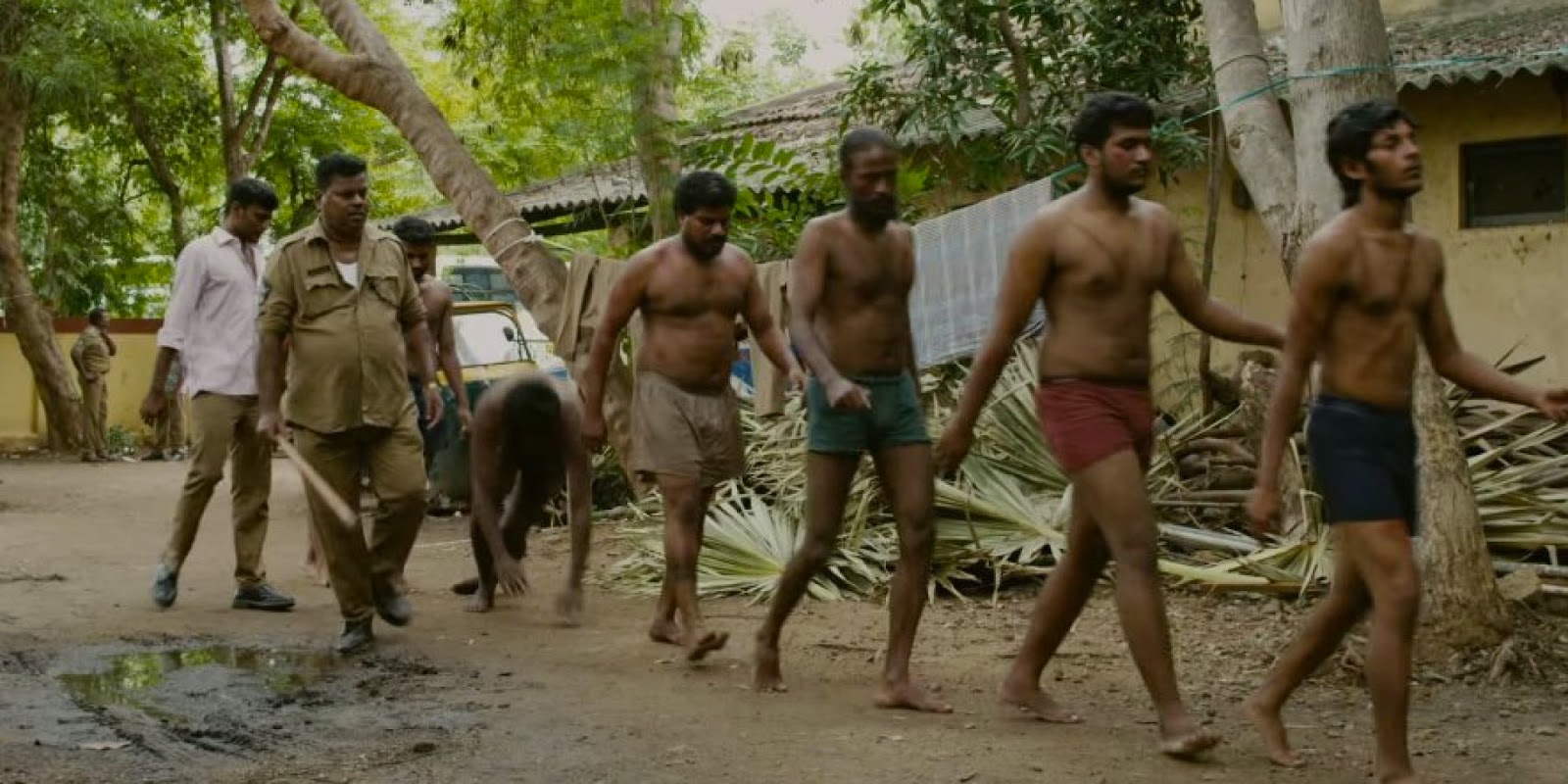
1. Visaranai (The Interrogation): Vetrimaaran's harrowing film is based on a real-life memoir, offering a blow-by-blow account of the torture a group of young Tamil-speaking migrants suffer at the hands of a posse of Telugu policemen who pick them up under pressure to 'crack' a high-profile case. Tautly crafted and stuffed with affecting performances, Visaranai's devastating home truths about how deep the rot runs in police 'investigation' have managed to travel far and wide while retaining an unapologetic dramatic excess that I can only characterise as Indian.

2. Aligarh: Hansal Mehta's film – also drawing on something that was 'covered' in the newspapers – is a portrait of a deeply lonely man: The casualty of a society quick to stigmatise anyone not exactly like themselves, and a media that does not hesitate to invade anyone's privacy. This is a media that speaks less and less for the individual, and more and more for the mob it is helping to create. Mehta and his screenwriter Apurva Asrani have justly been applauded for placing the right to sexual choice on an abstract moral map – but what makes the film so effective is its ability to make potentially unsympathetic audiences perceive Dr Siras in his particular individuality.


3. NeerjaYet another instance of a fiction feature informed by factual events, Ram Madhvani's film about the Indian flight attendant who was killed trying to save passengers during a 1986 hijack gave us another unlikely heroine, and an unexpectedly convincing performance from Sonam Kapur. Like Deepu Sebastian Edmond, on whom Rajkummar Rao's journalist character is based in Aligarh, all Neerja Bhanot was trying to do was to do her job well. Making heroism flow from something as ordinary as that – following the rules rather than trying to think out of the box – helped recuperate for us the long-lost Hindi cinema ideal of ‘farz’.


4. Raman Raghav 2.0
Marking the return of Anurag Kashyap to top form, this film is less about humanising heroes and more about humanising villains. It's scary stuff, with Kashyap and Vasan Bala's present-day reimagining of a‘60s serial killer given chillingly ordinary form by Nawazuddin Siddiqui. Siddiqui's outstanding performance is hard to rival, but Vicky Kaushal's cokeaddled Raghavan does add an additional layer to the sinister vision of police impunity laid out in Visaranai.


5. Dangal: A wonderfully enjoyable imagining of the childhood and youth of the Phogat sisters: real-life wrestling champions Gita and Babita, who were dragged kicking and screaming into the sporting life by their father Mahavir (played by Aamir Khan). Nitish Tiwari's film offers us new age heroines: Two winsome young women we can cheer for as they kick and punch their way into hard-won stardom, in a male-dominated sport in the male-dominated state of Haryana. And it does so in the finest traditions of old-school Hindi cinema: A song-studded filmic childhood, complete with the heroines 'growing up' before our eyes in a single heart-thumping instant of achievement; plenty of comic relief; a villainous coach whose excessiveness is made believable by the always-marvellous Marathi actor Girish Kulkarni.


(To be continued next week)


Published in Mumbai Mirror, 22 Jan 2017.

5 January 2017

Men on the Ropes

My Mirror column

Dangal grapples with wrestling’s tradition of masculinity — and Indianness.


On the simplest level, the tale told in Dangal is an inspiring, heartfelt one — of women entering an arena traditionally reserved for men and not just surviving but making a mark. The two young women whose journey the film tracks — Gita Phogat and Babita Kumari — are a beacon not just of bodily discipline, but of the struggle against mindsets. Their lives are a window through which we catch a glimpse of a possible new world: the world as it might look if girls in North India were treated the same as boys.

At another level, though, Nitesh Tiwari’s film (not unlike Ali Abbas Zafar’s Salman-Khan-starrer Sultan earlier this year) is a carefully calibrated engagement with masculinity, femininity and nationalism (not necessarily in that order). And it is no coincidence, it seems to me, that the chosen site of that engagement is wrestling.

With links to royal patronage and feudal elite sponsorship, writes the anthropologist Joseph S. Alter in his study of wrestling culture in North India, wrestling has a long history in this part of the world. And although wrestlers earn prize money at the regional, state and national levels, it is not the professional sporting academies but the informal local akharas — public institutions often run on gifts, neighbourhood chanda collection and charitable donations — that feed the widespread popular interest in wrestling.

Both the wrestling films I am speaking of have taken on board the sport’s in-between, possibly ambivalent status —as something local and deep-rooted and organically Indian, but also tragically undervalued by the very national custodians of sport who should be propping it up. In both the fictional (Sultan) and non-fictional (Dangal) narrative, of course, the assumption is that this indigenous sporting tradition will finally acquire value by being showcased on the world stage.

Onwards to masculinity. “Wrestling in India (pahalwani) is a sport engaged in exclusively by men who are extremely concerned with the nature of their masculinity,” writes Alter. Any woman who has ever tried to enter an akhara (a gymnasium in which pahalwans practice) knows that it is well-nigh impossible to be allowed in, even just to watch. Just last July, at a small but reputed akhara in Shivajinagar in Bangalore, I was curtly told to stand outside, while my male companion — as much of an outsider there as I was — traipsed happily in. (Dangal’s titling images of real-life young wrestlers — large, serious-faced boys in langots — are thus a rare equal-opportunity sight.)

The point, however, is that keeping women out of the akhara is not just a regular form of gender injustice; it is entwined with traditional beliefs that have shaped wrestling in the subcontinent. This is a culture of masculine excess, simultaneously bombastic and threatened, driven by an obsession with celibacy, disciplined self-control and the retention of semen — all only achievable by steering clear of the poisonous temptations represented by women. As one old pahalwan says to Aamir Khan’s Mahavir Singh Phogat when he seeks training at the akhara for his daughters, “Is umar mein paap karvaayega ke?” 
The ideological links with certain traditions of Hindu asceticism should be clear. 

Less obvious — but more fascinating — is how wrestling is seen by its practitioners as a form of self-perfection in the service of the nation, and the way that self-construction might connect to Gandhi’s pushing of the celibacy ideal as part of nation-building.

So it should not surprise us that in what is arguably the most bombastically hypernationalist year independent India has yet seen, the Hindi film industry has given us not one but two films about wrestling. What’s interesting is that both Sultan and Dangal chose to engage with the figure of the female wrestler, rather a rare species in real life. In both, the women bear the burden of their father’s ambitions — and they come out shining, so long as they keep their sexuality at bay.

In Sultan, the educated daughter (Anushka Sharma) returns to the village to represent her father’s akhara and increase its status; she does very well in her appointed task, until love, marriage, and an ill-timed pregnancy comes in the way of her winning a world title. In Dangal’s retelling of the Phogat sisters’ lives, it is their ex-wrestler father Mahavir who makes the decision for them. Among the most emotive scenes in the film’s first half is the way the girls are coaxed and coached out of girly-ness. In what feels like a radical role reversal for a man who is otherwise a standard-issue rural Haryanvi father with traditional expectations for women, Mahavir practically forces his daughters to wear shirts and shorts, wakes them up at five every morning for a gruelling fitness routine, and in a gutwrenching scene, has the barber chop off their hair.

The plot of Dangal’s second half, in fact, turns on Gita’s becoming distracted from her appointed purpose in the world — wrestling — by relaxing into the ordinary femininity that was wrested from her as a child. Growing her hair, watching romantic Bollywood films, and generally acquiring a consciousness of herself as a woman is apparently enough to make her lose her edge as a wrestler.

Perhaps it would be incorrect to call Dangal a defense of celibacy, but certainly its deep suspicion of femininity owes something to wrestling’s particular history of (un)sexuality.


Published in Mumbai Mirror, 25 Dec 2016.

28 February 2016

The Media and the Mob

My Mirror column today:

Hansal Mehta's Aligarh is both a tragic bio-pic and a finely-wrought critique of our mediatised present.


Aligarh opens on a chilly February night in 2010, in an area called Medical Colony, somewhere in the university town for which the film is named. We can see little in the darkness, but what we hear is a jarring sound: cars honking, distant but persistent. It feels like a warning, a premonition of danger. 

What follows is indeed dangerous. A man is forcibly photographed in the privacy of his own house, and those images are used to humiliate, blackmail and illegally shunt him out of his job. This is what really happened to the unfortunate Dr. Shrinivas Ramachandra Siras, a Reader in Marathi at the linguistics department of the Aligarh Muslim University (AMU), in 2010. 


A camera crew barged into Siras's house without his permission, and shot video footage of Siras and his male friend, using physical coercion to keep them in the frame. These media persons then called in three AMU faculty members, who were given access to the footage, which they used to charge Siras with "misconduct". Accusing him of having "indulged himself into immoral sexual activity and in contravention of basic moral ethics", AMU instituted a departmental enquiry against Siras. 


Even while the enquiry was pending, the self-appointed moral guardians of the university had pronounced their judgment: Siras was suspended, his electricity and water supply was cut off, and an order was issued giving him seven days to vacate his house. Meanwhile, the footage was leaked to local television channels, and it became difficult for Siras to even find an alternative house to rent. Initially persuaded that tendering an 'apology' would help carry on with his life, the 64-year-old professor eventually found himself having to fight for his job and his dignity in court. He won the case, but died mysteriously and tragically one day before his reinstatement. 


Hansal Mehta's film, at one level, is a straightforward, near-factual recreation of these events. But Apurva Asrani's script (based on an original idea by Ishani Banerjee) brings us much closer to Siras than the newspapers ever did - and it does so, ironically, by using the figure of a reporter. We see the professor almost entirely through the eyes of Deepu Sebastian (played by the excellent Rajkummar Rao). 


Modelled on a real-life reporter who came to have a rapport with the stigmatized professor, Deepu's character works as a bridge between Siras and us. It is Deepu's gradual shift, from seeing Siras as a 'story' to seeing him as a human being, that encourages the film's viewers—including those who may not be comfortable with homosexuality in the abstract—to make space for this person, in the particular. Deepu channels our better selves. 


Aligarh was completed several months ago, yet it speaks powerfully to the India being so cynically crafted in February 2016. What Aligarh defends is not just the right to privacy and freedom of sexuality; it is the freedom of the individual against the condemnation of the mob, and the role the media can play in mediating between the two. 

We live in times in which sections of the media have turned into megaphones for pre-existing political positions, giving up even the pretense of neutrality as they openly manufacture 'news'. These sections of the media speak less and less for the individual, more and more in the voice of the mob - a mob they are simultaneously helping to create. 


The tenor of television in India seems increasingly meant to whip up mass sentiment, rather than encourage a considered appraisal of differing viewpoints. This is not a media that questions its viewers; and even more rarely does it question itself. 


Aligarh offers an acute example of how the media's actions, no matter how damaging they might be to the individuals they drag towards televised mob justice, have come to be accepted as legitimate. When Deepu Sebastian (Rao) asks the AMU committee about the illegitimacy of filming a man's most private moments, the answer he gets is frightening. The issue here is not the camera, he is told -- only what is captured by it. 


In the ongoing cases of students being charged as antinationals, too, we are witness to the chilling process of a trial by media, in which the due process of law, or even the due process of newsgathering, counts for nothing. And if our media has long been unquestioningly parroting the police, we have now reached a stage where the police parrots the media. The self-legitimising circle of mendaciousness is complete. 


But Aligarh reminds us that Deepu, too, is the media. The journalist who resists his colleague's ham-handed intrusiveness, while being dogged in his pursuit of the truth; who asks permission of his interviewees and questions of his own profession; who is able to separate the grain of individual truth from the chaff of rabble-rousing hearsay—this is the media as it should be, the media we desperately need. 


Manoj Bajpayee's affecting portrait of Siras is a portrait of isolation, of the stifling 'morality' of those that would shut the doors of their institutions, their colonies and mohallas against anyone not like themselves. But difference is the lifeblood of democracy. We need our televisions to be windows to the outside - not a chamber of mirrors that closes us in upon ourselves.


Published in Mumbai Mirror, 28 February 2016.

13 April 2015

Songs in the Streets

My Mumbai Mirror column yesterday:

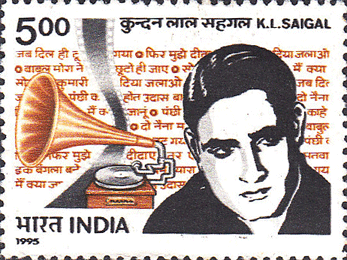
Kundan Lal Saigal would have turned 111 on 11 April. But here's a question. Why should you care?


When I was a child in Delhi in the early 80s, a family friend I called Vinoo Uncle sometimes sang me to sleep. The song was always "So ja rajkumari". I remember it in the best way a lullaby can be remembered: as a silken cocoon which never failed to rock me softly into slumber. 


It was only decades later that I learnt that it was a song made famous by KL Saigal. Saigal sang it for a film called Zindagi, directed by PC Barua, who made the original 1935 Devdas. (Zindagi, which repeated the Devdas star couple Saigal and Jamuna, was the highest-grossing film of 1940, and I recently learnt that it might be the only film Manto ever reviewed.) 

But Saigal appeared in my life much before I discovered all that. When I was 11, I lived with my nani in Calcutta, and every time I expressed irritation about the music classes I had to take, she would tell me how as a child she had badly wanted to learn to play the violin. And for some reason, the story of her (unfulfilled) musical ambitions was tied to her having been a Saigal fan. I had no idea who Saigal was, except that when Nani told me this story, her eyes would acquire a faraway look as she started to hum some quivery-quavery song of a type which the 11-year-old me could only definitely identify as "old". 

This, while somewhat imprecise, was not untrue. Kundan Lal Saigal was born on 11th April 1904. And if you remember that he was dead before independence, it is absolutely remarkable that so many people continued to sing his songs into the 80s. My nani was perhaps an unsurprising candidate: born in a village in Uttar Pradesh, she would have arrived in Calcutta at the end of the 30s, when Saigal's popularity was at its peak, and she a teenager with adolescent romantic yearnings. Why Vinoo Uncle knew or sang Saigal is less easily explainable: he must have been barely four when Saigal died, in January 1947. But he had a younger sister he may well have sung lullabies to, and they were growing up in Lucknow, the city that produced the song's lyricist, Saiyid Anwar Husain, better known as Arzu Lucknawi. 

But somewhere between the 80s and 2011, I acquired a taste for Saigal. I may not be able to write the paeans to his Bhairavi that biographers of a certain age do, but I was enough of an admirer of "Diya Jalao" and "Ek Bangla Bane Nyaara" to feel slightly conflicted when Ram Sampath composed an parody of his slightly nasal, melancholic, lyric-heavy style, called "Saigal Blues". I must admit that "Is dard ki na hai dawaai, Majnu hai ya tu hai kasaai" fitted perfectly with the irreverent faux-tragedies that filled Delhi Belly, but when I laughed out loud, I wondered if I was betraying Saigal. And my nani. 

This week, as Saigal turned 111, I reopened my copy of Pran Nevile's 2011 biography of him. Like so many Indian biographies of musicians and performers, the book is liberal with anecdotes and scanty with facts - perhaps inevitably so, given how little documentation appears to exist of Saigal's early life. But even these often conflicting origin myths do locate Saigal in the wider context of a North Indian musical milieu, of which little survives today. Nevile conjures up a Jammu in which "famous classical musicians... trained professional singing girls who then looked for patronage from the Maharaja's court", and where a pir could tell a boy to focus on zikr and riyaz for two years. Somehow it seems perfectly fitting that Saigal, having decided to become a singer, should leave home and spend eight years doing all sorts of jobs in the cities of North India - Moradabad, Lahore, Kanpur, Bareilly, Simla and Delhi - while picking up music seemingly from everywhere. The world of Saigal's childhood is a world in which a boy from a well-to-do family still wanted the singing part of Sita in Ramlila. It is a world of "wandering ministrels (sic), temple priests, faqirs and jogis", in which kissa singers sold satirical verses for an anna, and not just religious festivals, but the hawking of goods involved music. 

This was the matrix which early cinema drew on to create a film like Street Singer (1938), and into which its music fed back. In Nevile's words, "paanwallas, tongawallas, peons, clerks, hawkers, students and teachers could be heard humming Saigal's ghazals". And Lahore's famed kothas rang with Urdu ghazals popularised by Saigal. 

Nevile credits Saigal's songs for popularising film music on records. But cinema and recorded music were then far from replacing live performance; something best illustrated by the fact that cinemas in Lahore combined film screenings with live song-and-dance performances: "Ek ticket mein do maze". 

The story of Saigal could be the story of many things: of Indian cinema's first properly mobbed superstar; of the rise of gramophone recording; of Hindi cinema before it became Bombay cinema - when Indian cinema was being produced almost entirely from Calcutta, with several films made in Bengali and remade in Hindi. As the industry shifted base, Saigal, too, moved to Bombay, but died soon after, an alcoholic, at the young age of 42. (There is a strange echo of Manto here, who died soon after leaving Bombay, also an alcoholic in his forties.) Will someone not make the bio-pic?

Published in Mumbai Mirror.

19 October 2014

A Star Fell From Heaven

My Mumbai Mirror column today:

A recent biography of Hindi cinema's first superstar retraces the outlines of what could not be a more dramatically filmi life story. And yet things are never as meteoric as they seem.


A Stardust cover that asked 'Is Rajesh Khanna married?'
In one of the marvellous set pieces in Naseeruddin Shah's recent memoir, he describes how sometime in his final year in school in Ajmer, he was reading the fortnightly Screen in a barbershop when he came across "an ad for something called the Filmfare-United Producers Talent Contest". He promptly cut out the attached application form, though it wasn't at all clear where he would find the money for 'three cabinet size photographs; one front face, one profile and one full figure'. His ten-rupees-a-week pocket money certainly wasn't enough, and he never gathered up the courage to ask the couple of adults who might have helped. "[T]hat application stayed in my pocket, and the dreams in my head, as long as I was in school," writes Shah. 

Then, just after his school final exams, sitting in the same shop, he came across the results of the contest. Shah remembers comparing his teenaged reflection in the barbershop mirror with the winner's face in the magazine. "The man in the photograph already looked like a star: square-jawed with coiffed hair, perfect teeth, clear eyes and the confidence of having the world at his feet... I had to consciously check another strong attack of resentment at nature for not having given me a face like his. He was twenty-one years old and went by the name of Rajesh Khanna. And so that, as they say, was that." 

Shah's telling is true to his angular relationship with the popular Hindi film world: occasional fascination leavened with a long-lasting disdain for its self-referentiality and lack of respect for anything outside itself. Gautam Chintamani's just-published biography of Rajesh Khanna offers us another viewpoint on that Filmfare contest. This time we are situated not in some small-town schoolboy fantasy, but at the centre of the action. The who's who of the commercial Hindi cinema world -- including BR Chopra, Bimal Roy, GP Sippy, HS Rawail, Nasir Husain, J. Om Prakash, Mohan Saigal, Shakti Samanta and Subodh Mukherji -- had come together to form the United Producers' Combine, and the winner of the Talent Contest would be cast in the lead role in one film made by each of them. 

Jatin Khanna, pampered favourite son of a family of successful railway contractors who had moved from Lahore to Bombay in 1935, was then biding his time at the city's KC College while he did small-time theatre and waited for his big break. As the scion of a well-to-do family that was willing to support him financially, he was the sort of 'struggler' who drove a sports car to auditions and had a monthly allowance of a thousand rupees. He filled the form for a lark, and was shocked to reach the final round. Producer J. Om Prakash remembers that he asked so many questions about the scene he was given that GP Sippy told him, "Kucch bhi kar do." Khanna chose a monologue from a play he had done, and (though it sounds pretty damned awful), apparently managed to impress the pants off the judges, thus beating some 10,000 participants to the prize (including his closest contender Vinod Mehra, who lost by a single point). 

Chintamani does not say so, but competition seems to me to drive everything in Rajesh Khanna's life. Vinod Mehra does not appear again in the book, barring one brief mention -- one can only wonder whether two extra points might have changed the fate of this appealingly gentle actor, whose persona had none of the bombast or mannerisms that Khanna cultivated. (But then again, the film industry's big daddies picked the kind of actor they thought would be a star. And they were right.) But many other actors were competition for Khanna. Ravi Kapoor, his schoolmate in Girgaum and later at KC College, got his break before Khanna did, in V. Shantaram's Geet Gaya Pattharon Ne (1964), taking away the screen name Khanna wanted: Jeetendra. Another contemporary was Hari Jariwala, whom Khanna seems to have seen as a rival right from their theatre days till years later, when Jariwala had achieved acclaim as Sanjeev Kumar. Screenwriter Salim Khan remembers Khanna actually coming around to Mehboob Studios with a magazine in which Khan had named Sanjeev Kumar as among the brightest actors around, and demanding to know if he thought Kumar was better than Khanna. 


In his personal life, too, one-upmanship was crucial. Coming home after an angry break-up with long-time girlfriend Anju Mahendru, he told a visitor that he was looking to get married. The visitor suggested his teenaged daughter, then about to debut as an actress. Dimple married Rajesh soon after. The wedding was so much on the rebound that Khanna is said to have re-routed the wedding procession to go past Mahendru's house. 

The most legendary competitiveness, of course, was with Amitabh Bachchan. The biography repeats the well-known tale of Khanna, then at his height, mocking Bachchan as "manhoos" (unlucky) on the sets of Bawarchi, making Jaya Bhaduri angry enough to announce that only time would tell who was going to be the lucky one. We all know which way that went. The lanky newcomer Khanna took for granted in Anand (1971) had all but eclipsed him by Namak Haraam(1973). But it is not true that Bachchan's rise wiped out Khanna and his kind of cinema: Khanna began in 1966 with Chetan Anand's Aakhri Khat, and delivered hits like Souten and Avtaar till the mid-1980s. His career lasted much longer than the meteoric three years before Bachchan. As always with Rajesh Khanna, the legend was larger than the man.


An older column on Rajesh Khanna's appeal to women, here: 'Rajesh Khanna and the women who loved him'. 

24 October 2013

Tragedy in two acts: Meena Kumari

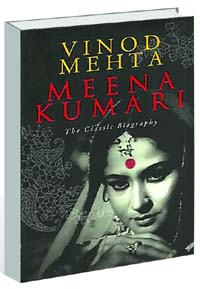
Vinod Mehta's republished biography turns the spotlight back on Meena Kumari.
Meena Kumari in Aarti, 1962.
Meena Kumari died of liver cirrhosis in March 1972. She was 39. A month or so later, Luis Vaz of Jaico Publishing called a young Bombay copywriter whose self-published book Bombay: A Private View had seen some success. Would he be interested in writing a biography of the woman universally acknowledged as Hindi cinema's greatest tragedienne?
In a memoir published 39 years later, the copywriter described that moment of decision: “Why not, I thought. And with the bravado of a 30-year-old who knew next to nothing about Hindi cinema, I launched into the project.” 
That 30-year-old was Vinod Mehta, and the biography he produced in October 1972 was pronounced “the most sympathetic, comprehensive and readable book on Meena Kumari” by the great writer-director KA Abbas. But after that first flush of critical acclaim, the book went out of print. And so it remained for decades, until Mehta's mention of it in his journalistic memoir Lucknow Boy (2011) aroused current-day curiosity.
Meena Kumari: The Classic Biography
HarperCollins, Rs. 350
 
Republished by HarperCollins this September, the biography is a remarkable creature. It bears witness not just to the incredibly filmi life of one of India’s most beloved actresses, but also to a past Bombay film world as observed by an outspoken young outsider. Mehta had watched some Hindi films growing up, but he was no starry-eyed fan. Hollywood impressed him more. One of the reasons he took on the project was that he’d read somewhere that Meena Kumari had identified with Marilyn Monroe, and her husband Kamal Amrohi with Arthur Miller. 
But what he really wanted was to place in her context the lower middle class Muslim girl who had become, like others of her ilk, a golden goose for her family, and to write about what kind of place India was in the ’70s. “I am often sounding off, and I enjoyed that,” Mehta told Time Out. That youthful pleasure is apparent in the summary dismissals that pepper the book. “For sheer vulgarity, dandyism, shallowness, squalor and dishonesty, the Bombay film world is hard to beat,” (p. 149), or “I can never understand how anyone who has the temerity to call himself an artiste… can find the time and mental apparatus to handle and organise the tortuous deceits necessary for hoarding hot money” (p. 185). “At that time it was fashionable to look down on Bombay cinema, not like now,” Mehta laughed. “And at that age I had an ego the size of a football.” But with zero journalistic experience or connections, it couldn’t have been easy to meet with Hindi film biggies? “Some of them were real prima donnas,” agreed Mehta. “What helped me was I had long hair; I used to wear a white raw silk coat and a tie and I had a bit of a British accent still. These film stars were quite flattered that a London-returned chap had come to see them. I quickly sensed that, and I exploited it.”
Whatever his reservations about the ’70s film world, Mehta has no doubt that it's a much worse place now. “I didn’t find the bitchiness that seems to exist today between [heroines]. There was space for everybody, and respect. Nargis spoke so well of Meena Kumari. And it was all extremely courteous – aapaapaap. I didn’t hear a single disparaging remark, not even from Amrohi [her ex-husband],” he said. There were, of course, those who refused to meet him, like her old love Dharmendra, and those, like Gulzar, who gave away nothing even when they did. The legendary lyricist-filmmaker, whom Mehta describes as “a cunning, urbane and sane man”, was bequeathed Meena’s diaries, and back in 1972, he scared Mehta by implying that he was writing a biography of her, too. But no biography ever emerged, and barring a small fraction of her poems, published as Tanha Chaand, Gulzar has kept Meena Kumari’s writing hidden away from the public eye, much to the disappointment of her fans (there are even those who suspect publishing her writing would reveal its influence on his own).
Mehta has no such illusions: he concedes that she may have been a third rate poet, more in love with the idea of poetry than adept at the craft. But, he writes, in a profession where most people “read nothing more taxing than Cine Advance”, that she was “able to put pen to paper… deserves a thirty-one-gun salute.” Mehta’s book is a combination of exuberant excess and judiciousness. He spends a whole chapter on whether she was a uniformly great actress, or only fitfully so. He evokes in loving period detail the stages of her relationship with Amrohi: the famous marathon telephoning, the silly but revealing quarrels over bassi roti, and the more serious ones over who entered Meena's make-up room, which eventually led to the break-up of their marriage. He evaluates her relationships with her family, and concludes that if she was exploited, it was because she chose not to cut herself off from people she felt she needed.
Mehta's recreation of the internal life of the woman he calls “my heroine” may seem rather imaginative to some, but he believes he was a model of restraint. “I didn’t find the nymphomaniac claim to be true,” said Mehta. “But she was quite promiscuous. Younger men, like Dharmendra or Sawan Kumar Tak, attached themselves to her and got breaks. And she almost certainly slept with all the top heroes.” He didn't put that in the book? “But that was standard. Kishore Sharma (married to Meena's sister Madhu) took me to this room with mirrors on the ceiling and said he was servicing her there. But he was such a shady character that I didn’t believe him,” said Mehta. On the other hand, he got fascinating details from her secretary, driver, doctor and three different make-up women: “people who had no axe to grind”.
The  book has brought offers to write about other film stars. “But present-day stars will accept only hagiography. Their PR people will give you a crore or two, but they want to vet your manuscript,” Mehta said. In any case, he hasn’t seen a complete Hindi film for 30 years. “These films of globalised youth, I find them completely artificial. I don't find becoming a famous rock star very interesting. Maybe I'm just too old.”
Published in Time Out Delhi, Oct 2013.

15 November 2009

The New Dadaist


Published in Tehelka magazine:

India's entry to the 2010 Oscars is a charming portrait of the father of Indian films. 

That cinema in India owes a great deal to one Dadasaheb Phalke, most of us are dimly aware. The Indian Government’s award for “lifetime contribution to cinema” is named after him. But very few people in Phalke’s film-mad country know more about the man. So when Marathi playwright and theatre director Paresh Mokashi read Bapu Vatave’s biography of Phalke in 2005, he decided it was a story waiting to be told. And since it was Phalke, it had to be told on screen, not on stage.

Harishchandrachi Factory tells how Phalke came to make his (and India’s) first feature film, Raja Harishchandra (1913), giving us a Phalke more charmingly eccentric than we could ever have imagined for ourselves. “But he had to have been that,” says Mokashi. “Imagine, as a Sanskrit pandit’s son in the 1890s, going off to the JJ School of Art, setting up a photo studio, or apprenticing with a German magician!”

The 40-year-old Mokashi, with a string of immensely successful plays behind him (Mukkam Post Bombilwadi [2003] ran for 460 shows), is known for his vivid brand of sharp, situational comedy. “To treat a serious subject with humour is no joke,” he says, deadpan. So in his film serious things happen, but are handled with a lightness that evokes Chaplin and Jacques Tati, as well as Shankar Nag’s televisation of RK Narayan’s Malgudi Days. We laugh, but there’s a sense that we could cry instead. Our first glimpse of Phalke is in a black top hat, doing magic for a delighted bunch of kids – only to do a real-life disappearing trick as an irate debtor arrives. His return home to a grieving wife and neighbours creates foreboding – before we realise they’re mourning a cupboard he’s sold to fund his new obsession. Even his temporary blindness in 1912 is not allowed to remain tragic: as Phalke lies there with eyes bandaged, someone says with mock gravity, “Your eyes will get cured – what shall we do about your mind?”

Before the success of Harishchandrachi Factory – it’s won awards in Maharashtra, Tamil Nadu and Kerala, and is India’s entry for the Oscars – someone might have asked Mokashi that question. Starting as an actor with Pune’s Theatre Academy, he spent years adapting a Berlin-based realist children’s theatre movement called GRIPS to the Maharashtrian context. He then moved to Mumbai and struggled until 1999, when playwright Ramu Ramanathan and Sanjana Kapoor insisted he stage one of his plays at the Prithvi Festival. In 2005, having become a bankable theatre name, Mokashi decided to make a film. Suddenly, funding dried up.

“A Marathi film with no stars, no songs: I don’t blame them!” says Mokashi, who mortgaged his ancestral home to fund the film, Phalke-style. His cast and crew (all theatre people) swear by him. Disagreements happened – when he decided to use a still frame, or when he urged his actors to underplay scenes they saw as “dramatic” – but Mokashi stood firm. Vibhawari Deshpande, who plays Phalke’s wife Saraswati, describes Mokashi as “scientific, sensitive without being emotional, and totally sure of himself.” Sounds like Phalke.

From Tehelka Magazine, Vol 6, Issue 45 Dated November 14, 2009

6 August 2008

A man in full: Maulana Azad

Published in the theatre pages of Time Out Delhi, 2007.

M Sayeed Alam’s Maulana Azad looks at the man behind the freedom fighter icon, says Trisha Gupta.


Maulana Abul Kalam Azad was a great Indian nationalist, but he smoked only Turkish cigarettes and drank only Chinese tea. “Despite being nationalist to the core, there were some Hindustani things that he hated – Hindustani doodh wali chai, yeh jo patti hoti hai, like dust; cigarettes, Hindustani oil and scent,” revealed M Sayeed Alam, writer and director of a play about Maulana Azad, which returns to Delhi this fortnight. “These are the things that make the play entertaining, and they are not of academic interest. Ab woh uthte kaise the, baithte kaise the, baatein kaise karte the, chaar baje uthte the ki teen baje uth jaate thhe, this no book will tell you,” Alam said.


An academic historian writing about Maulana Azad might mention that he smoked a lot of cigarettes, but it takes many conversations with people who knew him to find out which brand of cigarettes it was. Alam managed to track down a few such people – Aruna Asaf Ali, fellow-Congress party member and wife of the barrister Asaf Ali, Hasan Sani Nizami, whose father Khwaja Hasan Nizami had been a great friend of Maulana Azad’s, and finally, Ausaf Ali, who had worked with Maulana in the ’50s as a young journalist. It was Ausaf Ali who told Alam that Maulana’s brand of cigarettes was a Turkish one called Abdullah. And that he always drank the highest quality white jasmine tea.

Alam’s research for the play stretched over some five years, but during that time he had a day-job and was also working on a PhD. It was in a burst of enthusiasm over ten days in 2002 that he actually wrote out the script from beginning to end. His search for the private Maulana was aided by an Urdu biography written by Abdul Razzaq Malihabadi, who had been Maulana’s personal secretary for many years. Alam was clear from the beginning that writing a dramatic monologue in the voice of Maulana Azad was completely different from writing a play about his place in history. He wanted to answer the question, “Who was Maulana?” with something more than the usual trite clichĆ©s, like “a great freedom fighter” or “one of the main colleagues of Gandhiji, the fourth name after Gandhi, Nehru and Patel”.

The main source for Azad’s own take on his life and times was, of course, his autobiography, India Wins Freedom. But Alam wasn’t satisfied with simply using this account as the basis of the play. “This book is a huge disappointment for a reader who has read Maulana in Urdu. Maulana was a great writer. He had a command over history, over literature, over politics. In his newspapers, Al-Hilal and Inquilab, woh in cheezon ke bare mein bahut khubsoorat tareeke se likhte thhe.” Since that felicitous turn of phrase, or indeed any sign of the engaging conversationalist described by Aruna Asaf Ali, was completely missing from India Wins Freedom, Alam decided to construct the play not as an oral version of the autobiography, but as a series of conversations that Maulana has with Humayun Kabir the poet, his friend and one-time secretary.
This allowed Alam to do two things – one, to be historically accurate in his choice of language (it is known that Maulana actually dictated to Kabir in Urdu, and Kabir transcribed his words in English), and two, to return to Maulana something of the erudite, anecdotal quality that he had when speaking Urdu.
Urdu may have been Alam’s reason for casting Tom Alter, who he believes has done “a brilliant job”, but Azad’s own relationship with the language was more complex than we might imagine. His family of Muslim theologians and scholars had moved to Mecca soon after 1857, and he himself was born there, to an Arab mother.
When he was five, his family returned to India, but his education in Persian and Arabic as well as his family background meant that he always thought of Arabic as his mother tongue. But in India, writing in Arabic or Persian meant isolating yourself from the very possibility of a readership. “The status of Urdu in those days was like that of Hindi today. It may not have been seen as the highest language, but it had readers,” said Alam. It was a similar desire for readers, this time for an international audience, that Alam believes made Azad publish his autobiography in English. (In the book, and therefore in the play, however, it is Kabir who suggests that he write the book in English.)

Maulana may have made tactical compromises on the question of the language he wrote in, but in other matters, he stuck to a position once he had taken it. The greatest example of this was his principled and firm opposition to Partition, which makes up some part of the play. “You have a right over the whole country, and you want to claim only one corner of it? And then too, you want to claim an area where you are already a majority?”, he once said in a rhetorical query to Muslims who supported the League’s claim for Pakistan. He foresaw the splitting of East Pakistan into two countries, and predicted that Hindu-Muslim riots would not end with Partition, that they would in fact resume on a greater scale.
“He was prescient in both regards,” Alam said. “But I am not here to make judgements. Mine is a retelling of history, but interspersed with poetry, wisdom, anecdotes – all those things that make up Maulana, the man.”

Published in Time Out Delhi Vol. 1 Issue 4, June 1 - 14, 2007.