3 November 2019

Seeking stardust

My Mirror column:

An intriguing new documentary on actors who impersonate Bollywood stars offers insights into stardom and selfhood. 

Mahesh Waghela has built a career out of impersonating Rajesh Khanna. A still from the documentary 'Hubahu'.

Acting is usually understood as a successful imitation of life. But there are actors we watch less for their ability to play new fictional characters and more for a consistent, even predictable performance of themselves. We call them stars.


From Dilip Kumar’s perfect enunciation to Shah Rukh Khan’s romantic gestures, from Amitabh Bachchan’s baritone to Kareena Kapoor’s pout, our attachment to those we anoint as stars is usually based on particular elements of a screen persona. Every star worth the name is actually a constellation of signature vocal tics, repeated bodily gestures and stylistic choices: a particular haircut, a recognisable walk, an oft-repeated item of clothing.


And in our film-mad country, all of us have known someone who actually modelled themselves on a favourite star. It might be your father’s friend who, as a college student in the ’60s, took to flicking his hair and arching an eyebrow like Shammi Kapoor. Or your friend who adopted the tinkly Madhuri Dixit laugh along with the dance moves. Or the great-aunt who looked like Nimmi – and may have acquired something of her winsome air of naivete from that perceived connection.


Imitation, they say, is the highest form of flattery. Ramsha Alam’s documentary Hubahu, funded by the Public Service Broadcasting Trust (PSBT) and screened last Friday in Delhi as part of PSBT’s Open Frame Film Festival, zeroes in on three people who have taken this adage to its logical conclusion: for whom the imitation of their chosen star has become a lifelong, life-altering commitment.


Whether it’s Rais Khan, who works as ‘Junior Shashi Kapoor’, or Seema Motwani, who has played Hema Malini in countless advertisements and TV shows (MTV’s Fully Faltu employed her for seven years), or Mahesh Waghela, who has built a career out of impersonating Rajesh Khanna, Hubahu paints a fascinating portrait of the world of the Bollywood lookalike.


One of the things that Alam’s chosen subjects have in common is that the resemblance was first pointed out by someone else, and then gradually internalised. In Khan’s case, his mother first told him his teeth were like Shashi Kapoor’s. Khan, then young and impressionable, gradually began to see traits of Shashi in himself, and then worked extremely hard to improve on what he had. He spent years, for instance, training his straight hair into Shashi-like waves by tying it up in a handkerchief at night, using circular combs and so on, until it finally succumbed to his efforts. With sunglasses on, his now wavy hairstyle and slightly toothy grin makes him instantly ‘recognisable’ as Shashi. In Seema Motwani’s case, it was her co-actors, many of them already working as lookalikes, who told her that she could channel Hema Malini. For Waghela, it was a friend with a dance troupe who persuaded him to use the physical resemblance to his advantage.


Waghela’s story begins, like most lookalikes, with physical resemblance fanned by fandom. Just not his own. It was Waghela’s elder brother who was the Rajesh Khanna fan in the family, adopting the superstar’s look and hairstyle at the peak of his fame in the 1970s. The story suggests the endless loop into which mimesis can launch you: did the youthful Waghela start out copying Rajesh Khanna – or was he just a young man copying his elder brother, who happened to be copying a superstar?


“It takes a lot of effort to become a lookalike... though people just dismiss us as duplicates,” Waghela says ruefully. His brother had never performed. Stage fright drove Waghela off-stage, too, the first three times. But once he started performing Khanna’s famous songs and dialogues with the superstar’s signature moves in place, the audience roared its approval. There was no going back.


At the core of that feeling of gratification is the public adulation. The lookalike is perfectly aware that what the public is responding to is a performance (in fact, a performance of a performance), and yet something of the magic of the star rubs off on him or her. People’s unguarded, often emotional responses to a star-lookalike, especially in non-metropolitan areas, conjure up memories of public responses in the 1990s to actors Arun Govil and Deepika Chikhalia who played Ram and Sita in the televised Doordarshan Ramayana.


Bound already by the film industry's semi-feudal conventions in which artistes are classified as “senior” and “junior”, Khan, Motwani and Waghela have also come to identify deeply with their chosen star. Their investment in upholding the star’s image is total, lending them an air of gravitas – and dare I say, purpose. “I am careful never to wear revealing clothes, or do anything that would take away from Hema ji’s dignity,” says Motwani. Waghela regularly refuses comic routines centred on mocking Khanna. “When I’m earning because of him, why would I demean him?” After Khanna’s death in 2012 and Kapoor’s in 2017, there is a powerful sense that they are keeping a great man alive.


That process could be seen as subjugating their real selves. Waghela shaved off his moustache against his wife’s wishes, to look more like Rajesh Khanna. Motwani says she makes sure not to put on too much weight, so as to keep Hema Malini’s aura intact. But watching these actors talk to Alam – the barely suppressed teariness with which Motwani describes her own struggle, or listening to Khan’s eternally cheery manner, so reminiscent of Kapoor – it often feels like these are now part of their real selves.


15 October 2019

The Silk Route Between the Covers

My 'Shelf Life' column for October:

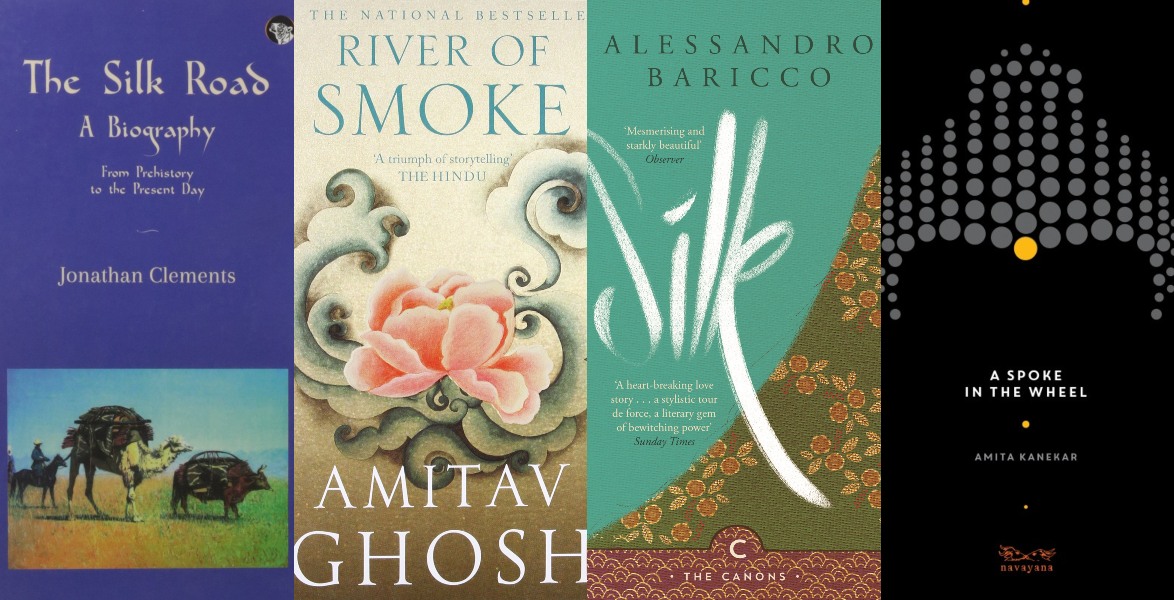
The unreal lustre of silk has long been the stuff of fantasy, in life and in fiction, from Alessandro Baricco’s Silk to Amitav Ghosh's River of Smoke


Cloth has been among the most ubiquitous items of exchange in the history of human civilisation—but silk is the only cloth to have had a trade route named for it. The legendary Silk Road was, of course, neither singular nor physical. It was more a name for a network, a direction in which goods travelled between China and the Mediterranean, with Xi’an and Samarkand as nodes. Jonathan Clements, in his book The Silk Road: A Biography (2016), points out that all manner of objects—gemstones, glass, tulips, spices, slaves—were traded on the route, but the commodity most likely to travel the entire length from East to West, was silk. The reason was its value in the West, but also its portability and durability. 

The moth called Bombyx mori was first cultivated in China, where the first evidence of silk goes as far back as 3000 BC. During the Han dynasty, silk became a form of currency in China. Arriving in the Central Asian steppes and deserts as bribes, gifts, soldiers’ salaries or just in lieu of cash, bolts of silk often carried on westwards, with tribesmen using them as payment for livestock or luxuries. Soon silk began to appear in the ancient Graeco-Roman world (332 BC -395 AD). But it was not common, and the fabric’s marvellous quality of light and shade, of movement, could alarm those who saw it for the first time. As late as 53 BC, Roman soldiers were so unnerved by the sight of the shimmering silken banners carried by the Parthian troops at the Battle of Carrhae that they took to their heels. 

By the 3rd century AD, it had become the cloth of kings. The Roman Emperor Heliogabalus, who reigned 218-222, reportedly wore nothing but silk. In Amita Kanekar’s superb fictional reimagining of the time of Ashoka, A Spoke in the Wheel (2015), all bhikkhus (monk) wear brown robes, as ordained by the Buddha. But those worn by the Thera of the Sanchi Stupa, made from “this amazing cloth from the lands of Chin”, mark him out as the first among equals. 

The Thera’s robes, like the Parthian banners, “looked alive”: “the same saffron-brown colour shimmered in the lamplight, making dark gold and orange pools that continuously changed shape and direction”. By the early centuries AD, Korea, Japan and India had also begun to practise sericulture. Silk appears twice more in Kanekar’s novel, both times more local. Once “pieces of stiff, shiny material” are hidden in a monk’s mattress, inscribed with a message in the Kharosthi script from Taxila. Another time, a conquered people forced to shift south from eastern India sport lengths of rough-textured golden mugga, “woven long ago on home-made bamboo looms and reserved for special occasions – for wild silkworms with their shining cocoons were not to be found in the Vindhyas, Bhima insisted.”

But even as silk earned the favour of the rich and powerful, it scandalised others. The Roman writer Seneca was appalled by the “glass togas” on sale: “I see silken clothes, if one can call them clothes at all, that in no degree afford protection either to the body or to the modesty of the wearer, and clad in which, no woman could honestly swear she is not naked.” 

Centuries later, when the Europeans had started to produce it, the sheen, softness and smooth drape of Eastern silk still retained an erotic charge. In Alessandro Baricco’s novel Silk (1996), translated from the Italian by Ann Goldstein, a 32-year-old French merchant travels to Japan to acquire silkworm eggs that have been spared from the damaging effects of a Pébrine epidemic. It is 1861, and it takes him three months. “How is the end of the world?” asks his associate Baldabiou. “Invisible,” responds Hervé Joncour. 

For his wife Hélène, Joncour brings back a silk tunic that she, “out of modesty, never wore”: “If you held it between your fingers, it was like grasping nothing.” Published in 1997, silk in Baricco’s novel is very much part of an erotic European fantasy of the East—but self-consciously so. In the house of Hara Kei, the Japanese lord who privately agrees to sell him the eggs, he is bathed daily by three old women whose hands are “gnarled, but very tight”, who dry him off with “warm silk cloths”. On his last day there, they are replaced by “the lightness of a silk veil” and unseen hands that caress his skin, “not the old hand of an old woman”. Joncour spends his life in the grip of those hands—never realizing the flesh-and-blood Hélène's rôle in stoking that fantasy.

In Amitav Ghosh's River of Smoke (2011), another mid-19th century merchant travels halfway across the world and brings back silk for his wife. Shireenbai does wear the pale brocaded China silk as a sari, and even the scarlet Jinliang slippers. Like the unhappy Hélène, though, Shireen knows that her opium-trading Parsi husband's heart lies in the East, even when he is in Bombay. 

But unlike Joncour's Japanese memory, the woman Bahram Modi becomes attached to in Canton is the opposite of ethereal. Chi-mei is warm, domestic, comfortable, she wears cotton not silk. She, not Shireen, bears him a son. And even in Bahram’s last pipe-dream, her fingers on his chest are rough and callused—as if to say that this Canton life has always been his real one. 

Silk’s very luxuriousness makes it a permanent figment of the imagination. Reality, it seems, feels rougher.

Published in The Voice of Fashion, 9 Oct 2019.

4 October 2019

The dream machine - II

My Mirror column:

What might we learn about our relationship with machines from Ritwik Ghatak’s classic Ajantrik and Buddhadev Dasgupta’s recent Urojahaj – with a detour through Naya Daur? The second of a two-part column


In last week’s column, I suggested that there might be something to be learnt from comparing two Indian films made 60 years apart, each about a man besotted with a machine – Buddhadeb Dasgupta’s most recent feature, Urojahaj (The Flight), and Ritwik Ghatak’s 1957 arthouse classic Ajantrik

In Urojahaj, the protagonist is a happily married man with a child, and his attachment to the broken-down Second World War plane he finds in the forest comes across as selfish. The mechanic’s quest for something so impractical can only be individualistic. The plane is an obsession that takes Bachhu Mondol away from those he loves. And as he hears more tales from ghosts of betrayed humans, he begins to be suspicious of those that love him: in one sadly revealing moment, when his wife tells him the police are looking for him, he actually asks her if it is she who has reported his discovery of the plane.


In Ajantrik, in contrast, the taxi driver hero Bimal has no-one else to love. The battered taxi seems to fill up the space in Bimal's heart where a person might have been. When Bimal speaks of Jagaddal, it is as a trusty companion – and when the car collapses, he sees it as betrayal.(“Even if I give you my all, I can't win your favour?”) His hunger for human company may be inarticulate, but when he encounters a young woman who has been cheated by her lover, something buried deep within the usually misanthropic Bimal bubbles up to the surface. When Jagaddal appears not to cooperate in his mission to help her, Bimal delivers a well-aimed kick to its engine. That unprecedented moment of anger kickstarts the process that will eventually bring the machine to its knees – and it might be said to stem from Bimal's frustrated effort to assist another human being.

Despite their differences, the close relationship between man and machine in both films seems to turn on excluding the rest of humanity. The same year as Ghatak made Ajantrik, the Hindi film industry also produced a hugely popular narrative about man and machine. Released on August 15, 1957, BR Chopra’s Naya Daur ('The New Age') starred Dilip Kumar as Shankar, a tangawalla who becomes the focal point of a battle between the horse-cart drivers of his village and the evil capitalist son of the village’s feudal landlord. The legendary climactic race between Shankar, straining at the reins of his horse-drawn cart, and the villainous Kundan at the wheel of his bus was staged such that the underdog would win. 

But even within Naya Daur’s wishful dream universe, laced with the labour-capitalist bhai-bhai rhetoric that was often as far as Hindi cinema socialism went, Shankar’s victory could only be presented as a one-time thing, a reprieve. The film was intended only to give us pause as we hurtled into the machine age, to consider the fate of the masses who would be left behind if we were not careful.

Ajantrik seems to occupy a mindspace so different that is scarcely recognisable as belonging to the same cultural landscape. Instead of a race between a tanga and a bus, Ghatak has his taxi compete with a train. The creaky, decrepit Jagaddal cannot win. But that does not lead us to anything so simple as a win or a loss for technology. Driving too fast on a curving hilly road to catch up with the train, Bimal must draw back from the edge in the nick of time – and the moment when he does is also the moment when he finally sees the world in which both taxi and train have arrived: disruptions, but here to stay.

What Ghatak shows us through Bimal’s eyes is a festive gathering of the Oraons: women singing with flowers in their hair, bare-chested men with drums, dancing in unison. There is something about Bimal’s gaze that seems to see but not see, the marvellous sight of the human body moving to a rhythm that has existed long before the rhythm of the machine. And yet, as the Oraon man who pushes the broken-down jalopy to Ranchi Station says to his sweetheart, it is the train from this station that takes “our people to Assam and Bhutan, to work in the tea gardens”. A single machine may die, Ghatak seems to suggest, but the machine is here to stay. 


Ajantrik extended the concept of pathetic fallacy from nature to the machine. But the human hero of 1957 still saw his favourite machine in human terms, giving his car a name and human attributes; a sense of life and death; even a kind of burial, at the scrap dealer’s. Sixty years later, at the end of Urojahaj, it is the human hero whose life and death are in balance. Bachhu Mondol, running from the irrationality of a tyrannical state, speeds through the forest and out onto what looks like a runway, and the camera pans over the ground, rising higher as if looking on from high. What Bachhu sees is what a plane would see, if it could. The man in search of freedom now models himself on the machine.

Published in Mumbai Mirror, 15 Sep 2019

The dream machine

My Mirror column:
In Buddhadev Dasgupta’s thought-provoking new film, a
 man obsessed with a plane starts talking to ghosts, making one think of another machine-loving madman in Ritwik Ghatak’s 1957 classic, Ajantrik


In Buddhadev Dasgupta's evocative new film Urojahaj (The Flight), a motor mechanic called Bachhu Mondol (Chandan Roy Sanyal) discovers an old plane abandoned in a forest near his village, and becomes obsessed with the idea of making it fly. He spends hours with the plane, repairing and repainting and dreaming. And most of all, talking to ghosts – the only other human beings to frequent the clearing where it lies hidden.


When it turns out to be a Japanese fighter plane that may have crashed there during the Second World War, one of the ghosts asks Bachhu, does he intend to go to war with the plane?

“I'm rebuilding this plane. I'm making it a new thing. It won’t remember killing people, or war,” says Bachhu immediately.

“Then what will it remember?” asks the she-ghost.

“The sky,” says Bachhu.

The mechanic’s idea of the plane as having a memory – and also being able to forget – is one of the gorgeously poetic ways in which the filmmaker conveys to us that at least for Bachhu, the machine is half-human. There are many other occasions in Urojahaj when the plane’s power over Bachhu is coded this way. “You’re dressing up the plane so much,” another ghost giggles. “Are you going to marry it?” Decrepit though it is, the machine has so completely captured Bachhu’s attention that even his wife starts to wonder if it is her soutan, the rival love of her husband’s life. Bachhu keeps assuring her of his love, but she is not convinced. “You don’t love me any more, else why would you go to the plane every night?” she asks him. And later, “What does the plane give you that I don’t?”

Urojahaj (2018) is Dasgupta's 17th feature film, the latest in a long and distinguished career that has established him as one of India’s internationally known auteurs, his films regularly screened and awarded at top-tier festivals like Venice and Cannes. Sadly, we live in a country in which films like Dasgupta’s barely make it to cinemas. But Urojahaj is a film well worth your time, and worth thinking about at many levels.

For one, the depth of Bachhu’s preoccupation with the plane instantly brings to mind another film about a man’s attachment to a machine directed by a Bengali filmmaker: Ritwik Ghatak's Ajantrik, made an astounding six decades ago. Released in 1957, Ajantrik was the second film made by Ghatak, maverick member of the trio of great Bengali auteurs along with Satyajit Ray and Mrinal Sen. Known in the West alternately as The Mechanical Man and The Pathetic Fallacy, the film starred the well-known Bengali actor Kali Banerjee as a taxi driver who treats his dilapidated Chevrolet jalopy more lovingly than a human companion. Banerjee’s Bimal names the car Jagaddal, and talks to it at opportune moments.

“Thirsty, Jagaddal? Yes, you're panting, wait,” he might say, pouring water into the radiator on a hot day. Or “Sorry, Jagaddal, you'll have to make do with patches for now. I’ll buy you a shiny new hood when I’ve saved some money, I promise.”

Friends and acquaintances snigger about Bimal's excessive attachment to the car – “Private matter? Is the car your lady?” – but he is unperturbed, even turning up in a starched white dhuti-panjabi the day he decides to get Jaggadal photographed. But having shown us Bimal dressed as a coy bridegroom, Ghatak joyfully juggles the car’s imagined gender and age. “Amar Jagaddal baagher bachcha (My Jagaddal is a tiger cub),” announces Bimal proudly in the very next scene. “They envy him, naturally. What young man wouldn’t envy an old man with such stamina?” Soon enough, we also see Jagaddal's number plate, which reads ‘BRO 117’.

In contrast to Urojahaj’s fairly even fable-like quality, Ajantrik alternates between physical comedy, meditative observation and a surprising emotional heft. There is early laughter when Jagaddal splutters and bubbles and honks in response to Bimal, making the film a precursor of such Hollywood creations as Herbie, the Volkswagen Beetle of The Love Bug (1968). But for the lonely Bimal, Jagaddal is his most constant companion, about whom he is quite openly sentimental. “He earns me two rupees a day, no matter what. He’s been with me since my mother died,” he tells the little boy who works in the garage.

On another level, Bimal’s trips with Jagaddal are a way for us to travel through rural Chhotanagpur, a 1950s landscape in which female faces are disproportionately limited to line-drawn advertisements for Baidyanath and Dabur Amla Kesh Tel. It is no wonder that a bejewelled Bengali bride who boards the taxi draws Bimal’s attention. He does not chastise her even when she switches from a romantic, almost aesthetic appreciation of the ruin – how lovely the sky looks through a hole in Jagaddal’s canopy – to a pragmatic, modernist disdain for it: “What a rotten car!”

Ghatak may seem merely to be gesturing to what Urojahaj makes explicit: that a man’s attentions cannot be successfully divided between a machine and a woman. But perhaps there is much more there.

(To be continued next week)

Published in Mumbai Mirror, 8 Sep 2019.

8 September 2019

Out of the Closet with Kitty and Nan


The third instalment of my TVOF column Shelf Life, in which I look at literature through the prism of clothing, is about a book I have loved for twenty years:

In the 19th-century London of Sarah Waters’ Tipping the Velvet, clothes can help keep secrets—or reveal new selves. What looks like display might well be a disguise.

“All the world’s a stage, and all the men and women merely players,” runs the famous speech in As You Like It. It is fitting that history's most famous playwright made the theatre a metaphor for the unfolding of human life. But the stage can also be the perfect literary take-off point for stories of self-transformation—and the first step in becoming something—or someone—else is to dress the part. Sarah Waters' extraordinary first novel Tipping the Velvet, published 20 years ago and set in the Britain of the 1880s, begins on the music hall stage. That is where, in the Canterbury Palace of Varieties, the entranced Nancy Astley first sets her eyes upon Kitty Butler.

At first glance, Miss Butler is a girl dressed up to look like a posh young man: in a gentleman's suit, tailored to her size and lined at the cuffs with bright silk, with a white bow tie at her collar and a top hat on her head. But as Nancy's hungry gaze takes in more detail, she realises that though Kitty strides and sings like a boy, and stands with her hands “thrust carelessly into her trouser pockets”, her slender frame is unmistakably rounded “at the bosom, the stomach and the hips, in a way no real boy's ever was”.

What makes Kitty attractive is her changeability: now she seems like an exceptionally pretty boy, and now a slender, boyish girl. And much of that sense of changeability—for Kitty, and later for Nancy—is achieved in the novel through clothes.


Clothes are crucial, too, to the unlikely relationship that springs up between the upcoming music hall star and the Whitstable oyster girl. The adoring Nan begins to visit Kitty in her dressing room, folding up her stage clothes with quivering fingers, secretly pressing to her cheek “the starched linen of her shirt, the silk of the waistcoat and the stockings, the wool of the jacket and the trousers” —receiving from the clothes an erotic charge that their wearer has not yet acknowledged. Soon, the growing familiarity with the costumes becomes the route to intimacy with the person: Nan becomes Kitty's dresser, and her companion in London.


It is after this that the novel really comes into its own, laying out in scintillating narrative a world of performance, both off-stage and on it. Hoping to distinguish Kitty from a rising tide of male impersonators, her agent tells Kitty and Nan that they must “go about the city and study the men”, so that her act can broaden into a host of different male guises, each with its own song—and crucially, its own costume: “What think you of a policeman's jacket? Or a sailor's blouse? ... all that handsome gentlemen's toggery that languishes, at this very minute, at the bottom of some costumier's hamper, waiting, simply waiting for Kitty Butler to step inside it and lend it life!”

The Pleasures of Dressing Up

A still from the miniseries adaptation of the novel
But Kitty is not the only one to experience the magical power of clothes; the book's real heroine is waiting in the wings. On their first Christmas, Kitty gives the normally drably dressed Nan a “long, slim evening dress of deepest blue”, which Nan thinks far too fine for her. At Kitty's insistence, she wears it to dinner, only to find herself attracting more male flirtation than she ever has—followed by Kitty's inchoate jealousy, which finally lights the spark that turns them into lovers.

“The dress was so transforming that it was practically a disguise,” writes Waters in that passage, presaging Nan's future. For she will soon join Kitty on stage, their double act rising to top billing.

Among the book's most perceptive moments is the one where the shy, reluctant Nan realises that performing gives her pleasure. From that on-stage frisson “in the wearing of handsome suits, the singing of ribald songs” to recognising that the thrill of “display and disguise” only becomes more acute if the performance is live, off-stage—that is the journey that transports Nan first into London's lewd side-streets, then into its upper crust lesbian boudoirs, and finally into feminist-socialist circles. 


Kitty had resisted the pull of her masculine clothing, trying almost obsessively to keep her stage persona apart from her ordinary life. But the inner and the outer cannot be delinked so easily. Kitty’s fear of public censure (for being seen as a “tom”, a lesbian) is also a fear of her inner self.


Nan, in contrast, seems to revel in the inner possibilities opened up by changing her external appearance. And those possibilities—like her costumes—are unendingly changeable. Dressing as a boy in real life begins as a strategy for safety, but it is risk that keeps her hooked.   

Clothes are, in many ways, the driving force of Waters' narrative of sexual selfhood. New costumes seem to propel Nan into new selves. And yet somehow, simultaneously, it is she who animates them, her very physicality altering with each new avatar. Perhaps that, then, is the ultimate power of clothes: they can turn all of us into shapeshifters, performing ever-new roles on a real-life stage. If we can just enjoy the performance, it might no longer feel like one.


The Spirit of Technologies Past

My Mirror column:

As we hurtle ever faster into a digitised present, some recent films cast an affectionate glance back at the technologies that made us who we are.


Right at the beginning of the recently released 
Shantilal O Projapoti Rohoshyo, director Pratim D Gupta tells us that his film is about a time “when porn was watched on DVD, news was read in print… and films were made for theatres”. Right from its charming children’s detective story title (the Bangla translates as ‘Shantilal and the Butterfly Mystery’), the film lives and breathes a certain gentle nostalgia. But its special focus is an era that existed until quite recently in India, a time that feels like it’s being elbowed out at top speed by technological transformation. What’s interesting is that the nostalgia is itself framed around an earlier era of technology: the newspaper, the cinema, the photograph.
The film’s deadbeat weather reporter protagonist, Shantilal, with his unquenched desire for a “front page story”; the neighbour who hounds him for a free spot in the matrimonial pages of The Sentinel; the DVD shop guy who urges Bertolucci, Bergman and Buñuel upon a customer who’s waiting for his supply of quality Malaysian erotica – all of these look back fondly to a time before the digital conquest of our lives. But the pirated DVD may be the one to focus on: a signifier of an in-between time. Not before computers, but before news stories began to be broken on Twitter timelines, before Shaadi.com, and before the endless glut of internet porn. It is an era that is not in fact that distant – which is perhaps why it feels so surreal that it is already gone.

Shantilal 
brings to the fore a theme that has, in fact, underlain many Indian films in the past five or six years: our memories of an analogue era. Ritesh Batra’s 2013 critical and commercial success, The Lunchbox, used a dabbawala mix-up to deliver a tribute to a fast-disappearing world – the Hindi music cassettes Deshpande Aunty still listens to, the Orient fan around which Deshpande Uncle’s stagnant life revolves, the Yeh Jo Hai Zindagi episodes recorded from Doordarshan that Saajan Fernandes watches endlessly in memory of his wife. (Using the voice of Bharati Achrekar as the never-seen Mrs Deshpande was, of course, the perfect meta-textual reference to Doordarshan, on which she was once such a profoundly familiar face.)


If
 The Lunchbox took a rather melancholy view, Sharat Kataria’s Dum Laga Ke Haisha (2015) was a more enthusiastic, even raunchy tribute to the 1990s, featuring Ayushmann Khurrana as the small-town owner of a cassette shop. Some of the most endearing moments of the film’s post-marital romance between Khurrana and Bhumi Pednekar involved the VCR as a therapeutic sexual aid and the playing of songs as messages on a cassette player.

The audio cassette with songs personally picked out and recorded was, of course, the ultimate 1990s romantic gesture. That was the matrix of a more recent 1990s-set romance, the Yash Raj production
 Meri Pyaari Bindu (2017), also starring Khurrana. In that film, Khurrana plays a Bengali middle class hero (complete with a daaknaam – Bubla), whose largely unrequited love for his neighbour Bindu is tied up with the technology of their adolescence: Ambassador cars, STD-ISD booths, a nascent virtual universe embodied in email addresses such as muqaddarkasikandar1977@hotmail.com.


Video cassettes were crucial to both Nitin Kakkar’s
 Filmistaan and Vishal Bhardwaj’s Haider. Both released in 2014: one set in Pakistan, the other in Kashmir, and both had political messages. Although tonally miles apart, the two films are united by their references to the early Salman Khan films Maine Pyar Kiya and Hum Aapke Hain Koun. Kakkar presents those films, as he does all Hindi cinema, as the great unifier of countries and people divided by Partition. Haider, written by the journalist and author Basharat Peer, adapts Shakespeare’s Hamlet to 1990s Kashmir: a dark and violent place, as searingly sarcastic as it is driven to desperation. In this world, the two Salmans – the original play’s Rosencrantz and Guildenstern turned brilliantly into Bhai fans and lookalikes who run a videocassette shop – initially seem like comic relief. But as the film builds to its necessarily tragic climax, it becomes clear that no amount of grainy re-watching of MPK songs can keep Haider (Shahid Kapoor) from seeing the reality of the Salmans – or keep Kashmir from seeing the reality of India.

To return to Shantilal o Projapoti Rohoshyo: it isn’t just a simple tribute to a past era. The protagonists of Pratim Gupta’s not-quite-mystery live on the cusp of the present, and often display an active reluctance to cross over. Shantilal himself doesn’t have Whatsapp, though he does have a mobile phone. The film star in her prime (Paoli Dam, very effective as Nandita) expresses a nostalgia for autograph seekers in an era of selfies, and keeps a corner of her bedroom as a photographic shrine to her past. But she finds her future threatened by a photograph from that past. Old technologies can inspire nostalgia, but our attachment to them may tell us less about those forms than about ourselves.

Published in Mumbai Mirror, 1 Sep 2019.