20 November 2018

Streets full of dreams

My Mirror column:

Two recent city films, one from Delhi, the other Bangalore, make us think about the role fantasy plays in the lives of the poor.


The memorably named Ghode Ko Jalebi Khilane Le Jaa Riya Hoon (I’m Taking the Horse to Feed It Jalebis) is a welter of visions. “This film is culled from interviews and dreams of pickpockets, street vendors, small-scale factory workers, daily wage labourers, domestic workers, loaders, rickshaw pullers and many others labouring in the city of Shahjanabad, Old Delhi,” reads the opening text of Anamika Haksar’s debut film. A long-time theatre person and activist, Haksar has said in interviews that the film germinated in her mind soon after her marriage, when she first began to spend time in Old Delhi and had a window looking out on a roof where three men slept every night.

Watching Ghode at the Dharamshala Film Festival earlier this month, it was clear to me that Haksar had spent many years with that memory, trying to turn that real window into a metaphorical one.

Ghode retains her originary three men on a roof, giving them professions and roots — the pickpocket (Ravindra Sahu) and the sweet seller (a tragically under-used Raghubir Yadav) are from UP, while the loader (K Gopalan) is Malayali. But she surrounds them with a cast of 400 non-actors from Purani Dilli. An unorthodox mix of animation, fiction and documentary, Haksar’s film has a clear political aim: expanding an uncritical, vaguely nostalgic gaze (afforded by her upper-middle-class Kashmiri family’s Old Delhi connections) into a perspective simultaneously sharper and more broad-based.

A crucial conduit in that politics of representation is the portly figure of Akash Jain, a well-off resident who serves as guide to Old Delhi, and as faux-sutradhar to the film. Played by real-life theatre person Lokesh Jain (who with his partner Chhavi did the interviews on which the script is based), “Awaragard Akash” sings the city’s praises in highfaluting clichés as familiar as they are fake. To watch him shepherd clueless visitors through this overburdened, garbage-filled, drug-addled place of poverty and backbreaking work, while declaring it “Tehzeeb ki jannat (A heaven of civilization)” is to both laugh and cry at the ironies we live with.

Less successful is the film’s shunning of a linear narrative and near-total jettisoning of psychological realism. Ghode’s multitude of dream visions can be surreal and cheeky — levitating corpses bandaged in white; a calendar-style Lakshmi contending with a lehrata hua Communist flag, or my favourite: a labourer’s fantasy of his exploitative boss turning into a lizard. But there’s also a hyperreal mode that tries too obviously to grab our attention: for instance, that same labourer’s muscles shown pulsing exaggeratedly, at excruciating length.

Dreams animating the dreary lives of the poor are also the subject of Indu Krishnan’s 78-minute documentary, Good Guy, Bad Guy, which was screened at the Urban Lens Festival in Delhi yesterday. Like the 59-year-old Haksar, Krishnan spent over five years with a much younger working-class man who is her central character. She first meets Zakhir in Cubbon Park, that island of quiet in the raucous tide engulfing Bangalore. He is feeding the monkeys — not by strewing food on the ground, but feeding each individually.

Krishnan finds this unusual and decides to get to know him. A runaway who left home many years ago, Zakhir works as a ragpicker in Bangalore’s scrap-sorting area, Jolly Mohalla. By day, he trawls the city’s streets for reusable trash. By night, his primary concern is to find a safe place to sleep. The animals he befriends — monkeys in Cubbon Park, street dogs, even pigeons that roost above a house where he sleeps — are a refuge in a hostile city, and Zakhir imagines their lives as implicitly better than his own. “No one bothers these creatures,” he tells Krishnan. “They can do what they want. If they show up at Cubbon Park, they’ll get fed, too.”

That imagined life is quite different, however, from that of a caged animal. In one of the film’s oddly moving juxtapositions, when Zakhir ends up in jail in a murder case, the filmmaker manages to track him down and asks him if he might want to work in a zoo upon release since he likes animals so much. Zakhir’s response is characteristically gentle but immediate: “It is a sin to keep animals captive.”

Later in the film, he ends up working for a piggery. But with Krishnan’s help, he also embarks on an attempt to fulfil what he tells her is his real dream: directing a feature film. In contrast to Ghode’s biting sarcasm and rambling excess, Good Guy is a gentler, simpler film, a bit like Zakhir. Like Haksar, Krishnan remains a privileged outsider, never really exposing herself. Still, despite some unnecessary drama and bad background music, her honesty about her own position vis-à-vis Zakhir — bailing him out or connecting him with a Kannada filmmaker because “without that there would be no film” — disarmed me.

Watching the near-illiterate Zakhir create a script and songs for his film, with at least one featuring himself as a sort of anti-hero, it was hard to know how I felt about his dream life. The question is similar to the one implicitly raised in Haksar’s film: do dreams keep people from being crushed by hopeless conditions? Or are they a perpetual escape from reality?

16 November 2018

In the Family Way

My Mirror column:

Films about parental figures — real and imagined — made revealing viewing at the Dharamshala International Film Festival.


Actor Manoj Bajpayee occupies the front row at the 2018 edition of DIFF, which took place in November at the Tibetan Children's Village school in McLeodganj

The seventh edition of the Dharamshala International Film Festival (DIFF), which ran from November 1 to 4, was full of films about parent-child relationships. It wasn’t a consciously chosen theme. “As in previous editions, a pattern emerged organically from the choices we made,” wrote DIFF’s directors Ritu Sarin and Tenzing Sonam in their festival brochure.


Deliberate or not, even just the names of the films on this year’s schedule made for a recurring motif. In many conversations at the fest, the multi-generational, multi-linear Taiwanese drama
Father to Son was mistaken for Of Fathers and Sons, a documentary based on exiled Syrian filmmaker Talal Derki’s two years shooting with a radical Islamist family in a north Syrian village. The Sri Lankan debut feature House of My Fathers added to the confusion.


Beyond the films whose titles declared themselves, however, there was Ee.Ma.Yau, Lijo Pellissery’s brilliant satirical drama about a Malayali Catholic man trying to arrange the grand funeral he promised his fisherman father, and the spare, rather too studied The Red Phallus, Tashi Gyeltshen’s symbolic unpacking of patriarchy in rural Bhutan through the tale of an atsara (a traditional clown) and his unhappy teenaged daughter. Dominic Sangma’s debut feature Ma.Ama, which I didn’t get to watch, ‘resurrects’ the filmmaker’s late mother (and casts his real-life father as the 85-year-old Philip Sangma, who has waited 30 years to be reunited with his dead wife).

The non-fiction films, too, gravitated towards this filial theme: Avni Rai’s documentary about her father, 
Raghu Rai: An Unframed Portrait, is as much about his photography as their relationship, while the fascinating, blackly funny The Beksinskis: A Sound and Picture Album (2017) reconstructs the complicated relationship between a famous Polish painter Zdzislaw and his radio journalist son Tomek, drawing on 300 hours of private video footage that extends from the period before Tomek’s birth till after his death. (The Beksinskis were also the subject of a more traditional biopic in 2016: Jan P Matuszynski’s feature The Last Family, which I saw at IFFI last year, didn’t have the advantage of ironic self-examination made for more harrowing viewing.)


Stills from Namdev Bhau: In Search of Silence & Hamid, respectively the opening and closing films at DIFF 2018.

What was uncanny to me, though, was something else: the fact that in so many of the other films, child protagonists created a cross-generational bond with an older adult — often in lieu of a parent. In the Ukrainian filmmaker Dar Gai’s road movie 
Namdev Bhau: In Search of Silence, the festival’s opening film, a Mumbai chauffeur frustrated with the cacophony of the city sets out a solo trip to Ladakh’s Silent Valley, only to find himself in the insistent company of a twelve-year-old boy travelling mysteriously alone in Ladakh. The boy’s ceaseless confident chatter contrasts starkly with the silences of Devashish Makhija’s Bhonsle, in which a retired Marathi constable takes a fearful Bihari child under his wing.


Makhija’s Mumbai, all shadowy corridors and low-lit, barely-furnished rooms, couldn’t be more different from Dar Gai’s picture-postcard mountain vistas. Even when the locale is comparable, the effects are far apart. Namdev Bhau’s chawl always looks bright, the sunlight as inescapable as the chatter of Namdev’s family and neighbours, while Manoj Bajpayee’s Bhonsle occupies what must be the most silent chawl ever seen on the Hindi film screen: a place where even make-or-break fights about chauvinistic community claims on the city don’t spill over beyond the few carefully chosen protagonists. Stagey as that often felt, and despite the predictable turning of its sole female character into fodder for competing masculinities, I was far more moved by the connection between Virat Vaibhav’s petrified Lalu and the taciturn but fair Bhonsle than by Dar Gai’s too-neat, emotionally manipulative conclusion.

Child actor Virat Vaibhav in a still from Devashish Makhija's disturbing Bhonsle (2018)

Emotional manipulation and tidy coincidences also reigned in DIFF’s closing film, Aijaz Khan’s drama
Hamid, set in Kashmir. An eight-year-old boy whose father has joined the state’s growing list of ‘‘disappeared persons” tries to phone Allah to send his father back, and ends up calling a Central Reserve Police Force (CRPF) man called Abhay stationed in Kashmir. Abhay’s initial dismissal of it a prank is jettisoned by Hamid’s touching faith. The angry, aggressive Abhay is quite far from being God. But, as the film cloyingly suggests, the goodness of adults might be a function of children’s faith in them.


A still from the sassy, satisfying 'children's film' Cross My Heart (2017, dir. Luc Picard). 
I was more wholehearted charmed by the Canadian film Cross My Heart, in which a girl threatened with the prospect of herself and her beloved little brother being split up into different foster homes abducts an old lady. Director Luc Picard cleverly makes twelve-year-old Manon’s act unfold against the 1970 October crisis, when political kidnappings by the Quebec Liberation Front had won some victories for Quebecois autonomy. But what makes the film moving is the imminent breakdown of the family and Manon’s heartfelt, if childish, desire to create a replacement for it — complete with a surrogate grandmother. What the children require of their baffled abductee is to read aloud bedtime stories — and make them a Mickey Mouse costume.

Fictive kinship, in most of these films, serves as a bridge across social and political barriers: the 
Bhaiyya-Marathi divide in Mumbai, the Kashmiris and the Indian state, and the English-French division in Canada. Perhaps the family — even in the imagination — does still have the power to summon our best selves.

Published in Mumbai Mirror, 11 Nov 2018.

15 November 2018

Myth, Post Facto


A short art review I did for India Today magazine, on an art exhibition called 'Babur ki Gai'. 

Mass propaganda discovered that its audience was ready at all times to believe the worst, no matter how absurd, and did not particularly object to being deceived because it held every statement to be a lie anyhow,” the political theorist Hannah Arendt wrote in The Origins of TotalitarianismArendt's words from 1951 ring terrifyingly true in our post-truth era, when opinions are ubiquitously shaped by emotional appeal rather than fact. “Facts remain robust,” the philosopher Bruno Latour recently told the New York Times, “only when they are supported by a common culture, by institutions that can be trusted, by a more or less decent public life, by more or less reliable media.” As that common culture breaks down, our belief in any statement comes to depend far less on its veracity than on who is making it and to whom it’s being addressed.

The exhibition 'Babur ki Gai', curated by Advait Singh, has 19 artists respond to this “general discrediting of the truth” by repurposing myths for our times. Singh's individual curatorial notes are informative (and charmingly handwritten). But his conceptual statement is plagued by the repetitive verbosity of contemporary artspeak. Sample: “By locating the point of origination of the myth in the conditional future, the fleeting 'nowness' or topicality of contemporary mythologies can be conserved.” The political claims made here – myth-making as a response to the breakdown of facts, of science – can feel a little grand for the playfulness of most works on display. Priyanka D' Souza's titular work, for instance, is a Mughal miniature style triptych traversed by a cow turning its rump to us, or half-hidden by the decorative margin.

Claiming these as “lost pages from the Baburnama folio” lets the artist tap into our faux-historical zeitgeist by adding her own “alternative facts”. Priyesh Trivedi's Adarsh Balak series cleverly transposes the poker-faced 'ideal children' of Indian school charts into socially-disapproved activities, but feels crowd-pleasingly hipsterish. Waswo X. Waswo's familiar painted photography here turns the colonial collector/scientist into a figure of fun. Shilo Suleman's embroidered poems “by an imagined [ancient] goddess cult of sexually empowered women” feel comic rather than magical. Amritah Sen's accordion-style takes on modern Bengali myths (from Netaji's hoped-for return to the Ritwik-Satyajit rivalry) are affectionate and fun but could be punchier. 

Not everything feels lightweight. Anupama Alias's rewritings of women into Judaeo-Christian iconography, using Adam's rib as symbol, have undeniable beauty. Manjunath Kamath’s hollowed-out terracotta divinities and Kedar Dhondu’s museumised array of displaced Goan deities draw attention to endangered belief systems. Ketaki Sarpotdar's finely executed etchings, using Animal Farm as inspiration for a satirical take on today's media circus, are sharp yet accessible, while Yogesh Ramakrishnan’s curious headless figures accompanied by snatches of Hindi commentary have both mystery and drawing power.   

Presented by Gallery Latitude 28 in collaboration with Art District XIII, Babur ki Gai runs through November 20.

30 October 2018

Celebrating Acceptance

My Mirror column:

The awkward event of a mature couple having a baby ends up offering an optimistic view of the Indian family in Badhaai Ho.


Since his debut in Vicky Donor (2012), Ayushmann Khurrana has emerged as the Hindi film industry’s go-to actor for good-humoured family films about matters sexual. If Vicky Donor addressed anxieties around infertility and ‘naturalness’, Dum Laga ke Haisha (2015) and Shubh Mangal Saavdhan (2017) took on marital sex life complications: pre-judgement about female attractiveness in one instance, the man’s erectile dysfunction in the other. Badhaai Ho, too, belongs to this growing genre: taking the dark, shameful things we were only ever supposed to sob about solitarily and making us giggle about them collectively.

Director Amit Ravindernath Sharma, whose 2015 feature
 Tevar didn’t get credit for its attempt at creating a masculine small-town hero who respects women, creates another rather optimistic protagonist here. Khurrana plays Nakul Kaushik, the twenty-something son of fifty-something parents who finds himself profoundly embarrassed when his mother gets unexpectedly pregnant. “Tu hi bata yaar, yeh bhi koi mummy-papa ke karne ki cheez hai kya?” he demands frustratedly of his girlfriend Renee, mid-intimacy. The mental vision of his parents getting it on is enough to ensure that Nakul and his girlfriend don’t.

Nakul’s initial response is exactly what one might expect in a middle class Indian universe, where sex isn’t meant to exist except when given public ritual sanction by marriage, where it’s intended for the socially approved goal of procreation. Then, of course, the ‘success’ of a suhaag raat becomes the business of the whole family and community: think of both
 Dum Laga and Shubh Mangal. 

But 
Badhaai Ho shows us how quickly even that socially legitimised conjugal bed can turn into something transgressive. A baby bump makes visible the existence of a sex life where we’d rather not imagine it: in our parents’ beds.

Badhaai Ho
sets out to be winsome, and part of that winsomeness lies in the particular parents it presents us with. Jeetender Kaushik (the marvellous Gajraj Rao) is a Northern Railways ticket collector who’s miserly with his money and his mangoes, but remains warmly attached to his spouse Priyamvada (Neena Gupta).

Priyamvada, for her part, supplements her domestic responsibilities with being the admiring audience for her husband’s amateur Hindi poetry written under the quasi-comic penname ‘Vyaakul’ (it is reading aloud his latest published poem that brings on a moment of passion). (Another recent portrayal of a middle-class couple, Love Per Square Foot on Netflix, had Supriya Pathak play an admiring wife to her railway announcer husband Raghuvir Yadav’s secret musical ambitions.)


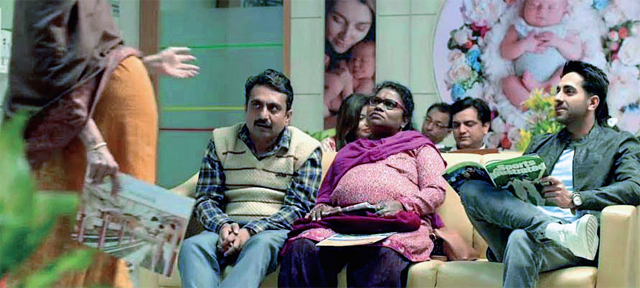
Ayushmann Khurana in a still from Badhaai Ho

The believable affection between the two is used to charming comic effect through the film — during the shadi song sequence ‘Sajan Bade Senti’, for instance, when Jeetender tries to get closer to Priyamvada within the space of a big family photo. Later, when he compliments her, she seems secretly pleased but tells him off because it’s his “saying this sort of thing that has put us in this mess”.


More interestingly, though, the film takes a very warm view of the joint family, where privacy and politeness might be missing, but bonds are strong enough to create acceptance, even in the face of declared social norms. It is clear where Sharma wants to go when he pits the Kaushiks’ cramped Lodhi Colony life against the cavernous bungalow inhabited by Renee’s single mother. There's a neat reversal of assumptions about social class and liberal openness: Sheeba Chaddha as Renee’s mother emerges as more judgemental —and less likeable — than Priyamvada.


From the fading mehendi to the sindoor in her broadened hair parting, Gupta makes Priyamvada layered and utterly real. Priyamvada is not a character one would call feisty, but there is a clear line between what she takes as her duties — e.g. listening to her mother-in-law (Surekha Sikri) — and what she takes as her due, e.g. the right not to have an abortion. There is also a way in which the film extends her maternal role from the familiar mode of asking after physical well-being (“Khana khaya tune?”) to inquiring, gently but firmly, after her children’s emotional health. The mother who can teach her son when to apologise in a relationship is a truly significant mentor in a world where so many men seem to grow up ill-equipped for emotional labour.

Badhaai Ho appears on our screens in a time when the opposition to court-approved entry of women into the Sabarimala Temple has brought women’s menstruating bodies onto our front pages. Given that powerful women like Smriti Irani still see fit to body-shame their own gender for a perfectly natural biological function, Neena Gupta’s smiling, quiet defence of her character’s ageing, but still sexual, pregnant body seems particularly valuable.

The family,
Badhaai Ho implies, can be a space of socialising for young men, a place to learn what female experience is like, through empathy with sisters and mothers and grandmothers, through simple things like learning that periods happen, or how to hold a baby. Its vision of joint family may be rose-tinted, but in these divided times it is a pleasure to watch proximity create acceptance, not its opposite.

Published in Mumbai Mirror, 30 Oct 2018.


60 years of RK Narayan’s The Guide: A tale ahead of its time

My piece for the Hindustan Times:

Sixty years ago, RK Narayan published his remarkable novel, The Guide. The celebrated screen version is known for its unconventional heroine, but she is nowhere as radical as the book’s Rosie; the hero too is more Dev Anand than he is Raju Guide


In her 2014 book-length interview with Waheeda Rehman, the journalist Nasreen Munni Kabir asked the actress which of her characters was closest to her real self. “I think I am most like Rosie,” said Rehman. As every Hindi film fan probably knows, Rehman was referring to the remarkable role she played in the 1965 classic Guide. By the standards of popular Hindi cinema, Rosie was triply unusual: a woman who walks out of an unhappy marriage, begins a romantic relationship with a man who isn’t her husband, and simultaneously embarks on a successful career as a dancer. She would be an unusual Hindi film heroine even today.
But the Rosie who made it to the Hindi film screen was nowhere near as radical as the original Rosie – the Rosie created by RK Narayan, in his novel The Guide, published 60 years ago in 1958.
Narayan was already an established author when he wrote The Guide. It was his thirteenth book and eighth novel. Like all Narayan’s novels, beginning with the delightful Swami and Friends in 1935, it unfolded in Malgudi, the sleepy South Indian town that Narayan had dreamt up as a setting for his fiction. The book’s protagonist, Raju, grows up on the town’s periphery, the son of a small shopkeeper who makes a living selling tobacco, paan and peppermints to peasants and bullock-cart drivers. Then the railway station is built opposite, and Raju’s father gets a shop there. Young Raju stops going to school to run the station shop.
“I began to be called Railway Raju. Perfect strangers, having heard of my name, began to ask for me when their train arrived,” writes Narayan. This is neither an evil man, nor a particularly good one, only a man who accepts the opportunities that come to him. People ask him questions, and he can never bring himself to say, “I don’t know.” His flaws are simply the flip side of his talents. From being the go-to man at the station, it takes but a step to become a guide to the sights – and as Narayan gently suggests, just one more to become a guide to the spirit.

Raju’s childhood and youth don’t appear in the film. Part of the reason lay in popular cinema’s need to be larger than life. All the small town specificity of Malgudi was erased. The station with its “noon train from Madras and the evening one from Trichy”, the crumbling caves with their unstudied rock paintings, the nearby Mempi Hills topped by a glass-fronted bungalow from which wild game could be observed (a location in which much of the book’s romance unfolds) – these were replaced by a tableaux of pan-Indian locations from Udaipur to Elephanta.
But it wasn’t only the locations, the scale and the general tenor that shifted from page to screen. It was the characters themselves. And yet, in his 2007 autobiography, when Anand describes first reading The Guide, he thought Raju so “extraordinary” that he immediately decided this was the story he wanted for his international collaboration.
So what happened? What was so special about Rosie and Raju as Narayan imagined them, and why did they have to change so much on screen? Reading the book, I had an epiphany: Raju’s life encompasses the four normative stages of Hindu life, varnashrama dharma – but in adulterated form. For Raju, brahmacharya, the student stage, unfolds not in school but on the street. He embarks on grihastha, the householder stage, with another man’s wife. His ‘vanaprastha’, the departure to the forest, is forced upon him by prison – and then, by a series of misunderstandings, he finds himself propelled towards moksha, salvation. It is a remarkable structure, of a piece with Narayan’s view of the world: thoughtful, even philosophical, but underpinned by a sense of the human comedy.
Narayan’s character had chutzpah, but he had his awkward moments. But the film was a star vehicle for Dev Anand, and its hero had to be more Dev Anand than Raju. So Anand’s Raju Guide has no self-doubt. He is never worried about the hairiness of his chest. He never wonders if he could be bold enough to woo Rosie. It is in relation to Rosie that he is most transformed – because Rosie herself has changed.
Narayan’s Rosie is no sophisticate, but her ambition is never in doubt. Nor is the carnality of Raju’s interest in her, or her reciprocation of it. The novel has none of the high-mindedness that Hindi cinema forced upon its heroes and heroines, so Raju can tell us the truth: he is attracted to Rosie; his support of her dance begins because it is the clue to her affections.
“I told her at the first opportunity what a great dancer she was and how she fostered our cultural traditions, and it pleased her... Anyone likes to hear flattering sentiments, and more than others, I suppose, dancers.” And later, “Her art and her husband could not find a place in her thoughts at the same time; one drove the other out.”
The book’s Rosie is full of plans; Raju need only support them. But Vijay Anand’s film, keenly aware of his conservative audience, turns his Rosie into a bundle of nerves who tries three times to commit suicide, only to be saved each time by Raju, and berated: “Tumhari haalat aaj yeh isliye hai ki tumne apni haalat se baghaavat karna nahi seekha.
Yet in order for Waheeda’s Rosie to leave her husband without being judged, the boring archaeologist of Narayan’s book has to become unmitigatedly evil. So the film’s Marco is callous as well as impotent, while also mysteriously managing to frequent sex workers. And even after she leaves Marco, Waheeda is shown studiously maintaining a separate bedroom from Raju. Romance was allowed, but sex could not be suggested until marriage. And despite exhorting women to envisage a life without marriage (“Aadmi ghar nahi basaata toh kya ghar basaane ka koi aur tareeka nahi?” Raju once yells at Rosie), the cinematic Rosie’s first impulse when asked to marry Raju is to offer to give up her growing career.
The other sociological element that makes both book and film fascinating is that Rosie is a devadasi by birth, and her reclaiming of dance in a new secular public form formed a fictional counterpart to the actual national reclaiming of Bharatnatyam. Here, too, the film has Marco insult dance, while Raju delivers a lecture on how artists are no longer bhaands.

At one level, the film externalises what is immanent in the book into explicitly pro-woman and anti-caste messaging. But unlike in the book, its agent has to be Raju. Sixty years after she was created, perhaps it is time for Narayan’s original Rosie to rise from the ashes.
Published in Hindustan Times, 28 Oct 2018.

Note: A previous piece on how The Guide came to be put on screen, and why RK Narayan was not happy.

27 October 2018

A Star Implodes

My Mirror column:

The newest version of A Star is Born updates the classic to our times — but its central narrative remains, more than ever, that of a man destroying himself.


Remakes are fascinating things, so long as you aren’t profoundly attached to the original. The first two versions of A Star is Born (1937 and 1954) revealed the underbelly of the Hollywood studio system, while the 1976 film and the newest one are set in the music industry.

Other differences abound. The pioneering grandmother figure who provided the 1937 heroine both inspiration and monetary backing, for instance, vanished from the 1954 and 1976 films, only to be reworked in the 2018 version into the heroine’s proud father — a chauffeur who talks of how he could have been a bigger crooner than Frank Sinatra.

But characters and setting apart, the new film directed by Bradley Cooper (and starring Cooper and Lady Gaga) retains the narrative core of the previous three iterations — a legendary male artiste with addiction issues discovers and helps promote a younger woman, only to find his career collapsing as hers begins to soar.

There’s something inescapably gendered about both parts of this premise. First, the supremely talented young woman who needs the older male star to tell her she’s good before she can even begin to see herself as an artist of any worth. And second, the man’s inability to deal with the fact of his romantic partner’s success, leading to jealousy and depression and growing substance abuse, ending in tragedy. Given that the first film was made over 80 years ago, it seems striking that this dual narrative — of female empowerment by a man and of the man’s consequent decline in the face of that empowerment — has stayed so substantially the same.

I
t isn’t, of course, that there have been no shifts in the dynamic. The 1937 Esther Blodgett first catches the 1937 Norman Maine’s eye based on her looks, not her talent. This despite the fact that their meeting is part of a scene that’s one of the only times we actually see Janet Gaynor’s Esther ‘act’: as a waitress at a big Hollywood party, she does slightly exaggerated comic imitations of various stars while serving hors d'oeuvres. But Fredric March’s Norman Maine begins a flirtation and decides she is star material without even having seen her do that little act.

By 1954, things are a little less shallow: James Mason’s version of Norman Maine starts flirting with Judy Garland’s Esther Blodgett after she has rescued him from a public drunken spectacle, and only pronounces on her talent after having heard her sing in the small band of which she is a part. In the 2018 film, real-life musical star Lady Gaga puts in an incandescent performance as Ally, a waitress who often performs among friends in a drag bar, but has never had the confidence to sing her own lyrics in public until literally dragged on stage by rockstar Jackson Maine (Cooper), who has secretly done an arrangement for a song she sang for him in private.


Many other parts of the romantic connection between the two protagonists have remained constant through all four films. For instance, the male star’s attraction to the younger heroine is expressed at least partly in assuring her that she is fine the way she is, and that her hair or face or nose doesn’t need to be altered in order to make her marketably attractive. That stress on Esther/Ally’s ‘naturalness’ is part of the vision of her character as ‘unspoilt’, a study in contrast to the artifice that is presented as the norm within the entertainment industry. Allied to this is the whirlwind romance, with the desire for a secret elopement and a quiet wedding coming up against the business interests that would benefit from making the star couple’s lives a media event, rather than letting them live out their fantasy of everyday domesticity.

But what seems to me particularly interesting about the heroine’s ‘unspoilt’ status is the way in which her freshness and her outsider status become ways in which the man seeks to rejuvenate himself. In the 1937 and 1954 films, that sense of rejuvenation is only personal, not professional: Norman Maine does not actually seek to recharge his actorly creativity by working with Esther. In 2018, though, Ally’s first appearance on stage is with Jack, and the video of their performance goes viral — making her instantly famous, but also giving him a new lease of life.
At many levels, Cooper’s 2018 hero is more sympathetic than the previous versions. Unlike in the 1937 and 1954 films, for example, Maine's drunken appearance at his partner’s award ceremony does not actually involve him snatching her microphone and taking over her acceptance speech to make a derisive or depressed one of his own. Male entitlement is not quite as vocal as it used to be. But the embarrassment Cooper’s character makes of himself is as bad, made worse by today's digital amplification. Also, his nasty jealous rage expresses itself in private, couched as accusations of selling out creatively.


It as if the more deeply intertwined their creative lives are, the more he actually draws artistic validation from her, the more sophisticated his competitive equation with her becomes. Somehow even the reconstructed man is still making it all about himself.


Published in Mumbai Mirror, 21 Oct 2018.