30 March 2014

Picture This: Living life Queen-size

My BLink column from yesterday:

I can’t quite pinpoint when Queen won me over. Was it the superb dadi, whose enthusiasm for her granddaughter’s wedding is focused on rehearsing her own dance steps? Was it the flashback when Vijay woos Rani, literally encircling her on his bike, overwhelming her with balloons and winsome PJs: “Manchow, Man jao?” Or was it when the now-jilted Rani, having courageously gone on her ‘honeymoon’ by herself, accosts the impossibly long-legged Lisa Haydon with that memorable expression I’ve never heard in a film before: “Aapka bachcha hai? Phir toh bahut hi figure maintain kiya hai aapne!
But almost everything else about Queen feels like something you’ve seen before. So what’s the big deal?
Sure, Vikas Bahl’s foreign vacation is thankfully not the tourist brochure of Zindagi Na Milegi Dobara, and we’ve finally moved away from the all-boys-trip narrative inaugurated by Dil Chahta Hai. But the Indian woman transformed by going abroad is not new: she appeared in English Vinglish (2012). In fact, Kangana Ranaut’s sheltered Rani often feels like a younger version of Sridevi’s unworldly Shashi: the halting English, the under-confidence that comes from never having done anything alone, the lack of exposure that makes everything in the Western city a potential culture shock, and yet the innate warmth that enables both women to make friends with a motley international crew.
We’ve also seen another outwardly demure young woman travel halfway across the world with a tiny bhagwan ki murti like Rani does: Diana Penty in Cocktail. And even the friendship that develops between Ranaut and Lisa Haydon’s Vijaylakshmi has much in common with the one between Penty’s Meera and Deepika Padukone’s Veronica. In Queen too, the ‘good girl’ and the ‘wild child’ forge an unlikely connection, though here the equation is tilted much more towards the liberation of Rani. Unlike Veronica, the part-Indian Vijaylakshmi expresses no desire for stability or roots. The difference has received applause from expected quarters. But if it’s Rani who seems the one transformed, it’s because this film is her journey. She’s the one to try new things: drinking, dancing, but also finding her way around a new city — and in one memorable scene, kissing a man she will probably never see again.
The drunken woman in Hindi cinema up until the ’70s had to be the vamp, like Bindu in the brilliant disco-lights original of Queen’s now iconic remix. ‘Maine hothon se lagaayi toh... hungama ho gaya,’ complains Bindu before she’s dragged off by Sanjeev Kumar. Ranaut doesn’t inaugurate the era of the tipsy heroine by any means — Deepika Padukone first caught my eye by being believably drunk in Love Aaj Kal and later, Cocktail, and Mallika Sherawat’s drunken sprees in Pyaar Ke Side Effects and Ugly Aur Pagli are legend. But Queen goes further. The “yaar” who gets our girl drunk, helping her up on the bar counter with an affectionate push on the behind, is now the female friend. And where the original lyrics had one hichki causing a hungama, Queen runs with that thought and turns it into a magnificent tribute to indelicacy as a gendered form of freedom. As Rani’s drunken truth goes: “In India, girls aren’t allowed to burp. Girls aren’t allowed to do anything.”
Even more importantly, Rani’s opening up to the universe involves not just herself, but other people. Unlike the boys of DCH or ZNMD, for whom travel seems merely a way to bond with old friends, the girls — Rani, like Shashi in English Vinglish — actually make new ones. Director Vikas Bahl deals a gently ironic hand here: Rani’s fiance Vijay (the stellar Rajkummar Rao, channelling his Love Sex aur Dhokha avatar) calls off the shaadi saying he’s changed and she hasn’t. It turns out, for all his having lived in London and ‘seen the world’, it’s Vijay who clings to fixed notions of what ‘foreigners’ are like — while Rani, with what starts as naiveté but turns into conviction, suspends judgement enough to forge connections.
The other overly familiar aspect of Queen is its Dilli punjabiyat. It’s now an industry conceit that everyone knows Lajpat Nagar, Karol Bagh or Rajouri Garden, just as we ‘knew’ Bandra or Virar. The cinematic journey from Oye Lucky Lucky Oye (2008) to Band Baaja Baaraat (2010) to Queen might even trace a shift in self-depiction — from wanting to erase one’s West Delhi roots to claiming Rajouri as home even in a foreign country. But is Bollywood just milking Dilli punjabiyat for laughs? If Vicky Donor (2012) and Do Dooni Chaar (2010) displayed some insider affection for Lajpat Nagar, Cocktail’s deprecatory references to “wohi Lajpat Nagar mentality” were code for what Boman Irani’s London-dweller ought to have left behind, Rani’s misidentification of sex toys for fashion accessories — “Yeh toh hamare Lajpat Nagar mein mil jayega (We can get this in our Lajpat Nagar)” — is code opaque to her bemused firang companions, but an inside joke for Indian viewers. It’s a wink-wink moment at the expense of the middle-class Punjabi, who is urban but not quite urbane. But Ranaut’s brilliant portrayal of good-natured humour turns the scene from superior and knowing into something goofy and laugh-at-oneself.
Perhaps that, eventually, is the secret of the film’s appeal: like its protagonist, it’s neither sharp nor perfectly sorted, but it’s not pretending to be either. Rani does whatever she does, not with the thin-lipped determination that she must, but with a bumbling enjoyment in the discovery that she can. What makes Queen endearing is precisely this lightness, this refusal to underline. When she returns from her solo ‘honeymoon’, Rani is still unselfconsciously carrying a backpack marked ‘Vijay’. But the weight of it has rolled unceremoniously off her back — leaving in its wake a young woman’s first, quiet victory.
x

27 March 2014

Post Facto - Why I love Holi: Ritual excess and the joys of reversal

My Sunday Guardian column for March 2013 (and I disclaim the print headline):

I've been a believer in Holi as long as I can remember. Actually, no, I do have one hazy six-year-old memory that would count as anti-Holi: a couple of Defence Colony uncles perched in and on a car, their deep purple and shiny green avatars just slightly less benign than their regular selves. But even then, I don't remember being terrified; only guarded. After that, I spent several Holis in Calcutta. Family formed the core of the celebrations, with close friends of either my parents or my aunt and uncle often being added to the mix. At 10, I was already the bespectacled child with my nose buried in a book. But Holi seemed to bring out all my latent energy: I remember running up and down pretty much all day, armed with one of the grandparental household's old brass pichkaris — a solid, effective weapon, and heavy, too: not one of these childish plastic playthings that get trashed each year. Once I played Holi at my best friend's house, with her cousins and aunts and uncles, and the faux-family ties cemented that day still feel like something, even if the friend and I are no longer close.

Back in Delhi as an adolescent, I discovered the delicious frisson that only Holi offered — water made everyone frisky, and putting colour on people involved actually touching them. I remember crushing on a classmate's elder brother with the perfect filmi Holi persona — colour-spattered white kurta, stubble and beautiful singing voice. His colours, I decided, were reserved for me. The secret love I nursed for a boy could be publicly expressed with gulaal. The festive flirtation could be conducted openly, in front of family and friends, and yet remain unseen. Holi offered other unusual liberties: if you had a colony/building gang, you could roam from house to house all day without parental censure — not something girls often did.

It was years later, reading about carnival in a cultural anthropology class, that I began to recognise Holi in it. A ritual feature of pre-modern European popular culture, carnival at its widest involved feasting and communal drinking, dancing and music and open-air amusements, comic verbal competitions and farces that often enshrined the low forms of folk humour. The Soviet-era theorist Mikhail Bakhtin used the Renaissance writings of Rabelais to think about carnival as an analytic. The excesses of carnival offered liberation from the utilitarian norms that governed agricultural society. Humdrum, everyday time was suspended, everyday hierarchies reversed. Joining the carnival throng, often with the anonymity of masquerade, allowed people freedom from the strictures of being themselves. The profane self, released from work, social rules, or moral boundaries, was given free rein — eating and drinking and sex and laughter — and all this as part of a collective body.

I had to wait many years to experience the adult equivalent of that childhood sense of collectivity, of licensed upheaval, of owning a neighbourhood — and it came via the JNU Holi. Delhi University, where I studied, never gave its women a campus that felt truly free, overrun as it is by the male-dominated street culture of Delhi. In JNU, on the other hand, the practices of Holi, like most things, manage to feel entirely rooted (dare I say 'traditional'?) while actually being quite particular to this unique post-independence campus. So bhaang-filled thandai, unmatchable intoxicant traditionally drunk on Holi across North India, features crucially in the JNU festivities too. But here each hostel mess actually produces a batch, and the re-filled mineral water bottles that circulate across campus often come with the implicit suggestion of which hostel's thandai is better. The night before Holi is devoted to a weird and wonderful contest for the title of Chaat Samraat. "Chaat" (lit: "to lick") is slang for someone who talks on and on, until you're bored to tears. He who is crowned the Emperor of Chaat is placed on a donkey and led on a procession around campus.

Last week, I read a 1966 essay about Holi in Braj, the only anthropological treatment of Holi I've read. McKim Marriott spends his first Holi in Kishangarh befuddled — both by bhaang and by what seems like pandemonium. By his second Holi, everything seems to fall into "an extraordinarily regular social ordering. But this was an order precisely inverse to the social and ritual principles of routine life." The women beat up the men. Lower caste women are the most avid beaters, and the wealthier Brahmin and Jat farmers their chosen targets. A "burlesque dirge" is sung for an unpopular "very much alive moneylender"; the 'King of the Holi' put backwards on the donkey is a famous high-caste bully (the implications for Chaat Samraat are interesting!). Holi functions, in brief, as a carnivalesque rite of reversal.

A very preliminary speculation, but it seems to me that whether Holi works or doesn't work depends on whether it enables a reversal of hierarchies, or simply reinforces the dominant power equations. In the North Indian city, it is certainly not men who need ritual license — and if Holi seems to give them that, it will feel wrong. My Holis, from childhood onwards, have always enabled rather than disabled, letting me embrace the bodily excesses of carnival; do things I might not have done otherwise. Of course, there is no reason why you should need a festival to free you — but for all the other creatures of ritual out there, Holi is waiting for you to claim it for yourself.


Published in the Sunday Guardian.

7 March 2014

Post Facto - Beauty is the beast

My Sunday Guardian column for March 1st:

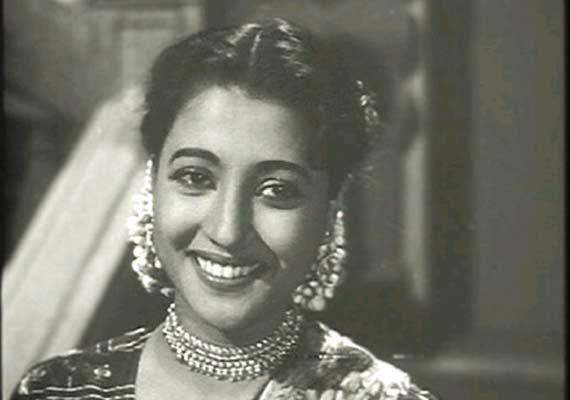
Suchitra Sen
In a sketch that's part of the Tadpole Repertory's superb play Taramandal, a nervous young woman arrives at the office of a Bollywood agent. She nods when asked if she wants to be a star. But she doesn't speak Hindi — and for the most part of her time on stage, doesn't speak at all. The more he talks, the more terror-stricken she looks. Eventually he suggests, not unkindly, that she sign up as a Junior Artist, commonly known as an extra. "It'll be work. And with your looks, you'll get slotted as A-Class."
The aspiring star is played by a strikingly attractive actor, and to hear that fact referenced in the dialogue — "aapki looks" — seems appropriate, even necessary. It both acknowledges her beauty and dismisses it as not being enough. But is it really not enough, one wonders? And suddenly that idea — that beauty isn't all it takes to become a star — begins to seem a little bit like the wishful thinking oftheatre-wallahs. Because in fact, the film industry seems to declaim from rooftops that beauty is all. Talent, if at all it counts, is secondary.
The young Suchitra Sen — then plain Krishna Dasgupta — apparently once sat on a school bench and announced that she would be remembered long after her death. An ordinary middle class girl who was one of nine siblings, and an average student bereft of any artistic talent, all Sen had was her looks. But apparently, that was enough. "She was conscious of her great beauty... and behaved as if she... deserved every bit of the natural selection," wrote Susmita Dasgupta in a thoughtful Facebook note. At the time, a wealthy groom was the biggest prize a middle class girl could expect for her beauty. Krishna got that, too. But her stardom, says Dasgupta, came about because she believed she was meant for bigger things. Beauty was her claim upon the universe. Hindi film star Juhi Chawla recently described entering the Femina Miss India contest when in college. "I knew I was good," she said, but "there were prettier girls in my class and that always kept me grounded."
Women are constantly being rated on grounds of beauty — and rating ourselves, too. The sad thing is that it isn't just those who aspire to be models or actors, professions that overtly reward bodily perfection, who buy into this hierarchy. Seemingly, it's everyone. And that ingrained sense of superiority or inferiority, based on how you think other people think you look, can coexist with an otherwise well-formed intelligence. I was distressed to hear recently of a bright, high-achieving woman being thrilled that a college reunion still rated her among the hottest girls in her batch.
Men are rated on other things: intelligence, talent, wealth, power. Looks, not so much. That criterion, seemingly, they reserve for us. Off the top of my head, I can think of a boy in high school whose unsolicited rating of three female friends as "cute", "pretty" and "beautiful" I have never forgotten. Another male friend introduced someone a decade after college as "one of the hot girls in college". What's worse is the enshrining of this stuff as popular culture — in university fests, college mags and so on. In St. Stephen's College, premier educational institution of the land, it was long considered a "fun" thing for male students to regularly produce "chick charts" — a list of the top 10 "chicks" in college, based on their physical attributes. In 1984, soon after the pogrom against the Sikh community, they produced a "Sardine" chart — the top 10 female Sikh students rated on their looks. Filmmaker Saba Dewan, then a student there, wrote in 2012 of the uproar that followed, the all-out gender wars in which the authorities sided with the male "pranksters" against women students protesting objectification, who were termed troublemakers. St. Stephen's College in the late 1990s, when I went there, no longer had "chick charts", or at least not public ones. But very similar issues existed, and came to a head around "Miss and Mr Harmony". Ostensibly gender-neutral, it was, in practice, a contest of wit for boys, but looks for girls. The gender wars of my time ended with the entry of women into residence at St. Stephen's, for the first time in its history.
Re-watching Imtiaz Ali's Rockstar the other day, I had a moment of shock. Ali — who went to Hindu College himself — had decided that the best way to introduce his Stephanian heroine to us was to show her topping the chick chart. And the only woman we see respond to it says merely, "Dekhna kya hai? Jab tak yeh St. Stephen's mein hai, yeh hi hogi na No. 1". There it was — a thing so many women had fought so hard to get rid of, shorn of all its history, reinstated as instigator of the beauty myth.
A day after that, a friend said to me she identified with much of the rule-breaking fun that Ali's heroines had, but his actresses were too pretty. "They do what girls want, but they look like what boys want." Ah, no surprise there.

4 March 2014

Picture This: A Long Shot on Delhi

Householders and house-owners in 1963 Delhi. My BLink column from last Saturday:
A still from Tere Ghar ke Saamne
Growing up, I often wondered what it was like to see Hindi films as a Bombay person. To have roads and landmarks you knew be part of an on-screen iconography seemed immeasurably glamorous. So I’ve enjoyed watching my own city, Delhi, begin to find its place in the cinematic sun. Sure, the road to filmi fashionableness has been paved with the tediously same-old Old Delhis and distressingly prettified college campuses. But there have also been gems like Do Dooni CharVicky Donor and Band Baaja Baraat, and at the top of the heap, Dibakar Banerjee’s Khosla ka Ghosla and Oye Lucky Lucky Oye.
Delhi in film is a subject for a much longer piece. Recently, though, I watched two Delhi films from long before they became a vogue — and was struck by how their Delhis of half a century ago still resonate today. Merchant-Ivory’s The Householder and Vijay Anand’s Tere Ghar ke Saamne, both released in 1963, and are preoccupied with homes. But how differently!
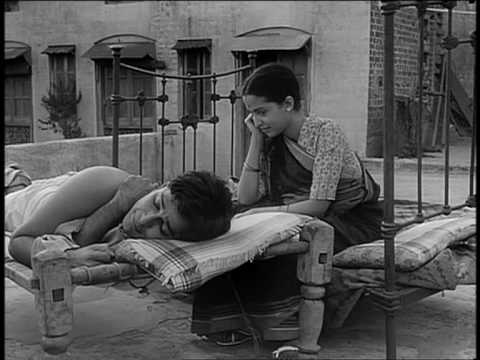
The Householder opens with a glorious long shot: an Old Delhi terrace, smoke rising from somewhere, the sound of the azaan emanating from the striped dome of the Ghata Masjid. Cut to a close-up of the two figures: Prem (Shashi Kapoor), asleep on a charpai, is gently woken by his pert-nosed young wife Indu (Leela Naidu). This is a world in which the prospect of attending a wedding in Mehrauli makes Indu sit up. “We will sit in a bus and go,” she says with childlike joy, before her brow furrows in contemplation of which of her two good saris she will wear. Prem is a lecturer at a small college, and much of the film — based on Ruth Prawer Jhabvala’s novel — revolves around his anxieties about making a living.
A still from The Householder
The dialogue dwells continually on money, the naming of sums echoing the way Prem must count every rupee. His monthly salary is ₹180, his rent ₹60 and repairing the ceiling fan will cost a princely ₹10. Eventually Prem gathers the courage to appeal for a raise, but he is shooed away by his principal’s shrewish wife. When he begs his landlord (Pinchoo Kapoor) to reduce his rent, the alcoholic Sehgal reads his petition, only to break into a bizarre drunken soliloquy. “The cost of living has gone up terribly. Sixty rupees for a bottle of whiskey!” And as poor baffled Prem looks on, Sehgal continues as if in a trance: “Sugar one rupee a seer, rice one for a seer, oranges three rupees a dozen, apples four rupees a pound...”
Tere Ghar ke Saamne talks money, too. And if Sehgal’s spending the whole of Prem’s rent on a bottle of Vat 69 seemed ironic, TGKS evokes a world even farther from the lowly lecturer’s. The film opens at a government auction for “Dehli ki behtereen locality ka behtareen plot”. Lala Jagannath (Om Prakash) outbids Seth Karamchand (Harindranath Chattopadhyay) on a highly valued front-wala plot. But the pugnacious Karamchand, not to be outdone, returns to bid the same amount on the lesser-valued back plot. As he announces to his appalled wife, “Shaan bhi koi cheez hoti hai (there is such a thing as grandeur).”
The level of irrationality is as high as the stakes. When Dev Anand (playing the foreign-returned architect Rakesh) asks about the adjoining plot, Nutan (playing Karamchand’s daughter Sulekha) wrinkles her nose in disgust. “Don’t talk about that.” “But why?” “Because it’s cheaper than ours. Theirs is two lakh, and ours two lakh one thousand!”
Yet Tere Ghar ke Saamne was one of 1963’s biggest hits, its effervescent comedy of manners and still memorable songs making it the year’s sixth highest grossing Hindi film. And The Householder, despite its affecting subject, flawless photography by Subrata Mitra (Satyajit Ray’s longtime collaborator) and a final cut apparently by Ray himself, never transcends its stilted characters and caricatured subplots. And it doesn’t help that everyone speaks in English, with no attention to inflections of class.
The Householder, even at its best, has a stodgy, one-note quality. TGKS seems to invite multiple readings. When Prem and Indu get off their bus amidst the ruins of Mehrauli, Prem remarks with pleasure on how quiet it is. But it is only an instant before his brain begins to count paisas again: “I’m sure rents are low (here). It would be economical for us.” Meanwhile, when Rakesh and Sulekha in Tere Ghar ke Saamne whiz past the same Mehrauli ruins in a car, they arrive in a village home. Rakesh offers to pay for the home-cooked meal, the old woman refuses. It’s a cue for him to applaud the non-money-mindedness of the poor as against the unprincipled avarice of the rich — before leaving money “for the oil that burns in the diya she lights for God”. The possibility of cloyingness is averted a minute later, when Sulekha rejects his proposal and a miffed Rakesh declares he will be waiting for the ₹5 he’s just spent on her roti — the money-mindedness of the rich has just been brilliantly, ever-so-lightly underlined.
The song-less film whose characters reminisce about watching Hindi films is the one that got reviewed in the New York Times. The mainstream hit was seen as mere fluff. But somehow the film about elite houseowners tells us more things about ourselves than the one about the sad householder.

28 February 2014

The Last Renaissance Man: The Reinvention of Pradip Krishen

Pradip Krishen's fascinating journey from academia to film, from film to forest. And desert. 

From my long profile in the February issue of The Caravan.


Pradip Krishen in his study. (Photograph by Arati Kumar-Rao. See the whole set here.)

IT WAS A LITTLE PAST 5 AM as we drove out from Jaisalmer into the alternately sandy and rocky terrain of the Desert National Park, a 3,162 square-kilometre swathe of the Thar Desert in western Rajasthan. We were heading specifically for a large dune that goes by the evocative name of Gaja Matha—“elephant head”. For the first time in four days, Pradip Krishen reserved the front seat of the Innova for himself. He had to direct the driver, he said, and proceeded to do so silently, with several elegant turns of the wrist. Just as the driver began to enjoy speeding through the smoky pre-dawn darkness, Krishen uttered a gentle but firm injunction: “Thoda haule le lo, chinkara vagairah aa jaate hain” (Take it slow, there might be chinkaras). Reluctantly, the driver decelerated, lulling the other four still-drowsy passengers back into a potential return to slumber. Krishen, though, remained thoroughly awake. Within minutes, he brought us to a stop with a quiet exclamation: “Was that a hedgehog?”

We drove back a few hundred metres. Sure enough, there was a sad, not-very-spiny ball of quills, rolled up in the middle of the road. Krishen and the rest of us got out for a look: Mithva, Krishen’s younger daughter, accompanying her father into the desert for the first time; Arati Kumar-Rao, a freelance photojournalist working with Krishen; Nishikant Jadhav, a retired Indian Forest Service officer whom Krishen affectionately calls his “Tree Guru”; and myself.

“He’ll go to hedgehog heaven,” said Mithva, as tender an animal-lover as her father.
“The great insectivore hunting ground in the sky,” said Krishen.
“The insects are already here,” Kumar-Rao said. 

It was a strangely affecting sight: the thin, sticky trickle of blood, and the insects lining up to devour the creature who would once have devoured them.

Back in the car, Krishen and Kumar-Rao described how long it had taken them to arrive at the Rajasthani name—just the name—for the specific habitat we were driving out to see. The sandy desert is self-mulching: a top layer of dry sand protects a lower layer of wet sand, providing enough moisture for plants to grow and a whole ecosystem to emerge, creating what might be called the “jungle of the desert”. Krishen and Kumar-Rao spent many trips asking local people what they called these sorts of areas with vegetation. They received answers ranging from the banal and slightly baffled—“registan?” (desert?)—to place-names, like Gaja Matha. Between themselves, they had begun to refer to it as the “SBK habitat”, using an acronym derived from the three plant species most commonly found in the sandy Thar: a spidery herb called seeniobui, or desert cotton; and a large thin-stemmed bush called kheemp. The coinage had almost stuck when a 19th-century reference—James Tod’s two-volume classic Annals and Antiquities of Rajasthan—finally gave them the term they were looking for: roee. Suddenly, the word was everywhere they looked. “Yes, going into the roee means going into the jungle,” our Jaisalmer hotel owner affirmed. “Hmm. You never mentioned it when I asked last year,” Krishen said, slightly disgruntled. That persistent trial-and-error approach to research—eclectic reading plus the pursuit of local knowledge, all the while also devising his own ordering system—exemplifies Krishen’s work.

In the Innova headed toward the roee, we grew collectively still, arrested by the grandeur of dawn breaking over the desert. Krishen’s voice interrupted my own reverie. “When you’re shooting a film,” he said, “there’s a moment at dawn that’s ephemeral. And if you have two or three dawn shots, you need to get matching dawns—a cloudy dawn can’t be followed by a clear one. But the classic is what we used to call RFD, Rosy-Fingered Dawn. Which, of course, is from the Odyssey …”

Like all good storytellers, Krishen is adept at using little sparks from his past to illuminate the present. Once at work, however, that leisurely digressiveness is replaced by a sharper focus. On each pre-dawn trip, we walked the dunes for hours, with Krishen, Kumar-Rao and Jadhav stopping to look at—and photograph—not just lizards and birds and gerbils, not just big trees and shrubs, but also the most minuscule grasses. They knelt, they hunched, they lay flat on the ground to examine everything from the roots of a shrub where a lizard had taken up residence, to the fuzz growing on an old cowpat. There was great passion here, an exhilaration and intensity difficult to describe. Yet there was also an immense sense of calm, an immersion in the present that took the form of an unhurried attention to landscape.

Barren expanses, which the locals called thal, were interspersed with the roee—stretches of vegetation that, even to my untrained eye, transformed the desert from a dry nothingness into a world secretly throbbing with life. Krishen was mostly happy for us to tramp along peacefully as he pointed out the flatter plains, or pediments, that are the oldest parts of the desert, and educated me about common plants like the khejri (“this is where you get the sangri from”). But in an instant his voice would drop to a hush, and everyone would suddenly start whispering dramatically: “Egyptian! Egyptian!” A sighting, as it turned out, of a raptor called the Egyptian vulture.

                                                                                     ***


AN UNFAILING SPOTTER OF SPECIES, Pradip Krishen is a bit of a species unto himself. A highly regarded naturalist and ecological gardener, he is the author of Trees of Delhi (2006), one of India’s most popular books on an ecological subject, and he has just published another—an equally exhaustive yet supremely readable guide to the Jungle Trees of Central India. In an earlier life, Krishen was a highly regarded filmmaker. He directed Massey Sahib (1985), In Which Annie Gives It Those Ones (1989) and Electric Moon (1992)—all, to different degrees, cult films for a generation of writers, directors and discerning movie-goers.

After Electric Moon, however, Krishen stopped making films and went into a hibernation of sorts. When he re-emerged into the public eye after a little over a decade, it turned out that he had spent much of that time teaching himself about trees. Almost simultaneously, he had been teaching others: leading walks into Delhi’s wooded tracts, helping protect the heritage environs of the city’s Sunder Nursery from being cloven by a flyover, and trying to create a microhabitat there. Krishen’s explorations extended into Rishikesh, with a “Wildflowers in the Rain” walk at a friend’s resort, and to Pachmarhi, in Madhya Pradesh.

Krishen’s success remains astounding to most people. “He’s an amateur who outdistances the professionals,” said Amita Baviskar, who has, as a sociologist and activist, long engaged with environmental concerns herself. Krishen has also pretty much invented the shape of the profile he now inhabits. As the documentary filmmaker Sanjay Kak, who started his career working with Krishen, put it: “How many people do we know who are amateur tree biologists and photographers and writers? Essentially, no one.”

                                                                                     ***

IN APRIL 2013, I travelled with Krishen from Delhi to Jodhpur, where his most recent project has unfolded in the shadow of what might be India’s best-preserved medieval fortress: the 15th-century Mehrangarh fort. In 2005, the Mehrangarh Museum Trust (MMT) invited Krishen to “green” the fort’s surrounding area, then an eroded, rocky wasteland dominated by the invasive Mexican species Prosopis juliflora—the mesquite, or vilayati keekar—also known by the rather appropriate local name of baavlia, “the mad one”. “Maybe [the MMT] had in mind something like a garden,” Krishen told me during one of our several interviews, on the road and in Delhi. What they got instead is an ambitious ecological restoration project on a scale unprecedented in India. Krishen has spent the last seven years trying to return the area to what it might have been like five or six centuries ago, before it was inhabited by people—and before the late 1930s, when Maharaja Umaid Singh of Jodhpur, in a well-intentioned bid to provide the subjects of his desert kingdom with a source of greenery, scattered the seeds of Prosopis juliflora across it from an aeroplane. A year before the MMT invited Krishen to Mehrangarh, the trust, which is headed by Jodhpur’s former maharaja, Gaj Singh, asked him to resuscitate a moat filled with old stone rubble at the 12th-century Nagaur Fort, about 138 kilometres north-east of the city. Based on his own research and the guidance of the late Dr MM Bhandari, a botanical doyen of the Thar desert, Krishen sowed a nursery of plants native to the Nagauri desert. “It just flourished,” he said. 


Read the rest of this profile on the Caravan website: here.

27 February 2014

Book Review: All in the Family

My review of Nony Singh's The Archivist for BiblioSee the pdf version, with images, here
The book jacket. (Click on the image to see it larger.)
Nony Singh is not a professional photographer. Born in 1936 in Lahore, she happens to be the mother of one of India's most feted professional photographers, Dayanita Singh. The photographs that have been collected in The Archivist were taken for personal pleasure, either by Nony Singh, or of Singh – or members of her family -- by others. The Archivist is thus an archive of Nony Singh's life. At one level, then, the book's pleasures lie in its closeness to the form in which most middle class people in the twentieth century grew up looking at photographs – the family album. But this is no standard family album. It does contain the expected portraits of sisters, parents, children and husbands – but it is the departures from expectation that give The Archivist its piquant quality.

Singh's wedding, for instance, makes the requisite appearance, but not in the form of the usual shaadi photo, the husband and wife with faces framed in tight close-up. Instead we get a full-length image of the newly wedded couple, taken from an angle, with a scattering of wedding guests seated on the carpeted ground around them. But Singh's face as she stands beside her husband is hidden completely, her head bent under the heavy gota-edged veil of her lehnga. The only part of the young bride not swaddled in yards of heavy fabric are her hands, held up to her chest in a clasping gesture that echoes that of her husband beside her.

The bashful bride of that 1960 picture would perhaps seem less carefully constructed if the book had not placed her next to a photograph from 1961, the year after Singh's marriage. In the second image, Singh looks out at us without the slightest trace of shyness, one insouciant finger in her mouth, having just tasted whatever's just been cooking on the chulha in front of her. There is a relaxed, almost tomboyish air about her, perched sideways on a chair in an open verandah, wearing a loose white kurta-pyjama that one speculates might belong to her husband. Her hair is in a long loose single plait, somewhat rumpled, like her clothes. One dangling foot has escaped the slipper meant for it. A bicycle is parked behind her, and something about the picture's sense of in medias res makes one imagine she might get up any moment and ride off.

Nony Singh's very particular persona – whimsical, playful, sensual – is imprinted upon most images in The Archivist. The book is full of moments of impersonation, of dress-up. The first person to have been subjected to Singh's staging instinct was likely her mother, Mohinder Kaur. The first photo she ever took was of her mother at a 1943 picnic on the way to Koh Murree: a picture of feminine grace, her eyes lowered, her crinkled dupatta draped over her head just so. The other image Nony created of her mother is a stark contrast. In perhaps the most astounding image in the book, Mohinder Kaur is dressed in drag. And not just any drag – with a false moustache and a policeman's baton, she is to play her IPS officer husband.

The easiest person to dress up was, of course, herself. In a series of images from 1951 to 1955, the teenaged Nony poses in different costumes: a khaki uniform with a toothbrush moustache, a full-length white dress befitting of a nun, in a burqa. A decade later, the desire for playacting is transferred to her daughters. Nixi (Dayanita) and Nikita appear in frilly frocks, but also as a Maharashtrian woman, as Sita, Mother Mary, an angel, a gypsy. Sometimes the same costumes and props appear over the course of the years: the jewellery worn by Nixi “as a Kashmiri girl in the wheat fields of her father's farm” (1966) reappears on her sister Nikita a decade later, “as a princess from the Arabian Nights, Modern School, New Delhi.” Sabeena Gadihoke's short biographical piece in the book tells us that the photographer, looking back at the Arabian Nights image, “is satisfied with the 'Arabian' face veil but feels that Nikita's ornaments are distinctly Kashmiri”. Her investment in her daughters is expressed in the imaginative stitching of clothes and in the careful staging with which these images are produced. The photographs are a record of their childhood, but also of Nony's motherhood.

Another persistent inspiration for Singh's images is the cinema. Her sister Rajman poses for her “like a village woman”, her sister Guddie appears as “Sophia Loren in Srinagar”. In one of my favourite pictures, Guddie looks out into the distance: her hands folded in her lap, dupatta slipping off one shoulder. There is a stillness to her and yet a certain yearning restlessness to the image, whose origin becomes clearer when you read Singh's caption: “After secretly watching Gone with the Wind, I asked Guddie to pose as Scarlett O'Hara”. What is remarkable is that unlike so many of the other pictures here, 'posing as Scarlett O'Hara' does not involve dressing up. No pert little bonnet or tight-waisted ball-gown or Mammy-like figure is needed to be Scarlett. It is the feeling that is sought to be emulated – though Guddie's dreamy-eyed gaze into a possible future seems quite different from the childish determination with which Scarlett sets out to shape hers.

That hankering for the cinematic image is something that Gadihoke's essay speaks to when she talks of film magazines as the place where film-goers “learnt to recognize star poses and gestures”. “With three single aunts and four sisters, it was a family dominated by women and they all loved the cinema,” writes Gadihoke. But “Nony's father was strict, and access to magazines and films was restricted.” Similar stories abound in many upper and middle class Indian families: I grew up hearing of how my grandmother and her sisters sneaked out to watch films without telling their disapproving father (and later, my equally disapproving grandfather). Clearly, it was hard for even the sternest disciplinarian to completely keep films out of the home.

The cinema is, in fact, one of the ways in which the rather privileged world of Nony Singh's book – picnics in Koh Murree, holidays in Srinagar, cousins who go to Doon School -- overlaps with the very different India that emerges from another recent book-archive of portrait photographs: Artisan Camera, Chris Pinney's tribute to Suresh Punjabi's 1970s studio photography from the small town of Nagda in Madhya Pradesh. Of course, the largely lower middle class men who come to be photographed in Studio Suhag model themselves on Hindi film heroes – the alcohol-soaked lover, the bidi-smoking gangster, the white-suited, sunglasses-wearing businessman all appear. Nony's cinematic referents, though she tells us she loved Nargis, Meena Kumri, Nimmi, Madhubala and Dilip Kumar, are as often as not from Hollywood – Sophia Loren, Gone With the Wind.

At a more fundamental level, Punjabi's images are of people for whom the constricted, constructed space of the studio was the only photographic space available, while Nony Singh's subjects seem to roam freely through the world, with her camera being allowed into almost intimate moments. Striking among such images are the Kasauli photograph of her sister Rajman, “newly married and in a romantic pose” (balanced rather beautifully on her husband's lap), the image of a male cousin, bare-bodied on a rock in the Lacchiwala river, Dehradun, and the 1979 one of Dayanita looking stunning in “the halter her father had forbidden her to wear, except for the photograph”.

But as always, that assumption of freedom, and of the camera as mere documenter, is too simple. The photograph of Dayanita in the halter is one stark instance of the camera being allowed to see what the rest of the world was not. In two images from 1960 we see Nony herself dressed in a way that perhaps only the camera could be privy to – first in an off-shoulder top and shorts, and then midstream in the same Lacchiwala river, only her bare shoulders visible above the water's surface. In another, from 1955, we see three young women sitting on the branch of a tree, with Nony's caption: “Climbing trees, though great fun, was not meant for girls those days. I asked them to sit on the tree to make an unusual picture.” All these images are real – but their reality is the creation of the camera.

During the making of the book Artisan Camera, Chris Pinney writes, he discovered that most of the original negatives of Suresh Punjabi's full-length photographs contained all the 'noise' of the studio, the part that had been cropped in order to produce the centrally framed human body that was all that was considered to be of interest to the customer, or to Suresh. When Pinney made fresh prints from the negatives, he was thrilled to be able to restore the “silent Brechtian margin” that had been sitting there, “awaiting recovery”. Fascinatingly, Dayanita Singh, describing her adult 'discovery' of her mother's images on the book jacket of The Archivist, describes a very similar process. “Many years later, I had contact sheets made of all her work. I saw how much the lab had cropped off each image. Printed in full frame, they turned out to be stunning images. They were more about the backdrop and the setting, rather than about her children.” Having read these words, one starts to wonder what the angel and gypsy would look like without the other child in fairy wings being led away by the hand in the background, or whether Nixi as Sita would work without the creeper-covered trellis and straw-covered shed behind her. I'm not certain I agree with Dayanita Singh's last claim. To me, Nony Singh's images seem very much about the people in them. But of course, most all, they are about herself.