Showing posts with label Punjabi. Show all posts

26 July 2020

The Reel Life of MS Sathyu - II

My Mirror column (a sequel to last week's piece):

In honour of his 90th birthday earlier this month, a look back at MS Sathyu's under-watched 1994 film Galige, currently streaming online.

At the very start of Garm Hava, Balraj Sahni's Salim Mirza waves goodbye to a train at the station and sits himself down in a horse-drawn cart. The Agra of the 1940s is small enough for the tangawalla to be acquainted with each customer. Who have you dropped off this time, he asks. “My elder sister,” says Mirza, adding a gloomy metaphorical remark about how thriving trees are getting cut down in this wind. Yes, agrees the tangawalla, those who refuse to uproot themselves will dry up. Then he adds a Hafeez Jalandhari couplet, rendered in its most charming street avatar: “Wafaaon ke badle jafa kar riya hai/ Main kya kar riya hun, tu kya kar riya hai?” (I'd translate that as “You torment me in exchange for my loyalty/What am I doing, and what are you doing?”)

What's remarkable is the spectrum of moods that the sequence encompasses. There is the sombre farewell, the meditative remark, the deep sense of living through a eventful time -- and yet all of it is leavened by the comfortable chatter of the everyday, by casual acquaintances who make up one's sense of home, and an ear for humour in the minor key that keeps one from dipping into the doldrums. Galige, which Sathyu directed in 1994, attempts to create the same kind of energy.

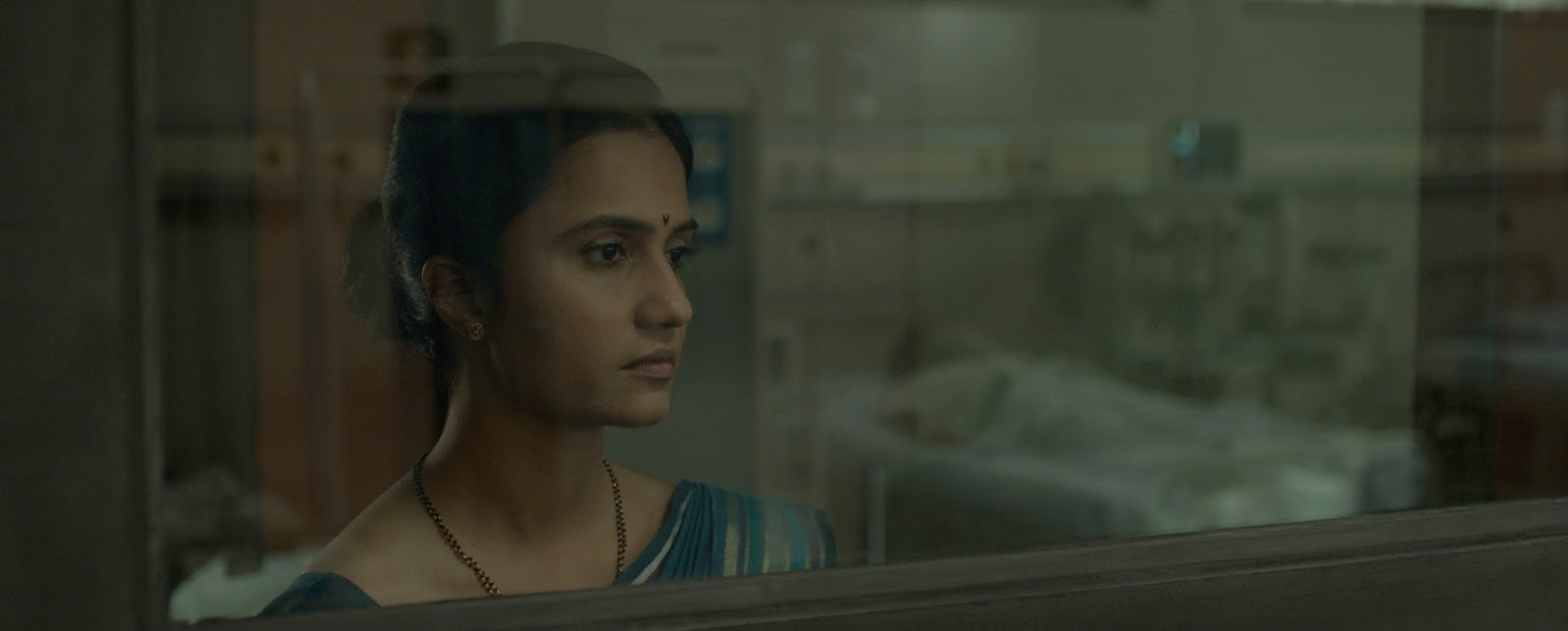
The film has two narrative threads, both with immense potential for melodrama -- but Sathyu staves off all maudlinness. Currently playing in the Indian section of an international film streaming platform, Galige centres around a young Bangalorean woman named Nithya. She lives alone in a rented house and has a job in the HMT factory, riding a two-wheeler to work each day. One day, the orphanage where she was raised calls her. An old couple has arrived from a North Karnataka village to claim her as their long-lost granddaughter.

Now this is a theme that doesn't just animate popular cinema in India, it forms the matrix for it: the family separated by a calamity and reunited at the end, the pauper who is really a prince, the enemies who are really biological brothers. Whether as the basis of a comedy of errors (think of every single double role film you know), or the underlying theme of the family melodrama from Waqt to Trishul, or even when ostensibly subjected to questioning by the plot -- as in Awara's nature vs. nurture debate, or Yash Chopra's unsuccessful but fascinating Dharamputra, in which a Muslim orphan grows up to be a Hindu fundamentalist, blood ties are assumed to be the ties that bind.

But unlike the hundreds of film orphans we have all grown up on, Nithya does not hanker for a family. She is guarded, unsure if she wants to be co-opted into an identity she has thus far escaped. The orphanage manager's reminder that she was brought in by a fakir, on the other hand, makes the wannabe grandmother baulk: what if she's actually a Muslim? They part company – but on her way back home, Nithya feels bad for the stranded old couple and decides to invite them to stay with her for a while.

A still from Galige (1994)

What Sathyu does is quietly subversive at many levels. By making the young female character financially independent, and the old couple needier than her, he shows how easily existing power equations of age and gender can be reversed. The 'family' becomes something chosen, contingent on mutual desire and supportiveness, rather than a unquestionable given. Within this new space of equivalence, the young woman makes her own decisions, refusing to kowtow to either neighbourly gossip or 'grandparental' interference. She looks out for the old people, and enjoys their companionship, but feels no obligation to live by their rules. The old couple, for their part, learn that their opinions are simply that – their opinions.

Galige's other subplot is even more surprising – the Khalistan movement, and the fate of a reformed terrorist. Girl does meet boy, even in an MS Sathyu film, and Nithya meets hers in a thoroughly charming Antakshari scene on a train. As a girl without a family, she is perfectly comfortable with a boy without a past. And by bringing a Punjabi boy into a relationship with a local girl, of course, Sathyu plays on Bangalore's insider-outsider tensions. In the film, though, the locals' suspicions turn out to have some basis in fact – not all unknown pasts are equally benign.

There are many other moments when the film touches on the question of identity – Nithya's Japanese boss at the HMT factory, the Sikh dhaba owner or the play within the film where Ekalavya's birth becomes the cause of his tragic fate, while Guru Dronacharya shifts all blame onto him: “How can you hold me responsible for your low birth?” In an early aside, the film's resident commentator, one Narhari, asks the rhetorical question: “Do we lack temples, mosques, churches, gurdwara here? Must slap Urban Ceiling on gods – only so many temples per god.” Nithya herself speaks often of not needing to have a religion, of being free to believe in people.

All the threads of Galige don't necessarily come together. The music can feel tacked-on, as can some of the attempts at comedy, and the Punjab segment has the rushed quality of nightmare. The film's uneven tapestry benefits from being woven of low-intensity conversations, like the Bangalore in which it unfolds. In one lovely odd little moment, a drunken Narhari sings a Kannada song by the poet Rajaratnam to a companion in a prison cell: “If you wish to live, escape from this world. Create your own, forget this one.” Words to live by, now more than ever.

Published in Mumbai Mirror, 19 Jul 2020

10 July 2019

The angry new man

My Mirror column:

Sandeep Reddy Vanga’s film 
Kabir Singh feels like an unfortunately era-defining film: a familiar alpha male hero with an unfamiliar anger


The Holi scene in Kabir Singh features the devoted friend and sidekick, Shiva (Soham Majumdar), assuring the hero, Kabir (Shahid Kapoor), that his not-yet-quite-girlfriend Preeti (Kiara Advani) is safe: she has been seen in the girls' hostel with not a smidgeon of gulaal. “Don't worry, you'll be the first to put colour on her,” says Shiva. Almost immediately after, though, Kabir gets a panicked call. When he reaches Preeti, she is shaken and weeping, and her white clothes have splotches of colour. Kabir holds her for a few seconds, then tells her to go get changed. Meanwhile, two cowering juniors report, quaking, on where the colour was put on Preeti: her chest. Preeti’s assaulters, it is divulged, are Kabir's football rivals from another medical college, whom he has publicly beaten up during a recent game. The comeuppance of the villainous main rival follows, with Kabir again beating him up in front of his college-mates, hurling abuses all the while.

This single scene encapsulates a great deal of the cultural matrix we live in, whose many assumptions about men, women, sex and gender are the seedbed that throws up a film like Kabir Singh [originally made in Telugu as Arjun Reddy (2017)]. Holi, the film implicitly decides, is only a carnival for men. Or at least Preeti cannot express any desire to participate (although other girls in the hostel seem to be enjoying themselves). The colour/sex metaphor couldn't be more direct: Kabir assumes other men want to colour Preeti, and he has reserved the right to be the first. Meanwhile, Preeti, her virginal fearfulness signalled by the pristine white kurta, is simply assumed to be waiting for him.

Holi becomes the locale for a security discourse created entirely by men. Some men endanger the woman's sexual safety, another designates himself protector. But that protection is premised on his ownership of her. More ironically, her very need for protection is premised on that ownership: Preeti becomes a target only because she is ‘Kabir's girl’.

The other profoundly ironic part of the scene for me is Kabir's rhetorical question, as he bashes Amit's head in: “Teri ma ko chhuega to accha lagega, madarc**d? (Will you feel good if your mother is touched, motherf**er?)”

Women in patriarchy are not people; they are only the most important symbolic signifiers of relationships between men. They are the means by which men compete with each other, hurt and humiliate each other, measure the degree of harm done to each other. And sometimes the ironies are too great for the language to accommodate. (In a later scene, the film does seem to gesture to the ridiculousness of mother-related swearwords – but it’s because the joke is more literal: Kabir, wrestling his brother Karan with a “Teri ma ki”, receives a half-chuckling “Meri ma teri kya lagti hai?” in response.)

Another thing to note in the Holi scene is how Kabir warns Amit never to touch Preeti again – not because molesting a woman is a terrible thing to have done, but 'because I really love her'. All other women, Kabir's behaviour through the film makes clear, can be treated purely as human receptacles for his raging phallus, even potentially against their will – friends’ cousins inquired about with only sexual intent, professional colleagues lunged at in hospital rooms, and in one egregious instance, a woman who changes her mind about having sex told to “open up” at knifepoint. Our hero even persuades a famous actress to “help [him] physically”. The fact that he then gets into a consensual, intimate, talk-y relationship with her is conveniently ignored: he dumps her angrily the moment she utters the L word.

So Preeti is special – but only because she is, as he puts it on more than one occasion, “Kabir Rajdheer Singh ki bandi.” (The word “bandi” is perfect, because it can mean a woman, or a female slave or bondswoman, potentially a servant of God). The “aur kucch nahi” that follows is said in anger, and the film later gives Preeti a chance to turn the phrase back on an errant Kabir. But she has displayed no signs of extraordinariness when she first catches Kabir's eye: when asked what he likes in her, all Kabir can say is “I like the way you breathe.”

Of course, we are meant to know the real reason Preeti is special: because she is capable of loving Kabir back. And the film leaves us in no doubt that its eponymous hero is exceptional: alpha male, ace sportsman, exam-topping medical student, alcoholic but high-functioning surgeon with a brilliant record, and to top it all, rule-breaker extraordinaire.

Kabir's refusal to be controlled by rules can involve moving his girlfriend into a boys' hostel room, or defying the principal's injunction to apologise for his violence. In a world as regimented as this one, where the external world's rules of caste, gender and class combine with centralised exams and institutional seniority to form a stifling hierarchy, Kabir's uncontrolled anger is greeted less with censure than with awe. There is so much suppression around us, the film wants to suggest, that a man who feels anything strongly is a hero.

In this vision of the world, the crazy boy is also the only one who knows how to get his father to cry, or play his grandmother's favourite song at her funeral, its disallowed liveliness triggering real emotion. Kabir Singh is a rebel without a cause – but not if we believe the film's millennial message, in which self-expression is the only cause you need.

30 January 2019

Obituary: Krishna Sobti 1925-2019

My obituary of a great Indian and a great writer, who was also warm, forthright -- and crucially, great fun. 

A DELIBERATE OUTLIER


Like the tragically rising caste of Indians educated almost entirely in English, the only Hindi writers I had read until 15 odd years ago were those prescribed in my school textbooks. Krishna Sobti was not one of them. Then, in 2005, I stumbled upon her Dil-o-Danish in the cold basement of a Columbia University library, and for the next 48 hours, exam semester notwithstanding, I couldn't tear myself away from Sobti's brilliant 1920s imagining of the city I called home.

Among the most delicious of Delhi novels, the saga of Kutumb, Kripanarayan and Mehek Bano is a universally recognisable love triangle embedded in a very particular Indian social context: the Kayastha patriarch, his lawfully wedded wife (perfectly named, 'kutumb' means family), and his beloved Muslim mistress, with whom, too, he has two children. Sobti captured the fraught but irrevocable tie of the marital, but also the deep-seated romantic attachment of the extra-marital. And she did all this while paying effortless tribute to the everyday cultural life of Delhi, from the making of new quilts at the onset of winter to the poems recited by children at weddings.

In the years since then, I read many more of Sobti's books, slowly realising that part of what made her oeuvre so remarkable was her mastery of language. In novel after novel, she worked to create a different milieu, each brought to fruition by her unerring ear for the multifarious spoken tongues that huddle together under the umbrella rubric of Hindi. The rhythms of rustic Punjabi (Mitro Marjani, Zindaginama) were as much under her control as the urbane Urdu-inflected language of Old Delhi's elite (Dil-o-Danish), or then again the mixture of English and Hindustani in a 1970s government office (Yaaron ke Yaar).

Her outspoken women characters, too, made her unique among Indian writers -- and unlikely to be prescribed in school textbooks. Whether it was the rough-tongued desirousness of Mitro in Mitro Marjani, or the difficult memories and sad-eyed yearning of Ratti in Surajmukhi Andhere Ke, or the many close mother-daughter pairs across her books, from Daar se Bicchudi to Ai Ladki, Sobti's very different women were unafraid yet never invulnerable. Perhaps a little like herself.

Her death yesterday, less than a month short of her 94th birthday, is likely to generate tributes to the grande dame of Hindi literature, but Sobti spent much of her career as a deliberate outlier. A Punjabi who chose to write in Hindi, she was too outspoken for the hidebound Hindi literary establishment. Her novel Zindaginama will live on among the most astonishing novelistic depictions we have of life in Punjab, but Sobti remained an outsider to the Punjabi scene -- especially after she filed a case of copyright infringement against the Punjabi literary doyenne Amrita Pritam for naming a book Hardutt ka Zindaginama. She was among the rare Hindi writers who wrote attentively, frankly and sharply about her peers, producing a series of magisterial sketches under the androgynous pen name Hashmat. Most of all, she was that rare Indian woman of her generation who carved out a life on her own terms: not succumbing to marital domesticity for most of her life, and only marrying the Dogri writer and translator Shivanath when she was 70.

When I first met her in 2009, Sobti was 84, and told me with all the clarity of experience: “Household chores sap women’s energies. If the family becomes the limit of your world, then you cannot think big.” It is a thought I often return to, and a dilemma that many women grapple with. Krishna ji resolved hers a certain way, but she knew that wasn't a possibility open to most women, especially in India.

By the time I met her again, for a long-form Caravan profile in 2016, she was 91, and practically as housebound as the mother in her Ai Ladki had been. Shivanath ji had passed away some years before, and she was back to living alone, with her trusted housekeeper-cum-assistant Vimlesh. But she rarely lacked for company: whenever she was well enough to see people, there were always writers, journalists or editors lining up to see her. And she loved to play the host, pressing Darjeeling tea and biscuits and namkeen upon guests in her small Mayur Vihar flat. Once I had spent the whole day listening to delightful tales of her Lahore or Shimla girlhood, or her frank, gleefully giggly accounts of scandalising the Hindiwallas, she might urge me to join her in a glass of rum-paani.

Yet there was something undeniably solitary about Krishna Sobti. When she retired to her desk, the world was always with her. But she always knew it had to be held at bay, in order for her to be free to do what she had been born to do: to write. 

6 February 2017

Best of 2016: Part II

My Mirror column:

The second part of my year-end list of my favourite Indian films from 2016.


Carrying on from last week's column: here are six more films that I particularly enjoyed last year.

In no particular order, they are:


6. Waiting – In Anu Menon's affecting hospital drama, two unlikely people are brought together by the shared frustration of having a loved one beyond their reach. Naseeruddin Shah is reliably good as Shiv, an ageing professor who is the epitome of softspoken rationality — except when he's not. But it is Kalki Koechlin as Tara who surprises. As a sharp young woman suddenly faced with the potential loss of the man she has just married, Tara's yo-yoing between anger, vulnerability and sassiness is at the film's heart. Shot in an upscale Kochi hospital that somehow lends itself to cinematographer Neha Parti Matiyani's clean lines and bright close-ups, Waiting serves up grief and angst without letting go of humour. (I particularly enjoyed the mild comic relief served up by Rajeev Ravindranathan as the too-helpful colleague).


7. Sairat – Among the frequenters of film festivals, there are still many who cannot but view the slow-mo set pieces and addictive songs of Nagraj Manjule's hugely successful film as somehow a betrayal of the hopes he sparked with his 2014 debut Fandry. But if Fandry's placing of its dreamy-eyed child hero in an unremittingly realist cinematic milieu earned it critical acclaim, Sairat's astute, sparkly retelling of the same tale —a cross-caste romance in a rural Maharashtra educational setting — won not just fame for its actors, huge profits and massive audiences, but an unimaginable level of exposure for both Marathi cinema and the film's difficult subject. Manjule gloriously subverts India's grim social reality with our love for filmi romance — and vice versa. A film not to be missed.


8. Chauthi Koot – Gurvinder Singh's arresting adaptation of two short stories by 
Waryam Singh Sandhu offers us a tense, sometimes sinister Punjab that's almost unrecognizable as the one regularly celebrated in Bollywood's song-filled sarson-da-sagas. But though the stories he adapts are set during the 1980s militancy and their central themes — gun-toting men intent on silencing a harmless dog, or train conductors unwilling to take people of a certain community on board — are certainly 'political', Singh's rendering of them is anything but heavy-handed. Trained under the late experimental filmmaker Mani Kaul, Singh is much less invested in plot or narrative resolution than he is in the atmospheric, painstaking exploration of a place and people — and of cinema itself. A film which will reward the attentive viewer.


9. Island City – A tonally ambitious film which pitches itself somewhere between sly humour and a pessimistic take on late capitalism, debut director Ruchika Oberoi's triptych of tales about people and machines can feel quite trippy at times. Each segment is anchored in a fine performance. In the first, Vinay Pathak puts in an eerily convincing turn as the obedient corporate slave sent unwittingly on a dangerous path. The second has Amruta Subhash walking a thin line between relief and guilt as a housewife whose oppressive husband's hospitalisation finally frees her to live her own life — and sublimate her desires in a fictional ideal man. The imagined ideal man reappears in the third segment, this time not via the television, but through letters received by Tannishtha Chatterjee's lonely worker. An occasional sliver of abruptness notwithstanding, Oberoi crafts a darkly acerbic comment on our increasingly alienated lives that's well worth watching.


10. Kapoor and Sons: The dysfunctional family is practically an indie staple in the West, but in Indian cinema it is still a rare enough occurrence to make Shakun Batra's film seem remarkable. While nowhere near as devastating as say, Kanu Behl's Titli (2015), Kapoor and Sons manages to take more risks with what it serves up as family foibles than similar recent films like Dil Dhadakne DoShandaar and Khoobsurat. Batra's ability to juggle the buried resentments and the goofy jokes is further buoyed by a truly superb ensemble cast: Rajat Kapoor and Ratna Pathak Shah outstripping the youngsters (Sidharth Malhotra, Fawad Khan and Alia Bhatt), and themselves being a little bit overtaken by the infectiously cheerful Rishi Kapoor as the family's indefatigable raunchy patriarch.


11. Thithi: A great deal of worldwide acclaim has come the way of this remarkable film, and all of it is justified. Set and shot in the very particular landscape of rural Karnataka, Raam Reddy and screenwriter Ere Gowda's delightful debut combines an observational documentary style with a fairly large involved set of characters (who are almost all played by non-actors from the region). Things may appear to be unfolding with all the natural ease of everyday life — but make no mistake, this is a carefully thought-through portrait of family and community, age and youth, freedom and responsibility, death and life. Don't let some imagined notion of rural Karnataka or a reluctance to engage with subtitles put you off it.


Published in Mumbai Mirror, 22 Jan 2017.

1 November 2016

DJs, poets, dramatic desi loves

My Mirror column:

Ae Dil Hai Mushkil falls flat when it aims for high romance. So do any of our old languages of love survive?


In many ways, Ae Dil Hai Mushkil is a fairly standard-issue Karan Johar movie. First, it is a soppy romance about people who’re confused between love and friendship (and trying hard to sacrifice their feelings for the blissfully unknowing beloved) -- think back to Kajol and Shah Rukh Khan in Kuch Kuch Hota Hai, or Saif Ali Khan, Preity Zinta and SRK in Kal Ho Na Ho. Second, it contains that classic K-Jo cocktail of oblivious upper-class-ness and self-conscious Indian-ness that emerges in full measure only when the protagonists are ‘abroad’. The first purpose served by this is in the aesthetic-emotional register: supremely well-off, well-dressed desis get to play out their overheated romances in picturesque cold countries. The second purpose is what we might as well call political: it is no accident that Johar has been among Bollywood’s pioneers of desi coolth, given his originary adeptness at turning not just firang locations but firangs themselves into mere backdrops for our Empire-writes-back moments.

Nowadays, Johar seems to have stopped enjoying making British characters stand for the Indian national anthem, and no longer even seems to get off having rude Hindi remarks made in front of foreigners who can’t understand them (admittedly, Kajol managed to make this reverse racism seem very funny in Kabhi Khushi Kabhi Gham). What ADHM offers instead, is a breezy world-is-our-oyster feel, in which South Asians on private jet vacations can bump into [also South Asian] ex-boyfriends DJ-ing at French discotheques (And just in case you were wondering about such prosaic things as visas, the film throws in two separate mentions of characters having British passports.) The resultant air of bonhomie is aided by the Empire choosing, whenever in doubt, to sing back: the oddly patriotic pleasure of watching white people sway to Hindi/Punjabi songs is amplified particularly in ADHM by having Parisians galvanised by the corny energy of Mohammad Rafi’s 1967 chartbuster An Evening in Paris.

Most of Johar’s romantic messaging is pretty spelt out in the film: such as Alizeh’s rather programmatic declaration, “Pyaar mein junoon hai, dosti mein sukoon hai (Love has madness, friendship has peace)or her insistent idea (pretty much taken from Imtiaz Ali’s Rockstar) that only a broken heart can produce good art. Or the film’s avowed thesis, that unrequited love can be more powerful than a relationship: “you have full control over it... because you don’t have to share it with anyone”. How much any of these statements affects you depends partly on your mood at the moment you watch it spoken on screen, partly on who speaks it (Ranbir does best), and partly on your general propensity for dramebaaz mohabbat.

But it is more interesting to read 
Ae Dil Hai Mushkil for the things it does not spell out. 
Many of those filter through to us via language. The film seems, for instance, an expression of Johar’s desire to unite two very different landscapes of romance that I will go out on a limb and suggest he personally inhabits: the thumping rhythms of smoky nightclubs on the one hand, and the mellifluous Urdu that was for years the language of high romance in Hindi films. The film’s dialogue (by Johar and his long-time collaborator Niranjan Iyengar) moves constantly between a conversational Hindi peppered with English words — eg. “Tum mujhe seriously nahi le rahi, lekin yeh mera God’s gift hai” — and a high-faluting Urdu/Hindustani that is largely expressed in dubious ‘philosophical’ statements that neither Anushka Sharma nor Aishwarya Rai can carry off.

Rai, in particular, is saddled with the impossible task of playing what Johar in all seriousness calls a ‘shaaira’. The Urdu word for poetess is one I last heard in the 1994 film Muhafiz, in which too it was used as a self-descriptor – but it came accompanied by the devastating force of Shabana Azmi’s hauteur and pronunciation, and the context was mid-twentieth century Delhi. Having Rai, in a white airport lounge somewhere between London and Vienna, introduce herself as “Main shaaira hoon” elicits a hilarious but apt response from Kapoor’s Ayaan, who assumes that Shaaira is her name. “Main shaaira hoon, mera naam Saba hai,” says Rai, her eyes glinting dangerously.

The moment is, sadly, one of the very few in which the film takes on board the hilarious unbelievability of this uber-posh, uber-glamorous Vienna-based character being an Urdu poet. But at least Saba is meant to be a poet. For Alizeh, a hyperactive London-based dilettante recovering from her break-up with a Sufiyana DJ, the Urdu she speaks makes even less sense. The only way we can make sense of Alizeh’s language (and her 80s film obsession and her kurta-clad entry into clubs) is if we replace her supposed Lucknow origins with Lahore. Given just how much political fracas has been caused by the mere presence of a Pakistani actor (Fawad Khan in a thankless role as the DJ), I suppose it is not surprising that Johar decided to keep Alizeh’s real origins — like her legs —covered up.


Published in Mumbai Mirror, 30th Oct 2016.

1 October 2016

Singular and Plural: Krishna Sobti’s unique picture of a less divided India

My long overdue longform profile of the extraordinary writer Krishna Sobti was published in The Caravan in September.
Images from Sobti's personal album

"Krishna Sobti watched the television screen
 intently, from her usual place on the worn brown sofa in her compact east Delhi apartment. As each new talking head appeared, she either bid me to listen carefully, or else gently resumed our conversation until the next section she deemed important. The scratchy DVD was something the doyenne of Hindi literature knows inside out: a Doordarshan programme about her, from the mid 1990s. We watched as the male interviewer and a series of male interviewees gave way to footage of Sobti delivering a literary speech: “Bhasha ki jo oorja hai woh maatra lekhak ke antar mein sthit nahi hai”—the energy that a language has is not located only in the interiority of the writer. “Chup reh!”—shut up!” said the old lady on the sofa to her younger self on screen. “Main iska bada mazaak udaati hoon”—I make fun of this one a lot—she added, turning down the volume.
Sobti laughs a lot. Even when she is the butt of her own jokes, it’s nearly impossible to stop yourself from laughing with her. She is 91, and finds it difficult to walk unassisted, even from the bedroom to the living room. But once comfortably ensconced on her sofa, she can talk for hours, reminiscing about all sorts of things and people, only stopping when she gets anxious about having forgotten a name. Her stories may ramble, but her capacity for writerly labour seems undimmed, as does her political sharpness. On my three visits to her house, between March and June this year, I learnt that she is in the process of readying not one but two manuscripts for publication: an autobiographical novel called Gujrat Pakistan Se Gujarat Hindustan Tak, and an illustrated edition of poems by the pioneering modernist poet Gajanan Madhav Muktibodh, selected and annotated by Sobti. On one occasion, she handed me two recently published pamphlets: one on the writer’s relationship to power and citizenship, and the second an impassioned criticism of the recent human-resource development ministry injunction that Urdu writers must certify that texts they have submitted for awards or grants do not contain anything against the government or the country.
Over the hours we spent together, Sobti received phone calls from publishers, illustrators, magazine editors, writer friends and admirers, who often wanted to make appointments to visit her in Mayur Vihar. In May, as the long-awaited English translation of her magnum opus, Zindaginama, was finally published, interview requests from English-language journalists increased. One evening, after the phone rang two or three times in quick succession, with her housekeeper-cum-cook-cum-assistant, Vimlesh, having to juggle her various appointments for the week, Sobti turned to me, raising her eyebrows in a gesture of happy disbelief: “Main inactive hoon!” (And they say I’m inactive!).
Sobti has never been one to mince words. The author of eight novels, two novellas, one collection of short stories, two works of non-fiction and three volumes of literary sketches, she has a long-standing reputation as one of Hindi’s most outspoken writers, unafraid to court controversy both on and off the page. Yet, she has also often been sidelined and attacked for her unconventional characters, and for her language, which many have perceived as unliterary. Today, Sobti’s work is worth reading not only for the pungent originality of her Hindi, but also for how she cultivates that language in order to envision the unity of, rather than the fissures between, South Asian communities."
To read the whole piece, please go here

14 August 2016

Gurvinder Singh Interview: "Writing and cinema are completely different"

An edited version of this interview was published in Vantage, the web section of The Caravan on 11 August 2016.
Gurvinder Singh, who trained at the Film and Television Institute of India, is best known for his two feature films. Anhe Ghore Da Daan (Alms for the Blind Horse, 2011) and Chauthi Koot (The Fourth Direction, 2015). Anhe Ghore Da Daan premiered at the Venice International Film Festival and won the special jury award at Abu Dhabi. It also received the National Awards for best direction, cinematography, and best Punjabi film. Singh’s second film has won awards at festivals in Belgrade, Singapore and Mumbai, as well as the National Award for best Punjabi film. A powerfully atmospheric portrait of Punjab in 1984, Chauthi Koot is an adaptation of the short stories ‘Chauthi Koot’ and ‘Main Hun Thik Thak Haan’ by Punjabi writer Waryam Singh Sandhu from his short story collection Chauthi Koot. The film released in cinemas across India last Friday, with English subtitles.
On 5 August 2016, the writer and critic Trisha Gupta met Singh at his parents’ home in Noida. During the conversation, they discussed his interest in Punjab, adapting literature into film, and learning from the late avant garde filmmaker Mani Kaul, the face of parallel cinema in India.
Trisha Gupta: Did you always want to make films set in Punjab? Is that where you grew up?
Gurvinder Singh: When I went to FTII, Punjab was nowhere in the picture for me, though I knew the [spoken] language well. The Punjab I had heard about was the Punjab of Partition. My [paternal] grandfather used to be the manager of a rice mill near Rawalpindi, but he had moved his family to Amritsar. They happened to live in a largely Muslim neighbourhood, and when the riots broke out in 1947, my grandmother escaped with my father—he was two, and took shelter in the Golden Temple. My grandfather returned from Rawalpindi and found the house burnt. Finally he went to the Golden Temple and found his family. There was nothing left, so they kept moving. His brother was in Shimla, so they went there. Then Gwalior, Ganganagar, Assam—wherever, for a job. For five years or so after Partition, they were very unsettled. Finally they came to Delhi and managed to set up a business here.

My maternal grandmother was from Kasur, she used to go to Bulla Shah’s mazaar every day. And my maternal grandfather was from Patti. Kasur and Patti are like Lahore and Amritsar, across the border. Luckily he got a job in Delhi before the Partition, and moved here.

I was born in Rajouri Garden, a gadh of migrant Punjabis. Everybody’s stories were of pre-Partition Punjab. They never lived in East Punjab. We never visited Punjab. I could not even read Punjabi. My reading until FTII had been in English, and literature translated into English from other languages. But then I thought ki film banana hai toh Hindi mein banana hai—If I have to make a film, it has to be in Hindi--and so I should read in Hindi. I had some friends from a Hindi literature background. I started with [the writer] Mohan Rakesh, then a lot of [Saadat Hasan] Manto, Krishna Baldev Vaid, Vinod Kumar Shukla, Agyeya, [Gajanan Madhav] Muktibodh.
Then in the library I came across the name Gurdial Singh, and [his book] Anhey Ghore Da DaanPunjabi toh mujhe aati nahi thhi [laughs]—I didn’t know Punjabi. I read five-six books of his in Hindi. Gurdial Singh is the most translated Punjabi writer. Suddenly, I thought, this nobody has touched. I have not seen this side of Punjab at all. This kind of character, this kind of issue, this kind of rural Punjab. His descriptions were very Chekhovian: the atmosphere, the mood, the landscape—with great feeling. Anhe Ghore stayed at the back of my mind. I thought if there is one book I want to make a film of, it is this… and I’d never been to Punjab!
TG: Do you think the book’s Punjabi-ness was what struck a chord?
GS: Of course, there was that desire to connect with Punjab—where your roots are, but you’ve never lived. When I met Gurdial Singh, he told me he was teaching in a college in Bhatinda in the [19]70s. And he basically wrote about what he was observing at that time: the thermal power plant was being built, the railway lines, the canals—they had just come up. It was the end of the Nehruvian era of infrastructure.
My other connection to Punjab was music.
TG: Are you a musician as well?

GS:
No, no. But music took me to Punjab. As a child I had heard artistes like Asha Singh Mastana, Surinder Kaur (she even sang in Bollywood) who sang jugni, jindwa and heer. The texts are folk, but they were popular radio artistes. They used newer instruments like the harmonium.


Soon after I graduated from FTII, somebody had brought some cassettes from Pakistan, of qissa. And I found a book by Alka Pande on Punjabi folk instruments. After reading it, and doing some more research, I realized there were qissa singers in Indian Punjab, too. So I applied to the India Foundation for the Arts, for a two-year grant to travel with these singers, and document their work.


I followed these dhadis [singers]. When my money ran out, I asked the IFA, and they gave me some more money, so I actually travelled for over four or five years. I was living in Delhi. I was shooting myself. I would just pick up a sound recordist and take my car and go. Sometimes we would go to a mela, or a dargah, or a wedding—they would start at sunset and then go on till sunrise. They take breaks in between, they have tea, they drink also.

One arrangement is of three or four people: the lead singer is the Agu, he always has a
tumba or the smaller tumbi; the accompanying singer is the Pichhu; one person on the drum, the dhad; and sometimes one on the algoza


TG: The algoza! I've only heard the Manganiyars use it.

GS: Yes. The one these dhadis use is somewhat different. Another arrangement is of sarangi and dhad.
Sufi dhadis are Muslim, and they either tell tales of the Sufi saints, or things like Heer, which are part of the Sufi tradition. Sikh dhadis were also [originally] Muslim, but they converted and now sing about the Sikh warriors.


All the people I was connecting with were from the lower castes. All the qissa walas were Balmikis, Mazhabis. Listeners were mostly peasantry, mostly Sikhs. You know, after the Partition, all the dargahs of Punjab have been managed and kept alive by Hindus and Sikhs.   


TG: So did you make the documentary?


GS:
The material was so much that I really didn't know how to compile it. [Laughs] So I decided to focus on one person I was really fond of, with whom I'd spent the most time. His name was Pala, so that's what I called the film.


This is how I discovered Punjab. Suddenly the characters from Anhe Ghore Da Daan started coming alive for me: their anxiety, their relation to caste status.


TG: Caste is the thing that jumps out at you watching the film. We're supposed to think of Punjab as casteless.


GS: Yes, I was also brought face-to- face with caste: the distinction was so strong. The fact that the lower castes have their houses on the periphery of the village and live in dirty conditions, whereas the upper castes live in big mansions... And then the gurdwaras, which one thought were these casteless places— but most villages, had two. The lower castes were technically not prevented from coming into the upper caste gurdwara, but they were second-hand worshippers there. They had no power there. So, they would make a gurdwara of their own.


I read the novel [Anhey Ghore Da Daan] in 1999. And in 2009, I wrote the script. I explored other options in between, but in the end I knew it was this. Although I knew it would be very difficult to find a commercial financier for it: this subject, and that too in Punjabi.


TG: Did you ever think of making it in Hindi?

GS: No. You've seen the film. Can you make those people talk in Hindi!
Eventually it was financed by the NFDC [National Film Development Corporation]. They also partially funded my second film.

TG: What was the reaction to Anhe Ghore Da Daan in Punjab?


GS: I got very diverse reactions: one person saying “I had heard so much about it, but I didn't understand anything; what are you trying to say.” And another person saying, “It is so beautiful, I have seen it five times.” I think the young have been more open to it. Especially for those who want to make films, it has become a learning text. I have received a hundred requests from young aspiring filmmakers in Punjab to assist me. And they are making things inspired by the film. Sometimes copying something from it. Just on their own... some of them are very young, not even out of school yet. 


TG: Are there any film schools in Punjab?


GS:
No! Not one. 


TG: Are you in conversation with other filmmakers in Punjab?


GS:
No.


TG: Where does the commercial Punjabi film industry operate out of?


GS:
Chandigarh and Toronto. And Vancouver. They have approached me now, to 
fund my films. I might consider, so long as there is no interference.


TG: Your entry into Punjab was music. And that's also part of the Bollywood version of Punjab. Do you think Punjab still has that vibrant culture of music and performance?


GS: The kind of people I was documenting have passed away. It was an oral tradition, and their children did not carry it on. Who wants to learn a qissa by heart to perform for twelve hours? Now the only songs are about daaru and guns.


Earlier the upper castes were not the performers—they were the listeners. But after independence, the industry has been dominated by Jatts: Gurdas Mann, Harbhaja Mann, Babbu Mann, Amarinder Gill, now Diljeet Dosanjh, who is actually very talented. There are one or two exceptions to this Jatt domination, like one singer called Miss Pooja. She is very popular, but little known outside Punjab -- you wouldn't have heard of her. 


Also now, the only way to enter the Punjabi film industry is to establish yourself as a singer.


TG: That is unique, true. Talking of Diljit Dosanjh, did you watch Udta Punjab?


GS: No, not yet. I will take my time and watch it. (grins)


TG: Anhe Ghore dealt with caste, and Chauthi Koot also has a political subject, the Sikh militancy. 


GS: I did not ever want the subject to weigh heavy on the cinematic form. For me the first thing when I was travelling was a childlike desire, that these faces will speak for themselves. I had not heard the kind of Punjabi they spoke, not personally, and not in cinema. It's different – it's more rustic, more rough. There are a lot of puns. Anhe Ghore is set in the south, the cotton growing belt, near Bhatinda.


TG: Malwa.


GS: Yes. Malwa stretches right from Ferozepur to Patiala, it touches Rajasthan. And Chauthi Koot is set on the border, the Manjha, down till Ferozepur and up till Gurdaspur. My Punjabi is more close to the Manjha.

TG: How did you come to make Chauthi Koot?


GS:
I knew I wanted to make a film about the insurgency. I had earlier thought of 
another story of Waryam Singh Sandhu's. It was called 'Bhajjian Baahein' (Broken Arms). It was also very beautiful, about a Hindu grain trader family, and how one member is gunned down by a terrorist. I had taken his permission to make that, in fact. But then he said, I have written more about that period. So, I went and purchased this book [of his stories] from Sahitya Akademi, and immediately I was bowled over by these two stories.


TG: How did you bring the two -- ‘Chauthi Koot’ and ‘Main Hun Thik Thak Haan -- together? That is the most striking thing, structurally.


GS: First I thought ki ek hi ka banana hai—just make one. And there was

something very modern about the train story: it was almost like a thriller. You don't know where they are going, who they are.


TG: That is the dominant feel of that section of the film. Was that true of the text as well?


GS: In the text, they are schoolteachers who have been assigned some duty in a 
school near Amritsar. I felt there was no need to say that. Writing and cinema are completely different—giving information that way in cinema will work against the film.


Anyway, this would have been a half-an- hour film. Then, I thought I would make the story of Joginder and the dog [A character from 'Chauthi Koot' who is told by militants to forcibly silence his dog lest it draw attention to them]. But then it struck me, why not both? Once it came to me, to enclose the Joginder story in the train story, I was thrilled. Because the device also breaks linearity. Anhe Ghore is also non-linear, moving between the city and village. Here, I constructed the connection between the two stories: the man in the train, remembering himself and the woman walking in the dark, and arriving at Joginder's house.


TG: Why did you move away from making documentaries? What is at stake for you in making fiction?


GS: I was not making films about big political issues, which is what documentary is in popular perception. It can be done in documentary, but somehow I felt that in fiction I could foreground the form better. The way the story is being told is an equal knowledge-giver, an equal source of entertainment as what is being told. In documentary, I felt I was painting over a given surface. Fiction allowed me the feeling of an empty canvas.


TG: The fact that you're adapting from literature doesn't limit you?


GS: No. I had complete freedom to remove and add things. For example, in the story, there was no storm. Joginder is taken away by the police, the villagers gather to protest: I had that in the script. But while shooting, the storm happened, and I immediately knew I wanted to use it. The producer asked me, “You really don't want to shoot that section?” I said, “No, I have an alternative, which is more poetic, more cinematic.”  


TG: I had actually put that down as a question about Chauthi Koot: "Was the coming of the monsoon part of the original story?"! Changing something like this while shooting, that takes courage.


GS: Yes, these are bold decisions.


TG: What are your thoughts on the independent cinema movement in India?


GS: It is still in a very nascent stage. I like parts of Court, I like Ship of Theseus. But we have to create a community. Anand Gandhi [who made Ship of Theseus and has founded his own production company] is trying, through his own company, inviting people to make films. He says he wants to change the ecosystem of this industry. It's great that somebody is thinking big. Because others are just struggling. It's not easy to do the second film, even after the first. And I don't even live in Bombay.


TG: I believe you live in Bir, in Himachal.


GS: Yes, a year and a half now. I lived in Bombay for three years, when Mani Kaul was there.  


TG:  What would you say is the most important thing you learnt from him?


GS: Image ka bhoot unhone mere dimaag se nikaal diya—He got me to stop being possessed by the image. Cinema is not a visual medium, he insisted, it is a temporal medium. It is like music, it is time. It may unfold in space, but it is time.The normal way of editing is that as soon as the information is grasped, you cut. But if you make people look at things longer, make them reflect on things after they have grasped the information, they suddenly become aware of the passing time. It works in reverse, too—if you cut before the information has been fully absorbed, then also people become conscious of time: ki dekhne nahi diya poora, samajh mein nahi aaya kya hua—we weren’t able to watch it completely, we didn’t understand what happened. He altered my way of looking through the camera.


And then, sound. The source of the sound image need not be on the screen. You have to create the world beyond the edges of the frame. Anhe Ghore was a complete exercise in that. Now, when I write the script, I think more about the sounds that will layer each shot: from a distance, close by, or something disturbing. Because you can have only one image on screen at a time, but you can have a hundred tracks of sound.

8 August 2016

A Punjab state of mind

My Mirror column, on the film you must watch in theatres this week:

Chauthi Koot unfolds as an atmospheric, deliberately elliptical journey into 1984 Punjab. But it keeps you on edge.

There are few parts of India so powerfully embedded in the popular cinematic imagination as Punjab. This mythical Bollywood Punjab is all mustard fields and aloo parathas, brimming with bubbly girls whose hands in marriage must be won by boring a heart-shaped hole through some Punjabi patriarch's rough-and-tough exterior.

In recent years, there have been occasional departures from this image: Luv Shuv Tey Chicken Khurana (2012) unpicked the smooth surface of the rural Punjabi family to reveal something charmingly bumpy and dysfunctional; earlier this year Udta Punjab produced a nerve-jangling portrait of the prosperous state as wracked by drug addiction. Outside the mainstream Hindi cinema context, Anup Singh's beautifully shot Qissa (2015) offered an unsettling window into Punjabi masculinity, potentially tying it to the trauma of Partition.


Men on the train: a still from Chauthi Koot
Another vision of Punjab can be seen in theatres this week, in Chauthi Koot (The Fourth Direction). Having premiered in the Un Certain Regard category at Cannes last year and won the National Award for Best Punjabi Film, Chauthi Koot is the second feature film directed by Gurvinder Singh, whose bleak but atmospheric portrait of rural Punjab, Anhey Ghore Da Daan (Alms for a Blind Horse, 2011), won awards internationally as well as in India. Based on a novel by the famous Punjabi writer Gurdial Singh, Anhe Ghore followed the fortunes of a lower-caste family of landless farm workers in a Punjab that had reached the fag-end of the Nehruvian era with many of its inhabitants left out of the state's fabled progress into modernity. Chauthi Koot also draws on the work of a well-known Punjabi writer, Waryam Singh Sandhu, combining two of his short stories to craft a tense, absorbing take on the Punjab of the 1980s, when the Sikh militant movement for a separate state of Khalistan was at its peak.

Singh's exceptionally assured filmmaking makes no attempt to take on the violence head-on, instead circling around the horrific moment of crisis in 1984 when militants holed up in the Golden Temple in Amritsar were gunned down by the army, bringing the confrontation between Indira Gandhi's government and the militancy to a head. The closest we get to Operation Bluestar is a BBC radio broadcast ("Rama Pandey se Hindi mein samachar suniye"). Yet so carefully calibrated is the film's feeling of constriction that right from the start, when we see two men on a bus, waiting to get off, we are drawn into their anxiety.

They walk at a frenetic pace through a crowded gali lined with shops, almost run through a wedding procession, and climb the stairs to a railway station, but as soon as they look out over the platform, we know that they are too late. They wait. They watch as uniformed men walk around the station, getting their boots polished till they gleam. They watch as the train trundles in, and men draped in shawls get off, bundles in their hands. And we watch with them, on tenterhooks, having absorbed the slow menace in the air.

The genius of Singh's film is that we don't actually know what we're waiting for. But it doesn't matter, because we're hooked, watching. And watching this film, unlike the process of watching Hollywood-style suspense, does not involve speed. So we have time, somehow, to look at the poster of Amjad Khan as Gabbar Singh selling glucose biscuits, or the Campa Cola sign that glows dully in red and white, the same colours as the station's plaster arch. And yet the pace does not slack. With every unexplained urgent request, every unannotated new presence, we push our imaginations to work: who are these men? Why are they in such a rush? Who are the strangers already sitting in the compartment? Why did the guard let them in and not these two?

Let me not, however, make it seem that watching Chauthi Koot is like watching some detective story. Because Singh's cinematic technique, redolent as it is of mystery, has little interest in resolutions of the sort we are used to. One of the most striking ways in which he demonstrates this is when halfway through the first narrative, he decides to introduce another. It is framed as what we might ordinarily call a flashback: one of the men on the train remembers something that happened a few months ago. But Singh refuses to stick the narrative rules of cinema -- one man's memory leads us into another man's life, producing an elliptical account that might puzzle viewers who are adamant on knowing how we know what we know.

In the courtyard: a still from Chauthi Koot
The second narrative, involving a family who find themselves endangered by their dog's natural instincts, brings us face to face with both militants and police. But again, the tensest moments are not those in which either militant or police violence seems imminent. The film reaches its acme in the relationship between man and dog, forcing us to complicate any easy notions of innocence and victimhood.

But a simple moral resolution is not Singh's style. There are no villains, no heroes. In collaboration with Satya Rai Nagpaul's arresting cinematography and Susmit Bob Nath's brilliant sound design, he makes every lined and unlined face on screen form part of this Punjab that but for him, we would never see. And yet, for me the film's most transporting sequence was a storm — during which 'nothing' happens. In an interview, Singh told me that while filming, he replaced a crucial bit of drama in the script with the storm. This is pure cinematic magic, where images and sounds that have no obvious connection come together to create the film — in our minds.


Published in Mumbai Mirror, 7th August 2016.