Showing posts with label Netflix. Show all posts

20 January 2021

A love that breaks class barriers

My Mumbai Mirror column:

An unlikely relationship reaches across social boundaries in Rohena Gera's understated romance Sir.

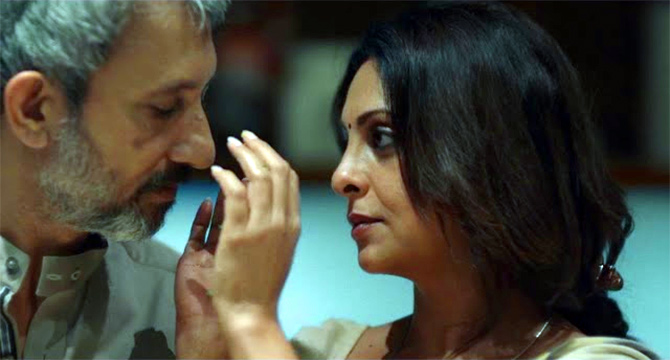
It may seem difficult to recall in the cold light of the present, but cross-class romance once warmed the hearts of Hindi film audiences. The poor boy who won the heart of the rich girl (and the wrath of her family), was a staple of the single-screen era. Even then, the rich hero-poor heroine equation was less frequent -- and for that fantasy to extend to the master-servant relationship was rarer still. Rohena Gera's lovely film Sir, completed in 2018 and released online earlier this month, tries to turn that dream into reality.


Ratna (Tilottama Shome) works as the live-in domestic help for Ashwin (Vivek Gomber), who is due to get married to his girlfriend Sabina. When the wedding – and the relationship – suddenly falls through, the quiet Ashwin finds himself being hectored from all quarters. His overweening mother wants him to reconsider, his father seems to assume he can't handle his part in the family business and his friends want to steer him into dating again. Increasingly isolated, he begins to notice the unobtrusive warmth of Ratna's presence. She comes from a space of experience far removed from Ashwin's upper class Mumbai universe – a poor rural family, a hurried marriage, early widowhood with its attendant social and economic fallout -- but her halting words are both genuine and wise. The gulf between them is huge, but Sir manages to make us believe in the possibility that it might just be bridgeable.


The America-returned Ashwin has never been anything but polite to Ratna. But as his appreciation of her grows, he baulks more and more at the rudeness of those around him. Gera's deft script and direction is aided by the wonderful understated performances she draws from both Shome and Gomber, Shome in particular delivering scenes of great devastation with a quiet wallop – such as when a boutique manager responds to Ratna's entry by yelling for the watchman, or Ashwin's party guest makes a scene over her spilt wine. Gera makes clear that nothing said or done to Ratna is out of the ordinary; it is what the servant-keeping classes in India mete out unthinkingly. From Ashwin's businessman father dissing his construction workers to the neighbour who insults her child's ayah (Geetanjali Kulkarni in a great supporting role) rather than chastise the child, the film throws into relief Indians' constant othering of those less privileged than us. It is upper middle class common sense to think of servants as 'lazy' or 'cheats' or inept, 'morons' who need to be kept in check with low salaries, stark boundaries and harsh punishments. The more we want to exploit the poor, the more it suits us to think of them as less than human.


It is against this usual wall of invisibility that Ashwin's gestures – that would be common courtesy if Ratna were not a servant – stand out as excessive. It isn't just in his class that they attract attention, but also in hers. Offering to wait for a servant to finish eating, asking if she needs a ride home -- these are acts so unthinkable on an employer's part that they arouse the mockery and suspicion of other servants. And for Ratna, made vulnerable by both class and gender, they can lead to social extinction.


And yet, it is in Ashwin's spontaneous crossing of that wall, his apparently unconscious transcendence of the very boundaries society wishes us to guard, that the possibility of any real relationship lies. Because even as Ratna fears the weight of social censure, she demands the respect of social acknowledgement. “Main ganwaar hoon [I may be a country bumpkin],” she tells Ashwin, “Lekin main aapki rakhail ban ke nahi rahoongi [But I won't live here as your mistress].”


In Zoya Akhtar's powerful segment of the 2018 anthology film Lust Stories, another quietly efficient domestic help (Bhumi Pednekar) finds herself taking care of her young male employer (Neil Bhoopalam). The intimacy between them feels far from furtive, and the banter that accompanies such frank, lusty sex holds at least the glimmer of equality. But that distant promise is shattered when Bhoopalam's middle-class parents arrive, with a suitable girl in tow. In front of his parents and prospective in-laws, the good middle-class boy behaves impeccably – which is to say he betrays not the barest hint of his real relationship with the maid.

But perhaps that's the point. When something only exists behind closed doors, is it ever really real?


In contrast, it is Ashwin's insistence that he isn't afraid of what people might say that makes his attraction to Ratna so heartwarming. It may seem utopian, but that's why it feels like love.


Published in Mumbai Mirror, 17 Jan 2021.

8 January 2020

The ghosts among us

My Mumbai Mirror column:

A new anthology film about the supernatural is a mixed bag, but it does try to point Hindi film horror in consciously critical directions.

A still from Dibakar Banerjee's segment in the new anthology film Ghost Stories.
After first coming together to pay homage to the cinema in Bombay Talkies (2013), and the self-explanatorily titled Lust Stories (2018), the once-unlikely foursome of Zoya Akhtar, Anurag Kashyap, Dibakar Banerjee and Karan Johar are back with a new anthology film: Ghost Stories.

The films vary widely, not just in setting and tone, but in quality. Anurag Kashyap's contribution, starring an awkwardly gangly sari-clad Sobhita Dhulipala as a woman who is both an expectant mother and a surrogate maternal figure to her little nephew, didn't work for me at all (spoilers ahead) despite the effectiveness of the scowling child. The possibility of an uncanny relationship between external visual depictions and real-life transformations – think everything from Oscar Wilde's The Picture of Dorian Gray to MR James 1904 classic ghost story 'The Mezzotint' – has always fascinated me, and it is of course also the basis of certain long-held ideas of magic, such as voodoo. So Kashyap's use of the child's drawing, his repeated scratching-out, and his apparently innate sense of his own power, was for me the most gripping part of the story. But the film stirs in all sorts of other elements – nightmares, superstitions, silent men, shouting mothers, half-human states, crows' eggs, and a whole room full of creepy dolls. If all these ingredients were meant to be a recipe for chills, the dilution leaves us baffled and lukewarm.

Zoya Akhtar's film wins big by casting the brilliant Surekha Sikri as a bedridden old lady attended on by a lackadaisical young replacement nurse (Jahnvi Kapoor). As always with Akhtar's films (including her segment about a maid and her master in Lust Stories), there is an attentiveness to space: the multiple empty rooms that the youthful Sameera dashes through with a token agarbatti, the echoing sound of children's laughter from the stairwell when she answers the doorbell to find no-one there. It's a talent particularly useful in crafting fear, if Akhtar were interested. But she isn't, not really.

What she seems keen on is a juxtaposition of youth and age, sharpness and shutdown– and things aren't as simple as they seem. Sameera's briskness as she cleans up Mrs. Malik is matched by her frequent distractedness. Mrs. Malik, meanwhile, drifts in and out of consciousness, but recites from Wordsworth's apposite 'Intimations of Immortality' with tinny perfection: “Turn wheresoe'er I may,/ By night or day./ The things which I have seen I now can see no more.” And knows more about the fruitlessness of waiting for someone than Sameera can.

Genre fiction and film – especially of the scary variety – has long been a vehicle for social commentary. The man-made monster at the centre of the still-popular Frankenstein – a book first published anonymously by a ridiculously young Mary Shelley in 1818 – is an early (and eerily prescient) warning against technological intervention in human life. Twentieth century horror, especially the zombie movie, has been powerfully shaped by George Romero's cult classic The Night of the Living Dead (1968), the first of his triad of 'Dead' films: Dawn of the Dead, set in a shopping mall, and Day of the Dead (1985). Romero onwards, the slow-moving, cannibalistic zombie – a creature whose bite turns the bitten person into a zombie herself -- has more often than not been a powerful metaphor for the horrific things that ail society: racial prejudice, consumerism, militarism, classism. That tradition continues down to Jordan Peele's Us (2019).

Karan Johar's film isn't scary, despite his newly-married heroine walking us endlessly through the candle-lit expanse of her husband's family mansion (going for a cross between K3G and Trikaal) in search of a ghostly grandmother. The only effective presence is that of the forbidding housekeeper Shanti, who guards Dadi's room in a manner clearly inspired by Mrs. Danvers' guarding of Rebecca's in the Du Maurier novel (and Hitchcock film). Johar has moments that invite critical examination: such as the friend who declares the family as “totally legit” based on “community mein izzat” and “thriving business”, forcing us to think about how such an aura of social legitimacy survives the violence pushed under the floorboards. (But you'd do better to watch Parasites.)

There is, happily, a zombie film in the quartet. It is Dibakar Banerjee's, and perhaps unsurprisingly, it is the sharpest of the four – politically, but also in filmmaking terms. Sukant Goel plays a bored, exhausted sarkari official who arrives in a remote village to report on a government school – to find a ravaged, half-burnt settlement where the only living humans appear to be two children. The zombies from the bigger village have eaten everyone from the smaller village, and will eat everyone except those who turn on their own kind. If you speak up, you attract the attention of the creatures. If you join the feasting, you will save your skin – but be blinded for life. Watch it -- and try not to be blind.

22 July 2019

Hairy Situations

My Mirror column:

A new film casts Jennifer Aniston as a New York City hairdresser caught up in a very European murder, making our columnist think about another fictional hairdresser embroiled in another murder


Jennifer Aniston as a hairdresser in the recent film Murder Mystery

Kyle Newacheck’s Murder Mystery (on Netflix) is an affectionate takedown of the genre, mixing comedy with thrills – and caricatures with characters – in a way that feels surprisingly satisfying. An ordinary New York couple called Nick and Audrey Spitz (Adam Sandler and Jennifer Aniston) land in the midst of a European murder that’s equal parts hamming and high intrigue.

The setting, a high-volume homage to all those Agatha Christie plots with a cast of suspects stuck on a train or in a country house, is a yacht in the middle of the Mediterranean Sea, with the first murder taking place while all the guests are literally present in the same room. There’s a charming viscount with a perfect jawline; there’s his sultry young Japanese ex-girlfriend who’s recently dumped him for his ancient uncle; there's the uncle himself, a millionaire with a mane of white hair that doesn't make up for his shrivelledness. There’s the obligatory colonel, updated from the moustachioed white man with a past in India to a black man who once lost an eye saving the millionaire’s life. There’s the colonel’s bodyguard, Sergei, a hulk made more forbidding by his refusal to make conversation. There’s a preening actress, a racing car driver, and the millionaire’s unhappy unsatisfactory son. Just as soon as we’ve met everyone, the millionaire announces his intention to disinherit everyone present in favour of his new bride – and is promptly murdered. Enter the other necessary stock character: a detective with a French accent and a high opinion of himself, a la Hercule Poirot.

Screenwriter James Vanderbilt (of Zodiac fame) keeps things zippy and droll, making Nick and Audrey prime suspects for a murder we know they haven't committed – and that they now need to solve in order to save themselves. The film is good fun at this level. But alongside the US-Europe jokes – the NYPD cop converting from dollars as he tips a caricaturish butler, or wearing shorts to the banquet on board yacht – I enjoyed the film for the oddly believable married couple at the centre, with their totally believable US-style quarrels over brands of allergy medication and anniversary gifts. Sandler, as a cop who's failed the detective test three times and taken to keeping that fact from his wife, surprised me with a sense of unspoken vulnerability. But Aniston, as his frustrated hairdresser wife waiting for the European honeymoon he promised her 15 years ago, surprised me more.

We first meet Audrey in the salon where she works, bonding with female clients over the unromanticness of men. As the film moves along, Vanderbilt gives Aniston a more sharply defined sense of unfulfilled aspirations. While her husband snores beside her, Audrey is the one who sneaks into business class and befriends a flirtatious viscount. When he invites the couple to his uncle's yacht in lieu of their tour bus, Nick flies off the handle, thinking it's an Indecent Proposal moment. And yet Nick is supposedly the practical one, the 'real cop' to Audrey's naive murder mystery fiend. The more earnestly his wife throws herself into her honeymoon-turned-adventure, the more he undercuts her: “This is what I do for a living, sweetheart – you're a goddam hairdresser!” Nick apologises quickly after, but the barb sticks. “Look who figured it out, the hairdresser!” Audrey taunts him later.

Kirsten Dunst as the hairdresser Peggy Blomquist in the crime series Fargo (2015)
Watching Audrey reminded me of another hairdresser in another sort of narrative: Kirsten Dunst's fabulous 2015 performance as Peggy Blomquist in the second season of the magisterial crime drama Fargo. Peggy, too, is a woman in a marriage and a life that doesn't quite live up to her desires. Her husband's only dream is to own the butcher shop in their small town. Peggy, meanwhile, thinks she has great style, hoards fashion magazines and is increasingly obsessed with a self-discovery workshop recommended by her beauty salon boss. Like Audrey and Nick, Peggy and her husband find themselves caught up in an increasingly surreal murder case. Fargo's iteration of this is of course chilling, not funny. Peggy's response, which is to start to imagine that expensive course as the bridge to an all-new life, is chilling, too. Murder Mystery makes Audrey's aspirationalness much more familiar, as in a hilarious scene when her budget fashionista self is mocked: “Your shoes still have a sticker from Marshalls,” sneers the Japanese heiress holding them at gunpoint. “They have name brands now,” says Nick defensively, even as Audrey scrambles to take the sticker off.

Is there something about hairdressers that makes them such evocative carriers of the unfulfilled American dream? We don't, in either Murder Mystery or Fargo, see very much of Audrey or Peggy at work, but it is as if they carry deep within themselves the desire for the makeover. The transformative hairdos they give other women are a gift they would love to receive themselves.

Published in Mumbai Mirror, 

24 June 2019

Future imperfect

My Mirror column: a two-part series on Leila

The new web series Leila, adapted from Prayaag Akbar’s 2017 novel, imagines a dystopian India that makes for harsh but necessary viewing.


An opinion piece I read recently suggested that comedy is becoming a difficult art to practise in today’s India, as reality becomes ever more ridiculous. The same might be said, I think, of dystopian fiction. As our collective lived experience itself edges away from the rational, it becomes harder to make our irrationalities visible in the mirror of fiction.

The writer who seeks to show us such a mirror must carefully calibrate the distance between an imagined future and the present that we’ve accepted as normal. In his 2017 novel Leila, Prayaag Akbar managed to do that successfully.

The book’s chilling vision of the future was filled with details that felt entirely plausible. Akbar’s world is one where birth determines social status, where mixing is strongly discouraged and the rich have parcelled out urban space amongst themselves, dividing up the city into community-specific neighbourhoods like “the Tamil Brahmin sector, Leuva Patel Residency, Bohra Muslim Zone, Catholic Commons, Kanyakubj Quarters, Sharif Muslimeen Precinct, Maithil Acres, Chitpavan Heights, Syrian Christian Co-op, Kodava Martials”. Linked by a network of “flyroads”, the leafy, peaceful universe of these segregated “high sectors” is enclosed by walls, and a vast air-conditioning system called the Skydome. The poor, known as Slummers, live beyond the walls – in a filthy, treeless world crisscrossed by Outroads, where the air is noxious with gases expelled from the Skydome’s purifiers, and the ground an endless stretch of landfills that often catch fire.

It is in a version of this universe, based on Akbar’s novel, that the new Netflix series Leila unfolds. Like the novel, the show centres on Shalini (a superb Huma Qureshi), who is suddenly hurled from an elite bubble of bungalows, swimming pools and poshly cosmopolitan schools into the margins of the new society that has come into being. “Purity for All” here means purity is all, and those who make the mistake of loving outside their communities must be punished, and schooled into submission. Deepa Mehta, who has directed the series’ first two episodes, told me in an interview that what attracted her to Akbar’s book, and to screenwriter Urmi Juvekar’s reimagining of it for Netflix, was “the journey of a person who is privileged, who has everything, but has it taken away from her in difficult times. It’s not just about looking for her daughter, it’s about looking for her dignity, her own self”.

“Wherever there is a totalitarian regime, women are having a really rough time,” added Mehta. Both for her and Qureshi, Leila’s woman-centric narrative was crucial to its politics. “The problem with a lot of female characters and roles is that you always have to be rescued by someone,” Qureshi said during the same interview. “Even in 2019, I get a lot of scripts in which [women] just have to hang around, look nice, basically support the man who saves the world. Even when the problem concerns women, a guy has to come and empower us. What about us empowering ourselves, finding that inner strength? Shalini offered me that.”

Gender is also at the crux of some changes the series makes from the book. For instance, a little boy called Roop, whom Shalini encounters during her search for her lost daughter, here becomes a little girl. “I’d seen [male children in] Lion and Slumdog Millionaire, and I thought about time, ladkiyan toh honi chahiye. It’s a desire, as a woman, to have an emotional journey to which as many women as possible are contributing,” said Mehta.

Given that a 250-page novel needed to be stretched to create a six-episode series, changes were inevitable. “A book is very different than a film, and a series completely different. That’s not an excuse, it’s the reality of the medium,” Mehta said. Some of the striking additions involve completely new characters, like the labour supervisor Bhanu (Siddharth) or the Dixit family, for whom Shalini goes to work, or the fascinating figure of Rao Saheb (Akash Khurana), who is both a founding figure of the regime and among its more conflicted critics. Other changes are within characters. The book, for instance, starts with Shalini’s husband Riz (Rahul Khanna) screaming at her that she will never find Leila, while on screen he is an almost cloyingly supportive husband, only appearing to compliment or reassure her. That change, perhaps, contributes to Shalini’s rather different self-image, from a kind of self-flagellation for cowardice in the book, to being the woman who begins the series by kicking her attackers and saying over and over, “I’m not afraid of you.”

There is also a textural transformation caused by the fact that the novel is in English, with entirely English dialogue, while the series largely unfolds in Hindi, with some characters switching to English when they would naturally do so, such as Shalini and her husband Riz.

(This column has a second part, which is here.)

15 April 2019

A blinkered vision

First part of my two-part Mirror column on Delhi Crime:

Delhi Crime's retelling of the 'Nirbhaya' investigation is gripping. But it sees things so completely through police eyes that it can sometimes feel deliberately blind.

For me, the most revealing moment in Delhi Crime arrived a day or so into the Netflix series’ recreation of how the Delhi Police apprehended the six men later charged in the December 16, 2012 rape case. In director Richie Mehta’s screen version, a man called Banke Lal arrives at the Vasant Vihar police station to tell the cops that at about 8.30 pm on December 16, a little before the rape took place, he had boarded a similar white bus from Munirka Bus Stand, been attacked and robbed of his phone and wallet by the six men on board, and thrown out of the bus near the IIT overpass.

“Had I landed on my head, I’d be dead,” says Banke Lal.

“Why didn’t you report it that night?” asks Vartika Chaturvedi, the senior cop in charge of the case, played by Shefali Shah.

“Who would I have complained to? I was asking everyone for help, no one listened,” Banke Lal replies. “I managed to borrow a phone from a passing auto driver and called my brother, who told me to come home. I figured, what would the cops do? It was only when I saw the news that I realised that this had to be the same gang.”

The sequence ends with Chaturvedi thanking Banke Lal for coming to them and asking for another case to be filed against the same suspects. She then goes out of the room, leans against a wall as her right-hand man Bhupender (Rajesh Tailang) wonders if there might be other victims to be found.

“If he had made a complaint that same night, maybe we could have prevented this,” responds Chaturvedi.

“We don't know that, says Bhupender. “Ismein hamari kya galti hai?

“Try saying that to Deepika,” says Chaturvedi, half swallowing her words.


As I watched the sequence, I couldn’t stop thinking about the fact that we live in a country in which a citizen who has just been robbed, beaten up and thrown off a bus can respond to his predicament with “What could the police have done in this?” It seemed to me to offer an involuntary glimpse of something the show appears to take entirely for granted: that we as a citizenry have so little faith in our police force that we don’t go to them for help, even when we’re victims of an act of targeted violence and robbery, bang in the middle of the country’s capital.

Then, as I sat down to write this column, reliving my own memories of December 2012, as all Indian women who watch it will do, I remembered that there had indeed been such an incident. A man had been robbed on the night of the gang rape, by the very same men, aboard the very same bus.

It didn't take much looking up online to find reports. What I found in them was distressing. The Times of India reported on December 23, 2012, that three constables from the Hauz Khas police station had been suspended for their failure of duty when approached on December 16 by one Ramadhar Singh, who had been picked up “from RK Puram Sector 4 by the six gang rape accused, and robbed and dumped near IIT”.

The report continued: “The three cops were on patrol duty around 8.15pm when they were approached by Ramadhar. He had told them that he was robbed and that he had lost his mobile and, hence, cannot call 100. The cops, however, told them they were from the Hauz Khas police station and he needs to go to Vasant Vihar to register a case. They neither sent out a wireless message to track the bus nor had they informed Vasant Vihar cops about the incident,” said a source.”

I describe this incident in such detail not to make the point that the heinous gangrape that would end up making Delhi the notorious site of frenzied international attention was preventable. That may be true, or it may not. The “what if” that it becomes on the show is easily voiced — and almost as easily dismissed. Richie Mehta’s version is so insistent on showing Delhi Police in good light that he simply erases the inconvenient truth that the victim of the robbery did in fact try to report it and was turned away by cops. It then absolves the police of even the glimmer of responsibility by making his female cop protagonist have a moment of guilt, that can, however, be painted as emotional, even irrational — since in Mehta’s version the onus is on the citizen who didn’t come to the police earlier.

In many ways, this is transparently the position the show takes: it makes the police the put-upon heroes, under-appreciated figures whose valiant efforts to fight crime while being enormously understaffed and under-budgeted are not appreciated by a thankless citizenry. All we ever see are good cops being treated badly. The DCP who hasn’t gone home for three nights is taunted by a judge as being someone who spends her time at parties and has probably never been to a crime scene. Children in a posh South Delhi school regurgitate their parents’ assumptions about the cops being corrupt. In a less monied class, too, Bhupender tells Vartika that he hides his job from any prospective in-laws he’s meeting because “no one wants either a dosti or dushmani with the police”.

Vartika chastises Bhupender for not seeing that a family that doesn’t respect his job will not “protect his daughter”. But the larger issue, the fact of why a city of 20 million people has a relationship with its police force that is one of “Best if we never have to deal with them” rather than “They will help us get justice”, is never really discussed. When we get unwitting glimpses of the reasons why — such as when some constables on duty taunt and torture the not-yet-convicted suspected rapists, driving three of them to attempt suicide — it is not treated as an abuse of power, but simply as something strategically unfortunate that happens.

But surely if the police in Delhi and in the rest of India are assumed by the man on the street — and even more so, by the woman on the street — to be not just professionally incompetent, but a power-seeking, corrupt and potentially malign class of people that is best avoided, there must be some reason why. Surely the answer cannot be the one Mehta provides by ventriloquising the ex-police commissioner Neeraj Kumar, who is a consultant on Delhi Crime: that it’s every other constituency who’s wrong — the politicians, the media, the judiciary, ordinary people, students — and the police who are right.

(To be continued next week)
 
Published in Mumbai Mirror.

19 March 2019

The dance of anger

My Mirror column:

Ivan Ayr’s film about a Delhi policewoman, now streaming on Netflix, is an astute study of female power and powerlessness.


The members of any oppressed class have two options on the world stage. They can fill the roles they're given, thrill to the indulgent applause that comes their way -- and accept that they will never direct the show. Or they can demand the bigger, better parts, try to change the script -- and risk finding themselves thrown out of the production.

When a system is stacked heavily against you, there are many advantages to be gained from not upsetting the apple cart. Given a bit of power within such a system, most people would play safe. But Soni isn't most people.

At one level, Ivan Ayr's first feature is a finely observed study of what it might feel like to be an ordinary young woman in present-day Delhi — in the streets, at home, in school, at work. But at another level, Ayr's eponymous protagonist is clearly not an ordinary young woman: because she works with the police. Co-written with Kislay (whose short fiction Hamare Ghar was mercilessly astute about our behaviour as middle class employers of domestic help), the film plays constantly on the gap between what Soni appears to be and what she actually is. It begins with Geetika Vidya Ohlyan's physical presence, her body language. When we see the petite figure on the bicycle, cycling as fast as possible through a dark alley, her lips pursed into silence even as her harasser grows increasingly vocal, we imagine the worst. We are primed to imagine a woman on Delhi's streets as a victim. So there is a sense of shock – and perhaps embarrassment – when we realize she isn't one.

And yet, that is by no means the end-point where the film wishes to deposit us. Because what becomes eminently clear is that Soni's unusual position of power – bolstered by her physical training, her job as a law enforcement official, even just her status as a financially independent working woman – does not in fact exempt her from the anxieties of ordinary women. That is true just as much within her closest private relationships – in the heartbreaking sense of feeling abandoned by the man she might have loved – as it is with men in public places. Even the women handling police control hotline are not immune to the unwanted attentions of men.

Ayr and his cinematographer David Bolen do a brilliant job of showing us how a woman walking alone on the Indian street might experience it as an obstacle course, a video game filled with potential dangers. The roads half-blocked by Metro construction, the lack of any pavements to speak of, the rickshaw that drives too close to you, the men huddled around bonfires at street corners, their casually delivered 'behen ke lodey's audible as you approach – these everyday sights and sounds of a Delhi winter night are both perfectly ordinary and possible sources of assault.

The scenes with Soni working as a police decoy have an indescribable intensity. As Soni walks tensely through the streets, her face drained of colour even in the glow of Lohri fires, one feels as if the city turns each woman in it into a decoy, each walk we take is an experiment upon the self. If even pretending to be a victim can be so draining, the filmmakers seem to suggest, can you imagine what it's like to actually be one?

And yet this is not some hopeless, helpless film. One of my favourite moments is when Soni gets out of the police car to get the special chai that the tea stall guy will only make if he knows it's for her. That individual relationship with the city, that claim upon it, is one women deserve to be able to make as much as men – and some day perhaps we won't need to remark upon it.

Soni is also a twin character study, contrasting the hotheadedness of its eponymous heroine against the quieter foil of her boss Kalpana (Saloni Batra). Though also a woman in a male-dominated force, Kalpana has arrived there via a very different route: the Indian civil services examination. That more bookish route is gestured to in Kalpana's rule-bound decision-making; in her attempts to make her subordinates follow the letter of the law – automatically file an FIR when a woman complains of harassment, or call in a woman officer to help question a clearly petrified girl who may or may not have been raped. There is also, of course, a class difference between Soni and Kalpana which might have some impact on their differential levels of self-control, though the film is never so crude as to spell that out.

But what is so fertile about their relationship is that each appreciates the other's characteristics. As the senior officer, Kalpana is constantly having to answer for Soni's outbreaks of uncontrollable anger. But her chastising of Soni seems always to come from a space of understanding. It is as if a part of her would be glad to punch those men herself. Violence isn't the answer, but sometimes it makes the questions visible.

30 September 2018

Mean Streets

My Mirror column:

A promising film about sex workers strives to be bleakly documentary while also taking the revolutionary road — and loses its way.


Aditya Kripalani’s film Tikli and Laxmi Bomb, currently streaming on Netflix, has many promising things about it. Based on Kripalani’s own 2015 book, the plot revolves around a group of Mumbai-based sex workers who come together to carry out what they call a ‘revolution against men’ — not by stopping the work they do, but by eliminating the middlemen who control their business.

Just by giving centre stage to a group of sex workers, Kripalani turns away from the long-standing cinematic tradition in which the prostitute/ tawaif/ dancing girl could really only be one of two things: a heartless two-timing vamp, or the golden-hearted receptacle of the hero’s pity and desire. Other than Shyam Benegal’s still unsurpassed Mandi, in which the occupants of a brothel find ways of dealing with the ire of ‘respectable’ society, even Hindi cinema’s non-titillating attempts to give the sex worker a voice have never been able to do without a ‘good guy’, a hero through whose eyes we might view these women sympathetically.


Whether it be Guru Dutt’s idealistic poet ‘accepting’ Waheeda Rehman’s Gulab in Pyaasa, Chandramukhi in all the versions of Devdas, or Rekha in Umrao Jaan, all the way down to Rahul Bose’s encounter with the streetwalker Kareena Kapoor in Chameli and Aamir Khan’s police inspector Shekhawat falling for Rosie (Kareena again) in Talaash, the sex worker has been a figure of romantic fantasy. Her existence on the Hindi film screen has remained about being fascinating to men — if not sexually, then as an object of curiosity.

So it is valuable that Kripalani makes the film’s pivotal relationship one between two women. Putul AKA Tikli (Chitrangada Chakraborty) is young and new to Mumbai’s streets, showing up on the scene with enough spark to reignite the fortyish Laxmi’s (Vibhavari Deshpande) fading hopes. Some of the ways in which the contrast between them is gestured to are perhaps too obvious, like Putul’s high heels, tight jeans and glamorously open hair versus Laxmi’s unchangingly loose, dark-coloured collared shirts at work and aunty-style nighties to sleep in. But both actresses are wonderful, bringing to life both the initial friction between the jaded, no-nonsense Laxmi and the fun-loving, talkative Tikli and their gradual path to friendship.

The fact that Kripalani’s film does not adopt a male point of view is reinforced by having women in many of the technical positions: art direction, cinematography, assistant direction, costume design and editing. It presents these women as sexual beings when they present themselves that way — when Tikli sashays down a hotel corridor, or when Shari lehraos a sari aanchal. When and if the camera dehumanises a woman, it is done very obviously through the eyes of a leering man.

“Andhera apna dost hai,” Laxmi tells Tikli early on, and the film is indeed shot in various degrees of darkness 
— in alleys, parks, seedy bars, even seedier living rooms and the interiors of cars — punctuated occasionally by neon lighting, as in AT’s auto which ferries the women to work. Something about Laxmi’s harshly tube-lit cubby hole of a room, with almost no furniture and a fading Prabhat Studio poster on the roughly plastered wall, reminded me of the rented rooms in which the dancers lived in Mira Nair’s affecting 1985 documentary India Cabaret.


The bareness of the locations and the handheld, almost jerky, camerawork underline the bareness and rootlessness of these lives. And the style does work, to the extent that the film shows us sex work as the unglamorous drudgery — the work — that it is. It also allows us to move from watching these women treat the police station casually, as a place they’re so used to that they can sit around after a ‘raid’ boredly taking selfies, to being suddenly jolted into the exploitative violence of this ‘workplace’. The normalisation of sex work as labour is matched by the normalisation of its potential violence.

But there is a strange disjuncture between this documentary realism and the heroic, almost epic narrative of the war that the ‘Tikli and Laxmi Gang’ sets out to wage against patriarchy. That melodramatic, almost filmi register appears particularly in the characterisation of Putul and Laxmi: in their tragic backstories, their action sequences, their grandiose plans. There is a Rang de Basanti reference in the dialogue that makes a wink-wink acknowledgement of this aspect, but the film remains tonally disjointed.


The very first scene had shown us Laxmi (Deshpande) waking up to find that the wrist she’d tried to slit at night has only bled painfully, without resulting in her death. “Failure even at suicide,” she mutters in disgust, placing the scene somewhere between tragedy and farce. Sadly, the film never quite figures out which it wants to be.


Published in Mumbai Mirror, 16 Sep 2018.

17 September 2018

Interview: Neeraj Kabi

Actor Neeraj Kabi came into the limelight with Ship of Theseus (2013). His work has since been appreciated in content as different as Hichki and Sacred Games. He spoke with me about the stage, films and streaming TV.

For film audiences, you burst onto the scene as the ailing Jain monk in Ship of Theseus (2013). Tell us something about your life before that.

I'm from Jamshedpur. My father is Oriya, my mother Parsi. I finished college from Pune and came to Bombay in 1991. I did all kinds of work for survival. In 1997, I did an Oriya feature film called The Last Vision, by AK Bir. It won a National Award. But nothing happened till 2010. I did form my own theatre group. Veenapani Chawla's Brihannala lit a spark in me. I directed plays; I did a Hamlet which drew on Yakshagana and Dhrupad. But I don't like to discuss that 'struggle' period much. What I went through is my strength.

Do you see film and stage as different kinds of acting?

In theatre, you're there from start to finish; you understand context, subtext. In films, you might shoot Scene 56 today and Scene 1 tomorrow. Actors who've never done theatre can end up with a mishmash. My training in theatre helps me stay centred, to produce continuity of character in a film. You have to be larger than life to be on stage. In films, you can get by without. Everything I did as a theatre actor was defined by physicality. It was stylised. I was not in the realist zone. I played Hamlet in Rosencrantz and Guildenstern Are Dead, where I was on stilts. Another time I did a Moliere play, all jumps and somersaults, landing on the knees. When I came into films, it became all about realism, getting deeper into the psyche of the character.

What inspires you as an actor?
I have this madness of falling into character when I'm outside, in public. Say, if I'm limping right now because I've hurt my leg, can I add a limp to one of my current characters? Maybe a character has a psychological limp: can I can translate that into something physical? The set or the stage, that's my office. But I'm living as an actor all the time. Like you have a way of the warrior, you have a way of the actor. If you do this, nothing in your life is a waste. You don't crib about it. You use it. Life and acting cannot be separated. You can't perform by reading books on acting!

Any books ever seemed useful?
[Shakes his head dismissively]

Do you miss the physicality of the stage?
I do.

Is a different kind of performance needed in an independent film like Ship of Theseus versus a Hichki or a Byomkesh Bakshy?

Thankfully, not yet. Maybe because the directors have been people like Meghna [Gulzar] or Dibakar [Banerjee]? And our audiences are not so insensitive that they only understand flamboyant acting. Both coexist: entertainment films and parallel films. I am a fan of all the Khans. For my entertainment, as Neeraj, I love it! And Imtiaz Ali, Zoya Akhtar, Aditya Chopra, Abhishek Chaubey make great entertainment films, which I'd love to be in as well. But for an industry to make only entertainment films is to numb an audience. It misrepresents Indian cinema to the world. Asked about actors, we name entertainers. With all due respect, they're not actors: they are stars. If you seem the same on screen as in real life, you haven't used the craft of acting at all.

Any trends in the Hindi film industry that look exciting to you?
One, audiences are transforming. It's slow, but they're starting to accept everything. There's no formula any more that guarantees a hit. Two, entertainment content is becoming slightly better. Films like Raazi, or Vishal Bhardwaj's work, these are somewhere in between, written to appeal to a larger audience.

Is streaming allowing for different kinds of content – aesthetically, socially, politically?
Absolutely. One, the format of cinema is two hours: you can't say everything. The web series format allows more space and freedom. Also, there is no censorship, so people are trying every damn thing they can do over here. It's like a new school has opened, where there's no principal. It'll settle down soon. But yes, right now that fire is there.

You've done many grey roles. Did playing the romantic lead exercise different muscles?
I was very excited. I'm a diehard romantic, I'll be that until I'm 90. But I came into the industry in my 40s, and the love stories are written for 25-30 year olds.

Unless you're Shah Rukh Khan.
All the Khans, even the Kumars have an audience that's seen them at 25. They can do this till they're 70. People will still accept them. But I'm doing this mature love story; I wanted to look good! Ship of Theseus, I was a monk in a dhoti; Byomkesh I had a massive beard; Talvar, I had a paunch; twice I've played Gandhi with head shaved: I thought a change would be nice. I'd like the audience to love me, even fall in love with me.

Do awards matter to you?
When you're acting, no. Critics and awards are the cherry on the top, after it's done. I used to get excited about award nominations. Now I don't care as much. I'm more keen on getting my audiences in place. I plan to create a theatre residency soon. I want to direct my own kind of films. I don't want to feed the audience what they say they want. I want to give them what I think they deserve.  

A shorter version of this interview was published in India Today, 15 Sep 2018.

Film review: Once Again


Old School Romance

My review of Kanwal Sethi's film Once Again, now streaming on Netflix:


A few minutes into Once Again, we see the middle-aged female protagonist Tara Shetty (Shefali Shah) patting her face carefully with her hands. The deliberateness of her gestures suggest a nightly ritual: she seems to be putting something on, perhaps an invisible layer of cream? Almost immediately after, there is a mirroring, when we see the film's middle-aged male protagonist in the midst of his own cleansing ritual. But Amar Kumar (Neeraj Kabi) is a famous film star called Amar Kumar, and his smoky black eye make-up is being gently dabbed away by someone else. The addition of an invisible layer versus the removal of a visible one; the woman's actions hoping to stave off the inevitability of age, while the man has just shot for an erotic dance sequence with a bevy of much younger women: of such contrasting details is Kanwal Sethi's film made.

Creating characters who share your sensibility is the oldest trick in the fiction writer's book, and writer-director Sethi unapologetically takes this route, making both Tara and Amar agents of the film's unhurried tactility. It makes perfect sense that Tara's cooking, all slow marination and hand-ground masala, should appeal to Amar, the sort of man whose first gift to her is a fragrant, creamy- white gajra.

The premise -- of a connection fostered through the daily delivery of a freshly-cooked meal -- is bound to invite comparisons with The Lunchbox (2013). Stylistically, too, both films are redolent with old-school romance: the anonymous pleasures of Mumbai's streets, and nostalgia for handwritten notes and landline appointments. Unlike the plotted safety of Ritesh Batra's film though, Tara and Amar do meet, and meet several times, letting the charmed flame of their phone banter flicker into unscripted disappointment. “What are you thinking?” Amar asks Tara after one tense moment. “Just that it's all so easy on the phone,” says Tara.

Women have long cooked to express love. The film recognizes both the intimacy of the act, and the unequal gendered labour of it. Tara's response when Amar introduces her as someone who cooks for him is not that different from Sridevi in English Vinglish when her husband declares “My wife, she was born to make laddoos”. But Sethi's glancing, atmospheric style doesn't delve too deep, sometimes leaving us with more suggestion than substance. 

The protagonists' relationships with their respective grown-up children – Rasika Dugal, Bidita Bag and Priyanshu Painyuli – never feel fully fleshed out, coming off like distractions from our main focus. This is particularly so because Shah and Kabi are both fine actors, and Shah's trademark intensity makes her chemistry with Kabi a live, smouldering thing. We could really do with more of her.

An edited version of this review was published in India Today magazine, 15 Sep 2018.

17 July 2018

Crimetime Mumbai, Adapted

My Mirror column:

With new series Sacred Games, Anurag Kashyap and Vikramaditya Motwane turn Vikram Chandra’s sprawling novel into an atmospheric but filmi crime thriller.


Watching a filmed version of a book one knows well is always a little unsettling, and more often than not, unsatisfying. No matter how detailed a writer’s descriptions might be, the places and people in them are not realised in your head the way they are when you see a film, play or television show.


When you read, there is always space between the words for your own images. And because the imaging — and imagining — is up to you, some characters or scenes might leap off the page more than others. And they’ll be different ones for different readers.


A book, you might say, leaves you alone with the story. But when the same story unfolds on screen, you watch it through the eyes of a team of people — the scriptwriters, the director, the musicians, the art directors. An entire technical team comes together to produce their vision of the story. The faces have been picked, and voices, accents, gaits, clothes, houses and street views have all been finessed into finality. The images are what they are: there is no space between them for your own imaginings.


And so, on Friday, as I prepared to watch the new Netflix series Sacred Games, my mind kept going back to Vikram Chandra’s magisterial 900-page novel from 2006, from which the show is adapted. As a reader who’s loved the book for a decade, I have lived with my own mental pictures of its central characters: an on-edge Sikh cop called Sartaj Singh and a self-aggrandising gangster called Ganesh Gaitonde. Watching Anurag Kashyap and Vikramaditya Motwane set forth their version of Chandra’s vision is interesting, but it’s going to take me some time to accept a turbaned Saif Ali Khan as Sartaj, or a mad-eyed, UP-accented Nawazuddin Siddiqui as the Marathi Gaitonde.


There are other reasons for my inability to go along instantly with Kashyap and Motwane’s fully realised world. Things get sliced off when a book —especially a sprawling, multi-headed hydra of a book like Chandra’s — needs to be fitted into a format like Netflix. It’s an unavoidable, perhaps even admirable surgical procedure; but the loss of detail can feel painful.


So, for instance, the series begins with the same memorable image as the book: a white Pomeranian dog flying out of a window, ending its life as a splatter on the ground near a group of convent schoolgirls waiting for a bus. But in the book, we know that the Pomeranian is called Fluffy, that “the man who had swung Fluffy around his head by one leg” from a fifth-floor window into the void was a Mr Mahesh Pandey of Mirage Textiles, that Mrs Kamala Pandey, from whose hands Sartaj extracts a knife with expert calm, talked of herself as Fluffy’s ‘Mummy’, and that there was “remarkably little blood”. In the Netflix series, an unnamed dog falls from a high-rise apartment, with the classic pool of blood around its sad little white body.


What was, in Chandra’s narrative, an introduction not just to the life and work of inspector Sartaj Singh and his assistant, constable Katekar, but to the violence that splices Mumbai’s domestic interiors to its streets, ends up here as a mere visual flourish.


The show’s first season is eight episodes, each roughly an hour long, and there are obviously things that would have to go as the screws tightened around Chandra’s baggy monster of a book. But the Sacred Games reader arriving at the TV series must deal not only with subtractions but additions. Writers Varun Grover, Vasant Nath and Smita Singh have clearly immersed themselves in the book’s universe, but even from the two episodes I’ve seen, it’s apparent that they’ve also made crucial changes.


With Sartaj, for instance. The book’s Sartaj Singh has his moments of bleakness: “He was past forty, a divorced police inspector with middling professional prospects... He looked into his future and saw that he would not achieve as much as his own father, and much less than the redoubtable Parulkar.” But Chandra’s Sartaj remains a handsome man who has once appeared on a magazine cover, is the object of flirtatious ribbing from bar dancers, and mothering and potential setting-up from his senior officers’ wives. He also receives benevolent patronage from his boss Parulkar, who at a press conference early on refers to him proudly as his “most daring officer”.


In the series, by contrast, Sartaj is a man who has let himself go. His relationship with Parulkar is far from benevolent. This Parulkar — played with more than a hint of cruelty by the superb Neeraj Kabi — mocks Sartaj to his face for his insistence on honesty, his refusal to cooperate in turning fictional encounters into facts. Behind Sartaj’s back, he dismisses him as a “low-performing officer” with a weight problem and a dependence on anti-anxiety pills.


Sartaj’s supporting cast of colleagues is replaced by a nasty crew that can’t wait to see him down. For example, the book’s friendly Majid Khan, who invited Sartaj over for kheema cooked by “your bhabhi”, becomes, in the series, a snarling younger man with a penchant for punches. Gaitonde, meanwhile, acquires a remote rural childhood with apoor priest for a father and a mother who’s having an affair. These are filmi touches — a hero seems more heroic if he’s alone against the world, the villain can always do with a tragic backstory of deprivation. Among literary Indian English writers, Chandra is perhaps already the most steeped in moviedom, so none of this feels jarring, yet. But whether the upped filmi quotient will stand Sacred Games in good stead remains to be seen.


Published in Mumbai Mirror, 8 July 2018.