Showing posts with label screenplays. Show all posts

10 March 2025

"Hindi filmmakers should go back to the drawing board": Interview with Manoj Bajpayee

A wide-ranging interview with the celebrated Hindi film and OTT actor Manoj Bajpayee, published in Frontline in May 2024.

The team of The Fable was jumping up and down—for joy and for Instagram—in the mid century modernist foyer of Berlin’s Akademie der Künste (Academy of Arts) building. Manoj Bajpayee, 54, stood graciously for the first few photographs, and then sat down a little to the left of where his 34-year-old director Raam Reddy and team continued their youthful photo shoot. Even at rest, Bajpayee exuded a kind of coiled nervous energy—quiet, unfailingly polite, but also watchful.  

Meeting the Mumbai-based actor in Berlin, on the fringes of the Berlin Film Festival where his film The Fable was premiering, felt unusual and yet oddly fitting. Born in 1969 to a farming family in rural Champaran, Bajpayee’s journey to becoming Hindi cinema’s best known ‘alternative hero’ has been nothing if not unusual. Rejected more than once by the National School of Drama, Bajpayee conquered his disappointment by finding work with Delhi’s theatre stalwarts like Barry John and N.K. Sharma, with whom he founded the Act One troupe in 1990. The route to cinema was not easy either. Bajpayee’s first film was Shekhar Kapur’s Bandit Queen (1994), which premiered at Cannes and was India’s entry to the Oscars that year. But his minor role as the dacoit Man Singh did not get him any new work. What it did, though, was lodge his performance in the mind of Ram Gopal Verma, who when he met Bajpayee two years later, promised him a role in his next film, a gangster drama set in Mumbai. This, of course, was the era-defining Satya (1998), with Bajpayee’s Bhikhu Mhatre at its incandescent core. 

Fine turns in films like Shool, Kaun, Zubeidaa, Aks, and Pinjar followed. While it has not always been a smooth ride, Bajpayee has successfully stayed the course. In 2024, he is really everywhere, appearing in OTT offerings, in theatres and in film festivals. Bajpayee’s recent roles have run the gamut in terms of power and social position: a middle class lawyer in Sirf Ek Banda Kaafi Hai, a troubled business scion in Gulmohar, a semi-feudal plantation owner in The Fable, a dispossessed adivasi in Joram, and to top it off, a double role as both abusive, womanising husband and clingy, put-upon lover in Killer Soup. Clearly, this is an actor at the peak of his prowess.

Excerpts from an interview:

You were an Amitabh Bachchan fan but began your career in parallel cinema—Bandit Queen, Drohkaal—and were part of creating a more realistic mainstream cinema, Satya onwards. How would you evaluate the state of Hindi cinema today, especially given OTT platforms and the pandemic? 

I think Hindi cinema had reached a good place—experimenting, entertaining but also not compromising on art. So many films—Oye Lucky! Lucky Oye!, Gangs of Wasseypur, Special 26 and many others achieved this mix. Then Covid came and people got out of the habit of going to the theatre. They aren’t completely back yet. During the pandemic, audiences got a chance to explore the new medium [OTT] that had come into their households. Now that option of watching on your phone is always there. Post pandemic, the Hindi mainstream is confused. I see a desperate attempt to entertain that was not there before. Earlier, creators came from a place of conviction. Now they don’t know what will convince the audience to come out of their homes and spend the kind of money needed.

Thus the tilt towards spectacle? 

That is the Marvel effect! It was there before too, but it is much more now. Producers seem to feel that people need an extravaganza to come to the theatre. 

Is that true? 

I don’t think so. The success of Kantara, or a small film like 12th Fail, or the huge critical acclaim for a film like Joram… give me hope. Hindi filmmakers should go back to the drawing board. Before COVID-19, we were doing everything right: women-led films were doing well, films were engaging as well as entertaining… But now the fear of failing is such that there is a push towards extravaganzas. I think we just need to look at Amitabh Bachchan’s films. Larger than life characters, yes, often rags to riches plots, the triumph of good over evil. But the hero was a coolie, or an orphan, or a police inspector who was non-corrupt, or an unwanted child who becomes a multi-millionaire. People related and clapped for him. Replace Marvel-style films with this; you’d save a lot of money on VFX. 

But Hindi cinema no longer tells stories about poor people, they are not the paying audience… 

But the same audience is watching a Telugu film where the protagonist is from a poor background. They are watching Kantara in the non-Kannada circuit and making it successful. Kantara’s story is like a lok katha, with a hero from a village. If we take the lead from there, I think we will find clarity. 

By “from there” what do you mean? 

South India. I do not mean imitate them, but take a cue from them. Heroes should look like us, talk about the problems that the common man is facing. Very few Indians actually make it to the civil services, but when you make something like 12th Fail, the level of identification is huge. The Marvel model might make money once or twice, but that is not a long-lasting solution. I have no problem with larger-than-life films. But stories should be rooted in our society. Because people want hope, and you can’t give them hope by showing life on Mars. 

Has OTT helped or hindered? 

OTT has opened up possibilities for storytelling. You can make things with good intentions and find an audience. Take Sirf Ek Bandaa Kaafi Hai. A regular lawyer fighting for a minor, fearful that someone might come out of any gali and kill him. It became a streaming phenomenon overnight. So audiences are looking for relatable characters, stories that offer excitement—and hope. 

Sirf Ek Bandaa... is based on a real-life sexual assault case against Asaram Bapu. But are things getting more difficult, the stories that can be told?

The censor situation was as brutal 20 years ago. But filmmakers are intelligent people. You can’t sit down and say you can’t make a film. You are a creative person, right? Then you will find a way. Among just my films, think of Sirf Ek Bandaa… or Gulmohar—that “family film” speaks of so many things so cleverly. Or Joram, about a tribal man who is displaced… and Joram has a U/A certificate. 

Could these be exceptions? 
One can be an exception, not five. I think cinema and theatre has gone through changes and challenges in any decade, and always come out on top. 

Theatre was where you began as an actor. Do you miss it? 

I miss it. So much that I tried going back to it. But theatre does not give you crutches—no takes, editing, background music, or sound. What you see with your naked eyes is the truth. It is an actor’s medium, but the actor has to be completely prepared. I was not. I would have to completely stop working in cinema for a time, to work on myself and be ready for theatre. 

Is that something you might do? 

Yes, I might. 

What is it you miss about theatre? The audience? 

The audience used to be a blur. It was as if nothing else existed. The stage was my safest space in the world. That is what I miss. 

Is the film set not like that?

The film set, you can’t really own it. There are too many factors that own it. 

Do you still watch theatre? 

Yes, I do. Whenever I am free and there is a play by friends—Makarand Deshpande or Danish Husain, so many people—I go to Prithvi Theatre. 

Do you prepare for a role by seeking out real people who resemble your character? 

I have met lakhs of people, thousands of them very closely, from all strata of society. From a village to a Paharganj basti to a Vasant Vihar palace, life has taken me everywhere. Everything is stored in the hard drive of my brain. So no.

I may not have grown up as a rich businessman’s son, but playing Arun Batra in Gulmohar or playing Dev in The Fable was not hard. These people are all around me, I know how they think. What was hard was Zubeidaa. To play a prince is a whole different mindset. I still remember [Shyam] Benegal telling me, “You don’t know anything about poverty. You are raja and they are praja. And you are not an exploiter. Don’t complicate matters too much. From the moment you open your eyes, you have only known this.” 

Do filmmakers write roles for you now?

When you’re dealing with Raam Reddy or Devashish Makhija or Kanu Behl, these are very creatively committed people. They do not write roles for anybody. But if those roles suit me, they do give me scripts to read. There I can compliment myself, I have never led a closed life—and I think they also feel that if Manoj Bajpayee comes on board, he doesn’t go away easily.

Are there roles you want to play? Any historical figures, maybe? 

Oh no, I don’t want to do biopics. See, you need an Attenborough to make a Gandhi. And then Attenborough needs to give Ben Kingsley the time to prepare. We do not give our biopics that commitment of time, money, and energy. Also some shades of grey are needed, which Indian biopics don’t offer. The only biopic I have done is Aligarh. I based the character of Dr Siras on a one-minute interview clip with Barkha Dutt. It was almost nothing to go by. But people who knew Siras told me, “He was just like how you showed him.” 

Does acting ever seem scary to you, its power?

I think acting affects people, though only up to a point. Dev’s journey in The Fable makes people realise the void they unknowingly carry. Siras’ plight in Aligarh affects people because it is hard to see a person trapped in his own house. We relate to it, because we are all the time invaded. 

Have you had that Dilip Kumar experience, of being too close to the character? 

It happened with Shool. But I was very young then. I did not know how to switch off and switch on. But even now, am I ever totally off? How many bruises I carry, I will only know at the end of my life. Until then I am enjoying myself! Maybe my moodiness is also the effect of playing all these characters so deeply. But I love acting. If I love the perks, I have to love the bruises. 

Has acting ever felt strange to you, the combination of intensely feeling something internally but having to perform it externally?

Acting is like stripping yourself in front of everyone. If you are ready for that, then come into this business. But yes, it’s amazing there are many actors like me—people who prefer to be quiet, very shy in many ways—who suddenly feel completely comfortable when the camera is on. It excites me, what art can do to an artist. 

Do you feel like each role teaches you something new? 

Yes. Each role’s humanity affects me. Also, don’t forget that the script is written material. You are finding new meaning as you go through every line, repeatedly.

Are you a reader? 

I am a reader, but not a voracious one. Because I do not have time. I read my scripts on flights. 

Have scripts become more professional? 

They have. When I entered the industry, there was only narration. People looked at me strangely if I asked for a script. Then people started giving me a page. Then ten pages. Now you see professional bound scripts. I ask for them in Devanagari, I am from Hindi medium. To read Hindi in Roman is impossible for me. 

You would be an exception, since most Hindi film scripts are originally written in English, and most actors and even directors are increasingly only English-speaking. Does this disconnect not link to the lack of rooted stories? 

Definitely. Look at all the filmmakers who’ve made an impact, from Vishal Bhardwaj to Rakeysh Mehra to Hansal Mehta to Anurag Kashyap to Devashish Makhija: all of them write in Hindi, though they studied in English-medium. I’m glad you asked me this. If you’re from north India, and coming into this industry, Hindi should be something you practice. Sure, we need English, absolutely, it’s empowering. But the lack of Hindi is a handicap. I sometimes see on a talk show, people making fun of a [Hindi] word that some actor has used. I think, how can you do that? You are making fun of yourselves. And I tell my 13-year-old daughter, sit with me, work on your Hindi, you’ll be at a huge advantage. She gets irritated, but it will have an impact. Especially since she is very active in theatre in school, and she wants to act. We are heading towards a situation in this industry where knowing Hindi will be the exception.

9 August 2021

Do you know who wrote your favourite film?

My TOI Plus/ Mumbai Mirror column for Sun 25 July:

Writers barely get the credit they deserve — a new book on women screenwriters in Bollywood illuminates a hazy corner of the glittering silver screen

Screenwriter Herman J Mankiewicz ('Mank') and director Orson Welles, whose real-life collaboration and battle over writing credit for Citizen Kane is the subject of David Fincher's 2020 film Mank.

“Film is thought of as a director’s medium,” the great Billy Wilder once said, “because the director creates the end product that appears on the screen. It’s that stupid auteur theory again, that the director is the author of the film. But what does the director shoot — the telephone book?”

Wilder, a Jew who managed to escape Nazi Germany for the US in 1933, became famous as the director of Hollywood classics as various as Sunset BoulevardSome Like It Hot and The Apartment. It’s no surprise, though, that he started as a screenwriter, his films forever filled with unforgettable characters and memorable lines.

The full version of the Wilder quote above ends with a sentence that dates him (perhaps even more than his mention of the telephone directory): “Writers became much more important when sound came in, but they’ve had to put up a valiant fight to get the credit they deserve.”

Cinema has now been around for over a century, and the first ‘talking picture’ was The Jazz Singer in 1927 — but most screenwriters still don’t get the credit they deserve, even when the film is a grand success. 
Last year, in a rare reframing of film history, David Fincher — known for directing The Fight ClubZodiacThe Social Network and Gone Girl, himself as much an auteur as Hollywood has ever had — devoted a whole film to a screenwriter who had to fight for credit for what’s often listed as the greatest American movie of all time – Citizen Kane (1941).

Until Fincher’s Mank (2020), most people who had heard of Citizen Kane (CK) saw it as a film ‘made’ by Orson Welles — not ‘written by Herman Mankiewicz’. Of course, Welles will remain a legend, as he should. But at least a larger cross-section of film-goers now know something about the sharp ex-New Yorker who first created the story of a newspaper magnate rising to power by manipulating public opinion during a war.

Within the smaller community of film nerds, the story of how Welles and Mankiewicz came together — and fell apart — in the making of CK has been talked about for much longer. Around CK’s release in 1941, the director and the screenwriter became embroiled in an ugly battle, with Welles eventually giving Mank shared credit for the Oscar-winning screenplay. In 1971, the influential film critic Pauline Kael wrote a 50,000 word essay foregrounding Mankiewicz’s script contribution as much greater than Welles’ — but Kael’s take, too, has since been challenged, drawing on the many drafts of the CK script in the archive.

The relationship between screenwriter and director need not always be this conflicted. The creative collaboration between them is often the bedrock of great filmmaking, with people sometimes establishing working partnerships that last for years. And yet, as film lovers or enthusiasts, we know far too little about the writers responsible even for what we might consider our favourite films.

Scripting Bollywood: Published by Women Unlimited, New Delhi, 2021. 300pp. 
Anubha Yadav’s stellar new book Scripting Bollywood: Candid Conversations with Women Who Write Hindi Cinema (Women Unlimited, 2021) is a great step in the right direction. The lacuna she addresses is two-fold. One, the writer’s job in Indian cinema has been even more invisibilised than in other film industries, for many reasons, discussed at length in my 2011 longform piece "Death by Dialogue". A primary one, as the screenwriter Anjum Rajabali rues (in his Foreword to Yadav’s book) is that” filmmakers as well as audiences in India treated cinema as an extension of pre-existing narrative performing art forms”, like tamasha, sangeet natak and Urdu theatre, so for decades, the best we had by way of a script was the director breaking down the story into incidents and getting dialogue written for the characters. More often than not, Hindi cinema was created on the studio floor, with the writer or writers being drafted into a highly informal set of collaborations, where someone might or might not be credited for ‘story’ and a writer was credited at best for dialogues, often because those had to be written in Hindustani/Hindi, which was often not the director’s mother tongue.

Now add to this already non-formalised working milieu, where the contributions of writers are barely documented, the possibility that that writer is a woman — and imagine how much power or influence she might be able to wield. That is the second reason why Yadav’s book is so important — she addresses a gap in the archive that we have barely begun to sketch the contours of.  

Yadav’s suggestive first chapter draws on new scholarly research as well as doing some independent detective work to open up the historical conversation about the women whose names we do know: Fatma Begum (who was also the mother of India’s first talking star Zubeida), Jaddan Bai (also the mother of Nargis), the utterly fascinating Protima Dasgupta (who collaborated with her sister-in-law Begum Para, making her a star) and the slightly better known Ismat Chughtai (who collaborated with her husband Shahid Latif). All these women performed multiple roles, often creating their own film companies with family members to try and achieve greater creative control.

The rest of Yadav’s book is devoted to long, thoughtful conversations with 14 contemporary female screenwriters, from veterans like Shama Zaidi — associated with such classics as Garm HavaShatranj Ke KhilariUmrao Jaan and a host of Shyam Benegal films — and Kamna Chandra (Prem RogChandni) all the way down to Juhi Chaturvedi (Vicky DonorPikuOctober and Gulabo Sitabo). Collectively, these writers represent the whole gamut of what might be called Hindi cinema, and sometimes extend beyond it — like Zaidi’s work with Satyajit Ray, or the younger writers branching into web series, like Sanyuktha Chawla Shaikh’s work on Delhi Crime, or Devika Bhagat’s on Four More Shots Please.

Almost every interview is studded with insights into not just each individual’s working process, but also the multiple ways in which films get made. Urmi Juvekar talks about the power of listening to the script (after it is written) to give it final shape, while Sooni Taraporewala talks of learning through the process of doing commissioned work (Salaam BombaySuch A Long JourneyAmbedkar).

The nature of each collaboration is different, too — while Zaidi has worked primarily with three filmmakers, Muzaffar Ali, Shyam Benegal and her husband MS Sathyu, Chaturvedi’s work thus far has been with the director Shoojit Sircar. Sabrina Dhawan, who wrote Mira Nair’s Monsoon Wedding, has also been an integral part of many Vishal Bhardwaj films. Reading Dhawan’s account of how she rewrote Vidya Balan’s character Krishna in Ishqiya to be the one that was playing the two men (rather than merely responding to them as in the draft Bhardwaj and Abhishek Chaubey brought her), or Urmi Juvekar’s candid but careful account of working with Dibakar Banerjee for four films before Detective Byomkesh Bakshy! ended their collaboration, even the most sceptical film-goer might start to pay a little more attention to screenwriters.

The story of Mank is instructive about the inevitable push and pull of the writer-director relationship. David Fincher was the one who read Kael’s essay and suggested Mank as a protagonist to his ex-journalist father Jack Fincher. But in a 2020 interview, David described his father’s first draft as “an anti-auteurist take” and “kind of a takedown of Welles”. “What the script really needed to talk about was the notion of enforced collaboration…" Fincher told the interviewer.

A writer is unlikely to get her idea on film without a director, but most directors need a script to work from, too. And so the process of collaboration carries on: complicated, sometimes fraught, but almost always indispensable to the making of cinema.

22 February 2021

An India viewed through French eyes

My Mumbai Mirror column:

For screenwriter Jean-Claude Carrière, who died on February 8, adapting the Mahabharata was both a way to enter Indian culture -- and to look at it from the outside.

"Writing for film is filming," Jean-Claude Carrière used to tell his screenwriting students. "You have to know that what you write, is not written to be published. It is written to be forgotten and to be transformed into something else. Into another kind of matter. [That is] absolutely essential."

The legendary French screenwriter, who died on February 8 at 89, exemplified the art of collaboration so necessary when writing for cinema. Over a wide-ranging career, he worked with some of the finest directors of the 20th century, from the masterfully comic Jacques Tati (who originally hired Carrière to novelise his films), to the surrealist Luis Buñuel (with whom he wrote six memorable films, including Belle De Jour and The Discreet Charm of the Bourgeoisie), Louis Malle and Jacques Deray, the master of thrillers (their La Piscine was recently remade by Luca Guadagnino as A Bigger Splash). His ability to think with - sometimes within – other minds gave him a rare talent for reworking the literary greats: He adapted Günter Grass and Marcel Proust for Volker Schlöndorff, Dostoevsky for Andrezj Wajda, Edmond Rostand's Cyrano De Bergerac for Jean-Paul Rappeneau and Milan Kundera for Philip Kaufman.

But he was most famous, certainly in India, for having adapted the Mahabharata.

Even by Carrière's standards, the epic may have provided him with his most ambitious project. An idea that grew out of a chance conversation with the maverick British theatre guru Peter Brook, turning the twelve-volume Sanskrit poem into a nine-hour-long French play became, for Carrière, much more than a job. I've never seen Brook's play, first staged in Paris in the 1980s, and I confess that the 3.5-hour English film version felt impossible to enter when it was shown to me as a young student. It is on YouTube now, and it remains hard to get past the odd mishmash of 'Indianness' sought to be evoked by Rabindra Sangeet, cave-like temples lit with diyas and a comically masked Ganesha - or the international actors speaking in English. But whatever one might think of the aesthetics and politics of the thing, its makers clearly took it seriously. 

None more so than Carrière, it became clear to me this week, when I finally read his Big Bhishma in Madras: In Search of the Mahabharata with Peter Brook. First published in French in 1997, it is a stunning little book about his journey into India and the epic. Part-travelogue, part-diary, and illustrated with Carrière's quirky sketches, it was delightfully translated into English in 2001 by Aruna Vasudev (herself an iconic Delhi figure who edited the Asian film magazine of my youth, Cinemaya, and founded the film festival that became Osians' Cinefan).

If you've grown up in India, you know the Mahabharata. Or you think you do, when all you likely know are the barest bones of the most capacious story ever told. Something similar is true of India: We live in our own little corners of it, hemmed in by walls of class, caste, language and religion, and imagine that what we're clutching in the dark is the whole elephant. Sometimes it takes an outsider to cast fresh light on a thing - and Carrière is that outsider.  

Like an ignorant but sharp child, he sees things an insider would ignore – and paints them with the lightest touch. Cows seen in the darkness of Delhi's avenues are "like pale ghosts"; a Calcutta hotel is "a British masquerade". He observes our turns of phrase, our ways of being. Meeting Rukmini Arundale, he talks of how in India the word "beautiful" seems reserved for women over 50, "a quality that is acquired". In Purulia, the actors return from the fields and are made up for Chhau, and as "the peasant becomes a god," his co-villagers treat him more respectfully.

Of course his references are Western, often Orientalist, the modern European's view of the past: The Meenakshi temple "possesses and swallows up the city...it is Babylon dreamt up by Cecil B. De Mille and directed by an Indian"; a Kerala meal served to them by an army of servants, supervised by a white-haired man in a lungi "could easily be a patrician home in ancient Rome".

But Carrière's vision is vivid and free. His glimpses of our dance, music and theatre, while preliminary, often catch something essential. At a dhrupad rendition at the Dagar brothers' home, "among all the instruments of music, the human voice reigns supreme. And one understands why". Bharatanatyam dancers seem to him to return over and over to the earth - which he perceives as the opposite of ballet, whose movements seem always poised for flight. 

There is also that rare thing, especially in the Westerner in India: Self-reflexiveness. And with that comes clarity. "Tradition here is very strong, with an energy that is constantly renewed...We cannot hope for anything to equal it. In the West we will, on the contrary, present an unknown story. Therein lies the danger of exoticism, of picturesqueness...".

Whether Carrière successfully avoided that danger, I don't know. But he manages, as always, to ask the sharp question. "On the other hand, in India, this all-powerful and omnipresent tradition must have a paralysing effect on contemporary expression. And even beyond that: To continue a tradition does it not mean, in a way, that the order of things is good as it is, that the caste system is excellent and nothing must be touched?" As he says quietly, "It is at least worth thinking about." 

Published in Mumbai Mirror, 21 Feb 2021.

24 June 2019

Grave New World

My Mirror column

The new webseries Leila is uneven in its language, its storytelling and its politics, but it offers plenty to think about. 

(Second of a two-part column)


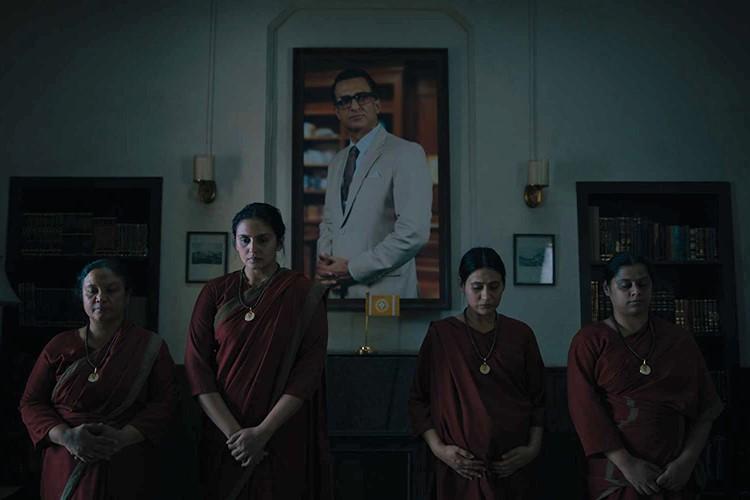
In Prayaag Akbar’s 2017 book Leila, which is in English, the use of Hindustani words is limited but specific: the unconscious use of the appellations “Abbu” and “Ammi” nearly gets Riz and his brother Naaz caught as being from ‘the wrong sector’. In the Netflix show, Shalini meets Riz’s parents and calls them Abbu and Ammi – but the subtitles flatten the words into “Dad” and “Mom”. Other world-building coinages by Akbar – the thuggish army of Repeaters, or the hierarchical division of society into Categories 1-5 – are allowed to remain in the show’s English subtitles, but necessarily translated into Hindi in the spoken version, sometimes losing specificity and power – eg “Paltan” for the Repeaters – and sometimes gaining it: “Panchakarmi” has far greater punch than Category 5.


There are other times when the Hindi dialogue is as nuanced as it is possible to be, delineating minute shades of meaning that then amplify the narrative. One instance not present in the book is when Shalini (Huma Qureshi) happens to witness the police raiding a professor’s study. “Yahan toh Sen wali kitaab bhi hai,” one cop announces triumphantly to his senior. 

“Politics? Aap politics sikhaate hain?” the senior cop demands of the professor. “Sikhata nahi, padhaata hoon,” he replies sharply. That almost pedantic distinction, even on the verge of being arrested, fits the character’s academic persona. But that difference between “sikhana” and “padhaana” also makes a subtle point about this anti-intellectual universe, in which politics can only be understood as a skill – not as a subject of study. And as is already becoming true in our present, it is not a skill that the establishment wishes students to have.

There is another funny detail in the scene. The nameplate outside H. No. 1/20, a mid-sized bungalow of the sort that a Delhi University professor might currently occupy, says “Dr. Nakul Chaubey, MA, M.Phil, PhD”. Given that a PhD implies having all the previous degrees, the nameplate’s recitation of degrees might be intended as humour. But it might also be read as signifying a world in which even visitors to an academic’s house are not assumed to know what a PhD is. As many degrees as possible must be listed on an intellectual’s door, and even that listing is not sufficient armour against the barbarians at the gates. As we – and Shalini – watch in silent horror, the knot of heckling protestors shouting “Nakul Chaubey murdabad” swiftly becomes a lynch mob kicking and punching the unarmed white-bearded man, now fallen to the ground.

The targeting of intellectuals in a Hindutva-driven dystopia has appeared in a previous Netflix India original series, Ghoul (2018), whose writer-director Patrick Graham shares writing credits on Leila with Urmi Juvekar and Suhani Kanwar. In Ghoul, that aspect is more frontally addressed: the protagonist Nida Rahim (Radhika Apte) is the daughter of a retired academic called Shahnawaz Rahim (SM Zaheer). Nida is part of an anti-terrorist force, and much of the narrative tension emerges out of the father and daughter’s starkly different positions on the state’s role in citizens’ lives.

The elder Rahim’s criticism of an authoritarian government is seen by his daughter as seditious. Father and daughter are both Muslim, but the daughter has internalised that second-class status as involving a greater need to prove her loyalty to the state.

That idea of a generational shift is also a shaping influence in Leila, which contains several scenes involving the brainwashing of children – and the attempted reformation of adults – by the new state of Aryavarta.

The show’s vision of Aryavarta feels almost programmatic in its symbolic combining of historical Fascism (a two finger ‘Jai Aryavarta’ salute, for instance) with a recognisable version of the Indian present (a leader called Joshiji whose name appears on every broadcast and every poster). Schoolchildren recite “Aryavarta is my mother” while doing martial exercises; babies are addicted to animated videos about Junior Joshi, whose heroic exploits evoke Bal Narendra.

More disturbing is the use, in the episodes directed by Mehta, of variations on existing Hindu rituals – rolling on the floor, for instance, or the marriage of a woman to a dog – as punishments imposed on women who break the rules of Aryavarta. In times like ours, it seems to me more necessary than ever to distinguish our criticism of the socio-political vision of Hindutva from what feels like a too-easy mockery of Hindu practice. To imagine existing religious practices as future forms of social torture is to display a lack of both imagination and empathy.


Leila also occasionally suffers from feeling like an Indian version of The Handmaid’s Tale, the web adaptation of Margaret Atwood’s novel. Akbar’s novel did contain the core idea of a regime that slut-shames and drugs recalcitrant women into submission, but the Netflix version has replaced the workaday dullness of Shalini’s office-cleaning and one-room-kitchen-attached-bath with a dark, shared dormitory for women who must undergo various forms of abasement, including bathing in dirty water, polishing shoes and being guarded by eunuchs. It also seems to adopt wholesale from Atwood the vision of categories of women dressed in different colours who serve different roles in society (the handmaids, the Marthas and the Wives). 

Still, these categories do provide the show’s most fertile ground for self-examination by the class of Indians likely to be watching Leila. I was excited by the show’s foregrounding of what is a more subterranean strain in the novel, the mistress-maid reversal. But the execution of that reversal, crunched into two years instead of the novel’s sixteen, is too quick to be credible. It allows for no interiority on the parts of either mistresses or maids. And if Shalini doesn’t see how her unearned privilege is part of what has led her world to this point, how will we?

Published in Mumbai Mirror, 23 June 2019. (The first part is here.)

27 August 2018

The Sharpshooter

My Mirror column:

Ismat Chughtai
 would have turned 107 on August 21. Who was she and why should she be the subject of a column on cinema?


The Urdu writer Ismat Chughtai (right) in a still from Shyam Benegal's 1857-set drama, Junoon (1978). Also seen: Jennifer Kendal Kapoor (left) & a very young Nafisa Ali

It was in 1942 that Ismat Chughtai wrote what still remains her most talked-about story. ‘Lihaaf’ (The Quilt) first came out in an Urdu journal called Adab-e-Lateef and then in a collection of Ismat’s short stories published by Shahid Ahmed Dehlvi.

In December 1944, Ismat and her literary contemporary Saadat Hasan Manto were charged with obscenity. The second and definitive hearing in the case took place in Lahore in November 1946. Here is Ismat, in her autobiography Kaghazi Hai Pairahan, recounting with not a little relish how the case fell apart in the courtroom:


The witnesses who had turned up to prove “Lihaaf” obscene were thrown into confusion by my lawyer... After a good deal of reflection one of them said: “This phrase ‘… drawing lovers’ is obscene.”


“Which word is obscene, ‘draw’ or ‘lover’?” The lawyer asked.


“Lover,” replied the witness a little hesitantly.

“My lord, the word ‘lover’ has been used by great poets most liberally. It is also used in naats, poems written in praise of the Prophet. God-fearing people have accorded it a very high status.” “But it’s objectionable for girls to draw lovers to themselves,” said the witness. “Why?” “Because… because it’s objectionable for good girls to do so.”

“And if the girls are not good, then it is not objectionable?”

“Mmm… no.”

“My client must have referred to the girls who were not good. Yes madam, do you mean here that bad girls draw lovers?”

“Yes.”

“Well, this may not be obscene. But it is reprehensible for an educated lady from a decent family to write about them.” the witness thundered.

“Censure it as much as you want. But it does not come within the purview of law.”


The issue lost much of its steam thereafter, writes Ismat. The implied sexual relationship between an aristocratic woman and her devoted maid which made 'Lihaaf' so controversial in its time still remains a hot-button topic. Abhishek Chaubey’s Dedh Ishqiya (2014) made a sidelong reference to Chughtai’s story while depicting the bond between Begum Para (Madhuri Dixit) and her maid Muniya (Huma Qureshi). A proper film adaptation by Rahat Kazmi is also in production, starring Tannishtha Chatterjee.

The division of the world into good girls and bad girls had always been of abiding interest to Ismat. The ninth of ten children, she grew up learning to ride and shoot and climb trees alongside her six brothers and three sisters. Her father, a deputy collector in places like Agra and Aligarh, was a remarkable man who gave all his children an education and the freedom to speak of anything under the sun. In a 1972 interview, Ismat attributed her early success as a writer to her frankness, and that frankness to her upbringing. “We were all frank, my father, my brothers, all of us. We never used to sit in separate groups, women in one place, men in another... We were all considered bold, rude and quarrelsome,” she told the Mahfil interviewer.


But her autobiography makes clear that her forthrightness was highly unusual for a young woman, getting her “bashed up often for telling the truth”. “Purdah had already been imposed on me, but my tongue was a naked sword,” she writes. Here is an example of Ismat’s sword, piercing through the hypocritical veil of 'decency': “The apparently shy and respectable girls... allowed themselves to be grabbed, hugged and kissed in bathrooms and in dark corners by young men who were related to their families. Such girls were considered modest.”


Ismat’s first visit to Bombay was as an inspector of municipal schools. She took the opportunity to reconnect with Shahid Latif, whom she had met in Aligarh and who worked in Bombay Talkies. Upon her urging, he took her to watch a film being shot. The lure of the cinema was a powerful one, and Ismat soon began writing scripts for films. Her first script — Ziddi — was bought by Ashok Kumar, then helping to run Bombay Talkies, for the highly impressive sum of Rs 20,000. To offer a comparison, Ismat tells us the heroine Kamini Kaushal, then already a star, was signed on for Rs 20,000, while Dev Anand — for whom this was one of his first roles — got Rs 6,000.

Between the late 1940s and late 1950s, Ismat went on to write scripts for many other films in Bombay. Of these, Aarzoo, Sheesha, Buzdil
, Fareb, Darwaza, Lal Rukh, Society and Sone ki Chidiya were all produced and directed by Shahid Latif, who was by then her husband. But while some of these (Buzdil, Aarzoo and Sone ke Chidiya) were both commercial and critical successes, it is clear that Ismat's screenplays were necessarily a toned-down version of her literary self. (Asked by the 1972 Mahfil interviewer if there was “any adverse effect on writers who get involved in film writing”, Ismat burst out, “how can I say anything against films because it's through films that we’ve been fed!”)
The one film through which one can experience the unexpurgated Ismat is MS Sathyu's Garm Hava, whose portrait of a Muslim family remains the most nuanced cinematic depiction we have of the effects of Partition.

But Ismat also wrote about the film world. Her novel Ajeeb Aadmi ('A Very Strange Man') is about the talented director-producer Dharamdev, his Bengali wife Mangala who is a talented playback singer, and his affair with the actress Zarina which ends up devastating all their lives. The central characters were entirely recognisable, embedded though they were in a sharply realised fiction that shows exactly how power works in the film industry. They remain recognisable today, even though two of the three are long dead. Perhaps some day soon, someone will make the film, and Ismat’s naked sword will again shine in use.


Published in Mumbai Mirror, 26 Aug 2018.

29 May 2017

The Romantic Realist

My Mirror column:

KA Abbas, who left us 30 years ago this June 1, spent a lifetime seeking to turn the dross of city life into fictional gold.

The opening scene of Bambai Raat ki Baahon Mein has the hero Amar Kumar (Vimal Ahuja) wading carefully into a swamp, his eyes fixed to the viewfinder of his camera. He takes a few shots – people washing in the dirty water, or attempting to clean their clothes on the edge. When he’s done, some locals ask if he has observed the poverty and pollution in which they are living. “Yes, I saw, and the eye of my camera also saw.”

KA Abbas wrote and directed Bambai Raat ki Baahon Mein (‘Bombay in the Arms of Night’) in 1967, creating a romantically-named suspense thriller charged with his characteristic ethical quandaries – here in the shape of a journalist who finds himself in an ethical dilemma. Amar’s expose of the pitiable condition of workers in Daleriawadi catches the eye of the factory owner Seth Sonachand Daleria, who invites him to Delhi and tries to buy him off. What Daleria offers Amar is much more than a bribe: he holds out the salary and perks of what is essentially a corporate communications job – a free house, free car, and tickets to New York, London, Paris.


The scene between Amar and the usually mild-mannered AK Hangal as the wily Daleria is one of the best things about the film – partly because Abbas, who would have known Hangal personally from the Indian People’s Theatre Association (IPTA), could see him as a slightly sleazy old man long before Shaukeen (1981), and as a seasoned businessman long before Garam Hava (1974). But also because of the wryly convincing detail with which Daleria sets up the terms of Amar’s quandary: “Beinsaafi sirf mill mazdooron ke saath hi nahi ho rahi, tum jaise kaabil journaliston ke saath bhi ho rahi hai. Itne acche lekh likhne wale ko sirf 500 rupaye mahina? Usmein se bhi 50 rupaye income tax aur provident fund mein kat jaate hain... [Injustice is not being done only to the factory workers, it is also being done to a capable journalist like you. Only 500 rupees a month to a writer of such fine pieces? And of that too, 50 rupees goes to income tax and provident fund...].”

It is no coincidence that Abbas spent much of his working life as a journalist. Born in Panipat as the great-grandson of Muslim poet and reformer Mohammad Altaf Hussain Hali, Abbas started bringing out a university newsletter while still a student of law at Aligarh Muslim University, while also writing articles and letters to the editors of various publications -- “using different pseudonyms to avoid identification,” according to his translator-editor Suresh Kohli.

Law did not work out, and he moved to Bombay, taking a job at the Bombay Chronicle. Even after he started to write plays (beginning with IPTA’s Zubeidaa) and then film scripts (starting with Dharti Ke Lal, also IPTA, and like Zubeidaa, involving Balraj Sahni), Abbas remained committed to journalism, writing what used to be the longest-running weekly column in India: 'The Last Word', in Russi Karanjia's Blitz. The column also appeared in Urdu under the title Azad Kalam (‘The Free Pen’), which is the name of the newspaper at which Amar works in Bambai Raat.


Although he was the director of 14 features, Abbas’s directorial abilities were uneven and most of his films sank at the box office. Perhaps partly as a consequence of this, until a few years ago, I thought of him as primarily a scriptwriter for Raj Kapoor films, including one of my all-time favourites, Shree 420.

A film that captured the Nehruvian zeitgeist like few others, Shree 420 also centres around an honest hero whom the big city tempts sorely, a young man torn between his genuine feeling for Bombay’s poor and the attractions of the high life. Watching Bambai Raat for the first time at an Abbas retrospective at the Habitat Film Festival in Delhi this week, I could see the same dynamic in action quite clearly. There are other recognisable tropes – the evil capitalist is called Seth Sonachand in both films, while the young lovers find romantic fulfilment in the 10 paise ki chai on the street. The high life – and the lowness of that high life – is embodied in the figures of various women, and often mocked for its hypocrisy: in Bambai Raat, there is a “Dance, Dinner and Fashion Parade” organised to raise money for the Bihar famine, under the shadow of an exceptionally fine linocut of starving peasants, likely by the great artist Chittoprasad.

Despite its noirish aspirations – rain-slicked streets, fast cars, chases, party girls and even the stylish debutante Jalal Agha as a tragically hopeful party boy — there remains something prosaic about Bambai Raat. Abbas was well aware of his limitations -- but didn’t see them as such. In his autobiography he wrote: “My forays into the sanctified field of literature and even into the rarefied field of cinema have been described, and dismissed, as only the projections of my journalism... But good, imaginative, inspired journalism has always been indistinguishable from realistic, purposeful, contemporary literature.”


Published in Mumbai Mirror, 28 May 2017.

Note: Two other recent columns on journalists and journalism in Hindi cinema, here and here

25 July 2016

Starring Scripts, Scripting Stars

My Mirror column:

What made Salim-Javed so unique as screenwriters in Hindi cinema? 


 Salim Khan and Javed Akhtar during their partnership days 
Early in Diptakirti Chaudhuri's book, Written By Salim-Javed, Javed Akhtar recounts the tale of his first ever script narration. He had gone to a producer called Baboobhai Bhanji, having got an appointment with many sifarishes. "[T]he man had listened to the script without interruption. After finishing, a nervous Javed Akhtar respectfully enquired what the producer thought of the scene." "Darling," [came the reply], "your story is good, but there is a big risk involved...this hasn't been used in any film yet."

Telling this story to Chaudhuri decades later, Javed — who went on to form one half of Hindi cinema's most famous screenwriting duo — adds a half-joking postscript, an explanation for his future success in the industry: "I never wrote a story that has not come before." Later, Chaudhuri quotes Salim Khan as saying that he does not believe there is any story that does not derive from something older, except the Ramayana and Mahabharata. "Originality is the art of concealing the source," Salim says.

But what's interesting is that the duo have never actually tried to hide their borrowings. In his first job as a writer, as assistant to Abrar Alvi in the late 1960s, Salim says he "used to suggest ideas he had read in popular novels or seen in Hollywood films". Chaudhuri's book is a film buff and trivia lover's tribute and delights in digging out Salim-Javed's influences, from James Hadley Chase novels to Ibn-e-Safi's Urdu detective stories. Their script for Majboor, for instance, was an emotional reworking of a thriller called Zig-Zag, in which a dying insurance executive frames himself for a murder in such a way that his wife and daughter can benefit from the reward money. Instead of a wrong diagnosis, as in Zig-Zag, Amitabh Bachchan in Majboor is dramatically cured by an operation, but the resolution is very similar.

Even with 
Sholay, their most famous film, the duo have never shied away from speaking of their sources of inspiration. The coin toss scene to decide the course of action is something Salim attributes to a card scene in a film called Garden of Evil; the massacre of the Thakur's family was inspired by Once Upon a Time in the West; while Viru's famous tank scene drew on an Anthony Quinn film called The Secret of Santa Vittoria. The main idea of convicts hired as vigilantes to defend a village wasn't new either — Akira Kurosawa's Seven Samurai, reworked into The Magnificent Seven, had already spawned such Hindi films as Mera Gaon Mera Desh.

It is also undeniable that Salim-Javed plots were full of recurring tropes. Some of these had a longer history in Hindi cinema, but became signature elements of their repertoire: a solidarity with the working class against the rich; the poor hero who would rather break than bend; the mother who raises her children alone; a family lost and then found; the thief with a code of honour; relatives pitted against each other by duty.

And yet, the writing partnership which began in 1971 managed to redefine the course of Hindi cinema, in a single decade. The innovation they are usually credited with is thematic: the figure of the Angry Young Man, whose intense rage against the system had a starkly different tenor from an older Hindi film hero, whose disillusionment was in a more soulful register (think of Pyaasa).

But I think it wasn't so much new plots, but new ways of presenting them and snappy, witty dialogue that made their films seem fresh. And, as with their scripts, it was the 'how' rather than the 'what' of their careers that really made them gamechangers: because unlike pretty much all Bombay screenwriters before them — and most who came after — Salim-Javed managed to position themselves as sole custodians of their scripts.

"Earlier when writers put together a script," says Salim Khan, "it had contributions from the novelist from whom the story was taken, the director who would make the film, the actor who would act in it. When we started working together, we said we will give you the complete script. You will neither interfere in the writing, nor change the finished script."

It was remarkable. They may have cobbled together ingredients from everywhere, but their recipe was sacrosanct. This confidence — which many in the industry perceived as arrogance — began to seem more justified as film after film became a box office hit.

Salim-Javed also took it upon themselves to ensure that their contribution was publicised, often putting their money where their mouth was. They were perhaps the first screenwriters to pay for trade advertisements in their own names. The most famous one appeared in the same Trade Guide that had forecast Sholay as "a sad experience for distributors". It said, "This is a prediction by Salim-Javed... Sholay... will be a grosser of Rupees One Crore in each major territory of India".

Amitabh Bachchan in Zanjeer (1973)
In their story of their rise — which sounds quite like one of their films — they got Rs 10,000 for their first film, and Rs 55,000 for Zanjeer. "After the success of Zanjeer, we decided to increase our price to Rs 2 lakh and did not sell a script for nine months." But eventually they did and by the end, their fee matched that of the top-grossing star in the film, Amitabh Bachchan — exactly as Salim Khan had once told Abrar Alvi it would.

But here's a final question: why did this achievement, stunning as it was, not translate into similar conditions for other writers? Had Salim-Javed simply been co-opted by a star-struck industry, which conceded them individual stardom — but left the ordinary writer as underpaid and overlooked as ever?

Published in Pune Mirror, 25 July 2016.

19 June 2016

The Straight Dope


Udta Punjab may not always fly as high as it wants to, but its portrait of the drug-fuelled state steps fearlessly off the edge. 


There's a moment in Udta Punjab when one of the film's primary characters, an otherwise easygoing young cop, suddenly decides he can no longer be a willing cog-in-the-wheel of the terrible drug chariot rolling through the state, crushing people in plain sight. 


Before his companions guarding the naka know what's hit them, Sartaj has cracked open the headlights of a truck carrying the latest illegal consignment and bashed up its driver instead of letting him through. When his boss manages to get him back under control, he takes Sartaj aside and says to him, deadpan: "You beat up the man, I can deal with that. But why damage the truck?" 

That line of dialogue is a pithy pointer to the tragic state of Punjab today, where the gainers guard a corrupt system — like that truck — at the cost of a vast population. Cheap drugs have made inroads into the smallest hamlets, eating through the innards of a once-prosperous state. From the political big man to the small-time operator, the gainers worship at the altar of money, closing their eyes to the human wreckage piling up behind the throne. 

Sudip Sharma, who wrote the superb and harrowing NH10, joins forces with director Abhishek Chaubey to write this ambitious but not completely successful script. Unlike NH10, which channels our fear of the other, creating a chillingly believable war in which the battlelines are drawn by patriarchy, Udta Punjab asks us to suspend our disbelief as its disparate characters unite across barriers of class, language and experience, against drugs. 

The quietly winsome Punjabi star Diljit Dosanjh plays Sartaj Singh, a policeman who has no problems being on the take until he's shocked and then taunted into a change of heart by a personal situation — and by Kareena Kapoor's saintly but sharp-tongued activist-doctor Preet. Alia Bhatt plays an unnamed Bihari migrant labourer whose attempt to use drug money to engineer her way out of her circumstances goes terribly awry. And finally, but most importantly, we have Shahid Kapoor as the seriously unstable Tommy Singh, a rockstar whose highs and lows as a performer are no longer extricable from his highs and lows as a coke addict. 

There is nothing wrong with the characters per se. In fact, Sharma and Chaubey make a wise choice by deciding to keep the focus on each character's personal battle with drugs—the only one who seems to be acting purely out of the goodness of her heart, Kareena's Dr Preet, is the least fleshed-out (though Kareena isn't terrible, and she even has some sweet scenes with the effortlessly effective Dosanjh). 

But I found it hard to believe in the ease of the romantic alliance between the highly qualified Preet and the largely uneducated Sartaj—perhaps if we'd had more time with these people, it would have seemed less convenient, less pat? Bhatt dives enthusiastically into her harrowing role, but despite her valiant efforts at Bhojpuri, neither her body language nor her accent allowed me to believe she was anything but Alia Bhatt in brownface. As for her character's hockey-playing past, I wish it had had more play—it's certainly easier to imagine Bhatt as an aspiring rural sports star than as a landless labourer used to working in the fields. Who knows, I may even have believed in a rockstar falling for her. 

Shahid Kapoor gets the best written role, but he also puts body and soul into it. His Tommy Singh is the film's crazed, throbbing heart: careening wildly through both his concerts and his life, and dragging us willingly with him. It is Tommy — and the darkness of his life in the spotlight — that gives Udta Punjab that edge of madness, of devil-may-care-ness, that is so threatening to the powers-that-be. And certainly there is an unapologetic use of gaalis and cusswords -- not the only thing about the film that seems Tarantinoesque. 

But other than the lyrics of a song like Chitta Ve —dedicated to the 'White One'—you'd be hard put to find something in Udta Punjab that could be construed as "glorifying" drug use. But while Chaubey is obviously gifted in his ability to make narrative use of songs (think of Dil Toh Bachcha Hai Ji in his marvellous first film Ishqiya), songs in our cinema do sometimes have a tendency to become breakaway units, declaring their independence from the film that houses them. 

On the whole, Chaubey's film makes it absolutely clear which side of the fence it's on, showing us a whole gamut of utterly depressing examples of people and families gutted by addiction: in homes, in jails, in hospitals and de-addiction centres, and most scarily, in the thousands of empty sheds and barns and brick shelters across the state in which young men and boys lie about, shooting up all day. 

It is the smaller characters that make Sharma and Chaubey's script really speak—from Sartaj's sharp-eyed boss Jujhaar Singh, who counts himself amongst the gainers, to the creepy rapist (Vansh Bhardwaj) who takes selfies with his drugged victim before injecting himself with another dose of something. 

Udta Punjab isn't a perfect film, perhaps not even a great one. But it has an unstoppable energy, and a fierce honesty of purpose that almost always manages to stop short of preachiness. That's worth a great deal.

Published in Mumbai Mirror, 19th June, 2016.