Showing posts with label Om Puri. Show all posts

4 June 2021

How Benegal turned an '80s train ride into a journey of self-discoveries

For my weekly column in Mirror/TOI Plus, the seventh piece in a series on trains in Indian cinema: 

Shyam Benegal's thought-provoking television series Yatra gave the Indian Railways a stellar role, as the thread that stitches the country together


Yatra
, the 15-episode series telecast on Doordarshan in 1986, may be the most dedicated depiction of the Indian train journey on screen. Directed by Shyam Benegal, the profoundly memorable show was based on a screenplay by his longtime screenwriter Shama Zaidi and theatre director and playwright Sunil Shanbag. It was sponsored by the Indian Railways, which gave Benegal the use of a 10-bogey train for the 50-day shoot.

Benegal decided to have the show unfold – consecutively -- on two of the longest journeys you could make by rail in India at the time: On the Himsagar Express, which ran from Kanyakumari, at the southernmost tip of India, to Jammu in the north; and the Tripura Express, which ran from west to east, from Jaisalmer to Guwahati. We begin the journey with the Himsagar Express, in Kanyakumari, where Lance Naik Gopalan Nair -- Om Puri playing a Malayali armyman posted in Jammu -- misses his train. Gopalan and his wife's frenetic taxi ride to catch up with the train at the next station (and when they miss it there, the next one) is one of many delightful narratorial devices in Yatra -- among other things, enabling Benegal's brilliant cinematographer Jehangir Chowdhury to shoot the train from the outside.


Inside, on the moving train, we meet a cast of characters as varied as the country -- many of them revealing to us an aspect of the country's troubles, small or large. The telling is gentle, but the stories are powerful. An old Marathi couple who have just lost their daughter to dowry murder find themselves taking care of a young Punjabi woman (a marvellous Neena Gupta) who is escaping ill-treatment by her mother-in-law and trying to get to her natal home in Jalandhar before she delivers a baby. A theatre troupe that has just lost a crucial actor to Bombay is trying to get the play back on track before getting to Delhi for a performance scheduled at the National School of Drama. An ageing, unwell Hindu ascetic is being accompanied to Jammu by his devoted disciple (played by the wonderful Mohan Gokhale) because he wants to see the Himalayas one last time. A Muslim husband who has been wanting his doctor wife to give up her medical practice finds himself unexpectedly affected by helping her deliver a baby.

As a child of the 1980s, I remember being entranced by Yatra, recognising its difference from the cinematic content around me without being able to name that difference. The beautifully-captured train journey allows you to travel vicariously through the country. And many of the things that Benegal brought into the narrative were not things that found space in mainstream, popular culture. As the train moves from the Andhra region towards the jungles of Madhya Pradesh, for instance, we are introduced to an activist for minimum wages for adivasi labourers who has attracted the ire of landlords in Nellore district. Now a whisteblower on the run, Venugopal is taking some documents to Delhi – but there's a bunch of goons who know he is on the train. Even to a child who knew nothing of the world, it was somehow clear that these goons – perfectly ordinary looking, mostly unspeaking, not particularly large or muscular – were more dangerous than the henchmen the villain sent out in Hindi cinema. Even today, it is chilling to watch the scene where Venugopal gets dragged out of the train while everyone else is distracted by a theft.

There is a lovely unpredictability to Yatra's narrative, however, in which such moments of gravity and fear can segue into humour and joy – and sometimes the opposite. And as often happens when you spend some time together, people you might have dismissed at first glance begin to seem human, vulnerable, perhaps even worthy of admiration. Benegal achieves some of this empathy through Om Puri's Gopalan, who serves as a conscientious but opinionated narrator. Thus the ailing swamiji, whom Gopalan thinks is all talk, turns out to have once fought in Subhash Bose's Indian National Army. The theatre troupe, whom the Armyman dismisses as having no serious work, is actually the only group of people who are working throughout the train ride. Their frazzled stage manager (the dependably superb Harish Patel) seems like a drunken buffoon who can't possibly be coached to act – but after an accident brings him to his senses, the whole compartment watches him transform into Ashwatthama.


But as in life, so on the Indian Railways: Everyone has their own journey to complete. The characters get on the train, learn something of each other's lives, and then part when their destinations arrive. Yet something meaningful is often forged in that fortuitous intersection of time and space. A young man heading to a job interview becomes besotted by a pretty young co-passenger, wooing her silently in the presence of her oblivious parents while making up verbose dream sequences with her in his head. The Marathi couple are so clearly taking care of the pregnant Neena Gupta that the railway doctor and others constantly mistake them for her parents. Later, Om Puri's Gopalan, trying to follow up with the railway authorities on the disappeared Venugopal, is asked the same question. “Aapke koi rishtedaar thhe?” Puri pauses, and his silence contains multitudes. “No,” he responds quietly. “We only met on the train.”

Published in Mumbai, Bangalore and Pune Mirror/TOI Plus, 30/29 May 2021.

15 July 2019

The White Noise of an Urdu Poet

Very happy to report that I started a new column called Shelf Life, down at TVOF. A monthly look at literature through the prism of clothing. Here's the first piece!

In fiction and film, Urdu poets find their distance from the mundane through pristine white, mostly a kurta pyjama. Time perhaps to dye them differently? 


In Anita Desai's magisterial 1984 novel In Custody, which was adapted into a Merchant Ivory film in 1993, a small town college lecturer sets out to interview a great poet. The lecturer, Deven Sharma, teaches Hindi for a living, but dreams his literary dreams in Urdu—and Nur Shahjehanbadi is his idol.
Almost from the beginning, Desai uses clothes to mark the gulf between the two, to show us who they are and sometimes who they are trying to be, but failing. 

When Deven first knocks timorously at his door, Nur is lying there, “like a great bolster laid on a flat low wooden divan”. But even without words, in semi-darkness, the poet exudes a certain charisma, a grand visibility that has something to do with being dressed entirely in white, his “white beard splayed across his chest and his long white fingers clasped across it.” To Deven's awestruck eyes, his size and immobility suggest a marble statue, “large and heavy not on account of obesity or weight, but on account of age and experience."
Nur's all-white kurta-pyjama emerges as a signifier of his distance from the mundane, his separateness from the crowd. When Deven begins to doubt his gaze, Nur reappears “freshly bathed and looking truly poet-like in fresh, starched white muslin clothes, loose and flowing and free...”. He is a vision of purity, but purity in danger of being soiled by the lowly chaos around it. That metaphorical image is one Desai draws out fascinatingly, given that this is a Muslim man being described by a Hindu one: “It was clear to Deven that these louts, these lafangas of the bazaar world—shopkeepers, clerks, bookies and unemployed parasites lived out the fantasy of being poets, artists and bohemians here on Nur’s terrace, in Nur’s company... what was astonishing was that the great poet Nur should be in the centre of it, like a serene white tika on the forehead of a madman.”


It is Deven's hero-worshipping gaze that keeps Nur “poet-like”, even after he soils his clothes. So it should be no surprise that the gaze Deven turns upon his own clothes is one of self-loathing, a tragic combination of economic deprivation and aesthetic despair. His Urdu department colleague Siddiqui Sahib has both the money and the taste for “a fine muslin shirt” to wear to college, Deven's only new shirt is a pale green nylon one from his in-laws. When his wife brought it, “he had tossed it on to the floor in an obligatory fit of temper--the meek are not always mild—saying the colour was one he detested, that the buttons did not match, that the size was too large—how could they have chosen such a cheap garment for their son-in-law?” Now, setting out on what feels like the most important assignment of his life, he feels he has no better option—though Sarla smirks when he asks her for it. 
Om Puri, the superb Deven of the film, gets a better deal. We see him in a Nehru jacket over a khadi kurta-pyjama, and once even a dark sherwani. Ismail Merchant seems to have decided that no Indian literary man—even a mere lecturer with a penchant for Urdu poetry, who keeps announcing self-deprecatingly that he is “only a teacher”—can be clad in the cheap bush-shirts and trousers that Anita Desai wrote.
But how do we understand Merchant's decision? Is there a self-Orientalising gaze here? Of course, the Urdu poets of the late Mughal court wore even finer clothes: Shamsur Rehman Faruqi's The Mirror of Beauty spends pages describing Zauq's mashru tunic and wide pyjamas, or Dagh's five-pointed black cap. But does associating present-day Urdu poets with the imagined uniform of a long-gone Muslim nobility celebrate that historical culture, or is it a form of othering we could really do without now? 
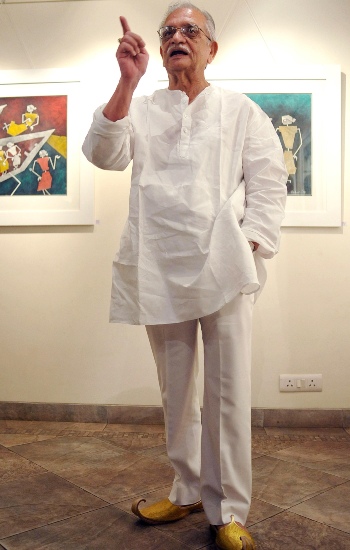
The great film lyricist Gulzar said in a 2017 interview that he has worn white since his college days, and it would “feel false” to wear colour now. But when asked if he feels most himself in a kurta-pyjama, he said he has never worn a pyjama! He wears a Punjabi-Pathani shalwaar on Sundays, of the sort worn in his home-town of Dina in Pakistan, and earlier often wore a dhoti. But what he wears almost all the time is “a regular pair of trousers, with the front crease and everything...” said Gulzar. “It’s just because I’m an Urdu poet that people assume I’m wearing a pyjama with my kurta.”
Photo: AFP PHOTO/STR STRDEL/ AFP

Poet and lyricist Gulzar at an exhibition in Mumbai.
Who is this fictional Urdu poet, who must wear only white, or even only kurta-pyjama? The image may have been truer when In Custody was written, but even the 84-year-old Gulzar has spent a lifetime playing tennis, wearing shorts. The young Urdu poets you might meet at a mushaira in Delhi, at Jashn-e-Rekhta or one of the city's many literary festivals, might be software engineers or tourist guides, TV journalists or government school teachers. They may be “of the bazaar world”, but are no lafangas. And you cannot identify them by their clothes.
Published in The Voice of Fashion, 2 July 2019.

22 April 2019

Prisons of the Mind


At 25, Ismail Merchant's In Custody (Muhafiz) remains a striking vision of poetry amidst pettiness, as well as a memorable tale about Urdu and Hindi.  


In 1984, Anita Desai was nominated for the Booker Prize for a novel called In Custody. It was a marvellous book about a shaggy old poet called Nur, whose last days we observe through the eyes of a college lecturer called Deven. Desai wrote her story in crystalline English, but the world she captured was that of the death throes of Urdu – as witnessed by a teacher of Hindi.

A decade later, the novel was made into a film by Ismail Merchant, starring Om Puri as the nervous, embattled Deven, and Shashi Kapoor – who had been a Merchant Ivory favourite from The Householder (1963) through ShakespearewallahBombay Talkie and Heat and Dust (1983) – as the teetering but still somehow charismatic Nur.


Interestingly, Desai agreed to adapt her book for the screen, collaborating with Shahrukh Husain, to whom we owe the fluid Urdu/Hindustani/Hindi in which Desai's imagined universe is translated back to life. Desai, the daughter of a German mother and a Bengali father who had been to school and college in Delhi, had set her novel between the hubbub of Old Delhi and the dusty provincialism of the fictional Mirpore, a trading town not far from Delhi. The film kept the poet's locational moniker “Nur Shahjehanabadi”, but transposed him (and the hole-in-the-wall magazine office run by Deven's friend Murad, which is angling for an interview with him) from the gullies of Shahjahanbad to Bhopal.


It was probably a practical decision, and certainly a more visually pleasing one. The circuitous route to Nur's house no longer went past “the reeking heart of the bazaar”, “evil-smelling shops” or the “lane lined with nothing but gutters”, but into a picturesque part of Bhopal. And the cinematic version of the haveli has a certain charm, despite the dysfunctional lives lived in it. The downstairs is presided over by the poet’s first wife, the perfect Sushma Seth, who spends her days supervising the fine chopping of onions and the utaaroing of nazar, while the upstairs is the preserve of the younger second wife, the complex, high-strung aspiring poetess Imtiaz Begum (Shabana Azmi).


Deven arrives with a very different vision of the life poetic than the one he finds being led by Nur. The film distils Desai's sharp-edged observations into something quite brilliant. An admirer of Nur's verse, Deven initially sees the great poet as trapped: when he seeks to escape the petty domestic squabbles of his household, his escape is limited to a circle of lowbrow sycophants. The delicacy of Nur's poetic imagination, it seems to Deven, cannot be nurtured by the coarseness that surrounds him. There is clearly an echo of recognition here – Deven, too, has aspirations to poetry, which he still writes – in Urdu. He feels defeated by having been tied to the mundane: the teaching job – in Hindi – that pays his bills but forces him to suffer the sly, mocking glances of students for whom romance tends more to dark glasses and motorbikes than literature; the harried, put-upon wife who does not understand poetry or the desire for it; the little son whose abilities seem too ordinary and unliterary to attract Deven's attention.


But Desai is not so one-sided as to allow even her favoured protagonists to get away with such easy self-delusion. The film incorporates these layers beautifully into the performances. We watch Deven's petulant, unnecessarily bossy behaviour with his wife Sarla (a superb Neena Gupta, who responds with the perfect balance between silent reproach and jaded complaints). We observe Nur’s own flaws: his indiscipline, his indulgence of the senses, his addiction to the excesses of alcohol and rich Mughlai cooking and late hours kept in the company of flatterers whose crude verse is so obviously no match for the quality of his. If coarseness there is, it is as much of Nur's making. And if the women are insecure, jealous, petty even when they have some ambition, In Custody is astute enough to show us that they cannot really be blamed: the limits of their imaginations are the limits of what their civilisation has allowed them.


The book went into much greater detail about the politics of Hindi and Urdu, with the poet often mocking Deven's employment in a Hindi department: “Forgotten your Urdu? Forgotten my verse? Perhaps it is better if you go back to your college and teach your students the stories of Prem Chand, the poems of Pant and Nirala. Safe, simple Hindi language, safe comfortable ideas of cow worship and caste and the romance of Krishna,” he derides Deven, in a line that seems bizarrely blind now. There are complaints about the Congress having placed Hindi and the Hindiwallahs atop the literary establishment, while Urdu is imprisoned in “those cemeteries they call universities”. Thirty-five, even 25 years ago, the fictional Nur and his bazaar hangers-on – largely Muslim, young, unsophisticated of taste and insecure of income – could still mock a Hindu lecturer of Hindi who had come to pay his respects to Urdu. If Nur stood for the decrepitude and self-delusion of Urdu, Hindi was represented by the innocuous wannabe poet Deven. That equation has changed, perhaps forever.

20 November 2017

Familial Fault Lines

My Mirror column:

Arshad Khan’s documentary memoir Abu bravely opens up a personal and familial history, touching on issues of cultural alienation, religion and sexuality.


"Migration is the hardest thing in the world. That, and coming out.” So says Montreal-based filmmaker Arshad Khan in the voice-over for his remarkably courageous autobiographical documentary Abu, which was screened yesterday as part of the sixth edition of the Dharamshala International Film Festival (DIFF). The 81-minute film, whose title is simply the Urdu word for father, is Khan’s attempt to grapple with his complex relationship with his late father: a Pakistani Muslim man who migrated to Canada in the 1980s and never really came to terms with his son being gay.

Abu’s unexpurgated deep dive into difficult issues draws on an astounding archive of VHS home videos taken during family gatherings in Pakistan, placing those grainy recordings of picnics and parties and weddings in conjunction with more recent iPhone and Flip-cam footage, as well as interviews that Khan shot with his mother, father and elder sister. “My family happens to be obscenely well documented. My father loved photography and he loved technology and documentation. We have photos from as far back as the 1930s,” Khan said in his statement to DIFF. This intensely personal — and often just intense — real-life footage is interspersed with other kinds of audio-visual material that leavens it with a much-needed playfulness, even humour. So, for instance, the religious certitude of his father’s dream — in which the old gentleman learns that he must visit the Al Aqsa mosque in Jerusalem and make a Hajj pilgrimage to Mecca before his death, which the dream prophesied would happen at 3am — acquires a totally different register when Khan turns the dream’s constituents into a cheerful animated sequence.

At other times in the film, we move seamlessly from Khan’s recounting of some fraught personal moment into a classic Hindi film song. For members of Abu’s subcontinental audience, at least, these are transitions that provide momentary relief from documentary realism (as we allow ourselves the guilty pleasure of humming along with Dev Anand and Waheeda Rehman in Guide) – while also enabling that familiar amplification of emotion that popular Hindi cinema has always offered space for. The lyrics of the Guide song “Aaj phir jeene ki tamanna hai, aaj phir marne ka irada hai [Today I wish to live again, today I’ve decided to die again]” do assume new meaning when placed in the midst of a voice-over-led documentary about a gay man who’s describing the terrible self-hate he underwent for years as a teenager and young adult in Canada.

Watching Abu, I was reminded of a film made by another Pakistani Muslim man about another Pakistani Muslim migrant father: Ayub Khan-Din’s East is East. First performed as a play in 1996, East is East became a hugely successful 1999 feature film, with the late Om Puri putting in a spectacular turn as the baffled, angry, violent George Khan. Like the real-life Arshad, who wants nothing more desperately than to fit into the largely-white Canadian universe into which migration has catapulted him, George Khan’s British-born children – the product of George’s relationship with his British wife Ella – resent their father’s insistence on trying to make them fit his notion of good Pakistanis.

Although East is East is set in England in the early 1970s, and Abu unfolds in Pakistan and Canada from the 1980s to the 2000s, it is remarkable how similar the themes are. The fictional George presses his reluctant children to attend namaz at the local mosque, practically kidnaps his youngest son into a circumcision and tries his hardest to marry his elder sons off to suitable Pakistani girls without once conferring with them: one of them, Nazeer, abandons his bride on the wedding day and is later revealed to be living with his male partner. Arshad’s father, in a different time and country, responds to his suspicions about his son’s sexuality by turning rides in the family car into forced listening sessions for Islamic discourses about the evils of homosexuality, in which gay sex is only a step away from paedophilia, and not that distant from bestiality.

Unlike George Khan, though, religion seems to have given Arshad Khan’s parents a real sense of support, as economic migrants adrift in a culturally alien milieu. Meanwhile Arshad himself seems to have some fondness for the world his parents left behind. Unlike George’s daughter Mina (the stellar Archie Panjabi), whose rendition of 'Inhi Logon Ne' with a floor wiper and a dupatta is entirely comic, a subversive send-up of the Meena Kumari performance, Arshad’s incorporation of Pakeezah footage comes with fond nostalgic memories of his mother secretly dancing to Pakeezah songs on the record player – and footage of her actually dancing in a family gathering.

But the thing that makes Abu, like East is East, truly significant is an ability to see beyond simple ideas of villains and victims. These are parental figures that may seem cold-hearted and cruel to their children, but what these films so heartbreakingly make us see is that they are themselves vulnerable.


Published in Mumbai Mirror, Sun 5 Nov, 2017.