Showing posts with label short stories. Show all posts

5 April 2021

Book Review: A Gujarati literary legend finds a home in English

Celebrated Gujarati writer Dhumketu doesn’t get his due in the latest translation of his work

Gaurishankar Govardhanram Joshi (1892-1965), who wrote as Dhumketu, was a pioneering short story writer in Gujarati.
Gaurishankar Govardhanram Joshi (1892-1965), who wrote as Dhumketu, was a pioneering short story writer in Gujarati. (Wikipedia)

“The short story is not the miniature form of the novel... The novel says whatever it wants. The short story, by rousing the imagination and emotions, only alludes to or provides a spark of whatever it wants to say.” These words, in the original Gujarati, appeared in the 1926 introduction to Tankha (Sparks), the first collection of short stories by the Gujarati writer Dhumketu, the nom de plume of Gaurishankar Govardhanram Joshi (1892-1965). Nearly a hundred years later, you can finally read them in English, in Jenny Bhatt's translated volume Ratno Dholi: The Best Stories of Dhumketu.

Bhatt, a Gujarat-born writer and podcaster now based in the US, has clearly thought long and hard about the shape of the book. Taking seriously the burden of responsibility that comes with representing the pioneering Gujarati author to the contemporary English-speaking world, she has picked one story from each of his 24 published collections, plus two of her own favourites. The book certainly displays his range.

It begins with what is perhaps Dhumketu's most anthologised tale, The Post Office, in which a postmaster who once mocked an old man ends up haunted by his ghost. The ending teeters on the edge of the Gothic, making one think of the Russian short story giant, Nikolai Gogol, with its use of the supernatural to invoke a moral justice that social reality rarely seems to grant us. Dhumketu isn't writing ghost stories, but there is often a suggestion that deeply felt hurt or expectation leaves its imprint in the universe even after death—often in the minds of those who caused or ignored it.

In The Post Office, old Coachman Ali's lifelong wait for his daughter Mariam's letter only makes sense to the postmaster when he is anxious about his own daughter. In Svarjogi, an old shehnai player summons the painfully despondent notes of Raga Jogiya only on the death anniversary of his son—who had played them in life. In Ratno Dholi, a village drummer who thoughtlessly drives his lover to suicide ends up imagining her dancing to his dhol for the rest of his life.

Not unexpectedly for a writer born in the 19th century, Dhumketu was also drawn to historical romance as a genre, writing several novels set in the ancient India of the Guptas and Chalukyas. His historical fiction is represented here by Tears of the Soul, which retells the legendary story of Amrapali, a woman condemned by her democratic city state Vaishali to become a nagarvadhu (courtesan, literally “wife of the city”). If such a beauty was to accept any one man as a husband, went male logic, there would be civil war.

Although he turns a critical spotlight onto male-made laws, Dhumketu's real condemnation of Amrapali's predicament is tied to applauding her sacrifice as a mother. In some other stories, too, Dhumketu is revealed as very much a man of his time. Female deservingness is often premised on sexlessness, most sharply in When a Devi Ma Becomes a Woman, the Gorky-inspired tale of a hostel-wali deeply admired by her male hostellers—until it turns out that she is human enough to respond to the odd sexual overture.

But Dhumketu certainly emerges as a sympathetic observer of the unfairness of women's lives. In the tale of two Kamalas in A Memorable Day, the matter is treated as one of luck: one woman finds herself forced to sell her body, while the other has a like-minded partner and a tasteful home. In The Noble Daughters-in-law, the widowed bahu of a rich household is shooed out, and finds herself sheltering in the home of another unhappy daughter-in-law. There is the hint of attachment between the two women, including a kiss on the cheek, before the story ends in a dramatic double suicide that made me think of Deepa Mehta's 1996 film Fire, and of so many lesbian loves that end in similar tragedy in India.

Women are also embedded in social hierarchies of caste and class, and suffer their consequences. In The Gold Necklace, Dhumketu reverses the traditional social hierarchy between wife and mistress. Caste appears frequently, as descriptor and motor of plot: the vagharin, whose low social status taints a man who helps her; the gohil and kaamdaar who prop up the colonial-feudal structure of the Gujarati village; Brahminness mentioned by characters to establish their gentility in many stories, including the comical The New Poet.

Ratno Dholi: The Best Stories of Dhumketu, translated from the Gujarati by Jenny Bhatt, published by HarperCollins India, 324 pages,  <span class='webrupee'>₹</span>399.
Ratno Dholi: The Best Stories of Dhumketu, translated from the Gujarati by Jenny Bhatt, published by HarperCollins India, 324 pages, ₹399.

Dhumketu is no radical, but these stories show an abiding interest in marginalised figures—the penitent criminal in Kailas and The Prisoner of Andaman, the disabled person in Mungo Gungo, the sick low-caste woman Sarju in Unknown Helpers, or the ekla ram, a man who chooses to distance himself from the village's social norms, like Makno Bharthi in The Worst of the Worst.

Some of these solitary souls immerse themselves in art or music: Ratno the dhol-player, the shehnai player of Svarjogi, the sarangi player of My Homes, or even the literary young man of A Happy Delusion. When he writes about these musicians, or even about the aesthetic domesticity of the housewife Kamala in A Memorable Day, Dhumketu is both generous and appreciative.

Fittingly for a writer, perhaps, he displays greater ambivalence when describing literary ambitions. The aspirational poet or writer, especially, gets a drubbing, whether the clerk Bhogilal of Ebb and Flow, the highfalutin train passenger of The New Poet, or the intently focused but talentless Manmohan of A Happy Delusion.

Bhatt's dedication aside, her translations leave much to be desired. Her literal renditions of the original leave us repeatedly in the grip of florid, often archaic language (“Then, because they had not heard such melodious, sweet, alluring, rising and falling music in years, an illicitly joyful passion grew in the soul of thousands” or “Her memory did not endure anywhere now except during the rare occasions of general small talk”), not to mention constantly tripping up against such formations as “slowly-slowly” or “From downstairs, a melodious, bird-like voice came”.

However deliberate Bhatt's approach might be, the English feels jarring; the sentences marred by roundaboutness and redundancy. “What if this amusement was flowing due to his writing?" thinks one character, while a policeman tells a woman “to be careful with [her] tongue when speaking”. Very occasionally one gets a glimpse of what I imagine is Dhumketu's idiomatic Gujarati, such as in Old Custom, New Approach, where a man complains sardonically about modern bureaucracy: “Letters speak with letters. People avoid other people, this is called administration.”

One hopes someday he will receive a better interpreter. In the meanwhile, this is a valuable addition to your Indian classics bookshelf.

Published in Mint Lounge, 5 Jan 2021.

24 November 2020

Shelf Life: Out of Vaidehi's Closet

My Shelf Life column for October 2020:

The link between clothes, sexual attractiveness and power is incestuous and can be unnerving. Kannada writer Vaidehi’s stories literally disrobe it.


Vaidehi's stories shocked me when I first read them. I don't mean in the manner that the 1945-born writer has apparently “sometimes shocked Kannada intellectuals”, by publicly declaring such things as 'The kitchen is my guru, that's where I have learnt many lessons'. The incongruity there, as a critic cited by editor-translator Tejaswini Niranjana in her introduction to Vaidehi's Gulabi Talkies and Other Stories (2006) points out, lay in one of modern Kannada's most successful writers speaking like a 'full-time grihini or housewife'. And yet, what Vaidehi was doing by adopting such a public stance was precisely why her fiction jumped out at me: she was forcing the (male-dominated, genteel, largely upper caste) world of Kannada letters to engage with the world of women as she knew it. She refused to be co-opted into literariness as they knew it. 

Since the late 19th century, women have been writing fiction about women's lives, not just in Kannada, but in Bengali, Marathi, Tamil, Urdu, Hindi and more. So Vaidehi, also Janaki Srinavasa Murthy, born 1945, married to KL Srinivasa Murthy at 23, and mother of two daughters, wasn't the first. But her words lift the ceaseless labour of women's lives out of the domestic space and onto the page with a ringing clarity. Somehow, the closer she sticks to the materiality of these circumscribed, cyclical lives – food and rituals, weddings and babies, illness and mortality – the more starkly we see their political, even philosophical ramifications. As she puts it: “What is important to us [women] is not whether the world is truth or lie. But work, work and more work.”

A still from the film Gulabi Talkies (2008), adapted from Vaidehi's short story by the director Girish Kasaravalli.

Among the material objects that recur in Vaidehi's stories are clothes. At one end of the spectrum is what is ritually and socially prescribed for women: the red saris encumbent on shaven-headed Brahmin widows; the gold jewels to measure a bride’s status. At the other are clothes as markers of individuality, the body as a canvas on which fashion can paint new identities.

But what was fashion in this India of sleepy villages and one-street towns, where the age-old injunctions of caste and age and community controlled so much of what people wore? In the title story Gulabi Talkies the opening of a local cinema triggers new dreams: “Day by day the bangle shop began to stock various kinds of face powder and other cosmetics...the seamstress struggled to tune her skills to the new fashions and her creations were passed off as fashionable, causing a commotion in the world of clothing which crossed over into the speech and gait of women...”.

The fashions of Vaidehi's tales may seem basic to us – but oh, how women wanted them. And how willing they were to suffer the consequences, because fashion felt like freedom. In ‘Remembering Ammachi’, for instance, the child narrator helps the grown-up Ammachi pleat her sari pallu “so that both its borders could be seen”. They set out for a neighbour's puja, but are barred by Venkappaya, who has arrogated to himself a status somewhere between adoptive brother and future husband. “How coquettishly you're going to town,” he rages. “That pallu has been pleated in such a way as to show both the breasts.”

Kannada writer Janaki Srinavasa Murthy, also known as Vaidehi. (Photo: Wikimedia Commons)


The poorer the women are, the more meagre their aspirations – and the more excruciating their non-fulfilment. In Tale of a Theft, the hungry Bachchamma thinks of the prohibitive price of glass bangles while sitting next to women covered in gold. In Vanimai, the titular central character is a woman with mottled, flat feet whose “biggest dream was to own a pair of slippers”. This is nothing short of radical in a milieu where a man called Narasimha can tell Vanimai’s elders never to buy her slippers, declaring with perfect assurance: “Those who use footwear are either the prostitutes of Bombay or the mistresses of the town. Not decent people...” 

The spectre of the whore, in fact, is ever-present in these tales. Whether it's Narasimha taunting Vanimai or Venkapayya deliberately ruining Ammachi's secretly-tailored back-button sari blouse, being fashionable makes women attractive – too attractive. 

The late Nirad C. Chaudhuri, one of our most politically incorrect writers, once speculated that Indian women have historically had so little free contact with men that they dress only to compete with each other, that is they are acquisitive and overdressed. “It follows from this tradition,” wrote Chaudhuri in 1976, that “a woman in “very smart or piquant dress”... “must be fair prey”. To prove his point he recounted two anecdotes, in both of which “lower-class” men associate being well-dressed with sluttiness. 

But of course it isn't only poorer men, or even only men, who tar women for wearing certain clothes. In Vaidehi's Chandale, watching Beena “climbing up the compound in her short skirt” makes the older Rami “want to scream”. In a stunning image, the nervous housewife suddenly imagines the carefree teenager “winking at [her son Satisha] in the style of a Mumbai prostitute”. So obvious is the link between clothes and sexual attractiveness, and between sexual attractiveness and power, that it is all we can do to suppress it in those we believe don’t deserve power. Mostly, that’s other people. Sometimes, it includes ourselves.

Banner: A book cover of Gulabi Talkies and Other Stories (2006)' a still from the film Gulabi Talkies. (2008)

Published in The Voice of Fashion, 23 Oct 2020.

6 September 2020

Shelf Life: Do Clothes Make the Woman?

The August edition of my column for The Voice of Fashion, on clothes seen through the prism of literature:

A story from Nisha Susan’s The Women Who Forgot to Invent Facebook and Other Stories casts clothes as signifiers of selfhood

All the world's a stage, but not all men and women are players. Meena, Annie and Nayantara – the self-declared “goddesses” of Nisha Susan's story 'The Trinity' – clearly are. Susan's deftly-drawn Kochi undergrads are all crackling confidence, their position atop the social pyramid propped up by each other's presence. Even before their 'fusion dance' choreographies start to win gold medals and glory, the trio is already living out their lives before an imagined applauding public. “In college, when the three of us walked in, I used to feel like we were in those campus film-like slow motion scenes,” says the story's narrator Nayantara. “Not like the fat twenty-five year-old heroines in Malayalam campus films, but Hindi film heroines.”

Costuming, of course, is crucial to a successful performance – and the trinity is always ahead of the curve, not part of the herd: “We were thin and tall before anyone else was thin and tall... We had good sunglasses, not those big, ugly Gulf-return ones. We wore ghagras at weddings before anyone else did. We draped dupattas over our elbows casually, even though our arms ached by the end of the day.” Sometimes their clothes stage liberatory forms of public disguise. On a trip to Thiruvananthapuram, they walk around “pretending to be NRI Malayalis who did not understand Malayalam”, their tight jeans and sunglasses a license to do things that local girls might attract censure for, like inspecting the city's famously naked giant mermaid statue. At other times, they design costumes for an actual stage – on the same Thiruvananthapuram trip, their combining of sleeveless sari blouses and salwars with tightly draped dupattas electrifies and scandalises the Malayali youth fest audience. (“Malayalis have this thing about 'sleeveless'. Sleeveless means bad girl. Usha Uthup-voice bad girl. Never mind that stomach and back and breasts are showing when you wear a regular sari blouse.”)

'The Trinity' is part of The Women Who Forgot to Invent Facebook and Other Stories (Westland, 2020), Susan's debut collection. The book's unifying thematic premise is India's digital landscape: it couldn't be more contemporary. But reading it made me think of a story from 132 years ago: Rudyard Kipling's 'A Second-Rate Woman', first published in 1888, and reissued most recently in a selection of Kipling stories named for a recurring character, Lessons for Mrs. Hauksbee (Speaking Tiger, 2017). Mrs. Hauksbee is the toast of colonial Simla (or Shimla), her very name a suggestive nod to her eagle eye and her queen-bee-like talent for gathering the young and bright around her. 

In this particular story, Mrs. Hauksbee is preoccupied with a recently-arrived Mrs. Delville, who is drawing disproportionate male attention in Simla society. This is grossly unfair, says Mrs. H, because Mrs D always looks like she “stood in middle of the room while her ayah – no, her husband – it must have been a man – threw her clothes at her”. “To dress as an example and stumbling block for half Simla... and then to find this Person... draws the eyes of men,” she rages, “It's almost enough to make one discard clothing.” So “disgustingly badly dressed” is Mrs. D, that Mrs. H labels her the Dowd – and the man paying court to her the Dancing Master. Back to Susan's opening paragraph: “We used to have names for everyone, and everyone had names for us.”

That bitchily competitive fashion-first vibe, the ruthless gaze the cool girls turn upon uncool ones, has apparently been around forever – and isn't going anywhere. Mrs. D's bonnet is terrible, her Terai sunhat has elastic under her chin, and “if she ever darkened these doors, I should put on this robe... to show her what a morning wrapper ought to be,” says Mrs. H to her friend Mrs. Mallowe. Whether the stage is the stiflingly small British circuit of 1880s Simla – the Mall, Library, horse rides to Jakko (Jhakhoo), dances at the Viceregal Lodge – or the equally tiny Indian college fest scene circa 2000, it seems that clothes remain our top signifiers of selfhood. When Mrs. M ventures timidly, “Do you suppose that the Delville woman has humour?”, Mrs. H scoffs at the possibility: “Her dress betrays her. How can a Thing who wears her supplĂ©ment under her left arm have any notion of the fitness of things – much less their folly?” I thought of the goddesses with dupattas over their aching arms.

A vintage image of Lower Bazaar, Simla (Shimla).


When persona is crafted from clothes, getting them wrong makes one non grata. In both stories, though, it is the sharp dressers that get it wrong. The Dowd turns out far stauncher than Mrs. Hauksbee imagines, telling men off and saving babies, provoking Mrs. H to declare, “I love that woman in-spite of her clothes.” Meanwhile the goddesses conducting feisty sex lives on the internet – without getting caught on camera like their silly college-mates – abruptly become arranged-marriage wives. Perhaps clothes can only tell you so much. 

And yet sometimes they catch up with our inner selves, when we are not looking. We used to call girls with white lace hankies Kerchief Kumaris, says Nayantara at the start of 'The Trinity'. When, she wonders, did she start carrying one?

Published in The Voice of Fashion, 27 Aug 2020

21 May 2020

Shelf Life: The Hand-Me-Downs

My Shelf Life column for May 2020.

Other people’s clothes can be prickly things, fulfilling neither the wearer’s desire nor the giver’s expectation of gratitude.

In Vinod Kumar Shukla's magnificent 1979 novel Naukar ki Kameez, a low-level desk employee in a government office is forced to do duty at the big boss's home. In his spare, masterful style, Shukla condenses his narrator's class-ridden predicament into a single object: a shirt. The sahib's first servant, we are told, wore ill-fitting clothes, obviously belonging to someone larger than him. So a thick white shirt was stitched for him. But the servant didn't last. His replacement, too, was fired soon. The shirt, like the position, now lies empty, awaiting someone who can fit into it. “Naukar ki kameez ek saancha tha, jisse adarsh naukaron ki pehchaan hoti,” writes Shukla: 'The servant's shirt was a mould, which would help identify the ideal servant'.

In an unsettling episode, Shukla's naive young narrator Santu is tricked into visiting the big boss's home, and physically held down until his own “bush-shirt” has been exchanged for the servant's waiting white kameez. Forced to wear it home, Santu returns the next day in his own clothes. When made to take his boss's wife shopping or conduct other semi-domestic duties, he goes along reluctantly. He doesn't see how else to keep his job. His resistance condenses into not wearing the servant's shirt.

The attempt to preserve one's self while being compelled to wear someone else's clothes is also the theme of the Hyderabadi writer Wajida Tabassum's famous story 'Utran' ('Cast-Offs'), translated by Sayeeda S. Hameed and Sughra Mehdi for Parwaaz, a now-classic volume of Urdu short stories by women. 'Utran' features a servant, too – but Chamki is the epitome of insubordination from the very first scene in which we meet her, as a seven-year-old who wants to exchange dupattas with her much richer playmate and 'become sisters'.
Her mother Anna Bi is wet-nurse to an aristocratic family, and so Chamki receives all of Shahzadi Pasha's innumerable cast-offs. But where Shahzadi's hand-me-downs leave Anna Bi thrilled and grateful, the one-way traffic only makes Chamki angrier: “Ammini! I am prettier than Bi Pasha. Then why doesn't she wear my cast-offs?”

 It is no surprise that the single saffron-coloured outfit that the mistress has tailored for Chamki, though it is of cheaper material than Shahzadi would ever wear, becomes the girl's favourite. Those clothes “elevate her to the heavens”, giving her a heady confidence that leads to the story's denouement.

And yet, there can also be confidence in wearing someone's old clothes. Upendranath Ashk's 1961 Hindi story 'The Ambassador' demonstrates this perfectly. It begins with a man arriving at the narrator's well-appointed bungalow in “a dirty shirt with no buttons, a loose coat full of holes, baggy trousers patched and torn, and boots that seemed worn down by centuries of use.” The houseboy is chasing the stranger away when he stretches out his hand, says “Hello, Bakshi” and advises the narrator, in perfect English, to fire his impolite servant.

By the end of Ashk's tale, the narrator's old roommate – for that is who he is – has eaten a sumptuous meal, wiped his dirty hands on his tattered clothes and demanded a set of clean old ones. As he walks away with them thrown casually over his arm, the narrator is struck that he hasn't even said 'thank you'.

Is this what makes old clothes so fraught? Those who receive them might use them, they might even be glad to have them. But the giver's demand for gratitude, wanting to be thanked for a 'gift' that the receiver knows to be mere surplus: that can cause heartburn.

And yet, clothes are often so powerfully desired that someone else's clothes can also become fetishised, objects of illicit passion. In Saadat Hasan Manto's story 'Kali Shalwar', a prostitute down on her luck tells her new lover that she really wants a new black shalwar for Muharram. When he actually brings her one, Sultana is very happy. It is just like the satin one her friend Anwari recently got made. Then she realises it is the same one.

Published in 1942 in the Lahore-based journal Adab-i-Latif, its frank portrayal of the margins of polite society got it banned for obscenity. But in fact the story displays Manto's characteristic combination of deceptively casual plotting and rare emotional subtlety.

If coveting a black shalwar brings Sultana quiet sorrow, coveting a dead sister's wedding trousseau brings grand gothic tragedy in Henry James' 1868 story 'The Romance of Certain Old Clothes'. Two New England sisters find themselves, as the daughters of 19th century gentry apparently often did, vying for the same man. One marries him, but dies soon after giving birth. The second, Rosalind, promptly inveigles herself into the widower's life, becoming the new Mrs. Lloyd. It is interesting that James seems to judge her less for wanting her dead sister's husband than for desiring her locked-away wardrobe. Of course, like a good gothic tale, when Rosalind opens the forbidden trunk, her sister's spirit finds a way to punish her. 

Aspiring for more can seem ungrateful. The sahib of Shukla's novel knew what he was doing: scotching desire. “I would never give my own shirt to the servant,” he tells his head clerk. “The tastes we know, they should never know. If they do, they will be ungrateful.”

Seen through the eyes of those who rule, even old clothes can disrupt status quo.

Published in The Voice of Fashion, 21 May 2020.

17 February 2020

The Art of Dress in Isherwood's Berlin

My Shelf Life column for the website The Voice of Fashion looks at literature through the prism of clothes. 

This month, it's about people living on the edge in a city turning Nazi: Germany at the end of the Weimar era in Christopher Isherwood's much-adapted Goodbye to Berlin.


“I am a camera with its shutter open, quite passive, recording, not thinking. Recording the man shaving at the window opposite and the woman in the kimono washing her hair. Some day, all this will have to be developed, carefully printed, fixed.”

So wrote Christopher Isherwood in 'A Berlin Diary (Autumn 1930)' -- the first of the six interlinked stories that made up his 1935 book Goodbye to Berlin, a brilliant document of a city turning Nazi, a world changing shape before one's eyes.

Isherwood was both stylist and storyteller, gifted with an authorial voice that convinced you that things happened exactly as he wrote them, even as he categorically forbade readers from assuming that his sparkling characters were “libellously exact portraits of living persons”. Whether Sally Bowles and her many friends and lovers ever walked the decadent streets of 1930s Berlin, Isherwood's “camera” kept them running in readers' minds long after. Over the next several decades, as Goodbye to Berlin was adapted first into a play called I Am A Camera, then into a Broadway musical, and later the brilliant 1972 Bob Fosse film Cabaret, they shapeshifted, acquiring new nationalities, sometimes new names and new emotional lives.

Sally Bowles, for instance, went from being the 19-year-old daughter of a Lancashire mill owner who sings at an arty bar called The Lady Windermere to an older American cabaret dancer with daddy issues (the father who's “practically an ambassador” never actually shows up). Sally's rich lover, who in the original story was an American called Clive became, in Bob Fosse's film, a married German called Maximilian. The book's narrator, Chris, became Brian in the film, his relationship with Sally going from platonic to not.

Christopher Isherwood (centre) with the poets WH Auden (left) and Stephen Spender (right)
Among the things that stayed constant, though, was the crucial role of clothes. In what might now be seen as a predictable trait for a gay man, Isherwood paid attention to what people wore. And his characters dressed well for members of a 1930s demimonde. Or perhaps precisely for that reason. So we meet Sally first “in black silk, with a cape over her shoulders and a little cap like a pageboy's stuck jauntily on one side of her head”: befittingly theatrical, aided by cherry lips and emerald green nail polish. Meanwhile Sally and Chris's common friend Fritz Wendel has a “usual coffee party costume” that evokes summer even when it is cold and grey: “thick white yachting sweater and very light blue flannel trousers”.

Clothes are the first external sign of the self in this world – and looking respectable can take you a long way. For Frl. Schroeder, the landlady of Chris's lodging house, that means having her “flowered dressing gown pinned ingeniously together, so that not an inch of bodice or petticoat is to be seen”. For Chris, it is keeping his overcoat on because it hides the stain on his trousers. In Cabaret, Fritz surreptitiously pulls his coat-sleeve down to cover his frayed cuffs.

More than most people, Sally Bowles understands the value of looking fine. She constantly performs an exaggerated femininity – at the club, but also in life. And yet under all the high drama lies a childish make-believe, and you realise that her primary performance is for herself. She paints her toenails because it makes her feel sensual. During one of her frequent break-ups, she and Chris spend a lot of time sitting on benches. People stare at Sally “in her canary yellow beret and shabby fur coat, like the skin of a mangy old dog”, while she only thrills to the thought of “what they'd say if they knew that we two old people were to be the most marvelous novelist and the greatest actress in the world.”

Michael York as the English protagonist Brian with Liza Minnelli as Sally Bowles in Bob Fosse's Cabaret (1972)
When she takes up with Clive, Sally accepts as gifts four pairs of shoes and two hats. And when Clive wants to get Chris a gift, she persuades him that six silk shirts would be better than a gold cigarette case. “Yours are in such a state,” she tells Chris with her usual cheerful brutality. In the book, these items of clothing are all that the two supposed gold-diggers get out of Clive – and 50 marks to be saved towards new nightdresses. The film makes everything more outrĂ©. Sally's rich lover Max actually gives the narrator that gold cigarette case – and lends him fancy clothes.

In Isherwood's last piece in the book, an ex-lodger called Fraulein Kost returns to visit the landlady in a fur coat and genuine snakeskin shoes, gaining Frl. Schroeder's grudging but real respect, despite her knowledge of her profession: “Well, well, I bet she earned them!... That's the one kind of business that still goes well, nowadays...”. In the film, it is Sally who acquires a new fur coat from Max – only to have to later sell it for an abortion.

Meanwhile, beyond Isherwood's charmed circle, other people are changing their clothes. Groups of young men in brown shirts and armed men in S.A. black uniforms have begun to attack solitary passers-by perceived as Communists. In one description that should resonate perfectly with present-day India, a young man is lynched and his eye poked out while dozens of people look on, and heavily armed policemen, “hands on their revolver belts...magnificently disregard the whole affair”.

On the eve of his return to England, the winter of 1933, Isherwood hears Frl. Schroeder talking reverently of 'Der Fuhrer' to the porter's wife. She voted communist last November, but she would probably hotly deny it. She is merely acclimatising herself, writes Isherwood, “like an animal which changes its coat for the winter.” Isherwood doesn't say it, but those animals are preparing for a long hibernation.

Published in The Voice of Fashion, 15 February 2020.

16 February 2020

Life after death

My Mirror column:

A range of recent narratives, including the quietly brilliant 2019 film Aise Hee (Just Like That), offer a perspective on the unexpectedly liberating possibilities of widowhood.


During a recent stint in a hospital room, I put on the television at low volume, hoping to distract the slowly recuperating 70+ patient. I searched fruitlessly for the things I knew he might enjoy – first for live cricket, then the news in English, old Hollywood films, or perhaps a soothing nature channel. But none of these seemed to be part of the already prohibitive ‘package’. A hospital staff member walked in and said, as if solving a non-existent problem: “Uncle ke liye? Arre bahut saare dhaarmik channel hain.”

How breezily we decide what the old ought to like. I was reminded immediately of the astute, delightful 2019 film Aise Hee, in which an old lady’s desire for the simplest of things – a stroll by the riverside, an ice cream, or just interesting company – raise eyebrows and then hackles across not just her family but the neighbourhood and then the city. Written and directed by debutant , the film received a Special Mention at Busan Film Festival and the Film Critics Guild award at MAMI, while Mohini Sharma won MAMI’s Special Jury Mention for Best Actor (Female) for her wonderful performance as an Allahabad-based woman who rediscovers a taste for life after her husband of 52 years suddenly dies.

For all our post-liberalisation embrace of consumerism, for the vast majority of Indians choice remains an illusion. The lives of old people, in particular, are regulated by a rack of rigid social expectations that offer very little room for individual expression. Of course, it's worse if you’re a woman. And if you’re a widow, your last link to life’s everyday pleasures is deemed to have automatically snapped when your husband dies – even in 21st century India. Some of this is simply an unthinking re-inscribing of deprivations ritually visited upon caste Hindu widows for centuries – in a brutal early scene in Aise Hee, a posse of younger female relatives matter-of-factly divide up Mrs Sharma’s wardrobe of saris without even asking her. It is simply assumed that she must exchange her suhaagan colours for vidhwa whites, or at least dull greys and beiges.

The widespread assumption is that as a widow, she will continue the socially approved life she lived with her husband – going for paatth, religious recitation, and attending the yoga circle in the neighbourhood park. But she is simultaneously expected to curtail her existence, literally reduce the space she takes up in the world. Her son, who lives on the ground floor of the family house with his wife and children, takes it for granted that unlike his father, his mother can be squeezed into one of the downstairs rooms while the upper floor is rented out for some extra income. When his mother resists, gently but firmly, in the direction of a quiet financial independence, even dealing with bank passbooks herself, there is shock. When she actually buys an air-conditioner for her own bedroom, there is outrage.

What makes Aise Hee a joy to watch, though, are Mrs Sharma’s new friendships – with an old neighbourhood tailor whom she persuades to teach her embroidery, and later with a 20-something single woman she meets on the ghat. And what Kislay’s subtle telling makes unmistakeably apparent is the extent to which contemporary Indian society frowns on such one-on-one connections: cutting across religion, gender and class in one instance (the tailor is Muslim), and across age and class in the other (Sugandhi works in a beauty parlour and isn’t a ‘respectable’ companion for an elderly widow).

Aise Hee
 reminded me of a short story called Compassionate Grounds by Tanuj Solanki, part of his collection Diwali in Muzaffarnagar, in which an ageing housewife whose husband has died worriedly contemplates the possibility of taking up a compensatory job in his government office. “I’ve only read Grihshobha and Kadambini after my BA. Not even the newspapers. The last time I dealt seriously with books was when I could still help with you with homework,” she tells her 26-year-old daughter. The documentary About Love, which I wrote about last week in another context, also featured a woman bemusedly describing how living with a dominant husband seems to have stunted her brain. When I’m with him, says the filmmaker’s fifty-something mother, I just do what he says.


Another powerful recent portrait of a spirited old woman suffering the stultifying effects of marriage – and the unexpected liberation afforded by widowhood – is Heena D’Souza’s short film Adi Sonal, which was the best part of last year’s anthology film Shuruaat Ka Twist. Neena Gupta is simply marvellous as a traditional, ritual-bound Sindhi housewife who understands marriage as being about serving her husband – and clearly expects her daughters-in-law to do the same. Until she doesn’t.

In an odd coincidence, in both Adi Sonal and Aise Hee, there is a younger woman played by the same actor, the wonderful Trimala Adhikari. In fact in all these narratives, we see the lives of the old partly through the eyes of the young, which is perhaps a good way for young audiences to empathise with the protagonists. But what we also see are the lives of the young through the eyes of the old. And in those older eyes, there is bafflement, curiosity, and sometimes envy.

Published in Mumbai Mirror, 26 Jan 2020.

8 September 2019

Abhishek Majumdar: Theatre Interview

A two-part interview with the multi-talented Abhishek Majumdar, published on Firstpost in August:

At 38, Abhishek Majumdar is one of India's most exciting playwright-directors. An alumnus of the London International School of Performing Arts (LISPA), Majumdar grew up in a Bengali family in Delhi. For the last decade he has been based out of Bengaluru. The Indian Ensemble, which he co-founded in 2009 and ran until 2018 with his friend and colleague Sandeep Shikhar, has produced some of the most interesting Indian plays of recent years: the Kashmir trilogy of Rizwan, Djinns of Eidgah and Gasha, the 10th century philosophical-political drama Muktidham, and the Allahabad-set Kaumudi, which is both a tribute to Mohan Rakesh and a complex engagement with the epic heroes Ekalavya and Abhimanyu.

His plays have been published by Oberon Press, UK, and translated into multiple languages from Marathi to Czech. His play Djinns of Eidgah was staged by Jaipur's Jawahar Kala Kendra this January and at Mumbai's Prithvi Theatre earlier in August. Another production of Djinns by the Bread Theatre and Film Company of Cambridge is currently being staged at the Edinburgh Fringe until 18 August.

In this interview, he speaks about theatrical form and content, the politics of language in India, and his many interests beyond the stage.

Muktidham, written and directed by Majumdar
The first time I heard of your work wasn't a play; it was at Lekhana, in Bengaluru in 2013/14, where you read a Hindi short story. Do you still write short stories, or things other than plays?
I do, but I don't share them with the world. They're not necessarily about personal subjects, but the act of writing a short story is for me very personal. I like to keep it for my friends and family. I have consciously never published my stories. I compose music sometimes, for other people, for other plays, sometimes for professional musicians. I also paint a little bit. That helps me in scenography, but mainly I paint for myself.
Coming back to the short stories, there is a series called Lakdi ke Makaan, which I have been working on, about women who live in the villages of Shimla (my aunt lives in Shimla). Someday it might become a monologue by an actor. But right now only about 10 people in this world know that I write stories.

Your short stories are in Hindi, but would it be true to say that you wrote plays in English earlier, and now write plays in Hindi?
I write in three languages: Bangla, Hindi and English. My first play, an adaptation of Sunil Gangopadhyay's novel Pratidwandi, was in Bangla. Later I wrote Dweepa in Bangla, but it has only been performed in Kannada.

I'm currently writing an adaptation of Shakuntalam, that's in Hindi. I recently wrote a satire about Communist history, which hasn't been produced as yet, called Dialectical Materialism Aur Anya Vilupt Jaanwar. That's in Hindi, although it starts in Calcutta at the time of collapse of the Berlin Wall, and then goes back to Karl Marx and Adam Smith at the Garden of Eden. I'm still working on that play, but strangely it's been translated into Czech and won an award in Prague. [laughs]

Translations of my plays are happening/have happened into Gujarati, Kannada, Marathi, French. Rizvan got translated from Urdu to Bangla, because there is a show in Bangladesh.

All my work internationally is in English. I write those plays in English whose natural language would not be Hindi or Bangla. So for example, Pah-la, which was staged at the Royal Court Theatre in London last year, is set in Tibet; that I wrote in English. I have another recent play, Batin, set in Medina on the two nights between the Prophet's death and his burial. It's about what happens when the word of God is not understood by everyone in the same way. The natural language of Batin would be Arabic. So that's in English. An early play of mine, Harlesden High Street, was in English. But now I don't produce any work in India in English.

So there has been a move towards Hindi?
Directorially, yes. Five years ago our company did make work in English. I consciously stopped. For two reasons. One, English is the only language in India where knowing the language is enough. In any other language, you also have to know how to act. Frankly, I find far fewer options for actors in English than in Hindi or Bangla or Kannada.
Secondly, an Indian audience watches Hindi or Bangla theatre differently than English. Their bodies change. Because theatre is fundamentally a community thing, you watch it with people. And when you get the third layer of the language — the language that you may have not gone to school in, but the language in which you make fun of people — that is the right language for that stage.
For example, if you read [Girish] Karnad in Hindi, that works much better than reading it in English (though some of the English translations are fantastic).
In India, my rehearsal room is also much more alive when I'm rehearsing in an Indian language. I am directing a play in New York in English, but there my actors' natural language is English. The contract of language is three-way: between the maker, the actor who is performing and the audience. [The play] has to be in the most suitable language for all three, not just for one.

Have you directed a play in a language you don't understand?
Yes, Kannada, which I follow, but don't speak. And I've done a play in London 10 years ago, which was seven vignettes: one in Hebrew, one in Cantonese, one in Arabic...

And that wasn't a problem?
No. Direction-wise, then it was less of a problem. Perhaps now it would be more of a problem. I was a drama school student then, more interested in form. Now I've gotten more interested in meaning.

Tell me more about your interest in form.
Essentially, a play is composing form over time. It's a bit like the work of an architect. One is always thinking about structure. And I've been an avid mathematics student, interested in pattern, shape, geometry, topography. Every play is a problem with multiple solutions.


Give me an example?
I'll give you two examples. For Muktidham, the problem was how do you write a play which from inside is European, but from outside is in the Indian epic format. Structurally, it's not a Greek play with three acts and five plot points; it is cyclical, there is a sense of elaboration. But the scene-work inside the play is not in the epic format: nothing is sung, for instance.

What is very Kathakali about it is that from the interval to the next scene, there is a big jump. We believe that time lapse for two reasons. One, because we believe there is a wall — the wall behind which the Buddhist king is standing. We never see it, but we believe it, and so we assume a certain urgency to everything else. Which is a very Kathakali thing to do. You know — “Duryodhana is coming”, but the scene only has Draupadi and the brothers. The other thing is that although you move forward in time, but the eclipse is stuck. It's nothing, really, it's one profab light on a disc! But it allows us, I think, to continuously imagine suffocation.
In Kaumudi, the challenge I set myself was linguistic: to write a play which used both the language of Aashaadh Ka Ek Din and Adhe Adhure [two classic Mohan Rakesh plays, one set in the time of Kalidasa, one in the 20th century]. So there is the play, and there is the play within the play. And there's a third language the characters use when they are playful, which is similar to Pandavani.

So each of your plays is a research project. Literary, anthropological, historical.
Yes. But art is about memory. It's about how you remember your research. That's the difference between researching and writing a paper, and researching and writing a play. A play has to go through oneself.  It can't be just your thesis — it's got to be your observation of life, your sense of taste, your politics, what you want to say.
But for me, if something doesn't have a hard problem to solve, it doesn't interest me. I can watch plays which are not very complex, I can watch anything live. But to work on an idea for two years of my life, it has to be intellectually complex.
PART II 

Is there one idea that each play starts with?
The theatre is all about confluence. For an idea to become a play, seemingly different things must stick together. Like in Kaumudi, you have a father and son, who mirror Ekalavya and Abhimanyu. The father is going blind, and there is a theatre inside a theatre. These could be four different plays. But I am fond of density, that's my thing. Though that is also one of the criticisms of my plays.

 Playwright-director Abhishek Majumdar on theatre as confluence, its future in India, and directing a film
Abhishek Majumdar

Density leads us nicely to my next question. You work in Hindi, in a moment when there's increasing criticism of the elitism of English. But you also work in theatre. Do you ever think about reaching out to larger audiences?
I have a lot of confidence in the theatre. If a play is worth anything, it will outlive at least one generation. And over time, plays have large audiences with a much deeper level of engagement. So I think the idea of audience is a more complex matrix than just the number of people right now — it's also about density, how many, where. 
The paradox of our time is that in this political moment, you want to make work because it feels urgent. Which is of course necessary, in the face of what is going on. But at the same time there are so many philosophical problems in the humanities and sciences which are completely worth looking at. Is an entire generation of artists only going to look at Hindutva? Maybe it has to, but we also need deviations.
Having said that, I make theatre because I like every dimension of it. I love the craft of it, the art of it, the coming together of people to do it it, the teams that we build, having that audience live, reaching out, going to small towns, going to big cities. While closing Muktidham, we had a moment where Sandeep Shikhar's daughter Sanchi, who I have seen being being born, was sharing a room with Ram Kissar, who does our make-up, who has worked with BV Karanth since he was 20. This is possible in the theatre, because of the nature of its form. It's not like everybody has to be trained in one dance form. It is rough, rugged, it is mixed, it reflects the streets of your town. The street has an old man and a young woman, so the green room must have that. And that is for me the reaching out of the theatre.

But are you often accosted by the question of whether you want to direct a film? Or turn your plays into films?
Suman Mukhopadhay, I call him Lal Da, has won a major award to make a film out of Djinns of Eidgah. I am not a big fan of cinema, though I will direct a film at some point. What I am interested in is directing concerts. I grew up travelling a lot with Indian Ocean, and that gave me the idea that there is a dramaturgy to concerts. A couple of bands have asked me. Susmit [Sen] also asked, but I've looked up to him for so many years, I can't direct him! He will have no problem, but I will have a problem. But now I'm thinking of a concert of sound designers, as opposed to musicians.
Djinns of Eidgah, by Abhishek Majumdar
A still from Majumdar's Djinns of Eidgah

Would you write the music for such a concert yourself?
Some of it. Right now I compose mostly for plays. I took music for granted, because I grew up with Hindustani music classes in my house, and my mother playing the piano every evening and singing Rabindrasangeet. I can use Bengali notation, Swaralipi, which is often used on the piano.

How do you see the state of theatre in India? Are there exciting things happening?
I think art and science need a lot more government support. These things are important for human beings to exist, and they can't be market driven. This emphasis on the commercial, treating ticket sales as the parameter of existence, as if without it you're not speaking to the people: that's a cop-out for not thinking deeply about what the human race needs.
Individually a lot of exciting stuff is happening, from solo performances to technological things. What in Europe is called 'site-specific theatre' has been happening in India in Prahallada Naatak for a thousand years. Going to the proscenium is a new thing for us. But now, the urban Indian is coming back from the West with the idea that only what's being made there is work.
As a person who teaches in a university, I straddle some of these worlds. For the last five years, I teach playwriting at the NYU campus in Abu Dhabi for a semester every year. I have never had two students in the same class from the same country.

How many students in a class?
Eight to eleven, from India, but also Jordan, Palestine, Latin America, the African countries. And the challenge is that they all need to find specific solutions to their postcolonial situations. We are much closer in the arts and sciences to Bangladesh or Algeria than to New York or London. But we have started thinking of the world as a ladder. That's not helpful at all. Yes, there are great things to learn from a cultural exchange of that sort. But just as the first world person is always operating out of a particular context, it is also important for us to operate out of our context.
I was telling a student the other day that if you want to know where you are making art, you have to ask yourself two questions. One, if about 10 to 12 percent of a country's GDP is spent on arts, then public support for the arts in say, Germany, is about 300 percent that of India. Second, you need to be conscious of historical imperative. It is lowest on Broadway, in New York, which is farthest from colonisation. You can make anything, it basically has to sell tickets. And it is highest in the Gaza strip, because right now, as you're making that play, you are colonised.
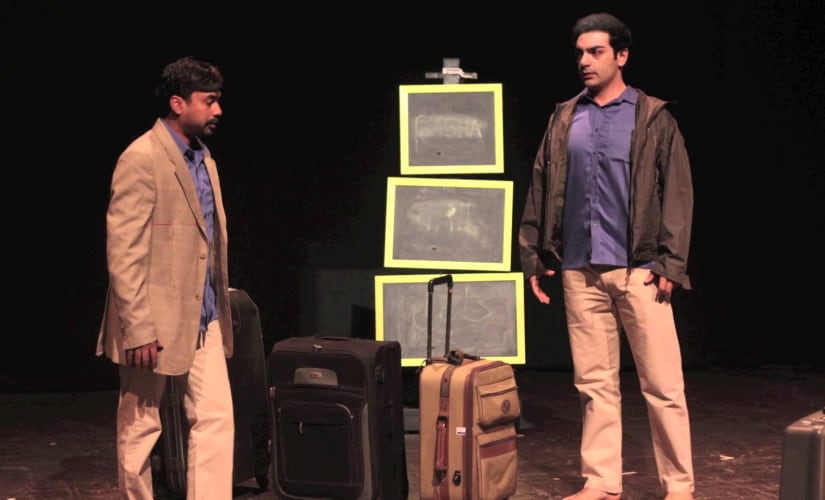
Gasha1 825
A still from Gasha, written by Irawati Karnik and directed by Abhishek Majumdar

Why is your idea of historical imperative limited to the experience of colonisation?
Yes, I'm being simplistic, in order to find an axis that works globally. There are other axes not directly related to colonisation. Within India, how many plays do we see with lower caste women as characters? Nothing, compared to the many with upper caste men.

You mentioned that developing a Dalit dramaturgy is one of the things you're excited about.
Yes. After we moved on from Indian Ensemble, Sandeep Shikhar and I started a new theatre company along with  Vivek Madan. It's called the Bhasha Centre, and our main focus are at the moment is to work with Dalit texts and Dalit writers, from Daya Pawar and Limhale on Dalit aesthetics to published Dalit autobiographies and the work of lok shahirs. It might not be a literature that already exists. We're collaborating on a version of Kisaan that will open at Prithvi Theatre in March 2020. Iravati Karnik is writing it, drawing on Prithiviraj Kapoor's original play Kisaan together with Daya Pawar's Baluta.

Any other ongoing projects you'd like to flag?
There's Tathagat, a street play we did in collaboration with Jan Natya Manch, which played in Mumbai from 9 to 14 August. There's a version of Eidgah ke Jinnat with Jawahar Kala Kendra, Jaipur, with many Rajasthani actors. Djinns of Eidgah is also being staged at the Edinburgh Fringe Festival this month, by Ananya Mishra and the Bread Theatre Company, formed by a lot of non-white Cambridge University students.

As someone who works in London and New York as well as in Bengaluru and Bangladesh, it is important to me to know how much time I work where. I am not making work in England in order to give up my work in India; that's not going to happen. But last year we were touring in Uttar Pradesh and sleeping in trains, and just after that I spent a month in New York. And that is absolutely fine in the theatre. But as time gets limited, it becomes important to choose, to measure.
I like that we have come back to the mathematics. Thank you, Abhishek.

Published in Firstpost in two parts, 19 and 20 August 2019.

2 March 2019

Living in the Ruins


Continuing her tribute to Mrinal Sen, our columnist writes about his rarely watched gem, Khandhar (1984).

Shabana Azmi in Mrinal Sen's Khandhar (1984)
Famine, as I wrote last week, was one of the recurring motifs of Mrinal Sen’s cinema. An even more ubiquitous image in his films was the ruins. Since most of Sen’s films drew on modern Bangla literature and were set in Bengal, it’s no surprise that the ruins were almost always those of a zamindar bari. These huge residential mansions that had represented the heights of feudal grandeur in the eighteenth or nineteenth century now dot the Bengal countryside, their colossal staircases and many-pillared verandas slowly crumbling into nothingness.

Sen’s first cinematic ruin was in Baishey Shravana (1960), where it serves as the film’s first marker of the cruelty of time. When his young wife (Madhabi Mukherjee) scampers out of their hut giggling, Priyanath follows her. He watches the spring go out of her step as she enters the ruins of the old family mansion. It is impossible to be anything but grave here, standing in the shadows of what they once were, what they will never be again.
In Akaler Sandhane (1980), the decrepit zamindar bari has managed to survive into the present — not as a home, but as a film set. Its ownership is farcically split among multiple descendants, who live all over the country. The only family members still on the premises are a middle-aged woman and her paralysed husband.

But it was with Khandhar (1984) that Sen really placed the ruin centre stage. Taking a classic Bangla story by Premendra Mitra called ‘Telenapota Abishkar’ (The Discovery of Telenapota), Sen adapted the atmospheric tale of three young men making a weekend visit to a ruined rural zamindari into the 1980s and into Hindi. Dipu (Pankaj Kapur) is the surviving scion who decides to bring two friends to see his crumbling ancestral home.


As in Akaler Sandhane, the city visitors treat the ruins as merely a picturesque setting. The dry, meditative Subhash (Naseeruddin Shah) is lured literally by the prospect of a ‘photographer’s paradise’, while the more talkative Anil (Annu Kapoor) is mainly happy to have a break from the city. The fact that real lives are lived here seems not to percolate into their consciousness; not even when Subhash has an awkward encounter with Dipu’s cousin Jamini (Shabana Azmi), an attractive young woman who is wasting away in the ruins.
Sole caretaker for her paralysed mother, the fine-featured Jamini remains unmarried, half-beginning to inhabit her mother’s delusional hopes about a Niranjan who was once betrothed to her. The figure of Jamini’s mother echoes the bedridden husband in Akaler, both also producing a doomed aura of clinging on to some pride from the past. Meanwhile, the unseen Niranjan, upon whose arrival all hopes seem to be pegged, brings Khandhar into synch with other Mrinal Sen films in which an important character is the subject of conversation for much of the running time but remains unseen: Chinu (Mamata Shankar) in Ek Din Pratidin, Professor Roy (Shriram Lagoo) in Ek Din Achanak, the servant boy Palan in the scathing Kharij.

Naseer’s photographer here is allied to Dhritiman Chatterjee as the filmmaker protagonist of Akaler, both figures making reference to Sen’s own observing, extractive artistic self. The camera is Subhash’s medium of communication with people, but it is also a shield against them: a boundary.
The photograph can be a memory created for the future. It can be a way of offering attention in the present. It can also be a way of enshrining the past — or enshrining the living as if they were dead. When Subhash decides to go along to Jamini’s house, the camera is his ticket. He’ll take a picture of the paralysed aunt, he tells Dipu: “You can use it to hang on the wall when she pops it.”
There is something about Khandhar that feels haunted, without the presence of anything supernatural. Unlike in the famous Tagore tale ‘Khudito Pashan’ (The Hungry Stones), in which a young man in another ruined palace became possessed by the spirit of an ancient dancing girl, the yearning spirit here is human, and very much alive.
And yet all the photographer/filmmaker can do is to frame her through the bars of a window, atop a terrace, or against a crumbling wall covered in cowpats. Whether he picks her out by the light of a torch or a camera, all he succeeds in illuminating for an instant is her loneliness. The ruins are inescapable. 

13 January 2019

Blue-sky filmmaking

My Mirror column:

The late Mrinal Sen’s career took off with a 1959 film, Neel Akasher Neechey, a rare portrait of a Chinese protagonist in Indian cinema.


Mrinal Sen’s directorial career started with a hiccup. Raat Bhore, starring Uttam Kumar and Sabitri Chatterjee as the lead pair, was released the same year as Sen’s contemporary Satyajit Ray released Pather Panchali (1955). But while Pather Panchali made Ray the immediate toast of the town (and the world), Raat Bhore sank at the box office and was panned by the critics.

In 1959, however, Mrinal Sen made a second film,
Neel Akasher Neechey, and this one gained him both popular approval and acclaim from high places. Even here, though, Sen was not the first choice as director. The singer-composer Hemanta Mukherjee (known to Hindi film-viewers as Hemant Kumar) was starting his own film production house and initially approached Sen only to write the script. It was only later, when he had disagreements with the director he had chosen, that Hemanta decided to offer the job to Sen.

Based on a piece called ‘Cheeni Feriwalla’ from the famous Hindi writer Mahadevi Varma’s book Smriti ki Rekhayein (Lines of Memory), the film traces the unexpected connection that develops between an itinerant Chinese peddler and a Bengali housewife who is an active participant in Gandhi's Civil Disobedience Movement. The treatment of the central relationship tugs unabashedly at heart-strings – Mrinal Sen later looked back at it as embarrassingly sentimental. But the thematic content is interesting even today.

Neel Akasher Neechey
 opens in the Kolkata of 1930, and in bringing that historical-political context to life with shots of newspaper headlines, nationalist speeches, and street-corner protests, Sen shows glimpses of the full-frontal political filmmaking that he would later be identified with. The first time we see our protagonist, Kali Banerjee as Wang Lu, he is but a blip on a screen dominated by a horde of schoolboys chanting, “The policeman’s stick, we don't fear it!” The city is in the grip of nationalist fervour, and the Chinese street seller is caught unawares. But the policeman who grabs him also lets him go almost immediately, recognising an outsider even as they both speak in Hindustani – as Calcuttans used to call the hybrid Hindi of the city’s streets, a lingua franca likely shaped by the Bengali speaker’s inability to handle the high genderedness of Khari Boli Hindi, and spoken by the polyglot city of Biharis and Anglo-Indians and Armenians and yes, the Chinese.

Among the first interactions the film shows between Wang and the locals is another troupe of children following him in the streets, yelling, “Here comes the Chinaman, he’ll take you away!” The scene offers up the first of the urban myths that seem to follow the foreigner in India. One little girl tries to stop the other kids, but even her childish sweetness is based on the belief that if you call a Chinaman a Chinaman, you’ll turn into one yourself, conjuring up what is to her clearly a horrifying vision (“Chinaman ke Chinaman bolle, shobai Chinaman hoye jabe”). Another weird Chinaman myth is provided by a household help called Haran, who claims they save their ill-gotten gains as gold teeth.

The exchange between Wang and the little girl evokes another important film of the period, Kabuliwala, which was made in Bengali in 1957 and in Hindi in 1961. Based on Tagore’s 1892 short story, it was also centred on a man from a distant country who walks the streets of Calcutta selling things. And sure enough, this is borne out by what happens next. Where the Afghan Kabuliwala saw his far-away daughter in the figure of little Mini, Sen’s lonely Chinese-silk-seller begins to see his long-lost sister in Basanti, the Bengali bhadramahila whose colloquial use of “bhai” Wang hears literally.

The sister-brother theme is, of course, one that has particular resonance in Bengali cinema, from Pather Panchali’s Durga and Apu to Ritwik Ghatak's Subarnarekha and Meghe Dhaka Tara. But here Sen uses it to a broader effect, suggesting a bond of kinship across class and language and country. He even brings in the rakhi-tying that was adopted by Bengal’s Swadeshi movement to produce a ritual bond between communities.

Calcutta’s Chinatown appeared in several big Hindi films of the period, notably Howrah Bridge (1958) and Chinatown (1962), both made by Shakti Samanta. But it served primarily as a setting for illegalities, with the depiction of the Chinese community stopping at Helen singing ‘Mera Naam Chin Chin Chu’ and Madan Puri as a Chinese villain named John Chang. In Neel Akasher Neechey, that depiction feels more substantial: the Tiretta Bazar ghetto where Wang lives, the Chinese temple where he once prays, the dhaba where a mix of locals and Chinese men eat, the latter eating their rice with chopsticks from a bowl. Together with a running stereotype of all Chinamen being involved in the opium trade, Sen creates a vivid picture of life in Calcutta as a Chinese alien.

And yet, in what might be the film’s most wonderful exchange, when the Swadeshi khadi-wearing woman tries to tell the Chinese man she doesn’t wear foreign stuff, he insists he is not a foreigner: “Eyes not blue, not foreigner, Chinaman!” Released in the era of Panchsheel, the film’s unspoken message of Indians and Chinese as being on the same side of a colonial divide was much appreciated by Nehru, who told Sen: “You have done a great service to the nation.”

It is a sad comment on how little faith our state has in our people that declining Sino-Indian relations after 1962 led the same film to be banned, albeit briefly.

Published in Mumbai Mirror, 13 Jan 2018.

7 October 2018

A half-told tale

My Mirror column:

Nandita Das’s ambitious biopic of Saadat Hasan Manto feels like a showreel of what could have been.


Many Indian film heroes have drunk themselves to death over a lost love. Manto might be the first one to do so over a lost city. Bombay was not the place of his birth, but Manto thought of the city as both muse and workplace. Its streets spawned many of his strongest stories and its film industry gave him both livelihood and community.

He was clearly profoundly shaken by Partition, writing several stories about how the new boundaries around nations and religions were also carving up human beings. Still, given Manto’s strong attachment to Bombay, his departure remains somewhat inexplicable — and it appears as such in Nandita Das’s biographical film about him.

Das’s ambitious tapestry of a script weaves Manto’s fiction in and out of the life he may have lived. So some of his most well-known Partition stories — ‘Khol Do’, ‘Thanda Gosht’ — are interwoven with moments when the communal divide inserts itself between Manto (Nawazuddin Siddiqui, for once a bit out of his depth) and his best friend, the actor Shyam Chaddha (the sadly wooden Tahir Raj Bhasin). We also hear, at a filmi party, the jibe that Bombay Talkies — the film studio where Manto worked — had “too many Muslims” in its employ.

More interestingly, in a scene set on the eve of Partition, we see Manto witness a conversation in a Bombay shoe shop where his wife Safia is shopping. “Mera toh watan Bhendi Bazaar hai. Main isse chhod kar Grant Road na jaaoon, aur tu mujhe Karachi bhej raha hai?” Manto hasn’t said the words himself, but the idea of the locality as stand-in for the nation has been introduced — allowing us to think of it later, when Manto’s nostalgia and sense of exile moulds itself around a city rather than a country.

In real life, Manto wrote scathingly and prophetically about the directions in which Pakistan’s politics would go. But the film fails to establish why he never felt at home in Pakistan — barring glimpses of his obscenity trial and a single scene based on one of Manto’s ‘Letters to Uncle Sam’ (lit up by Neeraj Kabi’s performance), there is little of his political bite on screen. Instead Das focuses excessively on Manto’s rather performative mourning. Like a dramatic lover trying to forget a past relationship, he refuses to even open letters from Bombay written by friends like Shyam and Ismat Chughtai. When a policeman rifles through his desk and says rudely, “I believe you write many things, where is it all?”, Manto’s retort is to hand him a scrap of paper. “Ismein toh Bambai ka pata likha hai,” says the Lahore cop. “Wahin toh hai sab kucch,” mutters Nawaz’s Manto. A cinematically stereotypical descent into lovesick madness follows, with Nawaz pricking up his ears and saying he hears a melody that Shyam used to sing.


Das’s film succumbs to another familiar filmi motif: muftkhor drinking partners whose appearance foreshadows the hero’s decline. These hangers-on, who serve to insulate the hero from self-realisation in films as disparate as Muhafiz / In Custody (also about a writer in free fall) and Guide, are here concentrated into the single figure of Shaad (Shashank Arora). But even the talented Arora cannot breathe life into this one-note character, whose only brief appears to be to provide Manto company as he drinks more, and more darkly.

Another of the film’s themes — because it was one of Manto’s longstanding fascinations — is the sex worker. The film opens, for instance, with one of his finest stories: ‘Ten Rupees’, in which a young girl is taken out by three older male clients. The scenario has the whiff of doom, but Manto does something unexpected: he preserves Sarita’s marvellous state of innocence till the story’s end, depositing us and our fears at the edge of a precipice. In another fictional segue, we see Tillotama Shome as a sex worker pushed to the brink by her pimp (Paresh Rawal).

The segments enacting Manto’s fictions contain the film’s better performances (Ranveer Shorey, Divya Dutta, Vinod Nagpal). But their near-pulpy high drama throws into relief the dullness of the rest of the film. Das tempts the cultural-historical junkies among us with a period recreation of a mythical Bombay in which Progressive Urdu writers mingled with film folk. But the interactions are flat; the characters —Krishen Chander, Ismat, Himanshu Rai, Ashok Kumar — cardboard cutouts. Only one, Ila Arun as the courtesan-turned-filmmaker Jaddan Bai (Nargis’s mother), has any spark. The only other interactions that achieve any immersiveness are those between Manto and his wife Safia (the excellent Rasika Dugal).

Given that so much of Das’s dialogue is provided to her by her inimitable protagonist, it is a shock when it falls flat. Even Manto’s sharpest barbs — “Agar aap mere afsaanon ko bardaasht nahi kar sakte, toh woh isliye ki zamaana hi na-kaabil-e-bardaasht hai (If you can’t tolerate my stories, it is because the age is an intolerable one)” or “Accha toh tum bhi tarakkipasandon ki tarah is daur mein bhi optimistic rehna chahte ho? (Oh, so you’re like those Progressives who want to stay optimistic even in this era?)” — fail to offer the non-Manto-knowing viewer a bridge between our times and his. Like Toba Tek Singh, Manto remains stuck in a no-man’s-land.