Showing posts with label Arjun Kapoor. Show all posts

3 April 2016

A Very Jagged Little Pill

My Mumbai Mirror column today:

A choppily-directed, gimmicky film about gender roles, Ki and Ka shows how far we have to travel. 

The smoothest radical statement in the otherwise bumpy Ki & Ka comes right at the beginning. The single, successful corporate career-wali Kia (Kareena Kapoor) is attending a wedding. Having looked wistfully at the groom and bride (some desire for coupledom is acknowledged in that lingering glance), swigged some whiskey at an uncleji's urging and refused an enthusiastic dance companion with a too-loud reference to having her period, she gets on the phone to someone. "I'm at my friend's shaadi. The last day of her life as an independent human being," she declares in mock-mourning. "Because after this she is going to become a khamba." 

After decades of Hindi film romance in which (after the requisite paeans to kaajal and zulfein) a man's search for True Love ends in finding a female pillar of support, Balki's new film has an undeniably fun premise. In Kia, we finally have a heroine who balks at being the wind beneath anyone's wings - she's clear she's going to do the flying herself. 

Unfortunately, that's where the newness ends. The film decides that to enable Kia to "achieve her dreams", she needs a partner who can be that wonderful, invisible, supportive presence in the life of every successful high-flier - a wife. And Balki thinks he's serving up something terribly revolutionary by making Kia's 'wife' - read 'non-ambitious support structure' - a man. 


But Ki & Ka is so intent on the assumption that a non-careerist man is an unbelievable oddity that Kabir (Arjun Kapoor) must have his present-day choices explained by past trauma. So we learn that his housewife mother died young, unappreciated by his brash and enormously rich father. 


What the film tells us is that Kabir thinks his mother was an artist, and he wants to be like her, creating a home -- rather than climbing a stressful corporate ladder whose final rung is inevitable early death in an expensive nursing home. 


What it doesn't tell us -- but makes screechingly apparent -- is that his wanting to be a house-husband is as much about emulating his mother as the standard-issue son's desire to undercut the father. Which might be read as a very masculine rite of passage. 


Balki's other target, it seems at first, is the whole mainstream definition of success: Kabir's wooing of Kia involves mocking her corporate ambitions and suggesting that these external criteria of 'Vice-President' and 'CEO' and lots of money may not necessarily make one a contented, happy person. But his bracing critique apparently doesn't mean he's looking for someone who shares his world view. Nor that he's going to try and help his partner shed such constricting ambitions. Nope, it just means he's going to be the backroom boy egging her on! And oh, before you cast any doubts on Kabir's own capabilities in the corporate direction, Balki makes sure we know he's an "IIM-B" graduate: because you know, we can only respect someone for non-competitiveness if they've won the competition. 


If the film's supposed critique of the corporate rat race is rather muddled, so is its challenge to gender stereotypes. First of all, Balki's script is so jittery about his hero's nurturing of his 'feminine' side that he provides ceaseless markers of 'manliness' to counteract it -- Kabir loves whiskey, Kabir loves women, Kabir can fight like Dharmendra. Then, Kia and her mother (the sweet but quite wooden Swaroop Sampat) going to work while Kabir keeps home, is meant to be the film's central provocation to the existing gendered division of labour.
But in fact, the film is so embedded in a received gender dynamic that its 'role-reversal' actually reinforces the idea of a complete separation of spheres. According to Ki and Ka's vision of the world, a successful career means no time to look after one's own diet, let alone one's ageing parents. And conversely, taking care of a home must be a full-time job, where all that's allowed to stimulate your brain is diet plans and books about bread. 

But why assume -- as Swaroop Sampat's tiresome climactic monologue does - that the only way to resolve our living arrangements is a total division between the home and the world? Why is it necessary that only person's work is in the public domain, while the other remains singlehandedly responsible for the private domain? Why can't men and women both contribute to the home, both from within and without? Someone who has never had to clean their bathrooms or cook their own meals can never appreciate the work that goes into keeping a home running. And conversely, someone who has never had to deal with an impossible deadline or a tiring daily commute is unlikely to understand those stresses. 


The film dimly recognises that the crux of the problem is the visibility and invisibility of different kinds of labour. But it fails to acknowledge the main reason for that difference: money. Only work outside the home gets economic recognition and confers social status. And those who do not earn it must deal, in one way or another, with the insidious accusation of freeloading. The solution to this does not lie in switching who does what, but in encouraging both genders to do their share of both. And in the meanwhile, giving domestic unpaid labour a little of the respect it is due -- without needing it to be done by a man giving a Ted-X talk.


Published in Mumbai Mirror, 3 March 2016.

11 January 2015

How to be a small-town superman

Today's Mumbai Mirror column: 

It's an unapologetically entertaining battle between good men and bad men. But if one looks closely, underlying Tevar's masaledar heroics is a fairly meaty take on masculinity.

   
In recent years, the Hindi action movie has grown bigger, brasher, more and more full of special effects, and less and less fun to watch. When Akshay Kumar or Ajay Devgn or Salman Khan are doing the pummelling, the only people likely to experience any surprise at their being flattened into chappatis are the baddies themselves. Because we’re dealing with Supermen, and everyone knows it.

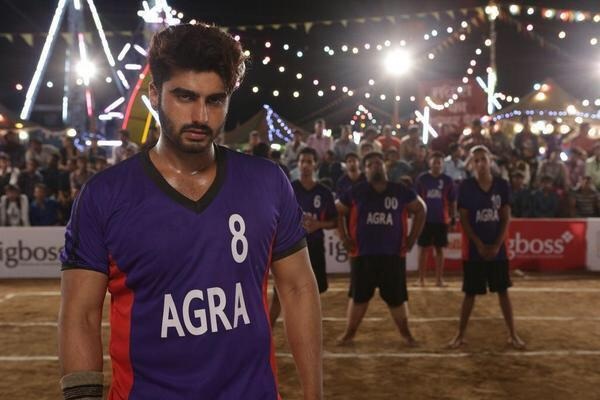
Pintu Shukla, in contrast, may get ‘Main hoon Superman, Salman ka fan’ as his ‘introduction song’, but he's no local legend. Or not yet. The hero of Amit Ravindernath Sharma's directorial debut is Agra's budding kabaddi champ, a local lafanga with a gender-sensitive heart.

Of course, Pintu, being Arjun Kapoor, is anything but pint-sized, and his opening one-man victory for the Kanpur kabaddi team has already showcased large reserves of strength and endurance. But something about Kapoor's energy makes Tevar's action scenes more enjoyable than any I've seen in a while. He captures the youthful swagger of the small town hero, in the sense of “bada hero banta hai”.

There's little by way of plot or character that could be considered new in Tevar. The small town boy's half-bored defiance of his middle class parents is something we've seen, for example, in Bunty Aur Babli (the father is even played by the same actor, Raj Babbar); the villainous politician casting a covetous eye upon a local middle class girl, too, has a long cinematic lineage — most memorably Haasil; the recreation of the UP-Bihar milieu of generalised thuggery, where corrupt cops and political goondas combine to throttle the faintest voice of resistance, has been a dominant current for more than a decade, including films like Shool and much of Prakash Jha's oeuvre. Stylistically, too, Tevar is an out-and-out masala film. It feels at least 20 minutes too long because it really doesn't skimp on the set-pieces: fights, songs, full-on dialoguebaazi.

I haven’t seen Okkadu, the 2003 Telugu hit from which Tevar is adapted, but director Amit Sharma (an advertising man best known for the Google reunion tearjerker) clearly has a sound grasp of his chosen North Indian milieu. He and Shantanu Srivastava, who shares Tevar's writing credits with Okkadu's writer-director Gunashekhara, have successfully transposed the script from its original Hyderabadi setting to a Mathura-Agra world that feels vibrant and alive, even while painted in broad, colourful, filmi strokes.

The song choreographies and fight scenes offer a satisfying tour through the grubby gullies and open terraces of the UP small town, with well-timed local colour provided by steaming istris, hot halwais’ ladles and even a tashtri full of gulaal. The opening kabaddi match between Mathura and Agra is also wonderfully imagined and nicely paced: the semi-comic display of local sporting talent spliced together with more lethal forms of political gamesmanship.

The dialogue has enough local flavour to make even predictable scenes juicy: “Jalwe toh nachaniyon ke hote hain,” drawls Manoj Bajpayee's menacing Gajendar Singh as he eliminates a rival; an anxious teammate waiting for our hero to arrive for the match, erupts: “'Aa jayega, aa jayega': kya Karan Arjun hai jo aa jayega?”

But what helped sustain my interest was the film's framing theme: masculinity. Spoken or unspoken, violent or couched in humour, there is no getting away from the film's central underlying question: what does it take to be a man in a society as lawless and violent as this one?

The answer the film offers is no different from a million Westerns and thousands of Hindi movies with even more invincible heroes: it takes brute force. This is a world in which the sharp-tongued truth-seeking journalist, for all the power of the media at his back, is easily silenced by violent intimidation; the state is run by thugs, and the police, even those members of it not in their pay, are emasculated by the deep rot in the system.

So what's left? Well, good louts versus bad louts. The street is, in Tevar, the domain of men. And I say this not to criticise the film, but to note the degree of attention it gives to what is after all, a plain and simple fact about North India, but one that doesn't get any play in most films set in the region. Here, there's an effectively menacing scene involving a phone booth and a pichkari filled with Holi colour; there's a lascivious driver at a traffic light. What is unusual about Tevar is that it makes a point to underline the non-stop harassment and lasciviousness that women face, without necessarily turning all of it into life-threatening violence.

The film's division between good masculinity and bad is built almost wholly on the edifice of respect for women. Pintu's heroicness is established early on by his playful rescuing of a cycling young woman from the leering attentions of a local ruffian—and all through the film's main rescue (that of Sonakshi Sinha's Radhika), he never once makes unsolicited advances. If you're female, though, you can be spirited and sardonic all you want, but in the end you're dependent on good brute force to rescue you from the bad. And when it does, you fall gratefully in love with it.

In a world where the cinematic POV offered to us is so often that of the man who takes the woman's reciprocation as his right (think Raanjhana, Ek Deewana Tha, and a million others), Tevar's model for masculinity is a huge advance. And for all their rambunctious filminess, the streets of Tevar's universe aren't quite a figment of the imagination. Hopefully some day, we'll have one in which men don't have to beat up other men, and women can be something more than grateful.