Showing posts with label tawaif. Show all posts

8 August 2016

Picture This -- In the Eyes of the Beholder

My BL Ink column:

The idea of dance as “not respectable” has a long history in the Indian subcontinent, as Mira Nair’s India Cabaret shows us.


Aapke pair dekhe, bahut haseen hain. Inhen zameen pe mat utaariyega, maile ho jayenge. (I saw your feet. They’re very beautiful. Don’t lower them to the ground, they’ll get dirty),” goes Raaj Kumar’s note to Meena Kumari in Pakeezah. Those words are usually considered among Hindi cinema’s most legendary romantic dialogues, the epitome of poetic delicacy. But think about the line again in the moral universe of Kamal Amrohi’s film, and you realise that it encodes a specific message for the tawaif to whom it is addressed: Sahibjan, the dancing girl, is being told that dancing defiles her.
The idea of dance as “not respectable” has a long history in the Indian subcontinent, tied to entrenched patriarchal and caste-based ideas of inequality. India’s performing artistes have traditionally had a lower social status than their audiences: in terms of gender and often also caste. Any woman who appeared in front of men — whether the performance was erotic or not — was seen as sexually available. Patriarchy thus divided women into those who were marriageable and those who could perform in public.
The nationalist and social reformist agenda that rescued the classical arts from this ‘taint’ unfortunately pushed most other performers into an even more illicit zone. The scholar Anna Morcom has argued in a recent book that for the vast majority of hereditary female performers from communities such as Nats, Kanjars and Deredars, where performing arts had ceased to be a livelihood since Independence, “dancing in bars had been a form of rehabilitation from sex work”.
I found myself thinking about these things as I watched Mira Nair’s affecting documentary India Cabaret recently. Made in 1985, it is a precursor to more recent films about the twilit worlds of performing women: Saba Dewan’s trilogy — The Other Song, followed by Delhi Mumbai Delhi and Naach — perhaps also Shyamal Karmakar’s I Am The Very Beautiful. Nair’s atmospheric hour-long film deals with the world of cabaret dancers in what was then Bombay, weaving its way in and out of seedy, dimly-lit bars and homes, talking to women who dance for a living, and some of the men who come to watch them.
The visual contrasts are striking, and often depressing. When the women are at work, they must look a certain way. They wear make-up and glittering clothes, and twist and turn and writhe on the floor as they slowly remove articles of clothing. Though neither they nor the spaces they dance in look anything like the glamorous Hindi film version immortalised by Helen or Bindu or Padma Khanna, the effort they put in is apparent. Meanwhile the watching men sprawl, as they might in their own living rooms, their ungainly paunches spilling out of gradually unbuttoning shirts.
But as you move from the ghostly green tinge of these interiors to the drab light of day, and watch the same young women waking up, automatically reaching out for cigarettes and a newspaper, your heart leaps up. Sleeping on mats on the floor, their meagre lives in rented rooms may be nothing to write home about — but there is something free about the moment; a freedom from enforced domesticity that is usually only granted to men.
Nair’s film is deeply invested in the freedom these women have earned. Her conversations with the cabaret dancers touch on their jobs and their negotiating skills, their comfort in their bodies and their pride in making a living for themselves and their families. What emerges clearly is the dancers’ own recognition that unlike other women, their bodies are not owned by husbands or lovers.
The contrast is established particularly sharply when Nair follows one Gujarati client to his home, where his wife says she waits every day for his return. She is aware that he goes from his office to the cabaret. She may not like it, but she is resigned. The madonna is as much a slave to patriarchy as the so-called whore.
But the film does not shy away from the sadder aspects of the bar dancers’ lives: the pervasive addiction to cheap liquor, the tenuousness of a career in which age subtracts from value, the deliberate public shaming by neighbours and strangers, and the lack of respect even from family. We watch as one dancer, Rosy, travels back to her village near Hyderabad to get her sister married. Her family is content to use Rosy’s money, but they shun her otherwise.
For the most part, though, the women stay sharp-tongued and cynical. One of them tells a joke which has a series of ‘sati-savitris’ arrive in the other world alongside a cabaret dancer. Yamraj, the god of death, duly recognises the virtue of those women, and gives them the keys to the silver door. The cabaret dancer gets the keys to Yamraj’s own door.
“Do you feel any shame?” asks Nair at one point. “When I go out at night, sometimes a customer sees me and says, ‘Look, there goes that naked dancing girl, that whore.’ I say, ‘Motherf****r, you enjoyed me on stage, and now you say this?’ That’s when I feel shame,” says one dancer. “If somebody said that to me, I’d say, ‘Here’s my address. Come see me tonight.’ If we speak of shame, then how would we work? And if we don’t work, how would we make money? That’s why, in such a place, shame does not exist,” says the second dancer. “If the viewer does not feel shame, why should the viewed?”
Published in the Hindu Business Line, 5th Aug 2016.

11 October 2015

Writing Filmi Fictions

Today's Mirror column:

Though we speak of great Urdu writers shaping Bombay's cinema, we forget how much cinema also shaped their writing.

It is a fact often remarked upon that the Bombay film industry of the 1940s and '50s was a place of prodigious literary talent. A list of those who wrote lyrics and scripts and dialogue for Bombay cinema reads like a veritable who's who of modern Urdu literature - Ismat Chughtai, Saadat Hasan Manto, Krishan Chandar, Rajinder Singh Bedi, Khwaja Ahmed Abbas, Kaifi Azmi, Jan Nisar Akhtar, Majrooh Sultanpuri, Ali Sardar Jafri, Majaz, Meeraji. Some of these are now better known as film people, while others, even while writing for the cinema, retained their primary identity as litterateurs. Chughtai, for instance, wrote 12 film scripts, including ZiddiBuzdilSone ki Chiriya and later, Garm Hava, but she is primarily known as a writer of books.

A young Ismat Chughtai

But while discussing how much these writers shaped the cinematic milieu of the time, what is often forgotten is how much that cinematic milieu shaped their writing. This writing could be non-fiction: A famous example is Manto, whose classic collection Ganjey Farishtey (translated as Stars from Another Sky) offered his readers a possibly embroidered but ostensibly factual glimpse of the '40s film world as he knew it. Or a writer might channel their experience of the film world back into it. Ismat Chughtai's script for Sone ki Chiriya (1958), directed by her husband Shahid Latif and starring Nutan and Balraj Sahni, was one such - the tale of an actress who becomes the golden goose for her exploitative family was believed to echo Nargis' real life. 

More often, however, these writers turned the film industry into a setting for literary fiction. Some of these stories and novels offer insightful, sometimes humorous, often brutally honest depictions of what life in the Bombay film world was like. Manto, whom Salman Rushdie once identified as an author of "lowlife fictions", wrote several stories featuring men and women who inhabit the lower echelons of this world, or just hover hopefully around its fringes, trying to angle their way in somehow. 

A youthful Manto
In his famous story 'Babu Gopi Nath', for example, we are introduced to the eponymous protagonist as "a great good-for-nothing" who "after sitting around doing nothing in Lahore" has "decided to grace Bombay with his presence, and...brought a Kashmiri dove with him". It turns out that Babu Gopi Nath's project in Bombay is to introduce this young woman, Zinat, into the film industry. "[Ghaffar Sayyan] told me to take her to Bombay because he knew two prostitutes who'd become actresses there," Babu Gopi Nath tells the narrator, who is called Manto and edits a newspaper like the real-life Manto. When Zinat's many meetings with men who "were only pretending to be directors" don't translate into film roles, Babu Gopi Nath decides to secure her future by marrying her off to a young Hyderabadi landlord from Sindh. 

Upendranath Ashk
Another Manto story called 'Janaki' also centres on a young woman who is dispatched from Peshawar to try and break into the movies. "Get her into a film company in Pune or Bombay. You know enough people. I hope it won't be too difficult," runs the letter from a friend that presages her arrival. The story's narrator (again a version of Manto, this time called "Saadat Sahib") is a little worried: "I had never done anything like that before. Usually the men who take girls to film companies are pimps or their like, men who plan to live off the girls if they can get a job." But having tried and failed to get her a job in Pune, he dispatches Janaki to friends in Bombay, where she manages to get a yearlong contract with a studio at 500 rupees a month. 

In a third story set in filmdom, called 'Director Kripalani', Manto describes a similar situation - but from the opposite side. Here it is the film producer - the Seth, in Manto's terminology - who tells Director Kripalani that he has a girl in mind to be the heroine of the film. She turns out to be a young Sindhi woman from Kripalani's hometown, with a rather implausible connection to him. The other woman in the story is a successful actress playing the main part in another of Kripalani's films, whom he gets thrown out of the role because she tries to seduce him. 

The women in these stories can scarcely be said to be similar in social background: Zinat Begum is a Kashmiri girl who has been "rescued" from a Lahore brothel by a rich man; Janaki comes from Peshawar where she was the mistress of a married man called Aziz, while the Sindhi girl seems from an educated middle class family. Yet all of them seem to have arrived from great distances away, with different levels of ambition and ability, to knock at moviedom's doors, and wait for them to magically open. And though he is too worldly-wise to be outraged by their free-and-easy ways, Manto clearly thinks of these women as occupying a tricky moral terrain. 

In a 1948 story called 'Formalities' ('Takalluf'), the writer Upendranath Ashk (who switched from Urdu to Devanagari on Premchand's advice, and who spent a few years working in Filmistan Studio in the '40s) mentions yet another such young woman of dubious morals. This "Miss Shameem", an upcoming actress whom we never actually meet, is described as having arrived in Bombay from Lahore. When she is "having a great deal of trouble finding a house", "Director Qadir" offers to put her up, only to find that she has promptly made herself at home - and shows no signs of leaving. 

Unlike Manto's wannabe actresses, who seem like gullible creatures despite all their gumption, Ashk's Miss Shameem is a shamelessly manipulative type. So, it turns out, are Director Qadir and his wife. Perhaps I'm reading too much into a few stories, but Manto and Ashk do serve up two possible readings of the film world that Madhur Bhandarkar may not balk at - either everyone's a crafty manipulator, or everyone's a gentle victim. Unlike Bhandarkar's, though, their takes are perfectly believable.

Published in the Mumbai Mirror, Oct 11, 2015.

4 November 2014

To a Different Drum

Last Sunday's Mumbai Mirror column:

The figure of the dancer has been the object of hypocritical censure, both in Indian society and Hindi cinema, for much too long. Surely, dance deserves something better?


When a self-taught dancer and choreographer makes a film about dance, surely one is justified in expecting some insight, or at least some feeling for dance? It is likely that Farah Khan is too preoccupied with ringing cash registers to listen to less celebratory noises coming from people like me - and anyway, as the fans/trolls never tire of telling us critics, I should have "left my brain at the door." But every film, especially one watched by as many people as Happy New Year, is a window to the way we think. By putting a bar dancer and a dance competition in the same movie, HNY held out the tantalizing hope of a bridge between two worlds that are usually kept far apart - the legitimate middle class dream nurtured by Nach Baliye and Dance India Dance, and the shadowy, subaltern domain of the 'ladies bar'. But then it went to reinforce the existing divide, even more starkly.

Perhaps I should back up a little. Dance is as much a child of Hindi cinema as music - but it has always received stepmotherly treatment. As a society, we nurture a deep-rooted set of moral judgements about dance. In the traditional framework of South Asian life, a woman who performed in front of men - whether her actual performance was erotic or not - was seen as sexually available. Patriarchy thus divided women into those who were marriageable - and those who could perform in public.

Through the 19th and 20th centuries, nationalist reform attempted to 'cleanse' our classical performing arts, hunting down the tawaifs and devadasis who had been its most professional and talented practitioners, and bringing in middle class women to rid dance and music of its earlier taintedness. But as the ethnomusicologist Anna Morcom has argued in her recent book Courtesans, Bar Girls and Dancing Boys, the taint did not disappear. All that happened was that a sanitised sphere of classical performance emerged, populated by middle class people, while traditional performing communities were pushed into a more illicit zone.

More recently, as part of the packaging of Bollywood as a global cultural export, Bollywood dance has also achieved a new social legitimacy. Middle class women, diasporic and resident Indians, take classes in Bollywood dance. Weddings (even among communities that would have baulked at the idea two decades ago) now include a revamped version of the traditional North Indian 'sangeet': where typically, the young women perform specially choreographed items, but 'everyone' dances -- often even the bride. There are discomfiting moments in which here too, women feel compelled to put their bodies on display -- but on the whole, there is certainly something wonderful about this unprecedented freeing up of physical expression.

And yet, some 75,000 women performing the same kind of dances, clad in similar blingy saris and lehngas, in Mumbai's dance bars, were deprived of a livelihood for nearly a decade by a state heady with moral outrage. The ban was eventually lifted last year after the Supreme Court ruled against it, but the pro-ban lobby tapped into what was clearly a popular form of hypocrisy, distinguishing between different kinds of dancing women. Popular Hindi films don't just reflect that hypocrisy; they fuel it.

A complicated version of the patriarchal divide about dance has always been in play in cinema. At one level, especially in the early years, acting was itself a disreputable profession, considered wrong for girls from 'good families'. Then there was the question of image. While film audiences (like reallife audiences) wanted to watch women dance, the heroine's virginal image couldn't be compromised. She was, for the longest time, only allowed to skip around a bit, and invariably only with the man she was going to marry: the hero. Barring the rare (though crucial) tragic courtesan roles: Pakeezah, Chandramukhi, Umrao Jaan, the heroine wasn't usually a professional dancer. She couldn't be a tawaif, or a cabaret dancer. An early way around this hurdle was the filmy trope of 'cultural programme' -- where the heroine's dancerly talent could be showcased in the safe, civilised confines of an auditorium.

The bourgeois acceptance of dance went alongside the rise of classically trained dancers like Waheeda Rehman, Vyjanthimala, and later Hema Malini, Jaya Prada and Meenakshi Sheshadri. More recently, the focus is on a dance contest: Dil Toh Paagal Hai, Rab Ne Bana Di Jodi, and now films like ABCD and Mad About Dance embrace more physically strenuous, professional practice. But films featuring bar dancers - and there have been many, from Madhur Bhandarkar's Chandni Bar to Benny Aur Bablu to Hansal Mehta's recent CityLights - do not dare suggest that they might actually enjoy their work. Or that it might involve any skill at all. This makes Mohini a radical departure. For her, dance is a passion: "Eajy lagta hai Mohini ka dance? Eajy nahi hai. Dance ek pooja hai. Art hai, art."

But then the film undercuts the pride she takes in her dance, by labelling her as a "saleable woman" and never apologising. It insists on a sob story that 'drove her' to this work -- denying, like most media coverage, the fact that most bar dancers were Bhantus, from North Indian communities where women have traditionally danced for a living, and where lack of patronage had begun driving them to sex work. It reinforces the idea that she only deserves respect if she dances for the country. And even when she does get what she wants -- a dance school where little children touch her feet -- it makes that seem cloying and ridiculous. The wait for a braver cinema carries on.

9 September 2014

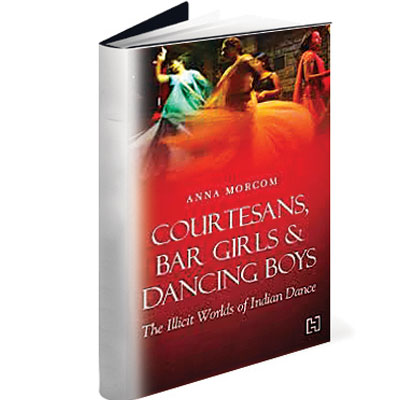
Book Review: Courtesans, Bar Girls and Dancing Boys: The Illicit Worlds of Indian Dance

Courtesans, Bar Girls and Dancing Boys:
The Illicit Worlds of Indian Dance.
By Anna Morcom. 298 pp. Hachette, 2014.
In Kamal Amrohi’s Pakeezah (1971), a nobleman enters a train compartment and becomes entranced by the beauty of a sleeping woman’s uncovered feet. He leaves her a note that says: “Aapke pair dekhe, bahut haseen hain. Inhen zameen pe mat utaariyega, maile ho jayenge.” That poetic injunction, telling the beloved that she is too ethereal to descend to earth, has become cinematic shorthand for nazaakat, for the delicacy of old-world romance. But it is also a metaphorical message to the tawaif, whose very profession involves placing her feet on the ground. The dancing girl is being told that dancing defiles her.

The social history of Indian dance has been hugely defined by that idea of defilement, and Anna Morcom’s book, Courtesans, Bar Girls and Dancing Boys: The Illicit Worlds of Indian Dance, is the first rigorous academic investigation into how this history informs our present. Morcom shows how dance and dancers in India are located in a grid of class, caste and gender, a grid whose traditional moorings have been realigned but not erased by modernity. 


The Indian performing arts, she argues, emerged in a patriarchal framework where the dynamics of power and sexuality were inseparable from those of social status — men never perform for women, nor high status women for lower status men. Those who performed were lower in status than their audience: in terms of gender (by being female, or being effeminate males) and often also caste. Dancing in public, particularly, has long been treated as a coded signifier of sexual availability — even if, as in most instances, the male audience’s sexual access to the performer’s body remained theoretical.

An ethnomusicologist by training, Morcom’s rich combination of archival research and ethnographic fieldwork is especially valuable in a field satiated with opinions but starved for real research. The book’s first chapter is historical, describing how the Indian performing arts were transformed by a combination of Victorian morality and nationalist reform. In what are known as the Anti-Nautch campaigns, colonial administrators and nationalists came together in their distaste for what they saw as feudal sexual mores. The discourse of social reform was used to stigmatise devadasis and tawaifs, their identity as skilled cultural practitioners subsumed by their perceived sexual dangerousness. 

In a remarkable double move, the marginalisation of these women paved the way for upper caste/upper class women to enter the “reformed” performing arts (from which the earlier dynamic of transgressive sexuality was now carefully erased). If women from tawaif/devadasi backgrounds wished to perform in public, they had to first perform respectability, by abandoning the mujra, moving out of the kotha and, ideally, marrying — thus converting themselves from “Bai” into “Begum”, or “Devi”.

This part of the story is perhaps familiar. But Morcom’s real revelation is that “nautch” did not disappear. “Rather" [she writes], "it went underground, involving far more prostitution, less ‘choice’ and a lower status for the women involved”. It is this process that ended up creating the “illicit worlds” of the book’s title.

The first such illicit milieu that Morcom explores is that of hereditary female performers, the majority of whom belong to a set of interrelated tribes or communities collectively identified by the term “Bhatu”. Drawing on colonial ethnographers like William Crooke and her own interviews in Tonk, Sultanpur and Pune, Morcom discusses some of the better-known Bhatu communities: Nats, Kanjars, Bedias, Kolhatis and Deredars/Gandharvas. Very briefly, she asks some crucial questions of each, such as whether the men were also performers, whether the community does other kinds of work too, and the extent to which dance as a livelihood has given way to sex work.

This is the background for what is one of the book’s most important arguments, laid out in a later chapter on dance bars: that the vast majority of Mumbai’s estimated 75,000 bar girls in 2005 were Bhatus of one sort or another, and that the campaign against Mumbai’s dance bars thus “represented a continuation of the history of exclusion of these hereditary performing communities from a livelihood and identity of dance.” Given the powerful discursive similarities — the appeal to rights and the “liberation” of women on one hand, and protection of “morality” and “Indian culture” on the other — as well as the actual continuity in the communities targeted, Morcom argues that the pro-ban movement needs to be examined as “Anti-Nautch II”.  

Further, for most of these women from communities such as Nat, where performing arts had ceased to be a livelihood since Independence, “dancing in bars had been a form of rehabilitation from sex work”. Crucially, Morcom points out that even English-language journalists and writers critical of the ban were content to produce narratives of women having been “driven to dance”, sometimes in conjunction with bargirls who, Morcom suggests, knew that a simplistic “majboori” narrative would get them more sympathy than the truth. In sum, even the well-intentioned continue to display a blindness to this complex, chequered history.

The other “illicit world of dance” Morcom addresses is even less acknowledged: that of dance performances by transgender males or female impersonators. Men dance as female in all sorts of non-elite traditional contexts — Nautanki, Ramlila, wedding shows and wedding processions, launda naach/Bidesiya in Bihar, and all-male Lavani performances called Binbaikacha Lavani. Some only perform femininity when dancing, but many others identify as kothis, and dance is an important part of this transgressive sexual identity. Morcom’s detailed accounts of kothis open up a new space for discussion of how performance and sexuality can be linked, though again, as with dancing women, cross-dressed male performers are not necessarily providers of sexual services.

The one “non-illicit” chapter is about the rise of Bollywood dance as a middle class activity that can even be proclaimed as a profession. Morcom persuasively contrasts this new public legitimacy with the continued illegitimacy and shame that haunts the bargirls. Yet, she sees some hope for wider attitudinal change in the middle class woman’s ability to perform Bollywood dances without stigma.

This is an ambitious book. The writing — especially the introduction — occasionally feels repetitive, clunky in an academic way. But thankfully Morcom rarely uses theory as a crutch. Her arguments are thoughtful and emerge organically from her fascinating material. Though the book’s vast and varied canvas can often make it feel like several separate books, Morcom has done an enormous service by bringing these worlds to notice. Most importantly, she has given us a lens through which we must begin to connect the highly visible forms of Indian public culture — whether the classical arts or Bollywood — with these profoundly invisibilised ones.

A truncated version of this review was published in the Asian Age.

17 November 2013

Film Review: Rajjo


The idea of Rajjo — a deliberate throwback to the courtesan film, one of Hindi cinema’s most beloved genres — is all very well. Even if the supremely literate tawaif of the sh’er-o-shairi and courtly manners and mores has long been dead, the business of women making a living by dancing, singing, and providing sexual services to male patrons is far from over. While the tragic tawaif with a heart of gold was replaced by the ill-fated bar dancer as long back as Chandni Bar (2001) and the beer bar has since become a fixture of Hindi film space, there have been few truly interesting spins on the theme. Only Anurag Kashyap’s Dev D and Reema Kagti’s Talaash come to mind, which goes to show there is always space for a cinematic re-imagining of the kotha. 

But the creators of Rajjo are too lazy or too unimaginative to produce the slightest morsel of newness. Or truth. Instead, they serve up a truly terrible rehash of all the possible brothel-based movies you’ve ever seen. Like in all those films through the ‘80s, Baaghi and Sadak and so on, the youthful, untainted hero falls in love with the poor prostitute and sets out to rescue her – by marriage, naturally. Director Vishwas Patil makes this completely unreconstructed narrative worse with supposedly contemporary side characters and subplots that pull in too many directions. 

It doesn’t help that Rajjo is full of contradictory impulses in the art direction department. We go from an oddly realistic middle class Marathi home where our hero Chandu (Paras Arora) lives with his father and mother and sweet little sister, to a completely filmi brothel labelled “Rooh Manzil“. At Rooh Manzil, the downstairs is straight out of Pakeezah: girls in colourful churidars dancing to the beat of a tabla. But upstairs is a massive half-lit hall, empty but for billowing diaphanous pink curtains. The strange time-travel feeling carries on as Kangana Ranaut appears on screen, in the eponymous title role of Rajjo. Dressed in a thigh revealing sharara, Ranaut’s uber-athletic movements couldn’t be further away from the slow sinuousness of Meena Kumari’s Sahibjaan. 

Patil’s film can’t seem to make up its mind whether it wants to be purely retro or place its brothel within the universe of contemporary Mumbai. There’s Dalip Tahil as a dark-glasses-and-sherwani-clad fixer, embroiled in romantic tussles within the kotha and financial schemes without. There’s also an alcoholic ex inspector wracked by the guilt of having killed innocents in encounters. Mahesh Manjrekar is wonderfully convincing as Begum, the hijra owner of the brothel. Patil’s most obvious attempt at contemporaneity is the real estate angle, with a distressingly repetitive Prakash Raj and his fat, oily henchman pushing through a fake housing scheme to cover up real plans for a mall to replace the kotha. The other moment where real estate figures in the film is so ridiculous that one doesn’t know whether to laugh or cry: Rajjo’s childhood memory of being brought from the village and sold into sex work by her elder sister for a few thousand rupees – apparently to help the sister buy a flat in Mumbai! 

The film’s idea of escape for Rajjo and Chandu is equally ridiculous – having failed to find shelter in the city, they move to a hillside village where an NGO runs a residential school for adivasi children. This allows them to set up home, complete with parrot and rangoli, in one of those adorable little huts that Hindi cinema’s runaway lovers have taken refuge in from time immemorial. It also lets Rajjo wander about with herds of goats in pastoral surroundings, while poor Chandu the Brahmin boy (no match for a young Salman or Aamir Khan when it comes to muscles) tries to labour for a living, then teach, then set up a Chinese food cart which for some reason involves a gigantic bank loan that Chandu accepts joyfully, apparently without looking at the interest rates. It really doesn’t help that Paras Arora’s Chandu looks about fifteen, and there is not the slightest sign of chemistry between him and Ranaut. 

Things change for the better as Rajjo‘s dancing talents are discovered, and she begins a new life as dance teacher to the adivasi schoolchildren. But Hande Bhau (Prakash Raj) can’t wait to get his grubby paws on her. The second half of the film is a mishmash of Hande Bhau’s multi-pronged attempts at evil – blackmail, forgery, trickery and intimidation – to force the hapless Rajjo to become the ‘devi‘ of his new ‘dance bar’. 

There is certainly a film to be made about our deep ambivalence about dance, a film that would challenge the middle class perception of dance as somehow unacceptably sexual, innately tainted by the presence of the (female) body. We see a tiny glimpse of that film in Rajjo‘s spirited monologue to Hande Bhau, about how her parents gave birth to a kalakaar not a randi, about how rhythm entered her soul from the breezes of her village. But Patil and his team are too muddled to produce that imaginative critique. Dance here must be shorn of sensuality to be acceptable; become something adivasi children have to learn from a city-fled bar dancer. And yet in the climactic scene when Rajjo dances with her students for famous dance guru Jankidevi (Jaya Prada), she must appear in the white bodice and diaphanous dhoti of the Amar Chitra Katha woman. Irony eats the soul.

Published on Firstpost.

30 April 2012

Book Review: Between Clay and Dust

Musharraf Ali Farooqi's earlier novel, The Story of a Widow (2009), was the delicate, understated tale of the middle-aged but still wooable Mona Ahmad, whose disciplinarian husband's sudden death leaves her in possession of an independent fortune and a desire to experience the freedom she's been denied all her adult life. One of the things that made that novel unusual, at least in the context of South Asian writing in English, was Farooqi's choice of protagonist: a woman who is no longer young, someone who has assumed that the pattern of her life is set forever, but now finds that she is a position to make changes.

The recently-released Between Clay and Dust also features older people being forced to grapple with unexpected change. But unlike Mona Ahmad, these characters are indisputably in their twilight years. The crumbling, once-grand domains of Ustad Ramzi and Gohar Jan, both barely surviving the post-Independence transformation of popular tastes, are a far cry from the comfortably-off Karachi in which Mona leads her cosseted existence. The end of princely patronage has sounded the death-knell for both Ustad Ramzi's akhara, once the focus of an unending stream of admiring fans and would-be pahalwans, and Gohar Jan's kotha. The great pahalwan and the celebrated tawaif must deal with a harsh new world, governed by the market on the one hand and an impersonal bureaucracy on the other.

But even as he describes lives that are increasingly affected by such unseemly things as municipal inspections and leaking roofs, Farooqi manages to retain a distant, otherworldly air. If his present-day Pakistan, as one grateful reviewer of The Story of a Widow pointed out, displayed a "complete absence of dictators, diasporas and post-9/11 traumas", his 1950s inner city has managed to remain unscathed by the "ravaging winds of Partition". Not for Farooqi the burgeoning historical canvas of an Amitav Ghosh, or even the unobtrusive (but omnipresent) detailing of a Vikram Seth. What we get instead is a setting that's left deliberately unidentified, the aim of the words less to recreate a known geography than to evoke a mood, distill an essence.

The elegiac mood is created as much by the inevitably tragic ebb in the tides of its protagonists' lives as by Farooqi's choice of language. There is an old-world quality to his prose that some might think teeters on the verge of purple — "The turmoil that had seared the fibre of men and gored their souls had not touched this quiet habitation" — but that, if read with the cadences of an imagined other language echoing behind the English, feels exactly right.

There are moments, though, when this feeling of 'translatedness' begins to extend its welcome; for instance when Farooqi writes, "He always experienced a deep sense of harmony in that place" — rather than simply "there", or "turquoise-coloured mosaic panels" – rather than simply "turquoise" (my italics). Sometimes the awkwardness is just the outcome of sloppy editing: "his life, too, would have conformed to that of his elders' existence and become part of it". Other curious linguistic choices include the repeated use of 'raga recital' for Gohar Jan's evening mehfil, 'nayika' for tawaif, and words like 'ewer' and 'mattock' where the Hindustani equivalents or at least less archaic English words might have been less jarring.

{
There is an old-world quality to his prose that some might think teeters on the verge of purple but that, if read with the cadences of an imagined other language echoing behind the English, feels exactly right.
But none of these linguistic stumbling blocks can quite divert one from the pleasures of a tale well told. There is a bell-like clarity to Farooqi's delineation of his characters, his slow unraveling of their motivations and desires. Instead of doing anything as indignified as building towards a crescendo, Farooqi maintains a deliberate even tempo. Even the most dramatic events are described without drama.

In this carefully laid out world, balance is everything. Farooqi's arrangement of figures is almost perfectly symmetrical: if Gohar Jan's life is tied to her kotha, Ustad Ramzi's heart lives in the akhara — and in the graveyard of his ancestors that is attached to it. Ustad Ramzi's tumultuous relationship with his brash younger brother Tamami has as its counterpart Gohar Jan's complicated connection with the young tawaif Malka. The Malka episode — which I won't give away — hinges on the way a tawaif's life swings between freedom and necessity. And balance is also key to wrestling: as Ustad Ramzi's tragic epiphany goes, "Did the essence of his art not lie in creating a delicate harmony between strength and the opposing force?"

It feels somewhat unfair, then, that Farooqi decides not to balance the attention he gives his primary protagonists: Ustad Ramzi — and the world of the akhara, its pitchers of sardai and two-kilo-mutton breakfasts — gets far more space than Gohar Jan, who despite all her potential complexity, ends up playing a mere foil to Ustad Ramzi, yet another version of the golden-hearted courtesan we know only too well.

This is a quietly affecting book, with a profound understanding of tragedy: that what happens to us is as much a function of how we respond to events as the events themselves.

Published in the Sunday Guardian.


4 September 2011

Cinemascope: Bol; That Girl in Yellow Boots

My Sunday Guardian film review column this week:

BOL

Director: Shoaib Mansoor

Starring: Atif Aslam, Iman Ali, Mahira Khan, Humaima Malick, Shafqat Cheema


***1/2

At one point in Shoaib Mansoor's Bol, the exhausted father of a missing teenage boy says to the rest of the gathered family: "Kahan kahan nahi dhoonda hai humne... (Where have I not searched for him?)". It's an almost predictable filmi dialogue. But then he turns away from the camera and completes his sentence with: "...Khuda kare mar-mara gaya ho (God willing, he'll be dead by now)."

Bol consistently challenges your expectations. Its tenor is that of an old-style Hindi movie – clumsy first person narrative, slow build-up complete with depiction of childhood, slightly overblown characters, melodramatic dialogues, fairy tale ending – and yet it cannot be called predictable, because it is unlike any Hindi film I've seen. The frankness with which it speaks of the things it has set out to speak of – the subcontinental obsession with sons, the neglect and oppression of daughters and wives, the blinkered interpretation of religion that is marshalled in support of chauvinistic practices, the social sanction for treating hijras as less than human while secretly lusting after them – is irreproachable.

There are cop-outs, to be sure, like the too-perfect romance between the pardanasheen 5th-class-pass girl and the guitar-playing doctor neighbour (not to mention her unbelievable one-shot transformation into swaying rockstar), or the inevitably tragic fate of the hijra, which one could choose to perceive as akin to what used to be the fate of the golden-hearted prostitute in older Hindi films.

But there's also much here that is nuanced, while being just broad-strokes enough to communicate perfectly with its audience. For example, the father, a Mohajir hakeem who sets up shop in Lahore after Partition, is responsible for much of the unrelieved awfulness of the life his family leads, and certainly we are not meant to sympathise with him. But we are given ways in which to begin to understand him, too, as a victim of his circumstances, trapped by his own beliefs. There's also the wonderful subplot involving a household of courtesans (mirroring the houseful of girls spawned by the Hakeem Sahab), which cleverly incorporates a critique of marriage – before it has to kowtow to dominant sexual morality.

Watch this film to see what the Bollywood blockbuster could be doing with itself.


THAT GIRL IN YELLOW BOOTS

Director: Anurag Kashyap

Starring: Kalki Koechlin, Naseeruddin Shah, Gulshan Devaiya, Pooja Swarup


**1/2

Ruth (Kalki Koechlin) is a white girl with an expired visa, doing the rounds of government offices so that she can stay on in India and look for a father she's never seen. Random men look at Ruth and think dirty thoughts, their fake smiles contorting into grimaces, even their burps emerging as a seedy, too-intimate confession.

It works at first, the unsettling focus on the instinct for prey that seems to unite the lowest of passport touts with the faux-British-accented foreign service officer ("I like your teeth: sort of like Bugs Bunny meets Julia Roberts," he says to Ruth).

But the bleakness is unrelenting, and one begins to tire of it fairly soon. Not only is Ruth fatherless and an illegal migrant – the screwed-up flotsam of the developed world – she also has a job administering Swedish massages, sometimes with thousand-rupees "handshakes", in a sleazy massage parlour, a cokehead boyfriend with whom she doesn't want to have sex, and a dangerously edgy ganglord who's out to redeem the boyfriend's debts from her. By the time one gets to the sexual abuse that is the film's primary theme, it feels worn thin.

True to Anurag Kashyap's record, spaces are stylishly shot: all tight corners and grimy walls, harshly fluorescent streets and depressingly dark interiors, and the film gives us some superb cameos: Pooja Swarup as the massage parlour manager who's chatting on the phone all day long ("School mein na Maggi quiz contest mein mujhe Best Memory prize mila thha, kucch bhoolti nahi hoon main") and Gulshan Devaiah (seen in a very different role in Shaitan) as the Kannadiga ganglord are almost worth watching this film for, and there's also Naseeruddin Shah in a tiny appearance as a massage parlour client who feels fatherly towards the hapless Ruth. But none of them – apart from Devaiah, perhaps – ever jolt us into feeling anything other than jaded by this deeply exhausting film.

Koechlin herself, with her red-lipsticked mouth, quivering hands and vacant stare (she really seems to have perfected the vacant stare), more or less completely inhabits the character of the lost little girl who must act tough. But even this performance is unable to shake this profoundly overdetermined film out of its too-tight skin.

1 December 2010

Delhi: Postcards from the Last Century

On a photography exhibition:


Images courtesy of Alkazi Foundation for the Arts

The Alkazi Foundation’s newest exhibition of vintage photographs is an ambitious one: it takes as its subject a much-photographed city, while limiting itself to images from a time that ensures that very few visitors to the show will recognize that city as one they know. 'Historic Delhi: Early Explorations of the Camera c. 1860-1950', showing at the National Gallery of Modern Art, consists almost entirely of photographs from the last century of colonial rule. But under that broad rubric is a variety of pictures.

There are memorable – if strangely empty – images of Delhi’s monuments after 1857 for example, created by pioneering photographers like Samuel Bourne and Felice Beato, and there are high-quality photographs, often of the same monuments, taken for documentary purposes by the Archaeological Survey of India. There are photographs by the famous pre-independence studios, like Lala Deen Dayal, documenting with aplomb such grand affairs as the Delhi Durbars of 1903 and 1911, or showing troops being dispatched along the Grand Trunk Road, a cloud of dust rising around the horses’ feet. There are a few lovely, carefully chosen pictures from the 1940s and 1950s, mostly taken by the news photographer couple Maneckshaw and Homai Vyarawalla – these include some haunting images of Ramlila performers. And finally, there are the anonymous images – annotated, if we’re lucky, with a year and a subject.

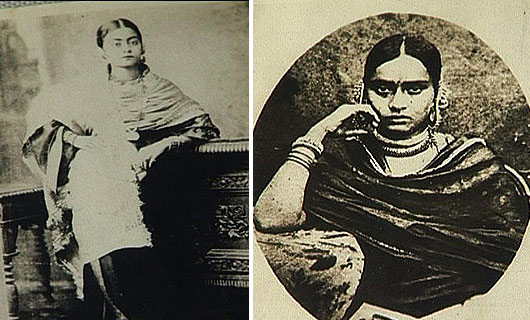
In some ways, it is these last that are the most interesting, because they fit less easily into any preconceived category in our heads. Looking at an image like ‘Miss Azijan of Delhi, c.1905’ – a young and pretty woman, photographed without purdah and alone, in 1905 – one imagines she must be a courtesan. But not knowing the photographer or his purpose – British or Indian, old or young, official or tourist, admirer or anthropologist – sharpens our interest. One’s eyes linger longer on Miss Azijan’s carefully arranged pose: one knee placed perfectly upon another, the self-possessed finger on her chin, and the face that remains somehow towards the camera – even as her gaze turns intriguingly away.

Sometimes, of course, a mere caption is enough to slot the image: a shy looking young girl with large earrings, dressed in gypsy fashion, can never escape the words, ‘Delhi Dancing Girl, c. 1905’. It was Jean-Luc Godard who once pointed out that the photograph is “physically mute”. “It talks,” he said, “through the mouth of the text beneath it.” Sometimes, I suppose, that can be a good thing. There are certainly moments when this exhibition comes to life through the inscriptions. Not contemporary curatorial ones (though those are informative enough), but old inscriptions that mark the image, conjuring up with great immediacy the past that lies congealed within it. A postcard with an image of the Mutiny Memorial that bears an exceptionally clear Leighton Buzzard postmark for May 23, 3pm (though the year was illegible to me) – and this laconic message: “Dear Flo, This place was put up by comrades of the men who died in the mutiny.” Closer to the bone is the image of Bara Hindu Rao, with a handwritten inscription as follows: “Our main picquet during the siege. Very hard fighting all round this place.”

Whether the past you’re looking for lies in the stately and studiously composed archival image, or in the postcard accidentally discovered, this is an exhibition worth visiting.

(Published in The India Tube)

21 November 2009

Bring On The Dancing Girls

An essay published in Tehelka magazine in November 2009.

The figure of the tawaif continues to haunt popular culture, but what sent the real ones into obscurity?


From Umrao Jaan to Pakeezah to Chandramukhi, the figure of the tawaif has been a figure of fascination in the popular South Asian imagination: the bejewelled, sensuous dancing girl with a golden voice – and almost always, a golden heart. To our Hindi-film-overloaded eyes, therefore, it may seem strange for an instant to look upon the black and white images of women who populate The Other Song, Saba Dewan’s film about tawaifs, looking out of the frame at us with a gravitas we do not expect.

But the gravitas is ephemeral. In one revealing moment, the camera pans an old album, with the moving finger on screen stopping at a pleasantly plump face. The grainy voice of an old sarangi player says, “Yeh Rasoolan Bai hain.” The filmmaker asks, “Kya yeh hamesha itne saade kapde pehentin thi? (Did she always wear such plain clothes?)” The reply is brusque and quietly ironic: “Mujra naach toh karna nahi tha. (Well, she wasn’t going to dance the mujra.)”

Rasoolan Bai gave up the mujra – the expressive, sometimes suggestive kathak-based dance that accompanied the tawaif ’s music – in 1948. At the same time that she moved out of her kotha and into a gali ka makaan in Banaras, the woman whose aching songs were perhaps India’s most famous renditions of the thumri stopped performing in her own city. The timing is remarkable. As India and Pakistan entered independent nationhood, the thumri was taken out of the kotha. A musical genre whose very form — intimate, expressive, always sung in a first-person female voice — had emerged from the courtesan’s salon, had, in order to survive in the bright light of modernity, to move into the concert hall, the radio station, the cinema. And in order to be heard in this new world, the tawaif herself had to become a ganewali or – in even more Sanskritised form – a gayika.

The most famous of such successful metamorphoses is that of Akhtari Bai Faizabadi into Begum Akhtar. The courtesan who had achieved fame in her teens became a respectably married lady, even giving up her singing career for years, “only to emerge into the public domain transformed into a national symbol iconic of the courtly musical culture which had shaped her,” writes scholar Regula Qureshi. But the nation exacted its toll. In order to be the voice of a new India, Akhtari Bai had to live a double life – her newfound respectable status was dependent on dissociating herself from every shred of her past, while the power she had over her audience, what independent scholar and historian Saleem Kidwai calls “chemistry”, derived in large measure from that very past.


Saba Dewan’s fascinating film, The Other Song, derives its name from a similar instance of doubling, of a repressed erotic self. Told by a respected Banarasi musician called Shivkumar Shastri that Rasoolan Bai had once recorded a different version of her famous Bhairavi thumri “Lagat karejwa mein chot (My heart is wounded)”, Dewan set out in search of the lesser-known variation. As she asks musician after musician (and later, tawaif after tawaif) if they’ve ever heard the version that goes, “Lagat jobanwa mein chot (My breasts are wounded)”, without success, we begin to see glimpses of a hidden world, a world whose frank sexuality and often joyful bawdiness were pushed deep below the surface, often by its own practitioners. Song after song turns out to have had its lyrics altered to suit ‘respectable’ tastes – from soibe (sleep) to jaibe (go), choli (blouse) to odhni (veil).

The tawaifs of North India (like South India’s devadasis) came from hereditary performing communities. According to historian Katherine Butler Brown, the term tawaif was first used to describe communities of female singers and dancers in Dargah Quli Khan’s Muraqqa’-i-Dehli (1739-41). But it was not until the early 19th century that it became a catch-all term. Even then, Brown argues, before 1857 there was always a distinction made “between elite tawaifs who were highly cultured, highly refined, models of etiquette and masters of performance genres, who might only have had a single sexual patron in their lifetime; and tawaifs who were less talented, less well trained, and thus more dependent on sex work”

BUT AFTER 1857, when British Crown Law came into effect throughout India, all tawaifs were criminalised alongside common prostitutes, with court judgements stating that singing and dancing were ‘vestigial’ activities while their real income came from prostitution. Meanwhile, the rising middle class, “influenced by Victorian values and empowered by colonial law, increasingly dismissed the tawaif as immoral and decadent, and began various moves to ‘rescue’ Hindustani music from them,” says Brown. The campaign for a national music — cleansed of its associations with tawaifs and Muslim musicians — aimed to make it appropriate for middle class women. In a stunning double move, the very processes that enabled ‘respectable’ women to come out of purdah worked to invisibilise the highly skilled, often highly educated, women who had been ‘in public’ all along: the tawaif.

With the decline of the feudal patronage that had sustained the kotha and its arts, many tawaifs explored other options. All India Radio (AIR) in its early days was almost entirely dependent on the ganewalis, as were recording companies: it was tawaifs like Gauhar Jan who were the first gramophone superstars. But in the early 2000s, a skilled singer like Saira Begum (one of the women from tawaif backgrounds that Dewan shot with) gets a recording slot at AIR in Banaras because of a zealous Italian pupil, only to be humiliated with a ‘musical theory’ examination she cannot possibly pass.

As the new guardians of music locked it up and shut the door, women from tawaif backgrounds entered first the theatre company, and later, the movies. “Cinema becomes a part of tawaif history, documenting tawaifi arts we’d never get to see – and also providing a way for the tawaif to reinvent herself,” says Kidwai. “And this reinvention was both on screen and off it. If Hema Malini in Sharafat wears plumes and a tiara to do a mujra, one can’t complain of inauthenticity: many real tawaifs like Siddheshwari learnt to sing in English – even if it was Twinkle Twinkle Little Star!” The tawaif’s remaking of self, as Kidwai points out, could take more radical forms: such as in the case of Nargis, whose mother Jaddan Bai prepared her for a cinematic career by teaching her everything except how to sing. The stardom of Nargis – the ganewali’s daughter divorced from the gana – demonstrated one route by which the tawaif could make it in the modern world. (It is tempting to conclude that this was the necessary obverse of the rise of the playback singer – the disembodied female voice who retained respectability by never being seen on screen.)

Cinema, though, isn’t an accessible career for most women. The two other films in Saba Dewan’s trilogy address more subterranean worlds of female performance. Delhi-Mumbai-Delhi (D-M-D) centres on Riya, who dances in a bar in Mumbai but is from Delhi, while Naach is about girls who dance to Bollywood numbers on massive, rickety stages in the town of Sonpur, between Muzaffarpur and Patna, during the annual cattle fair. For Dewan, the differences between these categories of women outweigh any similarities. Her D-M-D protagonist Riya, from an ordinary working class background, may have gained confidence and decision-making power within her family, but she remains wage labour. “The tawaif was much more her own mistress: the owner of the space, the person who paid the accompanists,” says Dewan.

Whether we like it or not, though, the tawaif remains the imagined reference point. “There is an attempt to recreate the mujra past, mediated via Hindi films,” acknowledges Dewan. “In Bombay bars, the girls wear so-called Indian costume – ghaghra choli, partly because it’s easier to get license for ‘Indian dance’, but also because it fits the audience’s appetite. The man there wants to imagine Rekha dancing for him, at least.” Even the filmic bar dancer draws on the pure tawaif of the 1970s Hindi movie: Tabu in Chandni Bar must remain chaste while working in a bar, just like Asha Parekh in the kotha of Main Tulsi Tere Aangan Ki.

But the relationship between bar dancers and tawaifs runs deeper. Ethnomusicologist Anna Morcom estimates that 80-90 percent of Mumbai bar dancers, “by informal accounts”, are hereditary professional performers from tribes like the Deredar, Nat, Bedia and Kanjar. They have also been the target of a moral campaign eerily similar to the Anti-Nautch campaigns of a century ago. In 2005, a ban on dancing in Mumbai bars made 75,000 such women redundant. It is still in force.

In early 20th century India, it was dance that seemed to lie at the root of moral opprobrium. The tawaif gave up the mujra to acquire respectability as a concert singer or actress. But in a newly-globalised India where ‘Bollywood dance’ is now a legitimitised ‘cool’ activity for the urban middle classes – think NRI/urban weddings, Shiamak Davar classes, TV shows like Boogie Woogie and Nach Baliye, feeding back into films like Dilli-6 or Rab Ne Bana Di Jodi – how does dance re-acquire its immoral connotations when performed by women in bars? That is a new double standard that will take longer to resolve.

From Tehelka Magazine, Vol 6, Issue 44, Dated November 07, 2009