Showing posts with label symbols. Show all posts

9 May 2021

Satyajit Ray’s world of trains

My column for Mirror/TOI Plus, the fourth in my series on trains in Indian cinema:

On the filmmaker’s birth centenary, a look at how the train is a motif in many of his films, including the Apu Trilogy, Nayak and Sonar Kella

A still from Satyajit Ray's Nayak (1966), starring Sharmila Tagore and Uttam Kumar.

Satyajit Ray, whose 100th birth anniversary was May 2, is associated with one of the most famous train sequences in all of cinema: The children, Apu and Durga in Pather Panchali, standing in a field of fluffy, white kaash flowers, listening for an oncoming train. I've always thought that what makes that sequence unforgettable is the rural Bengali landscape ruptured by the sound of the machine before the sight of it. The children hear the train's vibration in a pillar before the great beast rumbles past.

The train remained a motif throughout the Apu Trilogy, acquiring more layers of darkness with each film. What Ray had originally framed as the link between the village and the city became, in Aparajito, a marker of the distance between the two, and then in Apur Sansar, a site of potential death.

The eternal train scene in Pather Panchali, Satyajit Ray's 1955 debut feature

But there are two other films in which Ray put the train to less melancholic use. The first of these was Nayak, released on May 6, 1966, in which he cast real-life Bengali matinee idol Uttam Kumar as a film star called Arindam Mukherjee. When we meet Arindam, there are two items about him in the day's papers: One, a National Award he's being given in Delhi, and two, a brawl in which he was involved the night before. It's a succinct if simplistic summary of the film actor's life -- popularity and critical achievement, but alongside infamy.

Some mention is made of Arindam having left it too late to get a seat on a plane, and Ray thus successfully places his famed and shamed hero on a long train ride that exposes him to a microcosm of the Indian upper middle class – which, 55 years ago, was snootier about film stars than it is now. From the corporate head honcho who sniffs at the brawl to the old gentleman who disapproves of films on principle, the train isn't exactly filled with Arindam fans.

But what really feels completely unreal in 2021 is the degree of unguarded interaction that the train affords between the film star and his public. Arindam is kind to little girls, signs some autographs, and then gets drunk in a train toilet. When he stumbles back to his compartment, the upper middle class housewife in it is humane enough – and female enough – to help him to bed rather than, say, take a picture of his disarray. Even the snarky journalist (Sharmila Tagore) that Arindam ends up confiding in over a long pantry car conversation, decides he is deserving of her humanity and tears up her notes. The train serves, in many ways, as a filter – Arindam is on display and yet somehow he isn't quite out in the open.

On the sets of Sonar Kella (The Golden Fortress), 1974.

But by far the most sprightly use of the train in Ray's cinema is in Sonar Kella (The Golden Fortress), the first film adaptation to feature his famously-popular detective, Feluda. Released in 1974, the whole film practically unfolds as a series of overlapping train journeys.

The very beginning of the adventure in Calcutta involves Feluda, played by the late Soumitra Chatterjee (who died after a battle with Covid in November 2020), silently removing from his bookshelf a hardbound copy of the Railway Timetable for November 1973. On the other side of events, we are introduced to the film's villains by being shown their names on a railway reservation chart: M Bose (Lower) and A Barman (Upper). Bose and Barman are hot on the trail of the originary set of train travellers – a six-year-old child constantly making crayon sketches of a past birth, and a parapsychologist taking him to Rajasthan in the hope of identifying the golden fortress of his drawings.

The train is also where Feluda and his nephew Topshe first meet the man who will become the third member of their trio: The mystery writer Lalmohan Ganguly alias Jatayu. He boards their compartment at Kanpur station with his red 'Japani suitcase... imported', and proceeds to speak several sentences in rather grandiloquent Hindi before realising that his companions are Bengalis, too.

It is a remarkably orderly world that Ray maps out, in which precise calculations can be made based on train timings. If a set of people hasn’t arrived at Jodhpur in the morning, they can be assumed to arrive by the evening train instead. And if the expected villains haven't shown up on the day they should have, Feluda speculates that they may have failed to get a train booking.

Trains in The Golden Fortress are the route to excitement, transporting these parties of Bengalis into the 'dacoit-infested country' of western Rajasthan. But trains are also the possible way back to order and civilisation: In one pre-climactic moment, Feluda offers Lalmohan Babu the option of getting off at Pokhran, from where he can catch a train back, rather than proceeding to Jaisalmer with them.

In one of Sonar Kella's most memorable scenes, the intrepid Bengalis get on camel-back, and try to wave a train down across the desert. It's the one time in the film that Feluda's plan doesn't succeed. The train keeps on going.

Published in Mumbai Mirror (9 May 2021) & in TOI Plus (8 May 2021).

29 March 2020

What the burqa and the bindi (and the hijab) stand for in our books, and in our current lives

An essay published on the website Scroll.in:


There’s a scene in Prayaag Akbar’s 2017 novel Leila that never made it to the Netflix adaptation. In a not-too-distant dystopian future of water shortage, Riz and Shalini throw a grand poolside party for Leila’s third birthday. The children get their fill of inflatable slides, the parents of champagne. It’s a posh, Westernised crowd, where the women are comfortable leaving a shirt slightly unbuttoned, or showing some leg through the slit in a long dress. So Shalini’s sister-in-law Gazala stands out by being “sheathed in a flowing single-pleat abaya... with a dusty-pink silk hijab that brings out her alabaster complexion.”

“Cheeks glowing with rouge,” Akbar’s description continues. “This is probably as much sun as she ever gets.” The bitchiness is explainable as Shalini’s, not the author’s. But given Akbar’s otherwise nuanced characterisations, Gazala seems an easy stand-in for tradition-bound Muslim femininity. She is somehow both decorative and covered up, and never gets to speak. Her burqa does the talking.

Earlier, Shalini’s reluctance to live in the Muslim sector with her husband’s family is also routed through the veil. “Look, no disrespect to Gazala...,” she tells her brother-in-law Naz. “But I don’t want my daughter in a burqa.” In response, Naz shames Shalini – for offering him a beer, for not knowing that her maid has taken her child out. And Gazala, his hijab-wearing wife, gets held up as the contrast to the liberated, cosmopolitan Shalini: “She might not know as much about the world as you. But she knows our culture.”


Typecasting the burqa

 
The fact that Gazala’s burqa stands in for her is disappointing, but not surprising. No matter where one looks, it seems that the burqa comes to us always already loaded with meaning – and rarely a positive one. In Indian popular culture, it has long been trotted out either as a comic disguise worn by the Hindi film hero, from Shammi Kapoor to Rishi Kapoor to Aamir Khan in Delhi Belly, or as a symbol of women’s oppression. Sometimes, as in the dubious Islamicate subplot of the recent Ayushmann Khurrana starrer Dream Girl, it is both.

Feminists don’t necessarily do better: even a thoughtful film like Alankrita Srivastava’s Lipstick Under My Burkha can only see the burqa as the agent of the teenaged Rehana’s oppression. Zoya Akhtar’s Gully Boy is a welcome exception, giving us in Alia Bhatt’s lovely Safeena a headscarf-wearing Muslim girl who is neither a prude nor a pushover. Bhatt is also burqa-clad in Meghna Gulzar’s superb Raazi, where her fetching coloured hijab does fascinating triple duty as good Muslim, good daughter-in-law – and spy.

In Alice Albinia’s 2011 novel Leela’s Book, too, the burqa has the quality of subterfuge. First, an upper class Hindu woman purchases it secretly, hiding it from her liberal Muslim husband. Then her young Muslim maid Aisha takes it from its hiding place, wearing it to walk through her own neighbourhood unrecognised. It is an “Arab-style burqa”, heavy and black “with some gauzy thin material over the eyes”, writes Albinia, such as “some women in the basti [Nizamuddin] now wore”.
.
It allows Aisha to rescue the man she loves from unjust police custody, but Albinia the author cannot resist describing her character’s experience of wearing it as a limiting one. The burqa is too big for Aisha; the tree canopy seems denser and darker through it; her lover does not recognise her in it: “he peered at her, disturbed by the distance this... fabric put between them: it was as if they were seeing each other through a crowd of people”. The liberal non-burqa-wearer, it seems, can only attribute to the burqa-wearer a sense of alienation from herself and the world.

A sign of unfreedom

 
One way to normalise the burqa’s existence is not to dwell on it. In Altaf Tyrewala’s whipsmart novel No God In Sight (2005), we meet multiple Muslim female characters without being told if they veil. And when someone does, that doesn’t become the important thing about them. Jeyna-Bi’s burqa attracts attention because it is fluorescent orange, not simply because she’s got one. In the accepting cultural mix of Tyrewala’s Mumbai, a burqa can be a topic of banter, it can get sadly soiled when poor Jeyna-Bi throws up her portion of a wedding feast. It can be, in effect, just another piece of clothing.

But the space for such a perspective is steadily narrowing. Since mid-December 2019, as unprecedented numbers of Indian Muslim women have emerged into public space to protest against the discriminatory religious basis of the Citizenship Amendment Act (CAA), the burqa has become even more heavily charged with meaning. Not all the women protesting in Shaheen Bagh (or the many female-led sit-ins it inspired nationwide) wore a veil or headscarf. But the fact that so many did seems to have caused great bafflement and unease.

Because the burqa has become, for anyone who does not wear one, a sign of unfreedom. And if you aren’t free, how can you possibly be out on the streets, resisting an oppressive state? How can you be the living embodiment of oppressed Muslim womanhood that the Hindu right claims to be saving from Muslim men, and simultaneously be leading a political protest?

And so, according to the Sangh’s Whatsapp factory, the lakhs of women who sat out in the wind and weather for three months, while braving police lathis, abusive goons and horrific communal violence, were not doing it to claim their threatened rights as Indian citizens, but for Rs 500 a day and free biryani. What is chilling is that so many other Indians want to believe that canard.

We saw another glimpse of that suspicion and ill-will on March 23, when the mainstream media reported the police destruction of the gloriously democratic art-filled protest sites at Shaheen Bagh and elsewhere as some sort of desperate public health measure – as though the women had not already vacated the sites.


Wearing an identity


This tarring of burqa-clad women as not being legitimate citizens with legitimate concerns dovetailed perfectly with the Prime Minister’s statement in December that those protesting against the CAA-NRC “can be recognised by their clothes”. That shamelessly partisan taunting of a community fighting its own legal marginalisation has sparked a new kind of battle, with people turning their marked bodies into sites of symbolic display.

Refusing to be shamed for wearing burqas, caps or other identifiable markers of their community, many Muslim protesters have instead responded by embracing them. But histories of religious populism elsewhere suggest that such a move can be a double bind. In Meena Kandasamy’s recent novel Exquisite Cadavers, a Tunisian film-school student in London finds his white British teachers pushing him to tell his country’s history through the hijab.

A French-influenced secular diktat banned headscarves in Tunisia in 1981 – so when the dictatorship was unseated, wearing the hijab became a form of community identity. The Islamic right exploited people’s desire to reclaim their religion, and a country where a hijab-wearing “Arabian Barbie” had once caused a liberal outcry, Kandasamy writes, became one that provided the largest number of foreign fighters to the dreaded Daesh.

Closer home, as the recent violence in North East Delhi makes clear, such defiant wearing of religious identity on the body reaches its tragic, terrifying limits when social fissures widen into the abyss of communal violence. Symbols have power: they can mark us or unmark us, divide or unite. In Leela’s Book, the same Hindu woman once buys a packet of gold-embossed bindis for the maid Aisha, only to have her Muslim husband tell her, “They don’t wear bindis”.

Fear and loathing

Among the fascinating ways in which women have chosen to express cross-community solidarities these last few months is the interlacing of burqas and bindis. The young poet Nabiya Khan’s words rang out across many anti-CAA-NRC posters: “Aayega Inqilab, Pehen Ke Burqa Bindi Aur Hijab”.

Optimists of various stripes are bringing bindis and burqas together. But those whose minds are filled with poison can only see conquest, not mingling. To such commentators, like the virulently anti-Muslim “Katyayani” on hindupost.in, a poster saying “Women Will Destroy Hindu Rashtra” with a fierce female face wearing both a bindi and a headscarf, with sunglasses on her head and her tongue out, looks like a “demonised” Kali “surrendering” to the Islamic veil.

Another anti-CAA-NRC poster, of three women wearing both bindis and burqas, underscored by Faiz Ahmed Faiz’s now-viral poetic challenge to all dictatorships “Hum Dekhenge” (“We shall see”), seems to the same writer a call to “to ‘free’ bindi-sporting Hindu women by converting them into burqa-clad ones”.

Communal polarisation now involves a repeated insistence that the way people look is who they are – and yet when what is on display doesn’t fit the entrenched majoritarian narrative, then suddenly it is dismissed. “Bharatiya women of non-sanatani faith are also sometimes seen sporting the bindi, but that is just how a demography raised in mixed-culture behaves,” declares Katyayani when faced with the sociological fact of non-Hindu bindi-wearers.

No God In Sight contains a biting scene in which a young (upper middle class Hindu) wife must report her missing (Muslim) husband to the police. She wears her most saffron-like nylon sari, and borrows a mangalsutra and a bindi from her maid Gangu-bai, hoping that the Mumbai police will treat her complaint more seriously if she looks like a practising Hindu. They tell her to go to Pakistan.

Published in Scroll, 28 Mar 2020

10 March 2019

Flight into the wild

My Mirror column:

An evocative new film melds classic Western motifs with a vision of the Chambal wilderness, using a gang of 1970s dacoits to ask existential questions


A group of armed men arrive in a village to commit a robbery. They are on foot, their leader using a megaphone to announce who they are (“Je baaghi Maan Singh ko gang haigo”), why they are here, and what they would like the locals to do (the women and children to go indoors, the men to stay where they are). Then they walk into a wedding, round up the guests, and slide into a bag the several glittering gold sets laid out by the local jeweller for his daughter’s dowry. When the father of the bride starts to sink to the ground, Maan Singh sits the tubby little man down and announces that no jewels are to be taken off the bride’s body. Then, with impeccable gravity, he makes his incredulous deputy Vakila (Ranvir Shorey) hand over 101 rupees to the weeping girl.

This scene from Abhishek Chaubey’s Sonchiriya contains much tongue-in-cheek humour: the procession of dacoits that mimics an electoral campaign, the wedding gift delivered earnestly while looting. And Manoj Bajpayee, playing another ‘Maan Singh’ 25 years after his career-inaugurating performance in Bandit Queen, revels in creating characters who can keep us guessing. But Chaubey and his screenwriter Sudeep Sharma (they last collaborated on Udta Punjab) are also using the scene to communicate something that lies at the core of their film: that dakus have a dharam.

That thought isn’t, of course, something spectacularly new. Our memories may have been addled by Sholay overkill, but the uber-villainous Gabbar Singh is really not typical of how dacoits have been popularly seen in India. Pre-colonial bandits like Sultana Daku were immortalised in folk songs and nautankis, and that tradition carried on into Hindi cinema, too: think of Dilip Kumar in Ganga Jamuna (1961), or Sunil Dutt in Mother India (1957) or the underwatched Mujhe Jeene Do (1963). The historical dacoit on whose life Sonchiriya builds its fictional tale, one Malkhan Singh, was one of the last of these admired baaghis, a hero in Chambal because of certain moral codes. As described recently by photographer Prashant Panjiar, who spent some months photographing him for a book in the early 1980s, “he wouldn’t drink or let his men drink, he was a champion of the poor and made temples, and his gang wouldn’t misbehave with women”. More recently, Tigmanshu Dhulia’s superb biopic of Paan Singh Tomar told the stranger-than-fiction tale of a man who is driven to the army by poverty, becomes a great sportsman, and then pushed by humiliation to turn against the state he once represented.

Sonchiriya, though, is more invested than Paan Singh Tomar in paying cinematic tribute to some of the classic tropes of the Western: most obviously, the revenge narrative with a wronged man in pursuit of others, and the damsels-in-distress who must be rescued along the way. What I found exciting, though, is that these fictional characters and tropes inhabit a fully realised Indian universe that feels sociologically and linguistically bang-on. The cyclical Gujjar-Thakur battles of the Chambal region, and the historical entry of the Mallahs, once a caste of boatmen, into the gang wars; an arid rural landscape whose harsh dusty expanses feel part of its unforgiving poverty; a feudal world where women are merely the currency of male honour, set off against a heartfelt belief in local goddess shrines: all these the film evokes, if sometimes only glancingly.

It is gloriously shot and lit, with set-pieces that range from a shootout on a lamp-lit Diwali night to a woman singing on a boat on the Chambal river, evoking an almost mythical sense of heroes in exile. The ravines are put to great strategic effect in the action scenes, but also help to make Maan Singh and his not-so-merry men appear like the lone survivors of a disappearing world. Mostly we see the men walking tall on the outcrops (a heroic sort of framing which, to be fair, the filmmaker makes self-conscious reference in another scene featuring the lighting of a beedi); it is only when we first encounter a woman that the camera lowers itself into a gorge.

That scene, in which Bhumi Pednekar’s Indumati pulls down her ghoonghat before aiming a gun at the strange men who have appeared above, was one of many that drew informed sniggers from a largely male audience in a South Delhi multiplex. “Jeth lage hai uska,” went the snarky response in this case, gesturing to the fact that North Indian upper caste women veil themselves before their husband’s elder brothers. Earlier, when the youthful Thakur ‘hero’ Lakhna (played, interestingly, by Sushant Singh Rajput), steps back in fear at something he sees, a voice from the back said loudly: “Ghabra gayo?”. “Rajput hai,” sniggered his companion. 

Not all the laughter was sociological: when a brilliant delivery of “Bhaiyon aur behenon” by Manoj Bajpayee lifted the film out of its Emergency era setting, the whole hall erupted in chuckles. But Chaubey’s humour can be too dark for his audience: when the final familial crisis unfolded under a sign for ‘Parivar Niyojan’, I might have been the only one laughing.

I have mixed feelings about the film’s use of little girls as symbols of curse and benediction. But it is in turning the landscape into a symbolic terrain that Sonchiriya achieves something haunting. Varun Grover’s lyrics for ‘Saanp Khavega’ use snakes, mice and vultures to conjure a bloody cycle of life, in which each species will meet its match. If the maggoty snake at the film's start foretells death, a fortuitous escape from a gharial is a sign of long life. But like the golden bird of the title, the Great Indian Bustard, freedom in the ravines is both threatened and elusive.

22 February 2015

Post Facto -- Mufflers, jhadoos, onions and metros: symbolic politics in our time

My Sunday Guardian column this month:


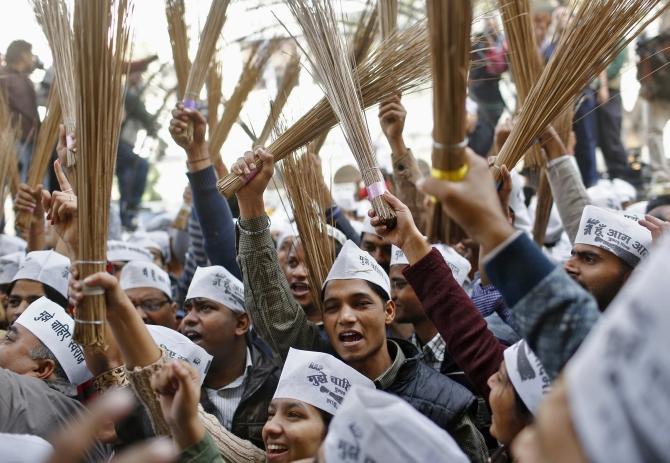
On 10th February 2015, as news began to come in of the AAP win in Delhi, Facebook, Twitter and WhatsApp were flooded with jokes. The best of these one-liners drew on symbols: the ordinary muffler weighing heavy on the bespoke pinstripe suit, or the jhadoo's clean sweep: "Modi wants a Swachh Bharat. AAP has the broom".


Of course, politics everywhere throws up symbols. But the Delhi elections turned bitter symbolic battles into smart, vibrant politics. The muffler made him seem like a chowkidar, went the sharply classist refrain in 2013. But the more Kejriwal-mockers made fun of his ever-present muffler, the more he clung to it. And eventually some clever young things in AAP turned the name "Mufflerman" into a kind of indigenous Dilli superhero — complete with T-shirts. As for the jhadoo, rarely has there been an Indian election in which the allotted symbol of a political party has assumed such far-reaching metaphorical meaning. The AAP jhadoo is now so profoundly linked to the party's "clean up the system" discourse that the anti-corruption message seems inextricable from the visual cue for cleaning up.
And yet the thing about images is that they can signify different things to different people, and mean many things at the same time. Days before the election, I happened to hear one of the city's cultural czarinas talking about how the visual matters in every field. Her example, but naturally, came from her driver, who had apparently said that Arvind Kejriwal and his message resonated with him to a great extent, but he could not bring himself to vote for AAP because its symbol – the broom – seemed to him to represent everything he had managed to leave behind. The visual association, in other words, was powerful enough to negate the effect of an otherwise convincing verbal campaign.
I don't know anything about the driver's background, but it seems unlikely that he was responding to the broom's valence as an instrument for cleaning. He was identifying it with those who usually wield it – not as a political weapon, but as a necessary act of earning their livelihood. Such are the powerful ways in which caste lives on in this country. Jhadoo dena remains an indelible Indian shorthand for manual labour in general, and polluting labour in particular. Those who followed the anti-reservation campaigns of a few years ago would remember students in front of AIIMS, would-be doctors who would eventually have to render service to human bodies in advanced stages of decay, protesting against the terrible fate that threatened them by sweeping the streets with brooms. And on 10th February this year, there was a WhatsApp joke doing the rounds: "Zadu wala becomes CM. Chay wala becomes PM. We Graduate, Engineers & MBA thinking of how to catch train at 8.37 AM & PM".

The Delhi election has been a turning point in many ways, but the real cleansing of our minds will need something more than empty Swachch Bharat slogans.
What is clear, though, is in a country so sharply fractured by class, symbols can go either way. While being a chaiwala's son definitely helped Modi win the votes of the poor in May 2014, it is not that aspect of him that appeals to "Graduate, Engineers and MBA" – though it seems that a ten lakh rupee suit might have swung too far in the opposite direction. And if the jhadoo's power is its everydayness, its familiarity, its emblematic connection with the poorest, then it also stands to be rejected for those very reasons — by that steadily increasing section of the population that aspires to something less every day, less basic, less poor.
Two other anecdotes might make the point better. The first is from a heritage walk I went on the day after the election. It was a young, upper middle class crowd, but for once, politics was on everyone's mind. The AAP enthusiasts may have been slightly more vocal, but I managed to overhear two twenty-somethings confirm their hopes of a BJP win. "The other night I saw a whole TV programme about the price of onions," sniggered the young man. "Imagine what will happen if AAP wins!" The price of onions, while it thankfully still has enough weight to swing the electoral taraazu, is something these young people think of as ridiculous.
The second anecdote is from the last day of campaigning. I was taking the metro from RK Ashram Marg towards Connaught Place when I saw a burly forty-ish Sikh man loudly accosting a group of AAP volunteers with caps. Apparently he'd seen one of them hawk and spit on the platform. I couldn't tell who the chastised volunteer was, but a whole host of his colleagues were apologising profusely: "He didn't know the rules, he's from outside, in fact he's from Andhra. But of course he shouldn't have done it. Humne samjha diya hai..." Sardarji, however, was not to be placated so easily. "You people want to run Delhi!" he raged. "But this is the respect you show to the metro. How will you ever make it a world class city!"
Whether it's onions or the metro, no symbol can ever represent any reality fully. But some symbols aren't interested in reality. What they want to do is to present an image whose grandeur people might aspire to — like a naam-wala suit, or a shiny new metro. The power of such symbols lies precisely in their distance from the real. In the politics of symbols, then, we must choose whether we want to be represented by our aspirations or our realities. Might our leaps not be more successful if we start with the ground beneath our feet?

First published in the Sunday Guardian.