From my Sunday Guardian column.
One correction before we begin," announced Mukul Kesavan to a packed house at the India Habitat Centre. "Waheedaji is not 'one of the best' actresses we've had in Hindi cinema — she is the best actress we've had."
The orange curtains of the Stein Auditorium had just gone up, and a
visibly excited Kesavan — columnist, writer and a history professor at
Jamia — was about to begin his conversation with the actress Waheeda
Rehman. It was the inaugural evening of the seventh edition of the
Habitat Film Festival, which included a retrospective of films of the
70-something Rehman who had already been described that evening (by a
70-something IHC director RMS Liberhan) as "the ultimate symbol of grace
and beauty".
Rehman has always tended to evoke superlatives; she is clearly used
to them. Whether it's the virtual certificate from Amitabh Bachchan, who
has always said she's his favourite actress, or the usually sharp
Kesavan, who gushed at the privilege of speaking to her ("Like most of
you in the audience, this is something we would fight to do..."), she
accepts the praise with her quiet grace — somehow neither embarrassed
nor coy.
Perhaps some of the chief guest's innate tehzeeb has rubbed off on
the Delhi audience that evening — there are no ushers or 'Reserved'
signs, but an informal self-censorship of the anonymously civilised
leaves the front row free for assorted dignitaries. By the time the
crowd has settled in, the first seat on the right contains a
bespectacled Sharmila Tagore, so unostentatiously dressed that the lady
to my left feels the need to confirm with me who she is. When Liberhan
insists on mentioning Tagore in his welcome address, I see the actress
spread out her right hand in a helpless gesture. The auditorium breaks
into applause.
It's that sort of evening. Kesavan, whose writing and public
appearances are always in English, declares that with the permission of
the audience, he is going to conduct this conversation "in Hindi" or "at
least in a sort of khichdi". One of his first questions to
Rehman is about language, too: she grew up in Madras, but the language
spoken at home: was it Urdu? It was Urdu, she says. (It is fascinating
how Kesavan refers to the language he is speaking as 'Hindi' and the
language in which Rehman responds as 'Urdu'.)
Her fluency in what was still the language of Hindi cinema seems to have
been crucial to Rehman's career. It was why Guru Dutt, stumbling upon a
function in Hyderabad celebrating a Telugu film called Rojulu Maraayi,
became interested in casting the lovely-looking girl who'd done a
much-talked about folk dance number for it. The daughter of a district
commissioner who had grown up in south India — and most unusually for a
Muslim girl in the '50s , learnt Bharatanatyam — Rehman says she forgot
about her meeting with Dutt until a few months later when she received a
message saying that he had asked her to come to Bombay.
"Mere walid sahab ka intehkaal ho gaya thha," says Rehman,
remembering both her own excitement and her mother's fears about sending
her to a strange city. But she finally went, and Dutt told her she
would star in CID, opposite the already iconic Dev Anand. The
17-year-old Rehman couldn't believe her luck. Fans of Bombay cinema have
never got over theirs.
Right from those early years, Rehman alternated with great success between the tragic intensity of films like Pyaasa (1957), Kaagaz ke Phool (1959) and later Chaudhvin ka Chand (1961) and more lighthearted romantic ones opposite Dev Anand — CID (1956), Raj Khosla's Solva Saal (1958), which contains Hai apna dil toh awara, and Kala Bazar (1960) — or Sunil Dutt (Ek Phool Chaar Kaante, 1960). By 1965, Rehman had even starred in a Satyajit Ray film (Abhijaan, 1962). She was confident enough to take on the unconventional character of Rosie in Guide (1965) – a devadasi's daughter, a married woman who falls in love with a guide and sets out to fulfill her dreams as a dancer.
R.K. Narayan, whose celebrated novel Guide drew on, later
wrote a hilariously scathing piece about how the filmmakers rejected all
the real locations he showed them (which, as he points out, would have
been free) in favour of expensive sets created in Rajasthan, and how the
performances of his small-town "exponent of the strictly classical
tradition of... Bharatanatyam" became "an extravaganza in delirious,
fruity colours and costumes".
Watching Guide today, there is no getting away from its
posturing and corniness and desire for spectacle. Dev Anand, as always,
walks some line between ridiculous and devotion-worthy that only a
Bombay star could have figured out, and Rehman's passionate dances are
Hindi movie classics precisely because they are no Bharatanatyam pieces.
And yet there is something true that emerges from all this. That
something even Narayan recognised when he apparently said to Rehman, "I
saw my Rosie in you."
We see her still.
31 July 2012


29 July 2012
Film Review: Harud shows us a Kashmir we rarely see on the big screen

In the last three decades, Kashmir in popular Hindi cinema has meant films about terror and militancy, almost always filtered through an Indian nationalist lens: Roja, Mission Kashmir, Fanaa. Before that, from the 1960s technicolour moment of Junglee and Kashmir ki Kali, up until as late as 1982 when Amitabh Bachchan and Rakhee sang “Kitni khoobsurat yeh tasveer hai, mausam bemisal benazir hai, yeh Kashmir hai” in Hrishikesh Mukherjee’s Bemisaal, Kashmir was the ultimate Hindi movie cliché for beauty.
Aamir Bashir’s 2010 Harud (literally, autumn) which releases in several Indian cities today under the PVR Director’s Rare Initiative, is quite aware of this strange cinematic history. As someone who grew up being an Amitabh Bachchan fan (until a screening of Vittorio de Sica’s The Bicycle Thief in Delhi “thankfully severed [his] relationship with ‘Bollywood’” ), Bashir knows the subconscious expectations with which a Hindi-movie-goer enters a film about Kashmir – and sets out very consciously to dismantle them.
 The sense of a dreamscape is created primarily through Rafiq (Shahnawaz Bhat), the adolescent boy at the film’s centre. We often see him actually sleeping: eyeballs rolling beneath closed lids, dreaming unsavoury dreams. Even the rest of the time, despite his wide-open eyes, one wonders if he is quite awake. He seems to inhabit a world of his own—and it is not a pleasant one. The seething anger he clearly feels—about his ‘disappeared’ elder brother, his father’s ineffectual slide into mental illness, his mother’s refusal to grieve—remains almost entirely suppressed.
That sense of feelings tightly wound up – of things simmering beneath the surface and not being allowed to come up – is integral to the film. Be it the low-key performances with their refusal of drama, the minimal dialogue, or its very colours, Harud feels deliberately muted. The film’s palette sticks close to the chilly half-light of an autumn evening—the buses, the interiors of houses, even the jackets and phirans never stray far from dull blues and grays, only interrupting them occasionally with the rich gold of fallen leaves.
At one level, Harud documents the unremarkable ordinariness of life in Srinagar: there are autos, there are red Marutis with PRESS signs, there are hawks in the sky at twilight, and young men who loll about in parks talking about imaginary football teams and dreaming of making it big. But it also shows you the walls with ‘Azadi’ scrawled in ink on every pillar, the slow-motion violence of identification parades, the guns pointing at you in frame after frame that thread the slowness of the everyday with menace. And yet, when this violence erupts—when the stone is thrown, when the grenade bursts, when the restaurant is bombed—it is absorbed back into the everyday, almost as unremarkable as the stifled fear that preceded it.
The film gestures constantly to the crisscrossing registers in which ‘Kashmir’ is pictured, saying a great deal about the politics of images, without spelling it out. A photo studio plays ‘Tareef karoon kya uski’ in the background, but the pretty girl whose pictures have been developed is mourning a lost lover. Rafiq’s friend posing like a hero elicits an angry remark about ‘tourist photos’ from a news photographer whom we have earlier seen haggling for a better price for his pictures. The famous 1948 Cartier-Bresson photograph of veiled Kashmiri women has someone ask if it is Afghanistan. A Delhi journalist’s smiling P2C about the arrival of mobile phones in Kashmir is just patronising enough to echo the Central government ‘gift’ she is documenting.
Bashir has made a film of great restraint, in which many things crying out to be said are left deliberately unspoken. In its slowed narration, its often silent contemplation of landscape and faces, its reduced dialogues and its use of symbols (the short-circuiting wire, the falling leaf, the lamb readied for slaughter), Harud seems inspired not so much by Iranian cinema as by the melancholy minimalism of the new Turkish cinema of Nuri Bilge Ceylan (I was especially reminded of Distant) and Semih Kaplanoğlu.
It is not an easy film to watch, especially for the unaccustomed viewer—regardless of dialogues dubbed into Urdu/Hindi—but it is often a rewarding one.
First published on Firstpost.
20 July 2012
The Biography of a Song: Spandan Banerjee's 'You Don't Belong'
A piece published in Open magazine last week.

When I first watched You Don’t Belong, at the Persistence Resistance Film Festival in Delhi in 2011, this cross-linguistic conversation about a taxi driver’s name seemed merely an amusing aside. I remember laughing at Paban Das’ typically Bengali insistence on informing the uninterested taxi driver that his name in Bangla would have been ‘Guru-deep’. The second time, though, this stray reference to the light of a guru’s knowledge seems to have greater resonance. After all, what you learn from a guru may be Sanskrit verses or computer algorithms—but it could also be a song.
Spandan Banerjee’s National Award-winning film is about a search for a song. As Banerjee puts it in an early voiceover, his idea was “to follow a popular Bengali folk song from the 1980s and the path it took”. Whichever way one looks at it—tracing a song’s elusive roots, or accompanying it on its journey as it branches out into the world—You Don’t Belong is a film about origins and transformations, about the mysterious act of creating something and the even more mysterious process of letting it go. It is also a film about being out of place—and going back home.
A lot of the film’s evocative charm, its sense of nostalgia, is a function of the song itself. ‘Lal paharir deshe ja, ranga matir deshe ja. Hethake toke manaichhe na re, ikkebare manaicche na re,’ is the recurring phrase. ‘Go to your country of red hills, your country of coloured soil,’ it says. ‘Here, where you are, doesn’t suit you; it just doesn’t suit you at all.’
The film—which translates that last line as ‘you don’t belong’—is as meta a comment on these lyrics as you could want. The song’s imaginary addressee is a migrant, a traveller, someone who has left his home far away. The first time we hear the song in the film, it is being sung by a Baul musician from Bengal, at the Jaipur Literature Festival in Rajasthan. The camera moves down to the JLF identity card, which reads ‘Nimai Goswami, Artiste’, before panning upwards again to show us the face of the man singing. Soon after, back on that same car ride to Jaipur, we hear a version of it sung by Paban Das Baul: a man whose musical collaborations with Sam Mills and Susheela Raman, among others, have hit the international big league, a man who has lived in Paris for years—an itinerant far, far beyond his native Bengal.
As the camera zooms into a huge ‘Tourist’ sign reflected in Paban Das Baul’s spectacles, we have the distinct impression that Banerjee is trying to tell us something.
* * *
Saba Dewan’s 2009 film The Other Song also documents the search for a song: in her case, for a particular rendition of a particular thumri sung by the famed Rasoolan Bai of Banaras. The song Dewan seeks to find is the repressed erotic double of a celebrated one—instead of the well-knownLagat karejwa mein chot (My heart is wounded), the line went Lagat jobanwa mein chot (My breasts are wounded). But even as Dewan’s research uncovers a hidden tawaif world, of frank sexuality and often joyful bawdiness, it becomes clear that this world has almost entirely disappeared.
The song that Banerjee’s film chooses to follow is much more alive in many ways. With versions being sung and recorded by all kinds of contemporary performers, from Baul singers to Bangla bands to the pop artiste on Bangla television, it is a song that feels like it’s part of a live folk tradition.
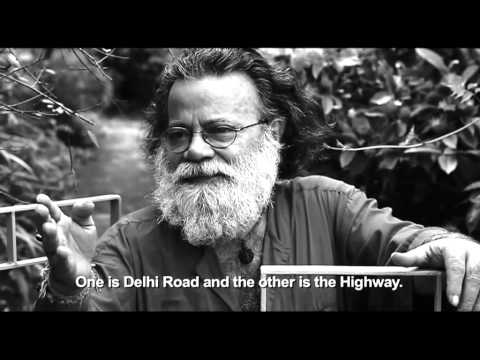
The poet, Arun Chakraborty, is a 60-something man with a straggly beard, a bird’s nest of hair and a twinkle in his eye. He lives in the sleepy town of Chunchura (Chinsurah changed hands between the Portuguese, the Dutch and the British) in West Bengal’s Hugli district, and his story of how he came to write Lal pahari is a lovely one. In the 1980s, he tells Banerjee, he used to travel a great deal, taking trains up and down the tribal regions of Bengal and what was then Bihar. One afternoon, he happened to get off at Srirampur station. “It was hot, April. The platform was empty. Then, at one end of the station, I saw a leafless mahua tree had blossomed.” Chakraborty, clearly a rather unusual man, did exactly what he would have done if he had been in a jungle: he began to pick up the fallen mahua flowers from the ground and eat them. It was only when a crowd gathered to gape that he realised he’d become a spectacle.
He left the spot, but the tree stayed on his mind. “I saw this mahua tree and my first thought was: ‘why are you here?’” Chakraborty says. “It was not meant to be there, it ought to have been in a jungle; in UP, Bihar, Bankura-Birbhum.” The tree, like so many of us, was a misfit. From that thought came this marvelous song, written—like a great deal of Chakraborty’s poetry—in the idiom of the tribal regions he has adopted as a spiritual home. He and a friend of his recorded a version on tape one Puja season. “It sold like hot cakes… in Assam, mofussil Bengal, Tripura.” Soon, Bauls began to sing it—and for some who asked, Chakraborty says, he wrote an extended version of the song.
A tradition of something like gurudakshina still seems to operate in Chunchura. Schoolchildren who have won a prize for reciting Lal Paharibring Chakraborty sweets. Nemai Goswami, the Baul artiste we met at the start of the film, comes over to display a green Honda bicycle he won for singing the song.
Versions of the song proliferate. The rustic ‘go’ of the poet’s first rendition— ‘Hethay toke manaicchhe na go’—has become in most urban versions, ‘re’. Other phrases change, the tone changes, even the tune changes. But as the filmmaker interviews more and more people for whom Lal Pahariis now a ‘folk’ staple on the commercial circuit—Kolkata-based recording companies, Bangla bands like Bhoomi and Parashpathar—it becomes clear that none of them either knows of or wants to acknowledge Chakraborty. Two Bhoomi band members—Soumitro and Surojit—talk of hearing a version of it from a Baul who once sang with them, but they cannot quite remember his name. They don’t seem to know anything about its origins. But they have no hesitation in declaring it procholito.
Earlier in the film, still in the back of Gurdeep Singh’s taxi, Paban Das Baul has already staked his claim. It was he who set the song to music, he says, with this poet called Arun Chakraborty, in Tamal-tala, 30 or 35 years ago. Everyone sings the song, but no one acknowledges his contribution, he laments. “E-ke bole guru-mara bidya. (That’s called knowledge-that-kills-the-teacher.)”
A musician called Prabuddha Banerjee, strumming his guitar in Kolkata, says he heard American folk icon Pete Seeger sing a Korean folk song (in translation), and the structure of it was identical to Lal Pahari’s.
Meanwhile, in Chunchura, Chakraborty continues with the tale of how he set the song to music in Tamal-tala. Was there anyone else present, asks the filmmaker. No, just me and Subhash, says the poet.
* * *
 |
| Poet Arun Chakraborty (left) with the filmmaker |
Banerjee’s film is more interested in throwing up questions than in providing definitive answers. Even when the versions—of the song, of the story of the song—do not match, Banerjee does not insist on a cross-examination. One has some inkling of where his sympathies might lie, but he lets the various tellings sit side by side, leaving us to make of it what we will.
On the one hand are the film’s many gentle references to gurus, which I read as suggesting that those who learn from others ought perhaps to acknowledge their debts. The person you learn from might be the published author of a text, or the villager you heard singing the song on a train—but it is your job to remember him. The way of forgetting is the way of gracelessness.
But it is also true that you never quite learn something until you have made it your own. And whatever premium the modern world might place on the idea of absolute originality, nothing new ever emerges from a vacuum. Arun Chakraborty may have written Lal Pahari, but the dialect he chose, the imagery he used, the lovely lilting rhythm he set it to—these came from a community of people whose language, whose music, whose very geography was one in which he had made himself at home.
18 July 2012
Madan Mahatta’s pictures are a history of Delhi’s present
My Sunday Guardian column this week, inspired partly by this fabulous exhibition at PhotoInk Gallery in Delhi.
|
To look at Madan Mahatta's photographs of Delhi's architecture, taken between the late '50s and the mid-'80s, is to have a new eye open up in your mind. Emerging into the city from the quiet of the gallery, you become suddenly attentive to the forms of buildings: the angle of a staircase, light falling into a courtyard and an unnoticed dome on a building you've passed a hundred times. To have seen Mahatta's magnificent black and white images is to have implanted in your mind the ability to look at a familiar outline and see it as something fresh and new. It is, in effect, to be able to travel back in time. Mahatta's family started the famous Mahatta Photographic Studio in Connaught Place in 1948. He returned from studies in England in 1954 and started work here, photographing the buildings being created in Delhi by a new generation of architects: literally, the building of Indian modernity. Like Mahatta, several had returned from training abroad. Habib Rahman and Achyut Kanvinde had studied under Walter Gropius of the Bauhaus School at Harvard and MIT, while Joseph Allen Stein had worked with Richard Neutra, and was inspired by Frank Lloyd Wright and Eliel Saarinen.
The new modernist vocabulary — the boldly dramatic geometrical forms, rough stone and poured concrete that characterised Raj Rewal's Hall of Nations, J.K. Chowdhury's IIT Delhi or Kuldip Singh's NDMC headquarters — was in stark contrast to the existing architecture of British New Delhi. Mahatta's photographs may create the illusion that 'Delhi Modern' was the dominant style of its era, but in fact it contended with, and responded to, what was present. And what was present was embroiled in debate — architectural debates that arose out of our colonial past that are still not completely dead.
The monumental classicism of Lutyens' and Baker's Delhi nodded to pre-colonial Indian styles. Some have suggested that these nods were rather cursory, that Lutyens' chhajjas — overhanging cornices along the side of a building, or over a door or window, and chhatris, decorative pavilions placed on a roof — were not based on existing Indian models, but instead reinterpreted them in an abstract, classicised idiom. By avoiding both the 'Hindu' and 'Moghul' elements of the colonial Indo-Saracenic style and modelling the roof of the Viceroy's House on the dome of the Sanchi Stupa, Lutyens thought he had gained neutral ground — Buddhism had no adherents in Victorian India. But, historian Thomas Metcalf argues this lack of connection to the present was precisely what made Lutyens' architecture a dead-end: "Confined within the classical traditions of European imperialism, it led, inevitably, nowhere."
Whatever the hopes of an anti-colonial historiography, official architecture in Delhi in the '50s and '60s had not emerged from Lutyens' shadow. The central dome of the Supreme Court (1958) was a simplified version of Rashtrapati Bhavan, and the major CPWD buildings built between 1955 and 1965 — Krishi Bhavan, Udyog Bhavan, Rail Bhavan — all had simplified domes, chhajjas and chhattris, grafted into classical style buildings.
The new modernists found them ridiculous: "Rahman and Stein made jokes about the new Supreme Court building coming up," writes photographer Ram Rahman (who is curator of the Mahatta show and the son of Habib Rahman). But for Lutyens acolytes like contemporary British curator Paul Waite, these structures were evidence that the wish to graft together Eastern and Western forms to create an indigenous architecture for India remained even after independence. For Waite, it is the coming of International Modernism that is cause for lament: "It did not matter if Le Corbusier was designing in Chandigarh, Paris or Morocco – it would be cement, high rise and without reference to any previous architectural traditions of the country. Architecture had to be the same the world over."
Ram Rahman believes exactly the opposite. For him, "What this generation of architects did was to develop a vocabulary of modernist practice suited to Indian conditions and connected to the ethos of the time". Stein, he reminds us, has spoken of how the spirit of Gandhi, still prevalent in the '50s, "meshed perfectly with the 'less-is-more' slogan of Modernism".
So is there really a 'Delhi Modern'? Do the cement and ceramic jalis of Stein's Lodi Estate or Rahman's Rabindra Bhavan make them 'indigenous'? Is indigeneity necessary? The debate is a fascinating one, and potentially endless. One way to resolve what one thinks is to begin to look more carefully at the buildings that surround us. Looking at Mahatta's image of the Shri Ram Centre, halfway through construction, it is impossible not to think of it as a spaceship that has recently landed, barely avoiding the elegant arcades of Connaught Place. And yet it is impossible to conceive of the Mandi House area today without the Shri Ram Centre. The alienating quality in the photograph has been erased by time and familiarity; even its once-harsh exterior seems softened by the presence of the little café.
Perhaps, despite all its conceits, any architecture is eventually dwarfed by those who use it. As it should be. Published as my Post Facto column in the Sunday Guardian, July 2012.
|
16 July 2012
Film Review: Cocktail
Ever since Farhan Akhtar captured the zeitgeist and (re)defined the genre with Dil Chahta Hai (DCH), Hindi movie friendship has never been the same. Vows and tears and pledges of loyalty (a la ‘Yeh dosti hum nahi todenge’) are now irredeemably old school. In new-age Bollywood, friends are people who hang out together, make fun of each other’s failed romantic encounters and preferably go on sunkissed ad-film vacations that will forever define their memories of youth. The invariably privileged young people who populate Akhtar’s universe — and made an updated appearance in his sister Zoya’s Zindagi Na Milegi Dobara (2011) — have a carefully cultivated coolth which does not allow them, even when in the midst of earth-shattering events, the old-world luxury of drama.
Homi Adajania’s Cocktail has much in common with those films. It’s astoundingly good-looking, filled with seductively-shot songs and fun montages of friends doing goofy things together. Life for our three protagonists seems like one long round of parties — a weekend jaunt from London is a trip to Cape Town, and money is clearly no object. So Deepika Padukone’s Veronica is a self-declared “rich bitch”, but the other two don’t seem to have real work lives either: Gautam, the flirt (Saif Ali Khan), lands contracts by declaring love at first sight to potentially difficult clients, while the mousy Meera (Diana Penty) snares a graphic design job with a big UK company without us being shown any sign of her experience or talent—or effort.
But Cocktail has something frank and warm about it that distinguishes it from the manicured, too-perfect vibe of those other films. It has the requisite coolness, but it has vulnerability, too. It has a finely tuned sense of the ridiculous, but it doesn’t shy away from drama, or darkness. And it is never coy.
The censors may have seen fit to beep the “bed” out of Veronica’s explanation for seeing Saif (“He’s great in bed”), but the scene’s amusing, comfortable vibe—including Diana’s slightly grossed-out “I didn’t need to know that” response—is that of a real moment of conversation between two women: such a pleasant change from the puerile nudge-nudge wink-wink stuff that passes for sexual liberation in films like Jodi Breakers. In fact, Cocktail’s first applause-worthy achievement is that it gives us a full-fledged female friendship—a whole 12 years after DCH’s portrait of male camaraderie first sparked the desire for a girl gang version. Admittedly, two women do not a girl gang make (and even this relationship is only snuck in via the love triangle route), but the scenes between Deepika and Diana will strike a chord with any woman who’s ever been in an intense and tumultous friendship.
Published in Firstpost.
Homi Adajania’s Cocktail has much in common with those films. It’s astoundingly good-looking, filled with seductively-shot songs and fun montages of friends doing goofy things together. Life for our three protagonists seems like one long round of parties — a weekend jaunt from London is a trip to Cape Town, and money is clearly no object. So Deepika Padukone’s Veronica is a self-declared “rich bitch”, but the other two don’t seem to have real work lives either: Gautam, the flirt (Saif Ali Khan), lands contracts by declaring love at first sight to potentially difficult clients, while the mousy Meera (Diana Penty) snares a graphic design job with a big UK company without us being shown any sign of her experience or talent—or effort.
But Cocktail has something frank and warm about it that distinguishes it from the manicured, too-perfect vibe of those other films. It has the requisite coolness, but it has vulnerability, too. It has a finely tuned sense of the ridiculous, but it doesn’t shy away from drama, or darkness. And it is never coy.
The censors may have seen fit to beep the “bed” out of Veronica’s explanation for seeing Saif (“He’s great in bed”), but the scene’s amusing, comfortable vibe—including Diana’s slightly grossed-out “I didn’t need to know that” response—is that of a real moment of conversation between two women: such a pleasant change from the puerile nudge-nudge wink-wink stuff that passes for sexual liberation in films like Jodi Breakers. In fact, Cocktail’s first applause-worthy achievement is that it gives us a full-fledged female friendship—a whole 12 years after DCH’s portrait of male camaraderie first sparked the desire for a girl gang version. Admittedly, two women do not a girl gang make (and even this relationship is only snuck in via the love triangle route), but the scenes between Deepika and Diana will strike a chord with any woman who’s ever been in an intense and tumultous friendship.
Image courtesy in.com
Rich London party girl Veronica, so popular a visitor at her favourite nightclub that she bypasses the long queues with a breezy kiss to the bouncers, may seem an unlikely companion for the quiet, salwar-kameez-clad Meera, whose hapless status as a rejected mail-order bride is a trifle hard to believe in anyway. But there’s an undeniable energy injected into the proceedings by having the two women come from such different backgrounds—women that most Hindi films wouldn’t dream of bringing together in the same frame. Deepika, glorious in smoky eye makeup and wild hair, looks the part completely and turns in her most affecting performance. (Though she struggles to sound natural when being forced to say impossibly colloquial lines like “Saanp ko doodh pila rahe ho beta”, Homi Adajania must get some credit for the fact that her dialogue delivery is so much better than in, say, last year’s Aarakshan). Diana, playing demure and lovely foil to the other’s overt sexiness, successfully imbues her character with a sense of unvoiced guilt and confusion.

The third component of the cocktail is Saif Ali Khan, playing the easy come, easy go Gautam Kapoor, a Delhi-born, London-based 32-year-old whose mother still calls him Gutlu and sends him pics of prospective brides. Saif looks (and is) much too old to be reprising the flirtatious loverboy role that he cut his acting teeth on. But at least he’s had so many years to refine his technique that he can get by purely on charm. Gautam’s in-your-face pick up lines may appear over-the-top, but for me his charm lies precisely in the fact that he knows quite well that he’s performing. And he can laugh at himself. He can, while lolling about on the couch and stuffing popcorn in his face, answer the question “What are you doing here?” with “I’m oozing charm”… and all of a sudden, it feels sort of true.
Adajania’s only previous film, Being Cyrus (2006), based on a script he wrote himself, was a strange and quirky little film which had space for humour and lust and murder—but very little for love. Cocktail, based on a script by romance-master Imtiaz Ali, feels radically different in tone. But Adajania repeats his lead actor—Saif was Cyrus in that film—and also casts Boman Irani and Dimple Kapadia again. Boman and Saif achieve a rare and wonderful camaraderie as layabout uncle and nephew, and the dynamic between the 50-plus but still-assumed-to-be-irresponsible younger brother (Boman) and the bossy elder sister (Dimple) is hilariously accurate in a way that has rarely found its way onto our screens. The scene where Boman gets caught mimicking Dimple (“Tinku, bulub change kar do…”) is hysterically funny. Dimple is superb as the theth Punjabi mother who arrives unannounced from Delhi, throwing the cosy threesome into a tizzy. The scene where she insists on handing over a pair of kadas to her prospective daughter-in-law is simply superlative, stitching humour and pathos and affecting sentiment into a seamless yet textured whole.
In fact, the film manages to segue beautifully between emotional heft and hilarity, allowing its characters to make the heavy-duty confessions that a younger, hipper director might have felt compelled to steer clear of—but letting them make fun of themselves as they do so. So when Veronica makes an uncharacteristically sentimental appeal to Meera to stay on in her house, she follows it up by asking Meera if she’s convinced yet — “ya aur thoda melodrama ka scope hai?” In a style that feels recognizably similar to Love Aaj Kal, Imtiaz Ali’s superbly crafted screenplay leavens almost every emotional interaction with an understated, half-ironic sense of humour. But perhaps Cocktail’s crowning achievement is that it also frequently manages the opposite: shoehorning us into a space where all the cues point to laughter, and then interrupting with a moment of quiet that stays in your mind long after the giggles are gone.
8 July 2012
Film Review: Convict Bol Bachchan for the murder of Golmaal
The relationship between Hrishikesh Mukherjee’s original Golmaal and Rohit Shetty’s Bol Bachchan can be summed up in one of the ridiculous couplets that make up Bol Bachchan’s depressingly bad title song:
“Where one represents a magnanimous name,
While the other represents a horrendous game.”
If this makes absolutely no sense to you, I apologise. A couple of hours in the world of Bol Bachchan is enough to make the best of us start to blabber.
Rohit Shetty takes the marvellous mild-mannered comedy classic, squeezes every drop of joy and wit out of it, and hangs it out to dry. It is murder most foul.
It’s not clear why the film is called Bol Bachchan, except to capitalise shamelessly on the presence of the name, and on the somewhat grudging presence of its owner: the senior B appears in the aforementioned title song, cannibalising first one, then another of his own most famous dialogues, even as we wait with dread to see what will come next. One is almost grateful when he announces, at song’s end, that he’s not in the movie.

Replacing Utpal Dutt’s exaggeratedly fearsome Bhawani Shankar, he of the moustache and satya vachan, with Ajay Devgn’s whip-wielding, nose-flaring Prithviraj Raghuvanshi, whose speciality is mauling English words and phrases into unrecognizable nonsense: this is just the first sign of Shetty’s hubris. Next comes the substitution of Amol Palekar’s immortal Ramprasad and Lakshmanprasad by Abhishek Bachchan’s Abbas Ali and—wait for it—Abhishek Bachchan: such clever self-referentiality, wow! We must also suffer through the grotesque flirtatiousness of Archana Puran Singh in place of the superbly subtle Dina Pathak, and of the now-invariably-overdone Asrani in place of the quiet, twinkling David.
It’s no surprise, then, that the quiet middle class world of the old Golmaal, where the flashiest thing ever was the sight of Amol Palekar wearing sunglasses to a hockey match, has been swallowed up and spat out as this tourist universe of fake havelis with fake rangolis, black-and-gold uphostered sofa chairs serving as thrones in scorching open courtyards, and streets filled with earthen pots and bangle stalls—all the better to shatter in fight scenes. (It’s a superlative piece of irony that this film makes one of its heroines an “art director”.)
But Shetty doesn’t stop there. He takes a film whose very premise—the made-up judwa bhai—was an exquisitely fine dig at the proliferation of identical twins in mainstream commercial cinema, and creates a blissfully oblivious reworking of it that makes the hapless Asin Thottumkal both Ajay Devgn’s long-dead love and her “real-life” humshakal (yes, the ‘art director’).
The filmmakers’ ridiculously high estimation of themselves reaches its acme with what one can only assume is their deep belief in intertextuality. Not only does Bol Bachchan rework the plot of the old Golmaal, it also has the old film appearing as a movie on TV, inserts a local naatak mandli that’s rehearsing a play version of it—and even bungs in a sort of dream sequence where Ajay Devgan puts on glasses and ‘becomes’ Utpal Dutt to Abhishek’s Amol Palekar. And just in case you still haven’t managed to cotton on to the plot by the time all this is done, the finale has Ajay Devgn and his cronies perform a cringeworthy burlesque of everything that has taken place already.
The film also gives us a wonderful ringside view of the contemporary Hindu mind, to which it is apparently perfectly normal that no Muslim can admit to have broken a lock on a temple, even if it is to rescue a drowning child, and worse, no Hindu can have studied in a ‘Muslim’ institution, so that Jamia Millia Islamia must quickly be replaced by a fictional “Pandit Nehru College”.
None of these travesties, however, can compare with the dialogue, where Devgn takes pride of place with his straight-faced rendition of pure rubbish. When praised, he replies, “Thanks for the Complan boy,”; when lecturing the males of his village, he tells them to “eat lots of akhrot, tighten your langot and fight with bare hands”; and when calming someone down, he advises them to “Pest control” themselves.
But then Devgn has given up on himself as an actor a while ago—pity, because he’s not half bad when he tries. Abhishek Bachchan, on the other hand, did a rather good job with comic timing in Bluffmaster and Bunty aur Babli and even the much-reviled but very fun Jhoom Barabar Jhoom. Here, though, no amount of impressive bawdiness—one of his selves is supposed to be an effeminate Muslim dance teacher—can make up for the autopilot performance that gets him by for the rest of the film.
One can only pray that Rohit Shetty does not take it into his head to remake any more Hrishikesh Mukherjee films. As the sole hummable song in this film goes, “Kahin nikal na jaye humri body se praan re”.
Published in Firstpost.
“Where one represents a magnanimous name,
While the other represents a horrendous game.”
If this makes absolutely no sense to you, I apologise. A couple of hours in the world of Bol Bachchan is enough to make the best of us start to blabber.
Rohit Shetty takes the marvellous mild-mannered comedy classic, squeezes every drop of joy and wit out of it, and hangs it out to dry. It is murder most foul.
It’s not clear why the film is called Bol Bachchan, except to capitalise shamelessly on the presence of the name, and on the somewhat grudging presence of its owner: the senior B appears in the aforementioned title song, cannibalising first one, then another of his own most famous dialogues, even as we wait with dread to see what will come next. One is almost grateful when he announces, at song’s end, that he’s not in the movie.
Replacing Utpal Dutt’s exaggeratedly fearsome Bhawani Shankar, he of the moustache and satya vachan, with Ajay Devgn’s whip-wielding, nose-flaring Prithviraj Raghuvanshi, whose speciality is mauling English words and phrases into unrecognizable nonsense: this is just the first sign of Shetty’s hubris. Next comes the substitution of Amol Palekar’s immortal Ramprasad and Lakshmanprasad by Abhishek Bachchan’s Abbas Ali and—wait for it—Abhishek Bachchan: such clever self-referentiality, wow! We must also suffer through the grotesque flirtatiousness of Archana Puran Singh in place of the superbly subtle Dina Pathak, and of the now-invariably-overdone Asrani in place of the quiet, twinkling David.
It’s no surprise, then, that the quiet middle class world of the old Golmaal, where the flashiest thing ever was the sight of Amol Palekar wearing sunglasses to a hockey match, has been swallowed up and spat out as this tourist universe of fake havelis with fake rangolis, black-and-gold uphostered sofa chairs serving as thrones in scorching open courtyards, and streets filled with earthen pots and bangle stalls—all the better to shatter in fight scenes. (It’s a superlative piece of irony that this film makes one of its heroines an “art director”.)
But Shetty doesn’t stop there. He takes a film whose very premise—the made-up judwa bhai—was an exquisitely fine dig at the proliferation of identical twins in mainstream commercial cinema, and creates a blissfully oblivious reworking of it that makes the hapless Asin Thottumkal both Ajay Devgn’s long-dead love and her “real-life” humshakal (yes, the ‘art director’).
The filmmakers’ ridiculously high estimation of themselves reaches its acme with what one can only assume is their deep belief in intertextuality. Not only does Bol Bachchan rework the plot of the old Golmaal, it also has the old film appearing as a movie on TV, inserts a local naatak mandli that’s rehearsing a play version of it—and even bungs in a sort of dream sequence where Ajay Devgan puts on glasses and ‘becomes’ Utpal Dutt to Abhishek’s Amol Palekar. And just in case you still haven’t managed to cotton on to the plot by the time all this is done, the finale has Ajay Devgn and his cronies perform a cringeworthy burlesque of everything that has taken place already.
The film also gives us a wonderful ringside view of the contemporary Hindu mind, to which it is apparently perfectly normal that no Muslim can admit to have broken a lock on a temple, even if it is to rescue a drowning child, and worse, no Hindu can have studied in a ‘Muslim’ institution, so that Jamia Millia Islamia must quickly be replaced by a fictional “Pandit Nehru College”.
None of these travesties, however, can compare with the dialogue, where Devgn takes pride of place with his straight-faced rendition of pure rubbish. When praised, he replies, “Thanks for the Complan boy,”; when lecturing the males of his village, he tells them to “eat lots of akhrot, tighten your langot and fight with bare hands”; and when calming someone down, he advises them to “Pest control” themselves.
But then Devgn has given up on himself as an actor a while ago—pity, because he’s not half bad when he tries. Abhishek Bachchan, on the other hand, did a rather good job with comic timing in Bluffmaster and Bunty aur Babli and even the much-reviled but very fun Jhoom Barabar Jhoom. Here, though, no amount of impressive bawdiness—one of his selves is supposed to be an effeminate Muslim dance teacher—can make up for the autopilot performance that gets him by for the rest of the film.
One can only pray that Rohit Shetty does not take it into his head to remake any more Hrishikesh Mukherjee films. As the sole hummable song in this film goes, “Kahin nikal na jaye humri body se praan re”.
Published in Firstpost.
Subscribe to:
Posts (Atom)