18 December 2019

Countries of the Mind

Solitary young immigrant men traverse Parisian streets in Na

Read more at:
https://mumbaimirror.indiatimes.com/opinion/columnists/trisha-gupta/countries-of-the-mind/articleshowprint/72623618.cms?prtpage=1?utm_source=contentofinterest&utm_medium=text&utm_campaign=cppst
My Mirror column:

Solitary young immigrant men traverse Parisian streets in Nadav Lapid's Synonyms and Jérémy Clapin's I Lost My Body, two of 2019's most befuddling, memorable films. 

A still from Synonyms (2019)

The opening sequence of Nadav Lapid's Synonyms bursts with a strange, irrepressible energy. A 20-something man charges through Paris, the camera capturing his long-legged strides and his thumping footsteps. He arrives in a grand old building, finds a key hidden under a corner of carpet, and enters a vast, rather beautiful apartment -- with not a scrap of furniture. Seemingly unsurprised, he is in the bathtub when he hears a sound. He runs out, nude and slippery, onto the polished wooden floors, to discover that his possessions – clothes, sleeping bag, money – have disappeared. He races downstairs looking for the thief, banging on the doors of other apartments. No one answers. He comes back to the apartment, still without his clothes, and settles back into the bathtub, seemingly prepared to freeze to death. The next thing he knows, he is waking up in a large clean bed, having been adopted by the young bourgeois couple downstairs. His rescuers Emile and Caroline – children of rich industrialists who have pretensions to the arts – feed him and clothe him, giving him money and a phone and a particularly memorable mustard yellow coat in return for the pleasure of his amusing, sometimes outlandish company. Stripped quite literally of his past, Yoav – for that is the name of Lapid's Israeli protagonist – resurrected in a new identity.


Synonyms, which won the Golden Bear at the 2019 Berlin Film Festival and was screened in India at both MAMI and IFFI, is a film about a man who wishes to shed his old skin, an Israeli man insistent that he will not speak Hebrew, who walks the streets of his new city with a Larousse dictionary under his arm, reciting synonyms from the language he thinks will grant him entry into a new nation.


Lapid's film, apparently at least partly autobiographical, is filled with anger against in-your-face Israeli militaristic nationalism. But as Yoav gradually realises that France isn't quite the haven of liberty, equality and fraternity that he has imagined, it also indicts nationalism of the French variety – with its insistence on linguistic blending in, its closet anti-Semitism, its citizenship classes that involve learning the words of La Marseillaise: “Let us march! Let us march! So that impure blood irrigates our fields!”.


Still from the award-winning animated film I Lost My Body (2019)

I found myself thinking about Synonyms as I watched another 2019 film about a young immigrant wandering the streets of Paris, this time a Moroccan pizza delivery boy called Naoufel. Jérémy Clapin's stunningly crafted I Lost My Body – the first animated feature film to receive the top prize at the Critics' Week section at Cannes, and now available to stream online -- has even grander ambitions than Lapid's film. It opens with a severed hand coming to life and making its way out of a medical laboratory. Surely this must be horror, you think – and I Lost My Body does have its tense, borderline macabre moments: a body-less hand suddenly wringing a pigeon's neck, or clicking an abandoned cigarette lighter into flame in self-defense against a pack of subway rats. But even as we watch the hand creeping and crawling and dancing its way across rooftops and drains, over pianos and under trains, it takes on a personality of its own. We begin to identify with its search – for its missing body, for itself. We do not tremble when the hand approaches a gurgling baby, placing a fallen pacifier back in the baby's mouth, and then laying itself down to be held in the baby's sleepy grip.


Perhaps our comfort has something to do with what we see in the film's parallel narrative, about the film's human protagonist, Naoufel. Bespectacled, shy and slight of build, Naoufel sometimes seems like the opposite of Yoav in Synonyms. And yet they share many things: an irredeemable homelessness, an emptiness that seems to express itself in a need to attach themselves to something or someone, and a painful preoccupation with the past, with a country of memory. Their responses to trauma are quite different. Yoav is constantly vocalising, telling outrageous stories about his past in Israel, once even presenting them to his writerly friend Emile in an extravagant gesture of generosity. Naoufel is painfully quiet, seeming to relive certain moments of his childhood over and over. If Yoav recites new words from a dictionary, Naoufel listens to old tape recordings of his parents. And the hand – the hand remembers trying to catch a fly.


A hand separated from its owner, a tongue separated from its language – these are strange but powerful metaphors for alienation. We might want desperately to leave our pasts behind, but the body remembers.


13 December 2019

The Catholic Dress: Bombay to Goa and Back

My Shelf Life column for TVOF:
 

The dress-wearing Catholic girl was an object of Indian male fantasy, but as Jane Borges’ Bombay Balchão makes clear, the reality was more complex than the stereotype


At the beginning of her just-published debut novel Bombay Balchão, the Mumbai-based journalist Jane Borges sets us down in the Catholic neighbourhood of Cavel on Christmas Eve 1945. Before we hear the midnight mass, we hear of Karen Coutinho, whose tailor Francis (“from John D'Souza and Sons”) has made her “a long yellow silk gown, which swept the road as she walked to church”, and of her husband Alfred, who is glad that his wife’s gold lace mantilla covers her “heavily powdered face and the crimson lips she had painted with cheap lipstick”. And we hear, almost simultaneously, of the Hindus on Dr D' Lima Street who “sneakily peered from the gaps between the iron rods of their windows, gawking at the dressy Christian women”. 

Borges doesn't dwell on her wartime setting, but a 2017 piece on 'aunty chic' by Cheryl-Ann Coutto published on Scroll points out that knee-length skirts were a wartime trend for economic reasons. “There was rationing, food coupons, there was less food, less cloth and so the hemlines too were shortish,” an 80-year-old Elettra Gomes tells Coutto. “Then after the war ended, Christian Dior came out with calf-length swirling full skirts and tiny cinched waists [this lavish, ultra-feminine aesthetic... became known as the New Look]”.

But even if the length of Karen Coutinho's gown could have been seen as a legitimate post-war luxury, Bombay Balchão makes it clear that she was up against other forms of moral censure: such as the local Hindu patriarch accusing Christians of having “sold their souls to the gori chamdi” (white skin) by dressing like Europeans--at a time when the Gandhian campaign for Khadi was at its acme.

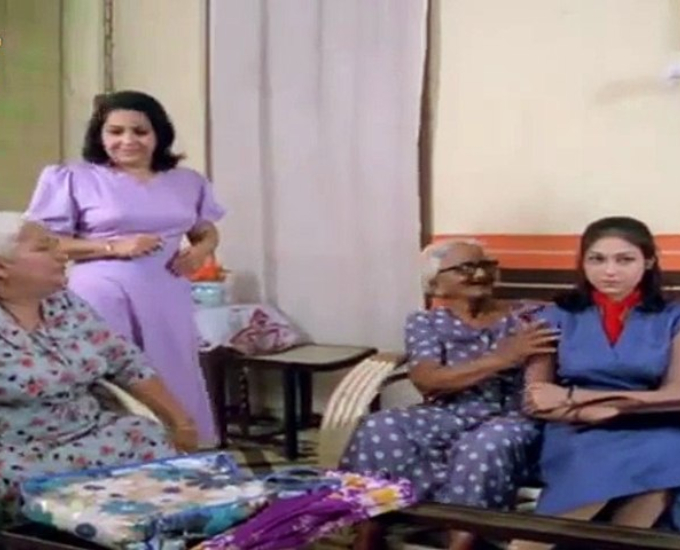
A still from the film Baaton Baaton Mein.

The real source of censure, however, lay far deeper than nationalism or economy. Bombay's Catholic women – whether the East Indians, as the original Catholic inhabitants of Bombay and Salcette called themselves, or the Goans who came to the city later–were invariably marked by the wearing of dresses. 
 
By exposing the legs to view, and simply by fitting around the female upper body, the dress seems to have sparked the sexual imaginations of generations of Indian men whose own wives and daughters were never without the protective drape of the pallu or the dupatta. Borges writes, “In the darkness, numbed by furious lovemaking, (the Hindu man) would latch on to his wife's waist, and in between suckling her breasts ask if she would wear one of those dresses, just for him. She would agree coyly, but as an afterthought dredge up the same feeling her husband had exposed in front of the family when he saw the Christian women strut on the roads.” That particular Hindu male fantasy made its way firmly into Hindi cinema via such depictions of Catholic girlhood as Raj Kapoor's Bobby and Basu Chatterjee's Baaton Baaton Mein, and lasted well into the 1980s, when Salman Khan made that 'secret' dress-wearing request of his long-haired, 'traditionally Indian' heroine Bhagyashree in the epoch-defining Maine Pyar Kiya (1989).

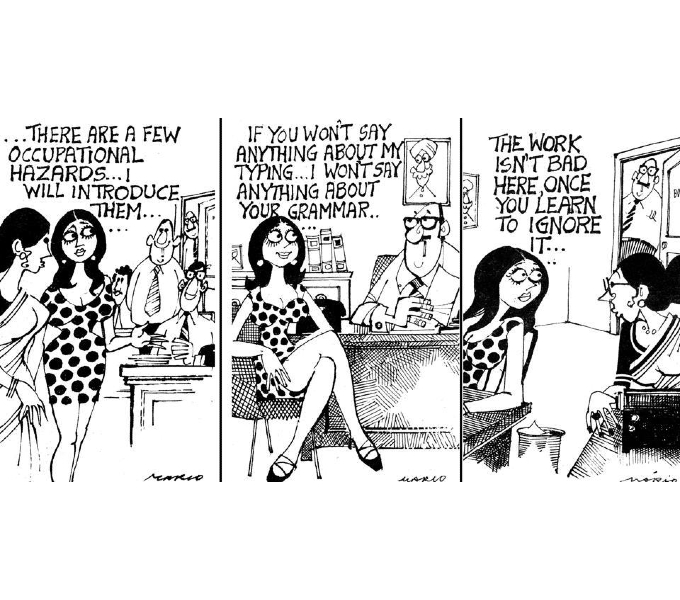
“For repressed Maharashtrians and Indians like me, Jesus Christ, this was where heaven began!” declared the late Kiran Nagarkar in Paromita Vohra's charming short film Where’s Sandra?, which addresses the precise question of what the office-going Bandra girl represented to the rest of the city. One of the real 'Sandras from Bandra' that Vohra tracks down makes the crucial point that the Christian girl was the object of Indian male fantasy also because women from most other urban Indian communities weren't allowed to go out to work. The Christian secretary in the form-fitting dress became embedded in the collective Indian psyche, with even such pillars of the Goan community as cartoonist Mario Miranda essentially reinforcing the stereotype with his polka-dotted Miss Fonseca.
The dress-wearing Goan Christian secretary was immortalised by cartoonist Mario Miranda in the busty figure of Miss Fonseca.

Of course, the stereotype of the Christian girl as open in her morals didn't quite fit the facts. Bombay Balchao is full of Catholic boys bemoaning their fate while the Catholic girls they're dating scratch them for trying to sneak a kiss. In Vohra's film, too, the late poet and professor Eunice D'Souza argues with efficiency that the Christian family and school-going milieu could be as orthodox as the non-Christian ones, policing female sexuality with just as much middle class paranoia. Dress-wearing was no marker of (im)morality. 

Not all Christians wore dresses, either. For instance, the Portuguese insistence “that converts adapt to the European style of dressing” led to such innovations as the pano bhaju, which Borges calls a “middle ground” created by orthodox Brahmin women. Now 'traditional' when dancing to sad Konkani love songs called mando, this particular Goan Christian outfit consists of a sarong-like lower garment (pano), worn with a loose gold-embroidered blouse (bhaju) and a stole called the tuvalo. The hybridity is India at its best: the pano draws on the South Indian lungi/mundu/veshti, the bhaju is Portuguese, while the gold thread work owes something to the Mughals. 

One of the pleasures of Borges' book is its mini-ethnography of Bombay's different Christian communities. The Goans and East Indians express disdain for the Mangaloreans as calculating, not so comfortable with English, not good dancers or good at Western music. The Mangaloreans, meanwhile, saw the Goan absorption of Westernised mores as a cop-out, too easy a surrender to their colonial masters. Mangalorean rebelliousness, not surprisingly, was expressed most vividly in their women's clothes: the community may have converted to Christianity, but the women still wore their heavily embroidered sarees and jasmine venis (floral garlands) in their buns – rather than floral dresses and bouffants.

Beyond Bombay, too, the dress-clad Christian working girl was the focus of Hindu male anxiety: think of the Anglo-Indian Edith, who becomes the heroine Arati's office colleague and then friend in Satyajit Ray's Mahanagar. For the two Calcutta women, lipstick marks a bond between them. For the Hindu husband waiting edgily at home, the same lipstick becomes emblematic of the 'corruption' of his wife. Clearly, as non-Christian women ventured tentatively into the workforce, the dress-wearing Christian girl was now a terrible threat. For on what women wear, as always, the whole burden of civilisation comes to rest. 

Thankfully, as Vohra suggests, Sandra the stereotypical good-time girl doesn't have a reason to exist anymore. Because we all a have a bit of Sandra in us now. Something to think about each time you wear a dress – and can even let the camera see you in it, unlike Bhagyashree.


10 December 2019

Learning of love

My Mirror column:

From Francois Truffaut’s Les Mistons to Shlok Sharma’s Haraamkhor, what propels so many writers and filmmakers to turn the child’s gaze upon adults in the throes of desire?


“Jouve’s sister was unbearably beautiful,” begins the voiceover of François Truffaut’s Les Mistons (The Brats), as Bernadette Lafont cycles through the historic streets of De Nimes – her slim, leggy frame suspended effortlessly over her bicycle, her skirt billowing in the breeze, such a vision of lightness that she seems barely to touch the ground. What we watch is five boys watching this young woman. The eponymous “brats” of the film’s title follow Bernadette everywhere, first with their eyes and then by actually stalking her, alone or with her lover Gerard.
 
Truffaut, a film critic who had made his first short Une Visite in 1954, thought of Les Mistons (1957) as his “first real film”. Certainly, it already contains many themes he would continue to explore over his cinematic career – women as objects of desire that seem to mystify men, a certain realist poetry of everyday life, the unexpected rupture presented by death. What interests me most, though, is the theme of adult behaviour – in particular, sexual passion or what Truffaut's narrator calls amour – as seen through the eyes of children. The boys in the film are arrested by this young woman’s beauty, transfixed by the stirrings of a desire they do not even understand, and irritated by the fact of the lovers without quite knowing why.
 
When she leaves her bicycle to swim in a shaded grove, they gather round to sniff it like little puppies, one of them even delivering a slow-motion kiss on the seat where her posterior has recently rested. Categorised only as “unbearable”, the one-sided attraction they feel mutates into something else: “Too young to love Bernadette, we decided to hate and torment her.”
 
The child on the cusp of adolescence becoming smitten for the first time has been the subject of many books and films over the years. In LP Hartley’s 1953 classic The Go-Between, which Joseph Losey made into a famous 1971 film starring Julie Christie, the young narrator Leo recalls the shaping summer of his childhood in which he first felt attraction. “My sister is very beautiful,” his friend Marcus tells him one day, and after that, “for a time my idea of [Marian] as a person was confused and even eclipsed by the abstract idea of beauty that she represented.” Once Leo helps Marian dry her hair, and Hartley describes the immersiveness of the experience evocatively: “I was the bathing suit on which her hair was spread: I was her drying hair, I was the wind that dried it.”

When Marian embarks on a secret, torrid, socially unsuitable affair with a local farmer called Ted Burgess, Leo finds himself turned into their messenger. The child enables the adult relationship. But jealous, torn between his desire to please Marian and his own inarticulate feeling for her, and childishly blind to what is really at stake, he is also the one that brings it to its tragic end.
 
The Go-Between, with its sun-kissed sexual innocence and stark coming of age, is likely to have been among the inspirations for Atonement, Ian McEwan’s wonderful novel, which was adapted into the Joe Wright film. Like Leo, the 13-year-old Briony is responsible for the betrayal that drives apart the two adults she is close to, based on her childish misunderstanding of a charged sexual moment she witnesses between the socially transgressive lovers.
 
Paresh Kamdar’s under-watched, atmospheric film Khargosh (2009) has a very similar story to The Go-Between. The child protagonist Bantu becomes a go-between for his older friend Avneesh, and slowly finds himself enraptured by the girl Avneesh is besotted with, whom the film nicknames Mrityu (Death).
 
More recently, we have had Shlok Sharma’s Haraamkhor, whose take on exploratory sexual urges is several shades darker, and perhaps more layered than any of these other films. For one, Haraamkhor contains two levels of watching and watchers. An adolescent schoolgirl (superbly played by Shweta Tripathi) in a dusty North Indian town becomes morbidly attracted to her maths tuition teacher (a scarily believable Nawazuddin Siddiqui) after she spies on him having sex with his wife. But the 15-year-old Sandhya has her own set of stalkers: two younger boys in the same tuition class, one of whom thinks he is in love with her. The film steers us between these different gazes, refusing to let us rest easy. One moment, we wait with baited breath with Sandhya in an abortion clinic – but then almost immediately find ourselves confronted by her childish exuberance as she licks an ice-cream and ribs her lover-teacher-exploiter about what he’s going to tell his wife. We begin by giggling as the two boys hatch plans for Sandhya to see Kamal naked, because if a man and a woman see each other naked, “toh unki shaadi pakki”. But as the film draws to its denouement, the dusty haze and windmills gather into a terrible, tragic downpour, childish naivete leading somehow inexorably into life-altering errors.

Perhaps, in the end, that is what makes the child’s-eye view so terrifying. Examined through the frank gazes of children, the lives of adults don’t seem that foolproof any more.

Published in Mumbai Mirror, 8 Dec 2019

8 December 2019

The arc of appearance

My Mirror column:

Amar Kaushik’s Bala takes a witty Kanpuriya route to show Indian viewers that our preoccupation with surface-level qualities runs depressingly deep


Bala in Bala is a pun on the Hindi word for hair, as well as the nickname of its hero Balmukund Shukla. What’s remarkable about Bala is that its hero is not a nice guy. And no one in Amar Kaushik’s film is trying to tell us that he is. Once the teenaged Shah Rukh Khan of his Kanpur school/gali/mohalla, Bala in his twenties is experiencing a massive crisis of confidence. As he loses his once-luxuriant mane of hair, he also loses the head-tossing arrogance that came with it.

Once the sort of cocky upper caste boy who could effortlessly cast himself as hero of his North Indian small-town universe, the balding Bala is now assailed by self-doubt in greater measure than those who haven’t had his level of entitlement. Far from being an action-packed vehicle for his starry antics, Bala’s life is now a tragicomedy: a series of misadventures with ever more outrageous hair-replacement tactics.

Coming after 2018’s Stree, in which Kaushik sneaked a snide gender angle into a ghost-centric comedy, it isn’t surprising that in Bala he uses the male balding plot as a way to hold up a mirror to our lookist universe. But not just any universe. Bala’s second plotline, featuring Bala’s childhood friend Latika, is about India’s constricted ideas of beauty, particularly for women. It holds up to the light our bizarre obsession with “fair” skin, which does especially widespread damage to self-esteem in a country where almost everyone would be considered “dark”. And it illuminates how these ridiculous casteist, subliminally racist ideas, far from being smashed by a more inclusive ‘global’ modernity, are being reinforced and amplified by a social media explosion that feeds on ever-greater exhibitionism and display.

In fact, we might think of the film as deriving its premise from a semi-conscious recognition: that women have been judged primarily by their looks pretty much through history, but the image-focused quality of the selfie era has finally started to get to men, too. Bala’s particular form of vanity gives him long-term aspirations – he does stand-up comedy on the side. But his need for outlets for more immediate gratification leads him down the TikTok path. Which leads into the arms of his dream girl Pari Mishra: a TikTok celebrity and the ‘face’ of Pretty You, the mass market fairness cream for which Bala is a marketing agent.

Having first cast Ayushmann Khurrana, Bollywood’s current patron saint of North Indian masculine vulnerability, as Bala, Kaushik goes on to give his hero a great deal of screen-time so we might learn to sympathise with him. Having seen the preening boy Bala at his worst – mocking his teacher for being takla, or jeering at Latika for her dark skin, we see those frailties turned inside out in the adult Ayushmann, when the character’s own fixation on good looks comes back to haunt him. You may still not like the fellow, but there’s definitely something about his honest appeal for help that works to make him human.

The female leads are both actors who have been paired with Khurrana before: Yami Gautam in Vicky Donor, and Bhumi Pednekar in Dum Laga Ke Haisha. Gautam aces the part of Pari, the perfectly turned out social media queen, whose primary desire on her wedding night is to make a suhaag raat TikTok video. Her purpose is primarily to entertain, but she gets one powerful dialogue moment in which to introduce us to the interiority of the surface-level character. Latika is played controversially by Pednekar in unfortunately varying degrees of black-face make-up. Pednekar gets a well-intentioned but not very fleshed-out role as the strong girl who refuses to be defeated by her complexes. She is meant primarily as a mirror for Bala to begin to see himself. But it seems to me significant that the film is self-aware enough to flag that fact – and that Latika has several moments to point out Bala’s self-absorption to him.

What makes the film transcend its inherently lecture-like core is the consistently well-crafted surround sound, achieved by a great ensemble cast who take the superbly written dialogues and produce a pitch-perfect rendition of a contemporary Kanpur milieu. Particular mention must be made of Abhishek Banerjee as Bala’s friend Ajju, Javed Jaffrey back in fine fettle as the Amitabh-impersonating Bachchan Bhaiya, and Seema Pahwa as Latika’s marvellous upbeat mausi, who has had her own look battle to fight in the form of being identified as “moochhon wali” (Ritesh Batra’s recent Photograph also contained a reference to a moustachioed aunt). The film has a brilliant soundscape, in which the base physicality of “kantaap” bounces effortlessly off the Shuddh Hindi register of “guru upahaas”. It also gives us an infectious Tequila song – and the potentially viral coinage “babyu”. We may not believe in Bala’s redemption speech entirely, but the film keeps us listening.

2 December 2019

Mothering desires

My Mirror column:

At this year’s International Film Festival of India (IFFI), the desire for children emerged as a preoccupying theme for directors from China to Turkey


 In Kantemir Balagov’s memorable second feature Beanpole (2019), which won the Un Certain Regard Best Director Award and the FIPRESCI Prize for Best Film in the Un Certain Regard section at Cannes, a young woman called Iya undertakes motherhood as a favour for her friend. It is the half-starved world of post-war Leningrad, and the friend, Masha, has had and lost a child. She has also had so many abortions that she can no longer get pregnant.

For a while, Masha seems unable to grasp this fact, leading her to seek out sex in the vain hope that a man might yet successfully impregnate her. “I want to have another human being inside me,” she tells Iya. Finally, giving up on that possibility, she persuades Iya to subject herself to sex with a man and carry the child to full term on her behalf.

The man that Iya requests to be her biological aid in this pursuit wants to know why she so badly wants to have a baby. “I want to be the master of her,” says Iya, talking of Masha. Having a baby may seem purely functional here, not something that Iya is invested in, except as a route to preserving her relationship with another woman. Yet, when she discovers she is not actually pregnant, the words Iya uses have an all-encompassing devastation. She is “empty”, she tells the doctor. Later she tells Masha that she feels “meaningless inside”. “There is no one inside me,” she continues.

The expressions I quote are the English subtitles, translated from the film’s original Russian dialogue. But that feeling of emptiness, the gnawing desire for a child, the all-consuming aspiration of motherhood, spanned across several films at this year’s edition of IFFI, which ended last Friday in Goa.

In Anthony Chen’s Singapore-set Wet Season, his much-awaited second feature after 2013’s Camera D'Or winner Ilo Ilo, a middle-aged teacher of middle school Mandarin is quietly distraught because she hasn’t conceived a child despite eight years of trying. Chen’s gentle, melancholy film is full of sharply observed moments that make her husband’s absentee status clear: her solo attempts to keep up with his side of the family and her increasingly lonely visits to the fertility clinic, where the extent of his potential contribution is frozen sperm – a perfect metaphor. When a newborn she is holding bursts into tears, a callous female relative is quick on the draw: “Why would she know? She hasn’t had one.” Between these draining medical and familial contexts, childlessness seems to have become the only relevant thing about her.

If Balagov took it into the past, director Gabriel Mascaro projects the desperation for a child into an imagined dystopic future, where a state-sponsored evangelical religiosity has made itself at home not just within the family, but within the sexual bond of coupledom. Divine Love is Mascaro’s vision of Brazil in 2027, where scanners on all public buildings reveal women’s pregnant status as they walk through the doors. Mascaro’s narrative centres on a bureaucrat called Joana, who deeply enjoys her work as the first port of call for potentially divorcing couples, but whose own marital life is under great stress from her inability to conceive. When she does, the husband – whose first reaction to the pregnancy news is to yell “I did it!” – is devastated to find out that he might not actually be the child’s biological father.

That almost total preoccupation with the biological role emerges, in the Turkish slow-burn thriller Chronology, as a primary symptom of male insecurity and self-absorption. In the very first scene, a woman tells her husband that the doctor has finally said they can’t have a child. She seems terribly weighed down. But the husband’s only question is: “On whose account is it not working?” He can only express sympathy or consolation with his partner once he has established that the situation is somehow her fault. As the film progresses, we see that that is a pattern. Paternity, it seems, is only something to be displayed as proof of one’s masculinity – and the needle of suspicion can easily pierce right through a marriage.

Perhaps the saddest film about the loss of and desire for a child at this year’s IFFI was the magisterial Chinese film So Long, My Son, in which the lives of a childless couple are revealed as inextricably entwined with the history of the country. Wang Xiaoshuai’s three-hour drama uses a long-range view of one family to impugn the one-child policy, while telling a compelling story.

In all these films, across time and space, pregnancy emerges as a tragic contest at which people either win or lose. The less control we have over our circumstances, it seems, the more we are willing and able to blame ourselves.

19 November 2019

Dispatch from Dharamshala – 2

My Mumbai Mirror column:

Films about animals at this year's edition of the Dharamshala International Film Festival had powerful things to say about the state of our humanity
 

The monkey as metaphor: a still from Prateek Vats's film Eeb Allay Ooo

You can never watch all the films at a film festival. What you can do is to make your choices, whether based on frontbencher commitment (read high-intensity googling of film titles) or a more backbencher attitude (what the lady in the loo queue seems excited about) and hope that the darkness of the auditorium will end up illuminating something you haven't quite seen before.
 
One of the things this year's DIFF threw into focus for me was age and ageing. There's no single model of the good life, but observing old people throws up possibilities to aspire to – or guard against. Archana Phadke's stunning documentary portrait of her grandparents and her parents, About Love, is as brutal as it is affectionate, letting us see these long-term relationships as the simultaneous safety nets and shackles they are. The bent, ancient fisherman of Kazuhiro Soda's Inland Sea smiles wryly about how the years can sneak up on you: “I thought I was still 50 or 60, turned out I had turned 90.” 

The other theme that seemed to me to emerge serendipitously from DIFF 2019 was animals. Zooming in on the non-human seemed, in film after film, to be a way of 
opening up the human condition. Sometimes the association felt subtle, like the gleaming night hauls of fish in Inland Sea that the old man disentangles from his net and tosses into the boat's watery hold, so they might live a little longer. The persistent slippery toughness of their bodies, leaping for life even at death's door, struck me as akin to their captor. 

Elsewhere, the weight of the beastly allegory seemed too much for the narrative to bear. The acclaimed Malayali director Lijo Jose Pelissery was at DIFF with his latest, Jallikattu, in which a buffalo due for slaughter runs amok, destroying plantations and shops in its wake. As the village men set off in pursuit, armed with nothing but ropes and their egos, it becomes clear that the film is only ostensibly about the buffalo.  

Pelissery's last two films, Angamaly Diaries and Ee Ma Yau,  demonstrated a talent for richly orchestrated set pieces, but Jallikattu feels more like a runaway display of that ability than a controlled experiment. For most of the film's running time, we watch men with flaming torches tramp through acres of hilly woodland and splash through streams, yelling, leaping, tearing at each other, with increasingly less rational cause. The buffalo seems almost forgotten as long-held internecine rivalries bubble up. The energy of the crowd is both majoritarian and masculine – “We will take it! There are more of us!” The thrill of the hunt, the performative frenzy of competition, the adrenaline and the testosterone – these, Jallikattu drills into us, are what drive humanity at its basest. And somehow, humanity at its most primitive is signified by animality. 

“Even now, with us here, this place belongs to animals,” says a goggle-eyed old man in Jallikattu. The sentiment is echoed at one point in Prateek Vats's stellar feature debut, Eeb Allay Ooo!, when Mahinder the monkey repeller of seven generations declares to the befuddled new recruit Anjani (Shardul Bhardwaj) that he has been asked to help train: “This is the neighbourhood of Raisina, traditionally ruled by monkeys.”  

But neither Pellisery nor Vats seem actually interested in our relationship with the animal world. What Vats's film does brilliantly is to use the monkey as metaphor, creating a multifarious web of associations that traverse the distance between animal and god – but elude the human. The bonnet macaque monkeys of Lutyens' Delhi, as elsewhere in India, have exploded as a population partly because they are worshipped and fed as a form of Hanuman – and as a bit of video footage in the films repeats, “The gods become pests.” 

Combining real locations and non-actors with a sharp script and a core of trained actors, Eeb Allay Ooo! follows the travails of a Bihari migrant who is hired to shoo away monkeys from the national capital's most grandly symbolic architectural corridor. There are several interwoven strands that combine to make this such a scathing indictment of the state of the nation: the humour of a young man's masculinity seemingly pitted against monkeys, the deeply unfair conditions of contractual labour, the absurdity of bureaucratic rules that defeat all of Anjani's innovations on the job. Meanwhile, the performative masculinity of the state at both the lowest level: Anjani's security guard brother-in-law being forced to wield a rifle that he can barely carry – and the highest: the Republic Day parade – emerge as equally farcical. 

It is only when the man pretends to be an animal – in a man-sized monkey costume, in blackface imitation of the lion-tailed macaques of Karnataka's R-Day tableau – that he manages to scatter the monkeys. We watch him wander through the streets, a modern-day Hanuman in his own sad Ramleela. 

His success is because the monkeys cannot tell the difference between a real langur and a fake one. Mahinder's real death at a mob's hands goes unmourned. Meanwhile, towards the film's end, the real rifle ends up in a costume tailor's shop, its value as limited to the performative as the fake costume. When, in the last scene, the jobless Anjani joins the parade of Hanuman impersonators, we know acche din has made monkeys of us all.

Published in Mumbai Mirror, 17 Nov 2019.