My TOI Plus column:
The man-animal conflict in India is
a complex, burgeoning problem, and one that is left unaddressed both
by our national forest policy and by our mainstream politics
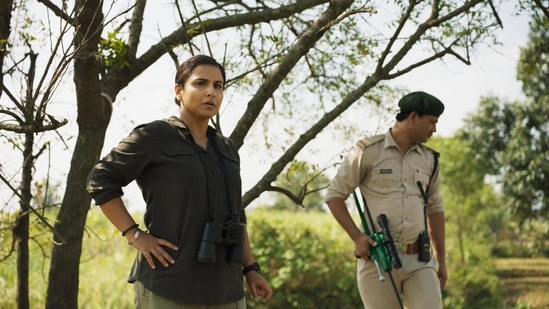 |
Vidya Balan plays an ethical Indian forest service officer in Sherni (2021)
|
Amit Masurkar's new film
Sherni
has some things in common with his award-winning 2017 film
Newton
-- the central Indian jungle setting, the town-bred government
official working against the odds in an unfamiliar setting, and
unlikely collaborations among people striving towards something
larger than themselves. The plot in one sentence: When a tigress
named T2 starts to attack villagers in the vicinity of a Protected
Forest area, an idealistic new forest officer named Vidya Vincent
(Vidya Balan) struggles to prevent more human deaths, while also
keeping her thoughtless, corrupt bosses from letting a self-appointed
hunting hero kill the tigress.
Where Newton tackled the state
of Indian democracy with pitch-dark humour and a sometimes-manic
edge, Sherni approaches the tragic impasse of environmental
conservation with enthusiastic sincerity, tempered by something akin
to haplessness.
Perhaps that is inevitable, given that
the man-animal conflict in India is a complex, burgeoning problem,
and one whose roots are left unaddressed both by our national forest
policy and by our mainstream politics.
To try and summarise a complicated
history: India spent the first 25 years after Independence wooing
parties of tiger-hunting foreign tourists, getting them to pay for
the privilege of what sahibs and maharajas had always done. A 1964
New York Times article reported 15 government-approved jungle
camps (up from only three in 1954) that organised these expensive
shikar holidays, complete with “clean, tasty Western-style food”
and liquor. “It is estimated that 3,000 tigers roam the forests,
and they are multiplying fast enough to support the present shooting
rate of about 300 a year,” the NYT declared.
That proved catastrophically untrue,
and in 1972, the government did an about-turn. According to a 2017
article by the Kumaon-based butterfly expert Peter Smetacek, a group
of hunters and naturalists had petitioned for a three-year break from
tiger hunting to let populations recover, but in response Indira
Gandhi's government promulgated the Wildlife Protection Act, under
which hunting of any species was banned permanently.
Smetacek, like some others, has
questioned the wisdom of this wholesale outlawing of hunting. For
one, it made it illegal for farmers to protect their hard-earned
crops from incursions by wild boar, monkeys, porcupines, nilgai,
bears or birds without permission from a forest officer, pitting
locals against the animal world they had cohabited with, while
leaving them at the mercy of a corrupt state.
Also, if hunting was strictly regulated
instead of being banned, allowing permit-based hunting of animals
whose populations were growing too large, we would actually have
records of animal populations besides the tiger -- and in fact be
able to track and respond better to their declining numbers. That
suggestion, outlandish and violent as it may sound to those who of us
brought up in a sanitised modernity alienated from the ways of the
wild, may be just the starting point we need to rethink the
simplistic, often counterproductive legal regimes that have failed in
practice to protect our forests.
Few Indian films before Sherni have
engaged with this difficult terrain. In Anay Tarnekar's brilliant
2016 short The Kill, a poor adivasi man's deep, reverential knowledge
of the jungle and the tiger goes from being a useless,
non-monetisable asset to the only thing he can sell – but at a
terrible cost.
In 1994, Sai Paranjpye made the sweet,
well-intentioned, Chipko-inspired feature Papeeha, where her
daughter Winnie Paranjpye played an anthropologist representing the
tribal perspective on living in and off and with the forest, cast
alongside a forest officer hero (Milind Gunaji) and a series of
corrupt forest officer villains who run clandestine logging
businesses.
A year earlier, in 1993, Pradip
Krishen had made a film called Electric Moon (scripted by his
then-partner Arundhati Roy), which takes a more sideways, ironic look
at the situation. The film's central protagonists are a family of
fading Indian royals who run a wildlife resort catering to foreign
tourists, selling tiger hunting as an Orientalist fantasy, while
responding to the new Hindi-speaking forest officer (Naseeruddin
Shah) with snobbish class outrage. The humour is spot-on, as is the
context: many Indian princely families who had once pursued hunting,
often in forests that were part of their own territories, did indeed
make this transition to being conservationists. It was a mixed
metamorphosis that allowed them to retain their privileged
relationship to the wild -- sometimes speaking legitimately from a
place of knowledge, and sometimes just bending the rules for
themselves.
The other film Sherni made me
think of is Bhuvan Shome, Mrinal Sen's 1969 New Wave classic.
Sen's film isn't intended as a realist comment on anything, certainly
not on Indian wildlife policy. Yet, at its centre, is a man on a
hunting expedition, who ends up not killing a single duck – and
handing over the single one he brings down to a young girl he has
become fond of.
 |
Utpal Dutt sets out to hunt birds in Mrinal Sen's New Wave classic, Bhuvan Shome (1969)
|
Further, Sen's marvellous lightness of
touch achieves much more than what that narrative outline suggests.
Utpal Dutt, acting the grand hunter with his sola topi and rifle, is
actually a tragicomic figure. The anglicised Bengali bureaucrat out
of his depth in the Gujarati rural desert landscape represents not
just bureaucratic mechanisation and urban dessication, but also a
State totally disconnected from ordinary people's lives.
The low-level chai-paani bribes that
Bhuvan Shome so sternly polices, and Mrinal Sen treats with comic
indulgence, are still not the primary enemy. Nor is the biggest enemy
the still-surviving big game hunter, who is given a little too much
play in Sherni, perhaps understandably because a film needs a
villain.
The problem is that out-of-touch State.
Under cover of 'development', that State now cuts secret deals to
give away our rivers and mines and forests to big men. It postures as
a protector, but its grand diktats only cut off the deep, pre-modern,
symbiotic relationships on which our forests managed to thrive for
generations -- leaving both people and nature vulnerable to the worst
kind of short-sighted profit motive. We cannot conserve our wildlife
– or any heritage, actually – if we continue to treat those who
live beside it as errant, trespassing children, rather than as
dignified, proud, well-paid stakeholders.
Humans and animals have lived together
before. We could do so again. But the task needs both intellect and
courage.
Published in TOI Plus, Sun 27 Jun, 2021


