 | 
A still from Bellissima
uchino Visconti is universally recognised as one of the world's great filmmakers. His neo-realist works — the rough-edged La Terra Trema and the masterful Rocco and his Brothers — are on countless film school lists, and his lush literary adaptations — Lampedusa's The Leopard and Thomas Mann's Death in Venice — are regularly numbered among the world's best films. But his third film, Bellissima (1951), has never got the attention it deserves. Such praise as has come its way has been focused on the exceptional performance Visconti drew from its lead actress: the magnificent Anna Magnani, playing a movie-mad nurse obsessed by the idea of having her five-year-old daughter snag a part in a film. Magnani aside, the film has been relegated to the status of a 'minor work', a comedy. The great Pauline Kael, for instance, condemned it with characteristic pithiness as "full of contradictory impulses, and... marred by a too pat ending glorifying the wisdom of the common people".
I can see what Kael means about contradictory impulses — Bellissima does seem to speak in multiple voices — but I think that is its strength (more in a bit about that). It remains, for my money, among the finest films ever made about the complicatedness of parental ambition — and about what the movies mean to us.
Bellissima opens in Cinecitta, Rome's famous film city, where Maddalena (Magnani) has brought her little daughter Maria (Tina Apicella) to audition. But the child has disappeared, and we see Magnani wandering the grounds, searching desperately for her, even as a man with a megaphone announces the missing child's name over and over again at a piercing volume: "Maria Cecconi! Maria Cecconi! " From that frantic start, the film transports us quickly to the little girl being discovered placidly dipping her feet in a pool of water. The shift in tone is played for laughs. But it is also an instance of the multiplicity that seems to me to make this film so fascinating — the constant fluctuation between broad caricature and unbelievably nuanced characterisation, between a satirical distance and a warm, profound sense of empathy.
| ||
 |
he most obviously caricatureish moments appear in the 'crowd scenes': Maddalena's nosy neighbours descending upon her as soon as they scent a domestic quarrel, or the masses of pushy mothers at Cinecitta, each trying to edge her child forward in what is clearly a cutthroat scenario. They all seem cut from the same cloth: petty and ridiculous, deliberately spreading rumours to dishearten the competition. They are not meant to elicit our sympathy or even interest — only our laughter. And yet, it was a real scene like this one that created the film: Bellissima (lit. beautiful) was conceived when Visconti was looking for a child actor for a different production and found himself surrounded by 4,000 mothers, each shouting, "Mine is bellissima!"
But Visconti's achievement is to zoom in on a woman who is very much part of this crowd, and turn her into someone we cannot dismiss. Maddalena's frenetic attempts to cobble together money for whatever she thinks will get her daughter the part — a fashionable haircut, an acting coach, a crash course in ballet, a bribe to a man who offers to send flowers to the director's wife — may seem utterly irrational, and just the sight of the child's wan, tired face as she jumps through these hoops is likely to elicit outrage from a contemporary audience. But it is a tribute to the film's humanising of Maddalena that as one plan after another collapses, what we feel is not so much relief for the child, but disappointment for her mother. Maddalena's actions might seem short-sighted, but her gaze is set on a screen in her imagination. And seen in the light of that dreamscape, her frailties seem utterly and resolutely human. This is a woman like so many we know, for whom the drudgery of real life is made bearable only by the thought that there is another kind somewhere out there — illuminated, however briefly, in the dark of the cinema. "It's so not make-believe," she insists to her husband, her trustfulness both vulnerable and determined.
The film's most devastating scene involves the shattering of that trust, with Maddalena watching in disbelief as the film crew dissolves into laughter while viewing her daughter's screen test. She stomps into the studio and tells them all what she thinks of them, grown men laughing cruelly at a child crying, but the damage has been done. The dream is broken.
Visconti could have ended the film here. But he adds a second climax: the director sends word that the crying girl is the one he wants to cast, but Maddalena refuses to sign the contract, having seen through the illusion that is the cinema — or the world. I am loath to sound as dismissive as Kael, but my subconscious self seems to agree with her about the ending: I first saw Bellissima ten years ago. When I watched it again recently, it was as marvellous as I remembered — but my memory had erased the final scene, preserving the film as I felt it ought to have been.
Published in the Sunday Guardian.
|
22 April 2013
Post Facto -- Cinema Non-Paradiso: Make-believe and the movies in Bellissima


14 April 2013
Mocking 'filmi-ness': more on Chashme Buddoor
A guest column I did for Business Standard:
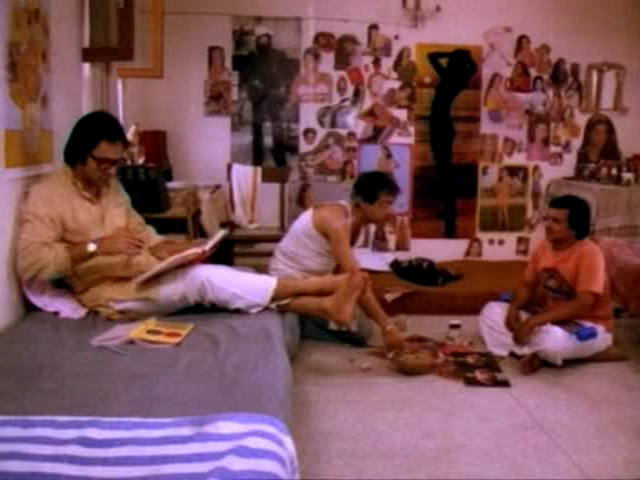
Sai Paranjpye's Chashme Buddoor, a light-hearted and mild-mannered comedy which also gave us an unforgettably sweet romance between a bespectacled, padhaaku Farooq
Shaikh and Deepti Naval as the irresistible but real girl next door,
was recently restored and re-released in theatres alongside a new David
Dhawan remake. A distressed Paranjpye has charged Dhawan with having
killed her delicately funny film by injecting it with double entendres,
bawdy jokes and a general crassness so antithetical to the sensibility
of the original that to call the new Chashme Baddoor a remake was a
travesty.
I watched both films last week, and I have to confess that while the old one has lost none of its delicate charm, the new one is a rambunctious and rather enjoyable ride. The new film, like the old one, centres on a trio of young men (inaugurating a whole Hindi film tradition of male friendship movies since). One is the sincere student who reads Economics textbooks for pleasure, while the other two spend their time gadding about the empty leafy avenues of 1980s Delhi in search of girls. Or to adopt the celebratory whoop with which they greet every sighting of young female flesh - "shikaar!". The reference to prey may sound shocking, but there's something about Omi and Jomo's unthreatening comicness that makes it not just alright but hilarious. And yet the indiscriminateness of their attentions is enough to indicate the unabashedly joyful sexual basis of their interest. Paranjpye's world may have been innocent, but it was not coy.
That frank vision of youthful (male) hormones is a clue to what made Chashme Buddoor such a remarkable film: its absolute outsiderness to the conventions of the Hindi movie - and even more, the quirky, tongue-in-cheek way in which it chooses to play with those conventions.
In 1981 - the year in which Chashme Buddoor released - the top 10 grossers at the Hindi box office included four Amitabh Bachchan starrers (Yaarana, Kaalia, Naseeb and Lawaaris) replete with dramatic father-son battles and villainous villains on whom revenge had to be wreaked. Other films in the top 10 were a colonial fable involving revolutionary Indian pirates and evil Britishers (Kranti), a reincarnation-revenge-romance (Kudrat), and two stories of star-crossed young lovers (Ek Duuje Ke Liye and Love Story). This was the cinematic universe that Chashme Buddoor emerged into - a universe whose high drama and heroic stunts it both distinguished itself from, and gently but thoroughly mocked. From the first scene, in which the Mehdi Hassan classic of the scorched heart Yeh dhuan sa kahan se uthta hai plays as accompaniment to our heroes' silent communion over a shared cigarette, to having them imagine their romantic conquests as a medley of old Hindi film songs, Chashme Buddoor never stops making fun of our filmi-ness.
Sai Paranjpye was not unique in this sort of mockery. The urban "middle class cinema", represented among others by Hrishikesh Mukherjee and Gulzar, enjoyed poking fun at the more unreal aspects of Hindi films. One of their favourite things to mock was the ubiquitous double role. Gulzar pushed it to its limits (and returned it to source) with Angoor (1982), his superb adaptation of The Comedy of Errors, giving us not one but two pairs of twins. And Mukherjee's Gol Maal (1979) used the idea of fake identical twins as the masterful basis of its comic plot. (Rohit Shetty's reworking, Bol Bachchan, 2012, was grotesque, among other things, because it created a "real" humshakal for Asin - seemingly unaware that Gol Maal's humour was based on mocking the proliferation of twins.)
But Chashme Buddoor went further than those. There's the marvellous scene in which Amitabh and Rekha appear to demonstrate a Hindi movie-style wooing - and how "the technique" falls flat in real life. Earlier, Jomo (the late Ravi Baswani) pretends to be a Bombay producer "talent-scouting" in Delhi, and, in his imagination, Deepti Naval giggles delightedly to hear that "there's a bit of a vacuum in the industry after Jaya ji" that she can fill. In the scene as it actually unfolds, Jomo is crisply rebuffed: she never watches Hindi movies.
Yet, when Naval and Shaikh fall in love and find themselves in a flower-filled Delhi park, they cannot but burst into song. "How do those people in the movies think up rhyming words and tunes on the spot?" muses Neha to Siddharth, before seguing neatly into a half-jokey rhyming song, holding a large flower up like a microphone. And while the climax sets out to stage a kidnapping so that the hero can rescue the heroine filmi-style, Paranjpye decides to play with our now-established expectations by turning the fake kidnapping into a real one. We may laugh at Hindi movies, she seems to say, but we also inhabit them.
David Dhawan, self-declared acolyte of Manmohan Desai - a specialist in mistaken identities and long-lost reunitings if ever there was one - has made a much louder, filmi-er, lowbrow film than the original. But it is also a cheery, self-conscious send-up of the raucous comedies for which he became famous in the 1990s. And in that combination of self-consciousness and inhabiting lies his tribute to Chashme Buddoor.
 |
| A still from Sai Paranjpye's Chashme Buddoor (1981) |
I watched both films last week, and I have to confess that while the old one has lost none of its delicate charm, the new one is a rambunctious and rather enjoyable ride. The new film, like the old one, centres on a trio of young men (inaugurating a whole Hindi film tradition of male friendship movies since). One is the sincere student who reads Economics textbooks for pleasure, while the other two spend their time gadding about the empty leafy avenues of 1980s Delhi in search of girls. Or to adopt the celebratory whoop with which they greet every sighting of young female flesh - "shikaar!". The reference to prey may sound shocking, but there's something about Omi and Jomo's unthreatening comicness that makes it not just alright but hilarious. And yet the indiscriminateness of their attentions is enough to indicate the unabashedly joyful sexual basis of their interest. Paranjpye's world may have been innocent, but it was not coy.
That frank vision of youthful (male) hormones is a clue to what made Chashme Buddoor such a remarkable film: its absolute outsiderness to the conventions of the Hindi movie - and even more, the quirky, tongue-in-cheek way in which it chooses to play with those conventions.
In 1981 - the year in which Chashme Buddoor released - the top 10 grossers at the Hindi box office included four Amitabh Bachchan starrers (Yaarana, Kaalia, Naseeb and Lawaaris) replete with dramatic father-son battles and villainous villains on whom revenge had to be wreaked. Other films in the top 10 were a colonial fable involving revolutionary Indian pirates and evil Britishers (Kranti), a reincarnation-revenge-romance (Kudrat), and two stories of star-crossed young lovers (Ek Duuje Ke Liye and Love Story). This was the cinematic universe that Chashme Buddoor emerged into - a universe whose high drama and heroic stunts it both distinguished itself from, and gently but thoroughly mocked. From the first scene, in which the Mehdi Hassan classic of the scorched heart Yeh dhuan sa kahan se uthta hai plays as accompaniment to our heroes' silent communion over a shared cigarette, to having them imagine their romantic conquests as a medley of old Hindi film songs, Chashme Buddoor never stops making fun of our filmi-ness.
Sai Paranjpye was not unique in this sort of mockery. The urban "middle class cinema", represented among others by Hrishikesh Mukherjee and Gulzar, enjoyed poking fun at the more unreal aspects of Hindi films. One of their favourite things to mock was the ubiquitous double role. Gulzar pushed it to its limits (and returned it to source) with Angoor (1982), his superb adaptation of The Comedy of Errors, giving us not one but two pairs of twins. And Mukherjee's Gol Maal (1979) used the idea of fake identical twins as the masterful basis of its comic plot. (Rohit Shetty's reworking, Bol Bachchan, 2012, was grotesque, among other things, because it created a "real" humshakal for Asin - seemingly unaware that Gol Maal's humour was based on mocking the proliferation of twins.)
But Chashme Buddoor went further than those. There's the marvellous scene in which Amitabh and Rekha appear to demonstrate a Hindi movie-style wooing - and how "the technique" falls flat in real life. Earlier, Jomo (the late Ravi Baswani) pretends to be a Bombay producer "talent-scouting" in Delhi, and, in his imagination, Deepti Naval giggles delightedly to hear that "there's a bit of a vacuum in the industry after Jaya ji" that she can fill. In the scene as it actually unfolds, Jomo is crisply rebuffed: she never watches Hindi movies.
Yet, when Naval and Shaikh fall in love and find themselves in a flower-filled Delhi park, they cannot but burst into song. "How do those people in the movies think up rhyming words and tunes on the spot?" muses Neha to Siddharth, before seguing neatly into a half-jokey rhyming song, holding a large flower up like a microphone. And while the climax sets out to stage a kidnapping so that the hero can rescue the heroine filmi-style, Paranjpye decides to play with our now-established expectations by turning the fake kidnapping into a real one. We may laugh at Hindi movies, she seems to say, but we also inhabit them.
David Dhawan, self-declared acolyte of Manmohan Desai - a specialist in mistaken identities and long-lost reunitings if ever there was one - has made a much louder, filmi-er, lowbrow film than the original. But it is also a cheery, self-conscious send-up of the raucous comedies for which he became famous in the 1990s. And in that combination of self-consciousness and inhabiting lies his tribute to Chashme Buddoor.
7 April 2013
Film review: David Dhawan's Chashme Baddoor

"Full disclosure: I have always been a Chashme Buddoor fan – the delicately romantic, hilariously funny 1981 film starring Farooque Shaikh, Deepti Naval, Rakesh Bedi and Ravi Baswani is one of my favourite Hindi films ever. And I have never been a David Dhawan fan. I spent the 90s avoiding the raucous comedies that Dhawan produced in quick succession, most successfully with Govinda – Aankhen, Raja Babu, Banarasi Babu, Saajan Chale Sasural, Bade Miyan Chhote Miyan. The only David Dhawan film I can remember laughing rather than cringing at is Hero No. 1, where Dhawan remade another classic of our quietly funny ‘middle class cinema’- Bawarchi. And Dhawan’s 2011 release, Rascals, starring Ajay Devgn, Sanjay Dutt and the unfortunate Kangana Ranaut’s cleavage, was among the most distressingly sexist, grotesquely tasteless films of the year.
So I went into David Dhawan’s remake of Sai Paranjpye’s classic expecting to abhor it. Imagine my surprise that I did not, and then my shock when I found that I was thoroughly enjoying myself."
Read the whole piece HERE.
26 March 2013
Post Facto: Spring Fling, or how to join the Lutyens' Delhi garden party
My Sunday Guardian column this fortnight:

The Delhi spring, short-lived as it is, brings into focus a feature of the city that seems to melt the heart of even the staunchest Delhi-hater: its flower-filled gardens. Though lovely at most times of year, Delhi's gardens in March are so gloriously green and so riotously colourful that only the stoniest soul can resist them. Of course, these particular urban pleasures — like uninterrupted electricity, or actually paved pavements — are almost exclusively the preserve of the city's most privileged core, the 43 sq km area usually referred to as Lutyens' Delhi.
Its architect Edwin Lutyens built his reputation by designing country homes in the Arts and Crafts style in collaboration with the English writer and designer Gertrude Jekylls, a woman said to have "affected the gardening habits of two generations", and his only urban planning commission before New Delhi was the Central Square of Hampstead Garden Suburb. So it was no surprise that the imperial capital he built was, at the most fundamental level, a garden city.
Seen from an aeroplane, New Delhi is still one of the greenest cities in the world. But most gardens in the British-built imperial capital remain strictly private, their rose beds (or cabbage patches—who knows?) guarded from curious eyes by high brick walls (and from the possibility of any more dangerous depredations by gun-toting security-men). The few gardens open to the public, interestingly, often surround buildings of one sort of another.
There is, for instance, the verdant expanse of lawn that surrounds the Nehru Memorial Museum and Library, lined by rows of flaming red salvias and many-coloured dahlias, complete with a bougainvillea-bedecked drive and the occasional peacock. The Teen Murti garden is a classic colonial bungalow garden, its neat flowerbeds, flowering shrubs and tidy rows of potted plants all really meant to set off "the lawn, that sine qua non of any proper English garden", as Eugenia Herbert writes in her recent book Flora's Empire: British Gardens in India. For "[w]ithout a lawn, the "centre of social life", how could one hold garden parties? Or play croquet or badminton or cricket?" As Mrs. Temple Wright's popular Flowers and Gardens in India: A Manual for Beginners urged her readers, even if they couldn't manage a garden, they must "make only a lawn, or grass plot, and this, with cleanly kept soorkee [brick dust] paths, and a few plants in pots, will be sufficient to keep up the degree of harmony you intend between the outside and inside appearance of your abode."
That injunction, of course, is recognisable as the inspiration for what a friend recently referred to as the "CPWD style of gardening", noting that the British had left the same legacy in other colonies, such as South Africa. Capetown, he wrote with all the astonishment of a Dilliwala betrayed, even has a PWD.
.jpg)

The Delhi spring, short-lived as it is, brings into focus a feature of the city that seems to melt the heart of even the staunchest Delhi-hater: its flower-filled gardens. Though lovely at most times of year, Delhi's gardens in March are so gloriously green and so riotously colourful that only the stoniest soul can resist them. Of course, these particular urban pleasures — like uninterrupted electricity, or actually paved pavements — are almost exclusively the preserve of the city's most privileged core, the 43 sq km area usually referred to as Lutyens' Delhi.
Its architect Edwin Lutyens built his reputation by designing country homes in the Arts and Crafts style in collaboration with the English writer and designer Gertrude Jekylls, a woman said to have "affected the gardening habits of two generations", and his only urban planning commission before New Delhi was the Central Square of Hampstead Garden Suburb. So it was no surprise that the imperial capital he built was, at the most fundamental level, a garden city.
Seen from an aeroplane, New Delhi is still one of the greenest cities in the world. But most gardens in the British-built imperial capital remain strictly private, their rose beds (or cabbage patches—who knows?) guarded from curious eyes by high brick walls (and from the possibility of any more dangerous depredations by gun-toting security-men). The few gardens open to the public, interestingly, often surround buildings of one sort of another.
There is, for instance, the verdant expanse of lawn that surrounds the Nehru Memorial Museum and Library, lined by rows of flaming red salvias and many-coloured dahlias, complete with a bougainvillea-bedecked drive and the occasional peacock. The Teen Murti garden is a classic colonial bungalow garden, its neat flowerbeds, flowering shrubs and tidy rows of potted plants all really meant to set off "the lawn, that sine qua non of any proper English garden", as Eugenia Herbert writes in her recent book Flora's Empire: British Gardens in India. For "[w]ithout a lawn, the "centre of social life", how could one hold garden parties? Or play croquet or badminton or cricket?" As Mrs. Temple Wright's popular Flowers and Gardens in India: A Manual for Beginners urged her readers, even if they couldn't manage a garden, they must "make only a lawn, or grass plot, and this, with cleanly kept soorkee [brick dust] paths, and a few plants in pots, will be sufficient to keep up the degree of harmony you intend between the outside and inside appearance of your abode."
That injunction, of course, is recognisable as the inspiration for what a friend recently referred to as the "CPWD style of gardening", noting that the British had left the same legacy in other colonies, such as South Africa. Capetown, he wrote with all the astonishment of a Dilliwala betrayed, even has a PWD.
Quite different in effect from the "keep
off the grass" lawn model is the landscaped space first brought into
being as Lady Willingdon Park — now beloved of joggers, dog-walkers,
baby-minders and picnickers as Lodi Garden. The avenues of palms that
structure our vision of the Lodi tombs are both orderly and grand, but
the garden itself — with an emphasis on winding walks, gentle slopes and
picturesque perspectives — draws on a mixture of more "natural" styles.
Narayani Gupta and Laura Sykes, in their annotations to Percival
Spear's Delhi: its Monuments and History, inform us that the garden was
"formed in 1936 on the site of the village of Khairpur; the villagers
were given other sites, in nearby Kotla Mubarakpur and in Punjab". It
was then re-landscaped in the 1950s by a Japanese team, and the
greenhouse added by American architect Joseph Stein (who also designed
the India International Centre, the Ford Foundation and various other
things in that little nook of New Delhi, providing reason for it to be
informally and affectionately referred to as 'Steinabad').
The grandest Delhi garden of them all, of course, is the 'Mughal Garden' that is the pride and joy of the Rashtrapati Bhavan (née Viceregal Palace). Lutyens was commissioned to make it by Lady Hardinge, who loved the Mughal gardens of Kashmir, with their stepped terraces, fruit trees and water channels. But she died early into the building process, and Lutyens' eventual design, though it incorporated a 'Purdah' garden with twelve-foot-high walls as well as water channels and fountains, was very much an English take on the 'Mughal'. The most give-away sign of this was the fact that where the water channels intersected in the Mughal garden, there would have been a stone platform with a pavilion, a place where you could sit to catch the breeze and fragrance. In Lutyens' version, the intersection was replaced by a lawn.
At the other end of the spectrum of possible publicness are the small but gloriously in-bloom gardens that make Delhi's interminable roundabouts a pleasure rather than a pain in this season. Non-Lutyensians, invariably lost as they circle past and miss their turns again and again, have something to feast their tired eyes on. Even the Rashtrapati Bhavan gardens are thrown open to the public in February and March. The visiting traveler Freya Stark once wrote of this practice, "It was extraordinary how alive and agreeable it made them. There is no point in having pomp unless there is a crowd to enjoy it." One wishes there were more who thought like her. Delhi's secret gardens might spring to life more often.
The grandest Delhi garden of them all, of course, is the 'Mughal Garden' that is the pride and joy of the Rashtrapati Bhavan (née Viceregal Palace). Lutyens was commissioned to make it by Lady Hardinge, who loved the Mughal gardens of Kashmir, with their stepped terraces, fruit trees and water channels. But she died early into the building process, and Lutyens' eventual design, though it incorporated a 'Purdah' garden with twelve-foot-high walls as well as water channels and fountains, was very much an English take on the 'Mughal'. The most give-away sign of this was the fact that where the water channels intersected in the Mughal garden, there would have been a stone platform with a pavilion, a place where you could sit to catch the breeze and fragrance. In Lutyens' version, the intersection was replaced by a lawn.
At the other end of the spectrum of possible publicness are the small but gloriously in-bloom gardens that make Delhi's interminable roundabouts a pleasure rather than a pain in this season. Non-Lutyensians, invariably lost as they circle past and miss their turns again and again, have something to feast their tired eyes on. Even the Rashtrapati Bhavan gardens are thrown open to the public in February and March. The visiting traveler Freya Stark once wrote of this practice, "It was extraordinary how alive and agreeable it made them. There is no point in having pomp unless there is a crowd to enjoy it." One wishes there were more who thought like her. Delhi's secret gardens might spring to life more often.
24 March 2013
Book Review: Those Pricey Thakur Girls

Anuja Chauhan’s third novel — starring a father and mother, a houseful of daughters, and a nicely bumpy romance between Daughter No. 4 and the tall, dark, handsome and difficult hero — has the unmistakeable whiff of a desi riff on Pride and Prejudice.
But though much of its action unfolds in the not-very-worldly, literally walled-in world of the Thakur family’s Hailey Road bungalow — paradise, as Chauhan throws in lightly, comes from the Persian pairi-diza, walled garden — Those Pricey Thakur Girls is a breezy, witty, thoroughly entertaining portrait of a time and a city. And whatever the pleasingly predictable plot might seem to lack in the 'serious realism' department is more than made up for by the book’s cornucopia of effortlessly accurate linguistic and sociological detail: a sharply remembered 1980s Delhi — a world of electric blue Marutis and inter-school western music competitions, in which fashionable Modern School girls had their mothers embroider pansies on their home-stitched peasant tops.
When we meet D-for-Debjani Thakur, fourth of the alphabetically named daughters of Justice (retd) Laxmi Narayan Thakur, she has just managed to pass three rounds of countrywide auditions to bag, at the ripe old age of 23, the massively coveted position of English newsreader on DeshDarpan, India’s one and only television channel. An early setpiece of a scene in which all family members present — Judge Laxmi, Mrs Mamta, their youngest daughter E-for-Eshwari and the girls’ well-intentioned but doltish cousin (his alphabetical position remains unstated, but yes, he is G-for-Gulgul) — pile fondly into the khandani Ambassador to see Debjani off at DD’s gates is enough to reveal Chauhan’s firm grasp of her milieu. She has down pat the bizarre but utterly believable cossetedness of this world, where the local dhobi’s entire family rises to wave to Baby as she departs for her first job in a sari pressed expressly for the occasion by the dhobi, and where the Bengali Market chaatwala declares the golguppas free because he saw Baby read on TV. And even as we shake our heads in recognition at the semi-feudal indulgences of this Lutyens’ Delhi of 20 years ago, Chauhan is up and running again, turning her gently mocking gaze upon everything from the Stephanian monopoly on the use of the term “college” to the countrywide obsession with “good English” which allows smarmy DD newsreader Amitabh Bose to sustain an elevated opinion of himself based on nothing but his pronunciation, while making a nice old man like Balkishen Bau the butt of jokes.
But while Chauhan displays an unremitting ear for the subtle gradations of class, she is never so simplistic as to make privilege (or the lack of it), map neatly onto the sympatheticness of her characters. So while the insecurities of Daughter No. 2, B-for-Binni, B-for-behenji, are partly explained by the fact that she was deprived of the glamorous childhood of her sisters by being sent away “to the village” for several formative years, that does not absolve her of blame for her wheeling-dealing, land-grabbing tendencies.
Some of Chauhan’s characters may be drawn with deliberately exaggerated strokes — from the oh-so-recognisable figure of A-for-Anjini, the flirtatious, good-looking sister who is the family’s self-appointed beautification expert, to the unfortunate Chachiji whose husband’s philandering with the maid has driven her to despair and totkas — but the portraits never seem to lack detail. The scenes between Debjani and Anjini, for instance, are a marvelously humorous capturing of a passive-aggressive sisterly relationship: Anji didi will go out of her way to help tart Dabbu up for her big day, but she’ll make sure to let her know that she, the elder by several years, fits perfectly into Dabbu’s jeans. And she’ll be singing Georgy Girl under her breath.
If Chauhan’s chosen backdrop was cricket for The Zoya Factor and politics for The Battle for Bittora, her milieu here is the media. It is a mediascape that would seem pretty much unrecognisable to the contemporary Indian teenager — a world in which a DD newsreader becomes an overnight national celebrity because the whole country watched her read the news, but that sole channel of news is entirely controlled by the government.
Chauhan has said in an interview that her daughters, who are 15 and 17, “seem quite into this whole ’80s thing”, and certainly her book plays on the curiosity value of this oh-so-bygone era: the single TV channel, the trunk calls, the Best-of-Hollywood video lending library, the kids fighting over whether the new VCR will be used to re-watch Masoom or A Nightmare on Elm Street.
But if there is something a little retro about many things — including the marriageability-obsession of even such a fashionable, educated bunch of women as occupy the Hailey Road household — Chauhan carefully positions her basketball-playing, tomboyish Eshwari character as the identifiable one, the one who bridges the girly-girl universe of her sisters’ generation and the co-ed-with-a-vengeance tenor of her emerging one. It is the new unshockability of Eshu that allows us to move smoothly from the rakish, Mills-and-Booneish flirtations of Dylan Singh Shekhawat to the calm recreation of “sonnets” written to Gitika Govil’s Golden Globes on the Modern School toilet walls: “Gitika Govil ke mammay mahaan/Unpe tika hai Hindustan”.
In sum, Anuja Chauhan has done such a stellar job of capturing priceyness and diceyness in her chosen era that one itches to know what those things will feel like in the next one. I am thoroughly looking forward to the sequel.
Published in the Asian Age, 24 Mar 2013.
23 March 2013
Film Review: Sona Spa cannot live up to its dreams

Sona Spa starts out with a winning premise: the increasingly common urban malaise of lack of sleep — and a strange, rather fantastic solution. “Subah jaagte hi man mein sawaal uthta hai – kya neend poori hui? (As soon as you wake up in the morning, the question arises in your mind – did you get enough sleep?),” pronounces the suave Baba Dayanand. And if the answer is no, what should you do? No, don’t resort to sleeping pills or alcohol, don’t waste your precious time and money, says the Baba from his deep blue television screen, eyes boring dangerously into you as he enunciates his ‘S’es as sibilantly as Kaa the python did to Mowgli the man cub in The Jungle Book: “Aap S-s-sona S-s-spa mein aaiye, jahaan ladkiyan aapke saath nahin, aapke liye soyengi.”
The question of why it is girls who must do the sleeping “not with you, but for you” — and the corollary: why the “you”, the client who has disturbed sleep, must necessarily be male — is the film’s first stumbling block. That gendered division of labour is so crucial to the film’s sensual/sexual dynamics that writer-director Makarand Deshpande does not even think to provide us a reason for it.
Instead we are catapulted directly into the strange half-lit world of Sona Spa, where invariably attractive young women are paid handsomely to sleep ‘on behalf of’ invariably male clients, after having ‘bonded’ with them. That oddly sentimental moniker of ‘bonding’ – which seems to refer to a mystifying process of shoulder-clasping and looking-into-each-other’s-eyes shot as if underwater – turns out to be a lead-up to the film’s real subject: the sleeping subconscious that awakens in our dreams. The girl who has bonded successfully with her client sleeps his sleep – and dreams his dreams. As Baba Dayanand might put it, the girls at Sona Spa do not give you access to their bodies – you give them access to your mind.
Sona Spa’s central narrative revolves round two very different young women—loud, bratty rich kid Rucha (Shruti Vyas) and well-behaved Hindi-speaking Ritu (Ahana Kumrah) — who happen to arrive together to seek work at Sona Spa. Separately but simultaneously, we see them enter into the minds of the somewhat unsavoury men who hire them. Both girls have their own troubles, too – troubles as starkly different as their backgrounds. The motherless Rucha has had a disturbed, drunken adolescence, and her rich businessman father spends sleepless nights in dance bars. Ritu’s parents are in coma from a car accident, and her elder sister is failing to grapple with that trauma while also dealing with a dictatorial fiancée. So both Rucha and Ritu have non-monetary reasons to believe in sleep work – but neither is quite prepared for the torturous, violent dreams their monetary clients will bring them.
Naseeruddin Shah’s appearance is limited to that television-plug cameo as Baba Dayanand, and a piercing visage that looks down on the sleeping girls from the walls of Sona Spa. There are two other women around: a playfully filmi sex-worker turned sleep-worker who goes by the appropriately M.F. Husain-inspired name of Meenakshi (Nivedita Bhattacharya) and the spa’s placid, unbelievably non-avaricious manager, Indu (Pooja Pradhan).
Deshpande, who is a critically acclaimed playwright and theatre director with a significant body of work, first wrote and produced Sona Spa as a play, and the film’s cast uses most of the actors who worked on the theatrical production. Nivedita Bhattacharya’s Meenakshi is wonderfully good, her frothy, flirtatious adaa laced with a believable undertow of yearning – she deserves more film roles. Pradhan’s work is half-done by her appropriately high cheekbones and implacable hostess manner. Kumrah and Vyas are perfectly cast, too, and make up for the occasional rough edges of their performances by never seeming anything less than sincere. The melodramatic intensity with which spoilt-brat Rucha eventually embraces Ritu (Kumrah), a girl she had dismissed at first sight as a “behenji”, is made believable by their heartfeltness.
Shailendra Barve’s background score sets the quasi-dreamlike mood nicely, and the effortless luxurious twilight zone of the spa is successfully achieved by Nitin Chandrakant Desai’s production design. Director Deshpande does a fairly decent job of keeping the film’s many plot lines and characters from getting tangled up. But the film is often choppy and contains several annoyingly self-indulgent sequences – especially the sex-and-violence dreams dreamt by the women for the men. Sona Spa is hard to applaud, but one must give it some credit for a sincere, occasionally thought-provoking speculation on our inner lives. After all, as the marvelous Meenakshi says in the film, “Jitna saaf, utna maaf.”
Published on Firstpost.
Subscribe to:
Posts (Atom)