My Sunday Guardian column this month:
At a big Delhi party hosted by an eminent economist and advisor to the government, a grandchild — a little boy — was misbehaving. The gathered guests waited for a parental figure to do the needful. And the needful was apparently done. Said the teller of the story without the slightest glimmer of sarcasm, "— is such a hands-on mum, she immediately called the aayah to haul him off."
It's a delicious anecdote — and timely, given the airtime recently devoted to Indians and their domestic help. Most of that discussion, in the wake of the Devyani Khobragade - Sangeeta Richard case, has been about minimum wages and maximum working hours: a crucial subject that could certainly do with more discussion, especially among Indians not disadvantaged by earning too few dollars. In stark contrast to the Khobragade affair was the already almost-forgotten November case involving Jagriti Singh, wife of BSP MP Dhananjay Singh, and her unfortunate domestic help Rakhi Bhadra. Far from high-profile international attention, Bhadra died of prolonged torture in a Lutyens' Delhi bungalow that her employer had turned into a monstrous high-security, total-surveillance prison.
But while these cases have drawn much-needed attention to the conditions of domestic workers, both circumstances are extraordinary. The media never seems to swing beyond the outrage/defensiveness pendulum enough to actually open up the quieter but larger conversation that we clearly need to have as a society: the complete ordinariness of our dependence on domestic help.
Which is where, snarky hilarity apart, my earlier anecdote seems to serve a purpose. Especially in conjunction with some other conversations I happened to have in the same fortnight. At a potluck picnic, it turned out that one friend who'd offered to bake a cake had actually made her mother bake it. I laughed about this to another friend, at which he pointed out that his contribution had also been prepared by the labour of others — in his case, the household kitchen staff. A few days later, a friend announced that she was moving back to India after over a decade in the UK. Her reasons: more jobs, better weather and an easier life — as she put it, "middle class privilege here really does free up time for intellectual labour." It's true: you don't need to be super-rich in India to be able to completely outsource your housekeeping, cleaning and childcare responsibilities. | |||
But if you pay domestic workers well and treat them fairly, comes the inevitable response, why should it matter whether you look after your own children or cook your own meals or clean your own bathrooms? Certainly it seems that the idea of basic self-sufficiency — being able to perform the basic tasks needed to live — has less value in South Asia than perhaps in any other part of the world. Great men who even drive their own cars are a rarity, while stories of those who couldn't perform simple household tasks are told with inordinate fondness: Satyajit Ray, his wife tells us, couldn't fix a light bulb. VS Naipaul — admittedly a Trinidiadian born and bred, but let's allow for his strongly Hindu upper-caste upbringing here — lived a lifetime in England seemingly without performing any domestic labour, his home and kitchen maintained to his notoriously exacting standards by his 'more Indian than any Indian' wife Pat.
Even within the servant-hiring classes, then, men are at the top of the non-labouring hierarchy; mothers and wives can end up as replacements for — or extensions of — the maid. In this context, Gandhi's remarkable emphasis on individual self-sufficiency: washing his own clothes, cleaning his own toilet — sometimes seems to me his most radical legacy. At least in my family, via Gandhian grandparents, it has passed itself down to me in a way that makes battles over bathroom-cleaning turn ideological in the best possible way.
Perhaps the only answer to the question of why labour matters is that those who do not perform it as a matter of course see it as beneath their status. And see those who do perform it as beneath themselves.
These ideas can often come to a real and symbolic crux in the matter of the toilet. In the 2011 American film The Help, the white women come up with a Home Help Sanitation Initiative that essentially seeks to build separate toilets for black domestic staff because "black people carry different diseases to white people".
South Asians who saw that film knew they didn't need to go as far as the American South or the early 1960s to find exactly the same cringeworthy segregationist sentiments. In the last fortnight, these two conversations took place: a friend renting a new apartment in Delhi announced with some surprise that it had two bedrooms, but three bathrooms. Then she corrected herself — it had two bedrooms and two bathrooms, plus a servants' quarter — with its own toilet. Meanwhile, my mother told me about an old friend who'd been feeling overwhelmed by the domestic demands made on her by an ageing mother, an increasingly finicky husband, and a son and daughter-in-law visiting from abroad who've promptly fallen ill. "Doesn't she have live-in help?" I asked my mum. "No, she can only hire a part-time person. Because they'd never let their help use their loos. And there's no servants' bathroom." |




Published in The Caravan, my essay on the worlds of Indian men and women as revealed by three powerful non-fiction films: Till We Meet Again, When Hari Got Married and Nirnay.
(This piece won a Mumbai Press Club RedInk Award in 2014.)
Girls were a hot topic, but none of the four friends seemed to have actually had a relationship with one. Their laughing confessions—about deliberately standing too close to “smart” girls in the bus, or verbally harassing ones who walked past them in the neighbourhood—displayed an unexamined sexism, pinned into place by a thoroughly disturbing circular logic. “Bolti woh ladki hai jo thheek nahi hoti. Agar woh bolegi toh uski beizzati hai ismein” (The girls who speak up are the ones who aren’t good. The good girls know that by speaking up they will bring shame upon themselves).
Despite these views, Roy’s protagonists were unsure enough to seem vulnerable. The swagger was laced with insecurity. The closest any of them had come to a real girl was the floppy-haired, boyish Bunty, who appeared to have a rather bold admirer. “She said ‘I love you’ to him thrice. He couldn’t even say it once,” his friend Kamal mocked him affectionately. “Her friend even left them alone together but this Bunty did nothing. I would have flung her down and taken a kiss at least.” The banter around sex remained at the level of adolescent peer pressure: competing with the other boys, rather than providing the space for anything like a real relationship to blossom. Even when speaking of romance, love could appear only within filmi scare quotes—“Mohabbat ke dushmanon ne gate lagwa diye” (The enemies of love put up gates outside), said Bunty with a laugh as they walked into the monument that served as the area’s romantic rendezvous spot.
The language of cinema was the surround sound of these lives. Hindi film romance could often couch harassment as attraction, and the boys imbibed that lesson faithfully: “Ladkiyan khud kehti hain, hamaari naa mein haan hoti hai” (Girls say it themselves, our ‘no’ contains a ‘yes’), as Sanju said. But even that ubiquitous fantasy did not make imaginable a leap into real-life love. It was the arranged marriage that loomed large, complete with the vision of the domineering wife.
At the end of the documentary, Roy asked the boys if he should come back ten years later. “We’ll be ready!” said Sanju immediately, “Ghulami ki zanjeeron mein jakde hue chaar maharathi phir dekhna aap”(Come and see us again, four great warriors bound in the chains of slavery). Cynical humour met television melodrama in his vision of the future: “Meri boorhi ma vahan khaans rahi hogi aur main apni biwi ke saath khaat pe leta hua hounga. Aur main kahoonga, ja ma ko dawai de aa. Toh woh kahegi, tum hi de aao, tumhari ma hai” (My old mother will be coughing there and my wife and I will be cuddling on the bed. I’ll say, go give my mother her medicine. And my wife will say, go give it yourself, she’s your mother). He paused for an instant, as if to let the joke sink in. Then his face changed. “Aise toh nahi hoga na sir?” (It won’t be like that, will it, sir?)
***
A little over a decade later, Roy did return, to shoot Till We Meet Again (TWMA), completed this year. The arranged marriages had happened, children had been spawned. The four protagonists had lost some hair, gained some weight. They seemed irretrievably older—but not necessarily wiser.
If WFFM contained much that was worrying, there was also an open-endedness that prevented that film from closing on an altogether pessimistic note. Perhaps it was just that the protagonists were young, not yet quite set in their ways; perhaps it was simply the good humour and hope they still had for the future. But watching both Roy’s films together now is depressing. Over 13 years, nothing seems to have challenged any of the easy clichés the men clung to as teenagers. The city has changed around them, yet these men’s convictions about appropriately masculine behaviour seem to have changed unsettlingly little. No radical loves have shown up to soften them. Their certainties have grown stronger. In order to become men, it seems, they must either become hardened, or break.
Made as part of a film project called Let’s Talk Men, funded by an array of UN agencies as well as South Asian and international government bodies, both Roy’s films feed into his long-term interest in masculinities (the project uses the plural deliberately, to replace the assumption of an essential or inborn masculinity with the different ways in which manliness is socially constructed). Roy’s body of work as a filmmaker reveals a lifelong interest in the intersection of gender, labour and class. In Majma (2001), he explored working-class male sexuality through the lives of two men in the Meena Bazaar area of Delhi’s walled city: one running a wrestling akhara, another a pavement seller of sexual remedies. InThe City Beautiful (2003), Roy’s focus is on a weaving community’s loss of livelihood, but he also pays close attention to its impact on marital dynamics. With WFFM and TWMA, Roy captures something of the travails of boys growing into men on the economic fringes of post-liberalisation India.
The enormous energies of Indian commercial cinema, in every region and language of India, are channelled into creating portrayals of young men for audiences of young men. And yet, watching Kamal, Bunty, Sanjay and Sanju makes you realise how rarely you see men on the Indian screen actually negotiating the everyday pressures of work, family or financial responsibility—and, importantly, failing. What makes Roy’s films remarkable is the non-judgemental space he creates, leaving his male protagonists free to express opinions that might diverge from his own, and to give voice to fears and vulnerabilities. A vast gulf separates the heroic masculinity of Indian cinema from most lived male experience. When is the last time you saw a Hindi film hero have—or strive for—an arranged marriage? They exist in our contemporary movie universe only as evil things that rob the hero of the heroine (Rockstar, Aakash Vani), as side-plots to a main story about shaadi planning (Band Baaja Baaraat), or at most, as chance encounters that can create complicated dramatic possibilities for romance (Shuddh Desi Romance, Tanu Weds Manu). Even in the “alternative” universe of Gangs of Wasseypur, Manoj Bajpai’s Sardar Khan could not be left to live out a life within his existing (presumably arranged) marriage to Naghma (Richa Chaddha)—on-screen masculinity demanded that a mistress be wooed, and won. Arranged marriages are too close to drab reality. Sometimes they’re a bit like work: “Doosri shaadi ke liye mujhe bahut paapad belne pade” (My second marriage took a lot of effort), says Kamal in TWMA. “I was booked every Sunday, seeing a new girl.”
This is not to suggest that popular cinema falls short if it doesn’t reflect reality. But if our feature films choose other tasks for themselves, then it is left largely to non-fiction films to give us some sense of what the lives of most Indian men and women are like. And documentary is indeed stepping in where fiction fears to tread. Two other recent films have also explored love and arranged marriage, opening up the question of individual choice within the traditional joint family from different perspectives, and providing valuable counterpoints to Roy’s vision. One is When Hari Got Married (2013), featuring a Dharamsala-based taxi driver whose voluble thoughtfulness manages to make our view of traditional Indian life a little sunnier. The other is Nirnay (Decision), a 2012 film that focuses its attention on young women in Ghaziabad, offering a bleak but powerful parallel narrative through the eyes of women rather than men. Both are set in North Indian contexts comparable to Roy’s, though Nirnay’s characters are lower-middle class rather than working class, and Hari has emerged from a rural background into a small town with a burgeoning tourist trade.
All four films, though very different in style and approach, are strongly rooted in their specific milieus. Jahangirpuri is a resettlement colony established in post-Emergency Delhi. Roy’s protagonists have childhood memories of arriving there with their families to find a barren expanse divided up into plots with lines of white powder. By the 1990s, it was a bricked-up warren of lanes. By the time of Roy’s second film, in 2013, it appears even more densely built-up, though no more glamorous than before.
The interiors of their pakka homes look as claustrophobic as in 2000, though they do contain, at the very least, a bed, a television and several plastic chairs. Each of the men has at least one parent around, usually the boorhi ma. Each also has a wife and children. Responsibilities have expanded, but the scope of their lives has changed very little. Only Kamal, who has stopped working since he made a loss of one lakh rupees a year and a half ago, is lucky enough to have parents still able to provide for him. Bunty, whom we saw driving an auto in 2000, now works two jobs daily: as a Vodafone salesman during the day and a delivery man for a Chinese restaurant at night. Sanjay still runs his cycle rickshaw rental business but mentions that his brother sources and supplies pigs, while he himself has begun to put his savings into real estate. Real estate, he says, is the future. Sanju, who used to assemble electrical equipment in 2000, made heavy losses and now drives an auto. He stopped driving for six months because of a spine condition, and has only recently got back to work.
One of the most moving sequences in the 2000 film was shot in Sanju’s workroom. He sat on the floor, cross-legged, hands continuously at work, answering the filmmaker’s questions about his dreams with a sunny smile that kept the depressingly bare space from closing in upon us. “Like everyone else”, he said, he dreamt of being well-off. “But if I stay honest, I’ll probably stay where I am.” “So dreams don’t come true if you’re honest?” asked the filmmaker. “Bilkul nahi hote hain ji!”(They certainly don’t, sir!) said Sanju. The “ji” had a jauntiness—it seemed to channel the upbeat tramp of Raj Kapoor’s Shree 420 persona, belying the gravity of what was being said. Then, as if on cue, Sanju flipped around the idealistic message of the 1950s classic. “Aajkal sachchai aur imandaari se sirf daal roti chalti hai. Jeene ke liye sapne dekhna zaroori hai”(These days, honesty only gets you the bare necessities. To live, one has to dream).
In the 2013 film, we see Sanju in his dark, cramped home, in which he and his ever-smiling wife live with his mother and three rather sweet children. The eldest child is urged by his mother to tell the camera what he wants to be when he grows up. Perhaps all of five years old, the boy struggles with the thought. “Vakeel (lawyer),” he says finally. Then “No, not that.” “And your papa?” “Mere papa? Papa abhi tak toh kucch bhi nai bane. Sirf gaadi chalaane wale driver hi bane hain”(My papa? Papa hasn’t become anything yet. He’s only become a driver), says the child with blithe frankness. Sanju’s smile is frozen at the corners of his mouth.
***
Roy shows how men's lives in Jahangirpuri are defined by work outside the home, and women’s by work within it. That gendered division of labour holds true even—perhaps especially—when a man is unable to go out and earn money. Kamal’s unemployed status does not propel him towards sharing any of his wife’s duties. The very thought of him changing his baby’s nappies is so amusing to his wife that she collapses in a fit of giggles. None of the four wives work outside the home. This, despite the fact that the households from which Roy picked his protagonists already contained working women in the 1990s. Sanju’s sister, for instance, worked with the NGO Action India, and while admitting that he had opposed her decision initially, he seemed grudgingly to applaud her himmat. Kamal’s mother, too, worked with the same organisation, and he could not quite object to her job. But he seemed to approve mainly because she could take days off at will. He himself would only let his wife work if it was “good work”; factory work would be a strict no-no.
Bunty’s first wife died tragically by being accidentally electrocuted, and in the course of the making of the second film, he acquires a second wife who seems to have come recommended primarily by her poverty and his children’s need for a caregiver. Unsurprisingly, with the exception of Sanju, the men all seem quite comfortable with the idea that disciplining their wives might involve some physical violence. Not a full-fledged beating like the ones administered by the drunkard husband of Bunty’s unfortunate sister, whom he describes as often dragging her out into the street—but perhaps a couple of slaps, just to make it clear who’s boss. The romantic ideas that seemed to still float about in their minds in 2000—Kamal quoted a line from Hum Dil De Chuke Sanam about how conquering a woman’s body might be easy, but it wouldn’t help conquer her heart—seem to have vacated space for a vague ennui.
Meanwhile, Bunty has acquired a lover, a relationship that seems to consist largely of cellphone flirtation—and that he does not appear to think of as being in any way unfair to his new wife. When he amuses his buddies by calling his lover and putting her cooing on speaker-phone for their listening pleasure, he does not seem to think he’s being unfair to her, either.
***
Another cellphone romance on speaker-phone lies at the centre of Ritu Sarin and Tenzing Sonam’s film When Hari Got Married. This one is much sweeter.
The film opens with Hari driving his taxi on a mountainous road, one casual hand on the steering wheel, speaking cheerfully into the cellphone. “Good morning,” we hear him say, in what is apparently his standard ritual gambit. “Good morning,” says a young female voice. “Namaste,” says Hari. “Namaste,” obliges our invisible voice. “I love you,” says Hari now, stretching out the phrase in a singsong way that suggests a response is due. “Same to you,” says his fiancée shyly on the other end of the line. Hari is quick to pounce. “No, you have to say ‘I love you’” he says immediately. “I love you,” we hear her say finally. Now Hari grins happily. “Good girl, good girl,” he says, eager to make amends for his earlier insistence. Then, in a mock-serious tone: “Madamji naaraaz toh nahi ho gaye?”(Madam, you didn’t get upset, did you?)? “Nahi toh (Not at all),” comes the voice on the other end of the line. “Pakka (sure)?” says Hari.
Whether it looks like it or not, Hari, too, is having an arranged marriage, one which he only agreed to after six months of refusing. Sarin and Sonam have lived in Dharamsala for 16 years, and have known Hari since he was 16—he lives in a village behind their house. They even knew he was going to get married. But what got them excited—and what gives their film such a marvellous sense of joie de vivre—is Hari’s subtle but sure-footed transformation of the circumstances of his arranged marriage.
Hari has not had much say in the choosing of his bride, Suman. But now, talking to the filmmakers, he chooses to have a say about not having had a say. And the tenor he chooses to do it in is often side-splittingly funny. “What kind of a girl is she?” we hear Sarin ask. “Chhoti chhoti ladki hai” (A very small girl), says Hari immediately, even as his father, sitting next to him, pronounces her “bahut badhiya (wonderful)”. Hari insists on repeating that she wasn’t his choice. They’ve been engaged now for two years, and he’s barely set eyes on her once. But now that he’s got hold of her phone number, he’s beginning to develop a connection with her. “Naturally, if you talk every day on the phone, you can fall in love with a stone, even...”
Hari’s father was widowed at the early age of 22, and never married again. Both Hari and his two brothers feel that the sacrifices he made for them must be repaid by being good and obedient sons, which means, among other things, marrying the girls their father chooses for them. The filial relationship here, just as it is in the Jahangirpuri of Rahul Roy’s films, is one of indebtedness.
But while Hari is marrying to oblige his father, his own expectations from a wife are fairly traditional, too. There’s no question in his mind that Suman’s arrival is what is needed to sort out the mess his domestic space is currently in: he visualises a life of coming home at night to home-cooked meals rather than staying out late drinking with men friends, or going to his father’s for dinner. Hari is completely transparent.
He seems to do his thinking in front of us, whether it is about how the sex of a baby is determined by the male chromosome (“keetanu”, he calls it), or about how only a son can be expected to stay with you forever, because a daughter, no matter how close or caring, will eventually have to marry. “Then, without her husband’s permission, she can’t even visit her own home... If I stop my wife [from visiting her parents], she can’t go.” That’s the way the system works, and how can he change it all by himself? “It is changing, but slowly.” And yet, at the end of the film, when Hari’s own first child is a daughter, he greets her arrival with undisguised delight.
Like in Roy’s films, where the spotlight is reserved for Kamal, Bunty, Sanjay and Sanju, the focus in When Hari Got Married remains on Hari. Suman, Hari’s wife, only really appears in the film after her marriage, which is to say, very briefly indeed. It was a deliberate decision in both cases—Roy’s films are meant to be about the men, and Sonam and Sarin, too, told me that they felt their film would be much tighter if they stuck close to Hari’s perspective. They chose not to meet Suman until Hari did. These choices do have the desired effect, of pushing us to inhabit the men’s minds. But I ached to also hear the women talk about their lives—without their husbands being around to hear the answers. That moment never came.
The men in Roy’s second film seem to derive little emotional succour from their marriages. Kamal dismissed his failed first marriage in a line as “kharaab ho gayi (went bad)”, but seemed to have even less investment in his second one—his phrase “sahi chal rahi hai thodi bahut (running okay, more or less)” could easily have been used for an old bike. Chanchal, his current “gharwali” seems “sahi” to him primarily because “she agrees to all I say and doesn’t make too many demands”. Sanjay tells us matter-of-factly that he doesn’t really talk to his wife. The only one conscious of a shared life is Sanju, who sweetly recounted how a post-marriage “date” at Rajghat helped Pooja and he reach an “adjustment”. But even he seemed too weighed down by the burdens of earning a living to fulfil the desires Pooja doesn’t quite dare to voice. “He keeps lying there silently, only talks when I talk to him,” Pooja says on camera. When the kids insist on going out, he takes them in his auto, but not his wife. “We don’t have the budget,” he says. Bunty seems to have mourned for his dead first wife, but clearly has no relationship with his second. It is hard now to imagine him as the same young man who burst into tears when Rahul’s first shooting schedule with them ended.
In contrast to these men, Hari offers us hope. He recognises that if the system doesn’t offer him much choice, it is weighted even more strongly against his wife (“What does a man have to lose? Even if the girl turns out bad, we’re still in our own home.”). And he is able to follow up that recognition with a wonderfully matter-of-fact sensitivity.
One evening a month before his wedding, Hari sits on a bench outside his room, swinging his legs with trademark restlessness as he muses aloud about love in marriage: “Ghar chhod ke aayegi apna” (She’ll have left her home). It’ll be difficult. I’ll have to love her.”
“And if you don’t?”
“Then she’ll get sad.”
“Then?”
“Then she’ll get sick.”
“Then what will you do?”
“We’ll have to go the doctor, and the loss will be mine.”
***
Hari's logical-emotional accounting, sweetly ridiculous as it is, endears him to us. It is all we have to go by, in any case, to help us believe that Suman will be more or less alright with him.
To actually hear from women, we must step into the world of a very different film: Pushpa Rawat and Anupama Srinivasan’s Nirnay (Decision). In 2007, Rawat, then a Class 12 student in Ghaziabad, signed up for a photography class at the National Bal Bhavan on Kotla Road, Delhi. Srinivasan, a 2001 graduate in Film Direction from the Film and Television Institute (FTII), happened to teach videography to Rawat’s group. Srinivasan stayed in touch with Rawat, taking her on as assistant on her documentary I Wonder. “Phir ma’am ne kaha, kab tak mujhe assist karogi, apna kucch banao (How long will you keep assisting me, ma’am said, urging me to create something of my own),” laughs Rawat, now 26. She began shooting in 2009 with a Sony Handycam, producing 40 hours of footage over nearly three years, constantly discussing it with Srinavasan, whom she credits with having done “all the hard work, all the thinking”.
Rawat’s confidence in her craft is still limited. But Nirnay makes remarkable use of the power of documentary, and displays Rawat’s steely courage in opening herself and her life up for scrutiny. When she began shooting, she was romantically involved with a young man named Sunil, a neighbour of hers in Ghaziabad. They had decided to get married, and Rawat wanted to give her friends an example of love marriage. “Main unko yeh dikhana chahti thhi ki yeh decision, yeh nirnay, kaise lo” (I wanted to show them how to take this decision), she says, smiling a bit sheepishly. “Lekin phhir sab kucch ulta ho gaya” (But then everything went topsy-turvy).To actually hear from women, we must step into the world of a very different film: Pushpa Rawat and Anupama Srinivasan’s Nirnay (Decision). In 2007, Rawat, then a Class 12 student in Ghaziabad, signed up for a photography class at the National Bal Bhavan on Kotla Road, Delhi. Srinivasan, a 2001 graduate in Film Direction from the Film and Television Institute (FTII), happened to teach videography to Rawat’s group. Srinivasan stayed in touch with Rawat, taking her on as assistant on her documentary I Wonder. “Phir ma’am ne kaha, kab tak mujhe assist karogi, apna kucch banao (How long will you keep assisting me, ma’am said, urging me to create something of my own),” laughs Rawat, now 26. She began shooting in 2009 with a Sony Handycam, producing 40 hours of footage over nearly three years, constantly discussing it with Srinavasan, whom she credits with having done “all the hard work, all the thinking”.
Sunil’s parents opposed the marriage, primarily because Pushpa came from a different caste. Pushpa’s parents were against it, too. Sunil chose not to oppose his parents. At their urging, he married Vinita. In a remarkable series of one-on-one interviews, Rawat trains her camera on her parents and Sunil’s, on Vinita and on Sunil himself. Alongside these interviews are her exchanges with her girlfriends: Mithlesh, Lata, Pooja, Sunil’s sister Geeta. In many cases, conversations take difficult directions. Pooja talks about being persuaded to abort a pregnancy because it might be a girl, and shares her sorrowful realisation that she could have resisted it. When Lata says that her parents never supported her desire to train as a singer, and that she is keen to find a husband who will, we hear Pushpa’s gentle, insistent voice: first parents, now husband—why do you want to depend on someone else all the time? But it is not only her friends and family of whom tough questions are asked: it is also the filmmaker herself. “Today you are sitting here with a camera. But what have I done? Have you ever thought about it?” demands a pensive Mithlesh of Rawat.
The film provides an affecting glimpse into the lives of young women from lower-middle class families in Ghaziabad: girls who are sent to school but not meant to think of careers, or, god forbid, love. They are expected to get home before dark, help with the housework and marry into households where their lives might well be even more curtailed than they already are.
By focusing on people and places she has known for years before she showed up with a camera, Rawat achieves an introspective intimacy that is often stunning. Instead of dramatic tension, we get closely observed, gut-wrenching detail. In one deceptively quiet conversation, for instance, her friend Mithlesh talks of her fears about arranged marriage. “The family in which we have been born, have lived all our lives: when we are not even able to understand them, how will we be able to adjust in a new family? I will not be able to.” And yet we can already see that the little toss of the head with which Mithlesh says this is all she will manage; she is not going to be able to resist the marriage when it comes. The terrible truth is that she knows it, too. “What has changed from age 12 to 22? Earlier also if my mother said no to something, I had to accept. Even today the situation is exactly the same. If she says no, it means no.”
We are on Mithlesh’s terrace, and as she speaks the camera moves away from her to slowly focus on three boys on a neighbouring roof, scrambling about to retrieve a kite. They seem strangely, radically, free.
The contrasting unfreedom of women emerges, gently yet undeniably, in Rawat’s repeated return to women’s hands at work: peeling onions, chopping lauki, cleaning rice, pounding grain, rolling out rotis. That visual theme—the incessant, repetitive performance of domestic labour—is constantly echoed by the voices of women in the film. The powerful opening sequence is itself about neglected housework. We hear the angry clanging of a ladle on a kadhai, and a loudly haranguing female voice: “You have no time to spare. So busy roaming around... You never wash the clothes! You never do any of the chores! Have you lost your senses?” It turns out to be Rawat’s mother, addressing the filmmaker herself. In the excess of that opening accusation is contained a clue to the magnitude of Rawat’s personal departure. And as the film unfolds, the tasks so deeply entrenched as women’s work transition in our minds: from benign everydayness to being the devourers of female lives. “There’s no time to think about my own life,” says Geeta, as she cuts down branches for firewood or fodder. “I’m so busy with the housework.” “There was no time to think,” says Vinita. Her family introduced her to Sunil, and insisted she make up her mind immediately. The time Vinita had asked for was a week. This is one of the few conversations where Rawat lets her words betray something of her feelings. Vinita, who seems to be meeting her for the first time, asks Rawat if she’s met Sunil. “Yes, I know him very well,” says Rawat. “I’ve known him for four years.”
 |
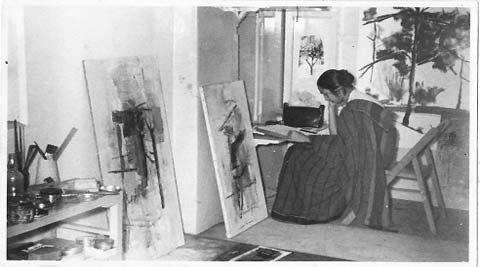
| A still from Pushpa Rawat's superb, thought-provoking film Nirnay (https://www.youtube.com/watch?v=oh2L_TcrIO8) |
Published in The Caravan, November 2013.


