18 March 2011

Konkan: Gold Coast

A quiet haven on the Maharashtra coast.

The first time I went to Tarkarli, it was June. The auto we hired from Kudal station took us through miles of shrubland, the red earth soaked from the last downpour, gleaming wetly in the sun as it waited for the next one. I spent three days there, on the Konkan coast of Maharashtra: quiet days, mostly waiting for the rain to start again. The downpours were unlike anything I had seen before, great sheets of water that seemed to merge sky with sea. But what I remembered most vividly from that time was the red soil all along the road, magically transformed into near-white sand along the water’s edge.

This time, it is December. The earth is still red, but there is no rain. The sun is mild, the sky a cloudless blue. The auto ride from Kudal is still rather lovely, but nothing feels as elemental. I am ready to be underwhelmed.

Then the road begins to wind its way slowly out of the plateau, past mango trees covered with new yellow-green leaves, down to the coast. Now there are coconut palms. And banana trees. The houses of Tarkarli began to appear. Many of the houses are still tiled in the traditional way, but their old-style red roofs sit atop the most funkily painted walls. It isn’t quite rainbow town (I never see a true blue, or a proper green) but there are oranges and yellows and reds and pinks and purples, in the most remarkable combinations. Banana-yellow walls with a fuchsia door, a red house with a purple well, a white temple with orange eaves and green trellises. Why don’t I remember these colours from the last time around? Had the monsoon lashed the colours into submission before I got there? Or was I so preoccupied with red earth and pouring rain that I never noticed all the brilliant ways in which people had added to that palette?

I’m still contemplating my oddly selective memory when we reach Devbagh, the next village along the coast after Tarkarli. Devbagh is where we’re staying this time round. The road has somehow managed to run alongside the coast while keeping the beach firmly out of sight, so that when we draw up in front of Siddhivinayak Beach Resort, the sea is like a surprise present. The Khobrekars live in the old house, closer to the road, and they’ve built a series of rooms for guests closer to the beach. In the large open area are several palm trees and a big thatched umbrella.

I’m just slightly anxious because our mobile phones have refused to work on the way here and the last time I called was three weeks ago. But everyone seems to know who we are. Yes, yes, our train reached on time. Yes, we’re from Delhi. Yes, we’d like our rooms. While our rooms are readied, we settle down in the shade of the thatched umbrella-roof. The benches are rough-hewn slabs of cool black granite, balanced on stumps of local reddish stone. The tables are covered with red plastic tablecloths. It is New Year’s Eve, and the Maharashtrian family there looks curiously at us. But there is white sand between my toes. There is a cat. There is cold Kingfisher. And there, with not even a palm tree standing between me and it, is the sea.

It is no time to be underwhelmed.


Fishermen buying ice to store their evening catch

For lunch, we eat the first of the vast meals that are to characterise this holiday. Each thali consists of rice and fish and chapattis and a vegetable — and sol kadi, a digestive drink that’s served in small steel katoris but should ideally be drunk by the gallon. There are four of us, so we’ve asked for two bangda (mackerel) thalis and two surmai (seer fish) thalis. Surmai is not available, so they suggest something called sawandara instead. It’s the local fish, we’re told, the fish that’s caught in Devbagh village. What we’re not told is that it is the tastiest fish in the world.

Suffice it to say, we eat a lot. We take naps. Then we do nothing at all, unless you count watching the sun go down. The evening brings a few more revellers, mostly families. We watch the men drink lots of beer while the women don’t. There are a few young men, too—a college gang on holiday. The resort guys decide they must please the crowds and put on ‘Sheila ki Jawani’. Thankfully, they soon run out of Hindi film songs, and start to play raunchy Marathi lavani hits: the only one I recognise is ‘Apsara Aali Re’ from the film Natrang. The songs are filmi, but the mood is real. The boys have brought fireworks. We sip our wine and watch the display. It’s a happy new year.

* * *

The next day we take a bus to Malvan, the nearest town (and the place which gives its name to the gorgeous food we’ve been eating). From Malvan jetty, we catch a boat to Sindhudurg — literally, the Sea Fort. It’s a massive stone fortress on an island called Kurte. There are crowds of tourists, including hordes of schoolchildren who spontaneously seem to break into chants of "Shivaji maharaj ki jai". I suppose I shouldn’t be surprised, since this is Maharashtra and the fort was built by Shivaji.

Our boat contains a group centred around a curly-haired man in sunglasses and white kurta-pajama, who I decide is a local politician. We are ferried through somewhat choppy sea, only to be told to get off far from an entrance. We descend into knee-high water and clamber stoically across a tricky stretch of rocks, gazing up at the impregnable stone walls above us, feeling like medieval invaders (or Crystal Maze participants, depending on your authenticity quotient). Stragglers (i.e. those who display reluctance to leap into seaweedy water) are exhorted to be more manly by Sunglasses. Thankfully, no battles ensue.

The inside of the fort is remarkably bare. There are trees, some houses, a temple to Shivaji. There seems to be nothing to do except climb up to the highest point like dutiful tourists. The view is spectacular. The land spread out below: dull brown, barren and bone-dry and, all around it, as far as the eye can see, an expanse of blues. And as I look out at the massive stone walls that we were so recently on the outside of, I suddenly recognise the space for what it is: territory. I’m reluctant to go but Sunglasses will be in a hurry. Sure enough, there he is, watching the children yell "Jai Maharashtra" as he waits to hustle us back to shore.

It is almost lunchtime. We head straight to Chaitanya, a restaurant I remember fondly. It’s packed. I’m just thinking about how much more Malvan locals are eating out these days when I realise it’s New Year’s Day. We eat a thali each, as we should, and add two new items to our Malvani repertoire—mutton and ‘mori mutton’, which turns out to be shark meat. (I prefer the mutton.) We wander around the town, admiring wooden houses and roadside churches, and window grills with Queen Elizabeth’s head in the pattern. We drink kokam soda. Then we catch an auto back to Devbagh.

The next morning we have arranged to go see the dolphins. Even though we’ve been shown pictures of a wounded dolphin that washed up on Devbagh beach just days ago, I am not hopeful.

The last time I was here, the sea was too choppy to go out to the spot where dolphins apparently gather, where the Karli river meets the sea. Since then I have been to the Sundarbans, clutching my copy of Amitav Ghosh’s Hungry Tide and (bookish tourist that I am) hoping to see dolphins almost more than tigers. But to no avail. Still, we wake at six and scramble out to discover that the boatman has forgotten about the plan. He has to be woken, as do the others apparently coming with us. We crossly refuse placatory offers of tea. When we set out, it is nearly seven.

But no grumpiness can hold out against a dawn sky and a grey sea slowly turning translucent blue. When we reach the river’s mouth, there are already two boats biding their time. We wait and watch. Then there’s a flutter of activity—someone has spotted something. It’s like the classic moment when the guide whips out his walkie-talkie and all the jeeps congregate next to the nala near which someone has just reported the sharp barking call of the chital.

Except we’re at sea and there’s nothing to mark the terrain. But there is also nothing to distract us. So that when the first gleaming silver snout appears, there’s a collective gasp. Then there’s another snout, then a fin, then a tail. There seems to be a pair of them, diving in and out in a kind of playful dance for several minutes before they vanish below the waves. For a minute there is silence. Then someone spies another, in the opposite direction. The boats jump to attention, revving up their motors to move as close as possible. There are more dolphins now and we watch in delight as they somersault. But they know we’re there and gradually they move away from us, swimming further out to sea.

* * *

We return to Devbagh via what is known as Tsunami Island, a sandbank created during the tsunami in 2004. Boats are parked there, and we wander around barefoot in knee-deep water, happy to discover a stall selling tea and—to our joy—fluffy homemade dosas and the wonderful Maharashtrian sweet called modak: plump parcels of rice flour filled with coconut and jaggery. It’s a thoroughly charming breakfast in a thoroughly charming place, but once we’ve boated and walked our way back to Siddhivinayak, we’re not unwilling to eat another one kept ready for us. It’s poha, light and lemony, with a sprinkling of grated coconut and the super-fine bhujiya that I am told goes by the super-fine name of nylon sev.

But it’s not just double breakfast day. It’s double marine-life expedition day, too. After a quick swim, we head to Malvan again—to snorkel. Two of our party are not-quite-swimmers—they can stay afloat but don’t know if they like the idea of going underwater. It’s only after our exceptional instructor explains that snorkelling doesn’t involve going underwater at all that they look a little more convinced. By this time we’re behind Sindhudurg—that rocky stretch of sea from yesterday turns out to be a coral bed too—and once we see the people already snorkelling, with float tubes around their waists and only their faces in the water, there’s no more tentativeness.

The coral reef is magical. None of us have ever seen one before and the multi-hued world that suddenly opens up before our eyes is indescribable. Jewel-like fish dart about in the shadows, their swiftness in stark contrast to the slow-motion quality of everything else underwater: the tendrils of various plants, the vast cabbage-like corals and us, slowly circling the area, our flippered feet trying their best to follow instructions not to splash.


A couple floats in the waters near the Sindhudurg fort

The afternoon meal feels much-deserved and we eat pretty much every kind of seafood on the menu. Then we wander through the backstreets, looking for a way back to the jetty that goes along the sea. There isn’t one, but we do find a rock garden, and a sunset point, and a cricket club on the beach. Eventually we reach the jetty and find the municipal fish market. We get back to Siddhivinayak, where we seem to be the only people for dinner. We eat and talk of various things. But, from time to time, one of us looks up and catches a dreamy look in the other’s eye and we both know it’s the coral we’re thinking of. Nearly two months later, the sea still haunts my dreams.

THE INFORMATION
GETTING THERE
The nearest railway station to Tarkarli is Kudal, approximately 45km away. The most convenient train from Mumbai is the overnight Konkan Kanya Express (`910 on 2A). Autos are easily available from Kudal to Tarkarli (`400). From Delhi, the Trivandrum Raj-dhani (`2,495) takes 24 hours to Sawantwadi Road, a station 54km from Tarkarli. If you choose to fly, the nearest airport is Dabolim in Goa, from where Tarkarli is 100km (a two-and-a-half hour drive). There are flights to Dabolim from all major Indian cities (from `3,000 one way ex-Delhi; `1,800 ex-Mumbai; `2,300 ex- Bengaluru; `4,000 ex-Kolkata). Maharashtra State Transport buses (msrtc.gov.in) ply from Mumbai (`375) and Pune (`415) to Malvan.

GETTING AROUND
The local bus from Devbagh to Malvan (`9) is fairly regular during the daytime. Autos from Malvan to Tarkarli or Devbagh will charge `125–150. The ferry from Malvan to Sindhudurg costs `33.

WHERE TO STAY
The MTDC Resort, Tarkarli (from `1,800; 02365-252390, maharash tratourism.gov.in) cannot be beaten for location. Each ‘Konkani hut’ (all non-AC) has an almost unobstructed view of the beach. There are dozens of homestays and ‘resorts’ in Tarkarli. Most involve a few extra rooms added on to an existing house, with food supplied by the family kitchen. Rooms are basic and usually non-AC. Try the well-regarded Ghar Mithbavkaranche (from `1,400; 02365-252941, gharmith bavkaranche.co.nr). In the adjacent village of Devbagh too, more and more families have opened up their homes to tourists. Among the more organised are Swami Samarth (`800; 9404170104, swamisamarthbeachresort.com). We stayed at the well-managed Siddhivinayak Beach Resort (`700 non-AC and `1,200 AC; 02365-248407, 9404448687), run by the marvellously hospitable Khobrekar brothers. Rooms are basic, but clean (some have AC). Whatever else you do, do not leave without having eaten ghavan (a soft pancake made from ground soaked unfermented rice, close to Karnataka’s neer dosa) here.

WHERE TO EAT AND DRINK
If you like seafood, Malvan is heaven—on a budget. Malvani cuisine centres around rice and fish, but chapattis are served with every thali, and in a restaurant, you can usually take your pick of prawn, crab, shark, chicken or mutton. Bangda (mackerel), surmai (kingfish) and pomfret (the most expensive) are all of high quality, and local varieties like sawandara are well worth trying too. The famous Malvani fish curry looks more fiery than it actually is, because the masala—a combination of whole dry red chillies, coriander, peppercorns, fennel, cumin, asafoetida, cloves, cinnamon and star anise—is tempered with the sweetness of coconut and the sourness of kokam. The best part of the thali, though, is sol kadi, which combines coconut milk with kokam to magical effect. Do not be put off by the pinkness of it; that’s the natural colour of kokam. The most well-known eatery in Malvan is the conveniently located Chaitanya (Dr Ballav Marg, Bharad Naka; 11am–10.30pm; 02365-242172), a five-minute walk from the bus stand. The bangda thali (`75), bangda fry (`25) and the mutton thali (`120) here are particularly good. Atithi Bamboo (Maghi Ganesh Chowk, Rosary Church Shejari; noon–3pm and 8–11pm; 9423304327) is further away, but worth the trek. The charming Yeshashri Coldrinks (a few minutes down the road from Chaitanya; 02365-252637) is a great place to shelter from the afternoon sun and offers a variety of lassis, flavoured sodas, amrakhand, shrikhand and homemade ice cream in such innovative flavours as ale-limbu-mirchi (ginger-lemon-chilli). I recommend the mango lassi: a rich, divine mixture of tartness and sweetness (and this is in winter, when it’s made not with fresh mangoes but with the mango extract popularly available in these alphonso-growing regions).

WHAT TO SEE & DO
The beaches of Tarkarli and Devbagh are stunningly beautiful. You may want to do nothing but swim, sunbathe and walk along the seashore. But if you’re interested, there is no dearth of activities—although these are largely weather-dependent. A boat-ride (`800 per boat) can be arranged from Devbagh to view dolphins, which tend to congregate at the point where the Karli river meets the sea. The seventeenth-century Sindhudurg fort, built by Shivaji on an island just off the coast of Malvan, is worth visiting. Ferries from Malvan Jetty depart every half an hour (`37 per person). (Not all boats can take you all the way up to the entrance, so if you’re reluctant to clamber across the final rocky stretch before the fort, inquire before getting on.) Snorkelling services are advertised in various places in Malvan—just make sure to insist on a trained instructor. `400 per person will include the cost of the boat-ride from Malvan Jetty, the snorkelling equipment and the services of the instructor. During the monsoon months—May to September—the sea is too rough to go swimming or for boats to go out to Sindhudurg fort. On a previous visit, we found a boatman who took us to Bhogwe (`800 for an hour there, more if you stay longer), which turned out to be a rather lovely neighbouring village, with mango and jackfruit trees and a small, gorgeous stretch of beach. The town of Malvan is worth exploring. The further away you go from the jetty and the bus stand, the quieter it gets. There is a rather charming Sunset Point and Rock Garden, both looking out over the sea. The Municipal Fish Market is most active in the mornings and evenings, when the fresh catch comes in. There are plenty of shops selling jewellery (real and imitation—my friend acquired a fetching nose ring). You can also shop for cashew nuts, kokam juice, Malvani masalas, papads, and sweet and sour concoctions made from mango, jackfruit, tamarind and other local fruit.

Published in Outlook Traveller magazine, March 2011. (Photos courtesy Outlook Traveller)

12 March 2011

WHY INDIAN THEATRE NEEDS META

A still from Akvarious Productions' The Interview

It’s garnered immense goodwill over the years among the theatre fraternity. But what has the Mahindra Theatre Festival actually achieved? TRISHA GUPTA finds out

AMONG THE PLAYS showcased at the sixth Mahindra Theatre Festival, just held in Delhi, was a production in English called Dancing on Glass. Written and directed by Ram Ganesh Kamatham, Dancing... is a scathing take on the IT world in Bengaluru. It also contains what the festival website describes as “some explicit language”. A few months ago, Kamatham’s play caught the eye of The Guardian’s theatre blog. Having excitedly described its expletive-laden dialogue as “drawing gasps” from Delhi’s Habitat Centre audience, the blog went on to heap praises on Kamatham for placing a “darker and angrier vision of India on stage” than is done “in the West and by its own film industry”.

Much might be said for the play’s brutal energy and unabashed language. But The Guardian blogger hangs his appreciation on the idea that in “a cultural climate dominated by escapist Bollywood narratives [and] song-and-dance routine[s]... realism can be every bit as shocking as the swearing.” The lazy, catch-all Bollywood bashing apart, this is precisely the sort of polemical argument that often gets made about theatre in India — sometimes, sadly, by theatrewalas themselves. But it is a tiresome and inaccurate stance, one that only does disservice to the thing it wants to promote — because while realist, outspoken, angry, unmusical plays are part of the contemporary Indian theatre scene, there are as many that are fantastical or myth-inspired, tender, thoughtful or riotously musical. The brilliance of Indian theatre — if such a thing can be assumed — lies in its capaciousness.

It is this capacious spirit that the Mahindra Theatre Festival, instituted in 2006 in conjunction with the Mahindra Excellence in Theatre Awards (META), seeks to embody. Plays staged have ranged from marvellous amalgams of literature, dance and music like Sangit Giribala (2008), Chetan Datar’s Marathi production based on Tagore’s short story Manabhanjan, to the affecting mime play Mirel Masingkha from Manipur, which won awards for Best Original Script and Best Sound Design in 2010. Plays that apply can be non-verbal and can include physical theatre, puppetry, multimedia and dance. Sanjoy Roy of Teamwork Films, whose team has been organising META since its inception, remembers an entry from Odisha last year that was taken from village to village by bicycle. While it didn’t make the final shortlist, the instance reveals an organisational vision inclusive and egalitarian enough to pit a practically unknown production from Kerala against a Girish Karnad play. After the inaugural year, when competing plays were first divided into “established” and “emerging” theatre, META has also done away with the seniority-based hierarchy that leads to competitions being limited to playwrights or directors under a certain age — like Mumbai’s Thespo. “The sifting process tries to showcase the best theatre and largely it succeeds,” says Mahesh Elkunchwar, Marathi playwright and META jury member for 2011.

META’s “sifting process” is also unusual. Unlike most theatre festivals, including the National School of Drama’s (NSD) Bharat Rang Mahotsav in Delhi, the Prithvi Festival in Mumbai, or the Ranga Shankara Festival in Bengaluru, it is not based on invitations. “We started in 2006 by asking our selectors to send their recommendations, but since then, it’s been a democratic process, where any group can apply,” says Roy. Ten productions are shortlisted from hundreds of DVD recordings by a committee of theatre experts to perform at the festival in Delhi, where they are viewed by the public and by a special jury. Plays compete for honours in 13 categories, from Stage Design to Best Ensemble.

OF COURSE, not having a ‘quota system’ that ensures equitable regional representation means that states and cities with a thriving theatre scene send in more entries and are likely to get more plays in. Over the past six years, Kerala, Assam and Manipur have all been regularly represented, as have Meghalaya, Delhi, West Bengal, Tamil Nadu and Karnataka. The most consistently successful state, though, is Maharashtra, with plays from Mumbai and Pune often dominating the festival. The 2011 selection was particularly skewed, with five productions from Mumbai and two from Pune. “With seven plays from Maharashtra, people were joking the festival this year should be held in Mumbai,” laughs Mumbai-based director Akarsh Khurana, whose dark satire The Interview is one of the seven. “But really, Mumbai audiences have had a chance to see them, so it’s great that it’s in Delhi.”

Maharashtra’s dominance at the META awards is perhaps not surprising. Apart from having successful commercial theatre in Marathi and Gujarati (and in Hindi and English, if in lesser numbers), Maharashtra regularly holds districtand state-level theatre competitions with state-sponsored awards. Though some other state governments like West Bengal and Manipur do give away theatre awards, as do corporations and smaller bodies devoted to the arts in some states, recognition and financial support for theatre in India is less than negligible. “Normally theatrepeople live in penury,” says Elkunchwar matterof- factly. In the contemporary Indian scenario, where non-commercial theatre survives largely as a labour of love, the power of the financial reward cannot be underestimated. Though the sums are by no means large if you place them in the context of the contemporary cost of living in urban India — Best Production gets Rs. 1 lakh, Best Original Playwright, Rs. 75,000, and the 11 other awards Rs. 35,000 each — the money is a bounty for most Indian practitioners. “META is the only thing that has given the experimental theatrewala some money,” says a grateful Manav Kaul, whose remarkable plays have won awards almost every year.

FOR LESSER-KNOWN groups, it is the prestige of competing at the national level that makes META a lifealtering experience. The excitement of performing to a full house at Delhi’s Kamani or Shri Ram Center auditorium is palpable, especially in those who do not work in urban metropolitan contexts — even if, like Bidyawati Phukan, director of last year’s award-winning Guti Phulor Gamosa, their performances regularly gather crowds of thousands. Phukan, whose group UTSA lives and works out of Namaithang, a village near Assam’s border with Arunachal, remembers the META experience warmly. “It was wonderful to meet other groups, and people like Boman Irani and MS Sathyu. And the awards inspired our group to work harder.” For Dr Yumnam Sadananda Singh of Manipur’s Kanglei Mime Theatre Company, META brought rare exposure. “We were invited to the NSD festival in January. It was packed. Many couldn’t get tickets. Now we are doing shows in Kolkata and Kerala.”

In great measure, the immense tide of goodwill generated by META and the Mahindra festival over the past six years is an index of how starved theatre, like the arts in India in general, is for both funding and recognition. “Any form of support for theatre can only be lauded,” says Neelam Mansingh Chowdhury, who runs the critically-acclaimed Chandigarh- based theatre group The Company and is a META jury member for 2011. Theatrepeople seem almost resigned to the fact that there is little space for critical (or any) coverage of theatre in a media culture so dominated by popular cinema. “There seems even less coverage than 10 years ago,” muses Mansingh. “But the play in the context of the festival gets covered at least.” “Theatre may or may not draw large audiences, may not have any visible returns in terms of a spotlight on the sponsors,” concurs Anuradha Kapur, director of NSD and co-jury member. But while most theatrepeople are deeply grateful for the existence of a META, it is far from filling the enormous and urgent need that exists. “There is absolutely no reason to be apologetic in demanding State support,” says Kapur. “The world’s best, most cutting-edge theatre, German or British, subsists on State funding.” Sanjoy Roy points out that the arts in India function despite — not because of — government policies. “It is not handing out money for charity, but an investment in the wealth of the nation, in creativity. And creative arts like theatre also provide a platform for the discontented voice: we see it in plays from the Northeast every year.” Clearly there is a great deal more that needs to be done, and no shortage of ideas about directions from which change can come. And almost every theatreperson you ask has tens of them — taking theatre festivals to smaller towns, instituting permanent repertory companies that might afford a viable livelihood to theatre practitioners, building affordable theatres in every Indian city. What makes META special is that it has had the gumption to go beyond the small-scale ambitions with which theatre in this country is taught to be content. Perhaps what is needed is to think even bigger. Arundhati Nag, 2011 jury member and founder of Bengaluru’s remarkable theatre hub, Ranga Shankara, is not being facetious when she says corporates have a duty to patronise theatre: “Earlier, you had kings, now you have corporations. Why should there be an IPL only in cricket? Why not in theatre?”

From Tehelka Magazine, Vol 8, Issue 11, Dated 19 Mar 2011

21 February 2011

A world framed by language: A report on the Jaipur Literature Festival, 2011

This report was written for Biblio's Jan-Feb 2011 issue. Do register on the Biblio website to read it and many other wonderful pieces in pdf.


Geeta Hariharan, JM Coetzee, Adam Zagajewski, Ahdaf Soueif and Mrinal Pande at a session called 'Imperial English' during JLF 2011

The Jaipur Literature Festival, whose sixth instalment ended on 25th January 2011, is undoubtedly the most talked-about book event in India. This year especially, miles of newsprint — not to mention many megabytes worth of facebook and twitter updates — have been expended upon it by celebrity watchers, enthusiastic revellers and irascible critics alike.While much of the gushing national-level coverage tended to focus on the number of award-winning writers in attendance (seven Booker- and five Pulitzer-winners), the local Jaipur papers seemed more interested in splashing their front pages with pictures of an anonymous white couple kissing on the Diggi Palace lawns. Last year’s prize kissing-at-JLF photograph involved known writers: the Somali-born Ayaan Hirsi Ali and the British-born-and-bred Niall Fergusson. This year’s favourite celebrity couple, novelists Orhan Pamuk and Kiran Desai, did not quite deliver on their tabloid promise.

This year’s festival has probably also fielded more flak than ever before: being accused — variously — of being beholden to British writers (and being run as a fiefdom by one of them); of having dubious corporate sponsors (Shell and Rio Tinto, in particular, have been singled out as companies that stand publicly accused of unethical practices); and most frequently, of having surrendered claims to literary gravitas by being too much of a social event: the descriptive terms bandied about range from “mela”, “circus” and “tamasha” to “fashion show” and “Page Three Party”. Let me skirt the first two charges for the moment to address the last one. There is no doubt that reading and writing are both such solitary activities that a literature festival, to begin with, seems almost an oxymoron. Yet there is something to be said for being able to see, listen (and just possibly have a conversation with) a writer whose work you love, or just to be in a space where reading, writing and conversation about books seems absolutely normal. Suddenly, literature seems to afford the possibility of community. As the festival drew to a close, amid the reluctantly-departing revellers were large numbers of writers and readers excited and grateful to have met other writers and readers. Of course, complaints abound: about how it is no longer an intimate meeting of bookish minds, how it is overrun by celebrity-seeking crowds who are there only to catch a glimpse of Gulzar, or worse, of Om Puri. Yes, large numbers of people who don’t really read books do show up, particularly on the weekends—because the music is rather good, entry is free and “everyone’s going”. Yes, there are plenty of people (even readers and writers) who are in Jaipur to socialise (or less delicately, schmooze) and who barely attend a session or two. Yes, it is crowded enough that you will often find no space to sit in a session you really really want to attend. From the three-day gathering to which 14 guests turned up in 2005, the festival has grown into a massive five-day affair with four parallel sessions going on at any point in time—touted by Tina Brown of the Daily Beast (not without reason) as “the greatest literary show on earth”. Since 2006, it has also grown out of the single-session confines of the charmingly yellow painted Durbar Hall, gradually colonising more and more of the seemingly inexhaustible grounds of Diggi Palace, the haveli-turned-hotel where the event has been held since its inception.

But these ostensibly non-literary crowds only really take over in the evenings, when the day’s sessions have ended, the bar has opened and the atmosphere is more Chhattarpur farmhouse party than anything else. During the day, however, the festival is thronged by all manner of listeners, of whom one assumes a generous proportion are also readers — some avid, some occasional, some potential. You would be hard put to find so large and varied a selection of people engaged in such attentive head-nodding (or such vociferous and articulate opposition) at any university seminar. In 2009, among the people I met were three enthusiastic schoolteachers from Ajmer, a yoga trainer who had just taken a class with the visiting Julia Roberts and a psychic healer (and potential writer) who invited me to come visit her in the hills to sort out all my problems. This year, as every year, sessions involving Javed Akhtar or Gulzar or Prasoon Joshi (or, calamitously, all three) were nearly impossible to get into because there were large numbers of college students from all over Rajasthan who had come all the way just to see them. There was the carefully made-up Jaipur dowager in the audience who greeted several of Junot Diaz’s declarations with a heartfelt “That’s right!”— whether she had ever read or would ever read Diaz’s Dominican-New Jersey fiction didn’t seem the point. My favourite encounter this year was with two Bengali sisters in their 60s, one based in Bangalore and the other in Australia, who had decided to make the lit-fest their ‘together’ vacation and when I left them, were rushing excitedly to the Mughal Tent to hear Atiq Rahimi, a Franco-Afghan novelist whose Stone of Patience one of them had fallen in love with.

The other primary accusation levelled at the lit-fest this year was that it is dominated by British writers and only has any significance because it ties us in India to the British literary establishment.The first thing to say is what one of the directors of the festival, British-born William Dalrymple, has already pointed out in a post-festival interview: that the figures ought to speak for themselves. There were 224 authors at Jaipur this year, of whom precisely seven were British. He also counted 162 writers of Indian origin and 64 from 32 other countries. But the larger question, it would seem, is not one of the nationality of writers, but of the skewedness of the publishing scene, and even more broadly, of the English language and its clout. Even those who disagree with the “British dominance” argument grant that the Indian publishing scene in English depends on approval from the western establishment, located in the UK and the US. Being feted in the West, by a big advance from a firang publisher, or even better, by a Booker Prize, is necessary for an Indian writer in English to be seen as important here. Within India, however, it is only if you write a book in English (and not in Bengali or Malayalam or Hindi) that you have a chance at getting hold of a piece of the new publishing pie: a book launch (hopefully with free alcohol), reviews and interviews in a few national dailies and magazines, a stab at a handful of book prizes. It is another matter that the number of books actually sold is abysmally low — 3000 copies is a normal print run for literary fiction; 10,000 is a coup — when compared to the numbers that anoint a book as bestseller in any of the regional language markets.

The Jaipur Literature Festival is not what ails the Indian book scene — it just exhibits symptoms of the malaise. The 64 non-UK writers, whether from the US, Turkey, Australia, Nigeria, China, Egypt or Sri Lanka, either write in English themselves, or come to us filtered through English translations. There may have been 162 “desis” at the festival, as Dalrymple puts it, but the number of those who write in one of the bhashas was very few indeed. And these Indian language sessions, too, were largely either in Rajasthani or Hindi — for the obvious reason that these were the languages in which local Jaipur audiences could be expected to be fluent, and therefore, interested. A bit more complicated is the issue of why the bhasha writers who do get invited tend to get put on panels of their own, speaking almost entirely to each other, quite separate from the sessions in which the “international” writers and Indian writers in English get to mingle, backslap and disagree. Partly, this is a function of the assumptions that underlie the festival’s programming, i.e. that audiences for these authors are neatly dividable: that those who want to hear Pavan Varma and Gulzar don’t want to hear Orhan Pamuk, or that those who might be curious about the Hindi blogosphere have no interest in non-fiction about Afghanistan and Pakistan. More importantly, of course, it’s about the limitations of language: the “international” lingua franca, whether we like it or not, is English, and so a writer who is not entirely articulate in English doesn’t usually get to be on a panel discussing something with four others who are.

Simultaneous translation is theoretically possible, of course, but it would double the time taken for any session (and potentially double the number of speakers). It is not as if translation is not an integral feature of the festival. In 2009, for example, there were at least two sessions devoted to discussing the act of translation: the astoundingly resonant Writers’ Chain session, the culmination of a workshop with eight British and Indian poets working in eight languages, and a slightly more academic session with Alok Rai and Arshia Sattar among others.

In 2010 there was a lively discussion with translators Gillian Wright and Arunava Sinha (the latter was present this year as well). There is also, at the JLF, a constant sense of translation on the fly, with spontaneous, provisional versions of things said being provided both off-stage and on—most often for international visitors by bilingual Indians, but sometimes also for a whole audience: among the highlights of JLF 2009 was the experience of hearing Nalini Jamila’s fluid Malayalam descriptions of her life as a sex worker in Kerala instantaneously rendered into perfectly idiomatic English by K. Satchidanandan and Paul Zacharia. Among the unexpected delights of 2011 was a morning session on Bhojpuri cinema where the (admittedly rare) foreigner present had the pleasure of hearing Avijit Ghosh and Amitava Kumar read, recite and banter in a joyful mixture of English, Hindi and Bhojpuri, with Kumar translating the important bits quickly into English.

But on the whole, of course, it is impossible for non-English speakers to have derived much pleasure from listening to J.M. Coetzee’s grave and sonorous (and practically unannotated) reading of a story on the Front Lawns, or conversely, for a non-Hindustani speaker to have been moved by Javed Akhtar’s heartfelt exhortation not to surrender the North Indian heritage of Urdu to a fictitious association with a religious community. Which is why the presence of someone like Mrinal Pande, fluent and thoughtful in both Hindi and English, felt both rare and wonderful. Pande was among the most considered speakers in an animated panel called ‘Aisi Hindi Kaisi Hindi’, which otherwise seemed to swing between an old sense of beleaguerment and anxiety about linguistic purity and a new puffing-up-of-the-chest based on the explosion in Hindi media and cinema. She was also the sole bilingual Indian writer on a superb session called Imperial English, which perhaps more than any other session, provided clues to the complex linguistic universe, both political and personal, with which the festival — and we as readers and writers in English—must grapple. Pande spoke of growing up in many languages (Kumaoni, Hindi, even Gujarati and Bengali to some extent) and said that though English had “expanded the circumference of [her] experience”, it would never be the language in which she was at her best. Yet, English was a “survival tactic” that allowed her to speak of things that Hindi often didn’t: sex, for example. Egyptian novelist Ahdaf Soueif said she could only write fiction in English, but that if she were forced to live in one language, it would have to be Arabic. The most surprising thought came from South African writer J.M. Coetzee — whose mother tongue is Afrikaans, but who has only ever written in English and has won a Nobel Prize for his efforts — that he has never felt at home in English. Bilingual people, said Coetzee, lead “dual lives”, a mode of living on which two perspectives are possible. One way of looking at such people is that they have always known that the world is not simply what it is; it is always a world framed by language. Language, in other words, makes the world what it is. The other perspective on bilingual people, writers who write in a language that is not their mother tongue, is that they have been divorced forever from the language natural to them and to what they write about, and will therefore always be at a disadvantage. The first view is probably that of most people at this festival, Coetzee said quietly, because people who hold the second opinion are not invited here.

No-one responded.

Published in BIBLIO: A REVIEW OF BOOKS, VOL. XV NOS. 1 & 2, JANUARY - FEBRUARY 2011

26 January 2011

Not quite the belly of Delhi: No One Killed Jessica review


THERE’S A MOMENT in No One Killed Jessica when a girl — someone we’ve never seen — watches the candlelight vigil scene in Rang De Basanti, comes out of the cinema and sends out an SMS calling for a similar vigil for ‘Justice for Jessica’. The scene is spot-on. Without saying a word, it shows you how the news media, cinema and mobile phone technology came together to create a new kind of middle-class activist public, the outrage of its thousands of SMSes amplified by the power of television, leading to the eventual reopening of the Jessica Lall murder case.

Unfortunately, the film doesn’t often manage such verbal economy. It opens with a scene we know well from newspaper accounts: the late-night party at which the feisty young bartender, Jessica, is shot by a loutish customer who doesn’t like the idea of a do take ki model having the gall to refuse him a drink. But the quiet tension of this sequence — displaying some of the taut pacing of director Rajkumar Gupta’s controversial previous film, Aamir — swiftly disintegrates as Gupta decides to milk the idea of the decadence (and hypocrisy) of Delhi’s Page Three elite for all its worth, teetering dangerously over Madhur Bhandarkar territory and finally falling into a morass of easy lecturebaazi (“Sabrinaji, yeh kaise logon ke saath uthti-baithti hain aap?”).


NOKJ also fails miserably as a Delhi film. Every film set in Delhi doesn’t have to devote itself to the city. But we’re told constantly this is a story about Delhi. Sadly, it never goes beyond the clichés — Mumbai = paisa, Delhi = power; “Everybody is a somebody here” — and even these are lamely served up in a voiceover. There is the intermittent well-done cameo — example Bubbles Sabharwal as the socialite restaurant-owner swinging between self-absorption and hand-wringing helplessness. But Mumbai high society cannot pass off as Delhi’s: clothes, accents and intonations betray most characters. Worse still, none of the three principals — newcomer Myra as pretty Delhi girl Jessica who doesn’t take shit from men, Vidya Balan as her supposedly dowdy, stoic sister Sabrina, or Rani Mukherjee as hard-boiled star reporter Meera — look or sound like Delhi women. Balan puts in an admirable performance (largely wordless, thus easier in the context of this film) while Mukherjee struggles to give her shrieky, sloppily-written character something like a graph. The only thing Delhi about this film is Amit Trivedi’s zippy Dilli anthem.

From Tehelka Magazine, Vol 8, Issue 3, Dated Jan 22, 2011

17 January 2011

Twist in the Wedding

Why the shaadi is still a staple of Bollywood romance


Bittoo Sharma first meets Shruti Kakkar at a wedding. She’s rude to him, but he’s quite taken with her. He borrows his friend’s video camera to shoot her dancing, turns up in her U-special the next day to present her with a DVD exclusively devoted to her performance. The opening of Band Baaja Baraat makes one think you know exactly where it’s going. The girl seen by the boy at a shaadi, the wooing that ensues, leading up to the couple’s own wedding — it’s among the oldest tropes in the Hindi movie universe. And Band Baaja Baaraat’s opening scene is a clear tribute to Yash Chopra’s own contribution to the genre: Chandni (1989), where Rishi Kapoor first sees Sridevi at a wedding, starts photographing her in secret, and later, in one of the dramatic high points of the 1980s filmi romance, reveals a roomful of pictures he has taken of her.

The Indian wedding has always been a traditional mating ground. It was a rare, socially sanctioned space where young women of marriageable age were on display, for matchmaking aunts — and potential husbands. (Ask around in any north Indian family and you’ll find at least one uncle and aunt who got married because he saw her at his brother/ cousin/ friend’s wedding and set his heart on her.) The shaadi ka ghar, with its dressing-up and dancing and suggestive songs, was the natural setting for romance, a place where banter between young men and women was laughingly condoned and flirtation was almost traditional.

These days, one might think, urban young people don’t need the socially sanctioned space of the shaadi to meet a potential partner, either on screen or off it. The CCD-mall-multiplex generation should have no time for wedding movies. The days of Hum Aapke Hain Kaun...! (1994) are over.

Yet it seems that the 2000s — after Karan Johar’s K3G (2001) — were when the choreographed Bollywood sangeet really became de rigueur, first in movies and then in weddings across the country and the diaspora, and I can think, off the cuff, of three Hindi films in the past few years where the hero first properly sees the heroine at a wedding: Saathiya (2002), Love Aaj Kal (2009) and Rab Ne Bana Di Jodi (2008). And at least three 2010 films derive much of their energy from weddings — Aisha, Do Dooni Chaar and Band Baaja Baraat.

Do Dooni Chaar
is least obviously preoccupied with the wedding — it serves mainly to kick-start the plot, which is really about the middle-class family’s desire for a car. And yet there is a way in which, despite all their travails and tribulations in getting to it — the borrowing of the car, the cost of the wedding present, the potential theft, the potential exposure — the wedding itself has the power to create a generally celebratory mood, successfully drawing in the glum father and the teenage cynic alike.

Aisha — which sets Jane Austen’s Emma in contemporary Delhi — is possibly the most traditional of the three, in that it opens with a shaadi where we first see the heroine, Aisha, and ends with Aisha’s own wedding. But the hero already knows the heroine, so the wedding is not the setting for their romance. On the other hand, it sets in motion a definite trail of matchmaking — only the matchmaker in question is the heroine herself. Almost the whole of the film is taken up with pairing off young people who appear in the original wedding scene, culminating in the final wedding, where we have the pleasure of seeing them all matched up (in more ways than one, since this is the most alarmingly colour-coordinated wedding you’ll ever see).

The film that really takes the wedding movie theme and runs with it, though, is Band Baaja Baaraat. It seems to play by the old rules — introducing the heroine and the hero at a wedding, following their relationship and culminating in their own wedding — but, in fact, it brilliantly subverts both the genre and our expectations by making them wedding planners. Shruti refuses Bittoo’s romantic overtures. She accepts his DVD and, later, his partnership, only on condition that he isn’t going to line maaro her. She arranges weddings, and she’s going to have an arranged match herself. She has Plans — and love isn’t part of them.

Yet, as we watch the two of them lean laughingly into each other at wedding after wedding, complementing each other perfectly in the exaggeratedly comic flirtation-rejection of the wedding song, we know that the shaadi movie will have its way. It’s as if the well-done north Indian wedding — with its glitter, its banter, and, crucially, the zippy song that gets the whole family on its feet — casts a kind of spell, temporarily erasing the rules of the ordinary world and making romance seem somehow inevitable. Much like the well-done Hindi film.

The writer is a Delhi-based writer and anthropologist.

Published in the Indian Express, Friday Jan 14, 2011.

12 January 2011

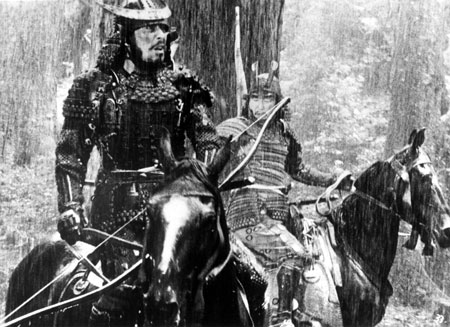
The Dark Knight: Akira Kurosawa


Kurosawa's cinema may seem to be about heroic action, but heroes, in the end, are merely human.

One of my most vivid cinematic memories involves a stocky little Asian man and a suited-booted white man frantically cutting wild grass, while the sun threatens to set behind them. I was six or seven, and understood nothing of the film. But the elemental power of that single scene never left me: the vast, bleak grassland, the eerie light, the wind beginning to howl, and the knowledge – somehow contained wordlessly in the furious cutting of the grass – that life depended on it.

Fifteen years later, I learnt that the film was called Dersu Uzala (1975), which was also the name of its memorable protagonist: an old Goldi hunter who knows the cold forests of the Russian Far East like the back of his hand, but loses his eyesight and is forced to go live in a town. Its world-renowned Japanese director, Akira Kurosawa, had been offered the project by the Soviet studio Mosfilm in 1973. It was a time of great tumult in Kurosawa’s life: his attempt to break into Hollywood with Tora Tora Tora had gone horribly wrong, his experimental venture Dodesukaden (1970) had received a lukewarm reception in Japan and he was unable to get funding. In Dersu’s profound bewilderment – that he, who was so attuned to the wilderness, can no longer survive in it – one senses an echo of Kurosawa’s own feelings about cinema in those years.

In 1973, Kurosawa had already been directing films for thirty years. Identified in the West with his superlative samurai films – Yojimbo, Seven Samurai, Rashomon, Sanjuro and The Hidden Fortress (which inspired Star Wars), he was seen as a master of the dramatic action narrative. Dersu Uzala is, by comparison, a slow film. But it contains many long-term Kurosawa preoccupations: the individual striving to surmount all odds (seen most powerfully in Ikiru (To Live, 1952), where a minor bureaucrat’s life is transformed by the discovery that he is going to die); relationships between younger and older men (Seven Samurai (1954), where a newbie samurai apprentices himself to an older one, and Red Beard (1965), about an old doctor and an arrogant intern); and the connection between man and nature.

Kurosawa was deeply concerned about human hubris. He once said, “People today have forgotten they’re really just a part of nature. Yet, they destroy the nature on which our lives depend. They always think they can make something better...” There is something magical about his rendition of the landscape in Dersu; the wind, the rain, the sun seem almost to conspire to make the two men lose their way. Then you watch the two warriors befuddled by the forest in Throne of Blood (1957), and you realize that Kurosawa has thought of nature in this way for a long, long time. Transposing Macbeth to medieval Japan, he takes the Birnam Wood of the prophecy (“I shall not be afraid of death or bane, till Birnam Wood come to Dunsinane”) and makes of it an eerie presence more powerful than the strongest warrior: the Cobweb Forest. Even in Seven Samurai, the heroism of the samurai is ephemeral – it is the land and the peasant’s link to it that is forever. Kurosawa was known for his larger-than-life dramas. But what makes his cinema truly epic is the profound sense that there is something larger than the heroic human life.

Published in UTV World Movies magazine, Dec 2010.