8 January 2020

The ghosts among us

My Mumbai Mirror column:

A new anthology film about the supernatural is a mixed bag, but it does try to point Hindi film horror in consciously critical directions.

A still from Dibakar Banerjee's segment in the new anthology film Ghost Stories.
After first coming together to pay homage to the cinema in Bombay Talkies (2013), and the self-explanatorily titled Lust Stories (2018), the once-unlikely foursome of Zoya Akhtar, Anurag Kashyap, Dibakar Banerjee and Karan Johar are back with a new anthology film: Ghost Stories.

The films vary widely, not just in setting and tone, but in quality. Anurag Kashyap's contribution, starring an awkwardly gangly sari-clad Sobhita Dhulipala as a woman who is both an expectant mother and a surrogate maternal figure to her little nephew, didn't work for me at all (spoilers ahead) despite the effectiveness of the scowling child. The possibility of an uncanny relationship between external visual depictions and real-life transformations – think everything from Oscar Wilde's The Picture of Dorian Gray to MR James 1904 classic ghost story 'The Mezzotint' – has always fascinated me, and it is of course also the basis of certain long-held ideas of magic, such as voodoo. So Kashyap's use of the child's drawing, his repeated scratching-out, and his apparently innate sense of his own power, was for me the most gripping part of the story. But the film stirs in all sorts of other elements – nightmares, superstitions, silent men, shouting mothers, half-human states, crows' eggs, and a whole room full of creepy dolls. If all these ingredients were meant to be a recipe for chills, the dilution leaves us baffled and lukewarm.

Zoya Akhtar's film wins big by casting the brilliant Surekha Sikri as a bedridden old lady attended on by a lackadaisical young replacement nurse (Jahnvi Kapoor). As always with Akhtar's films (including her segment about a maid and her master in Lust Stories), there is an attentiveness to space: the multiple empty rooms that the youthful Sameera dashes through with a token agarbatti, the echoing sound of children's laughter from the stairwell when she answers the doorbell to find no-one there. It's a talent particularly useful in crafting fear, if Akhtar were interested. But she isn't, not really.

What she seems keen on is a juxtaposition of youth and age, sharpness and shutdown– and things aren't as simple as they seem. Sameera's briskness as she cleans up Mrs. Malik is matched by her frequent distractedness. Mrs. Malik, meanwhile, drifts in and out of consciousness, but recites from Wordsworth's apposite 'Intimations of Immortality' with tinny perfection: “Turn wheresoe'er I may,/ By night or day./ The things which I have seen I now can see no more.” And knows more about the fruitlessness of waiting for someone than Sameera can.

Genre fiction and film – especially of the scary variety – has long been a vehicle for social commentary. The man-made monster at the centre of the still-popular Frankenstein – a book first published anonymously by a ridiculously young Mary Shelley in 1818 – is an early (and eerily prescient) warning against technological intervention in human life. Twentieth century horror, especially the zombie movie, has been powerfully shaped by George Romero's cult classic The Night of the Living Dead (1968), the first of his triad of 'Dead' films: Dawn of the Dead, set in a shopping mall, and Day of the Dead (1985). Romero onwards, the slow-moving, cannibalistic zombie – a creature whose bite turns the bitten person into a zombie herself -- has more often than not been a powerful metaphor for the horrific things that ail society: racial prejudice, consumerism, militarism, classism. That tradition continues down to Jordan Peele's Us (2019).

Karan Johar's film isn't scary, despite his newly-married heroine walking us endlessly through the candle-lit expanse of her husband's family mansion (going for a cross between K3G and Trikaal) in search of a ghostly grandmother. The only effective presence is that of the forbidding housekeeper Shanti, who guards Dadi's room in a manner clearly inspired by Mrs. Danvers' guarding of Rebecca's in the Du Maurier novel (and Hitchcock film). Johar has moments that invite critical examination: such as the friend who declares the family as “totally legit” based on “community mein izzat” and “thriving business”, forcing us to think about how such an aura of social legitimacy survives the violence pushed under the floorboards. (But you'd do better to watch Parasites.)

There is, happily, a zombie film in the quartet. It is Dibakar Banerjee's, and perhaps unsurprisingly, it is the sharpest of the four – politically, but also in filmmaking terms. Sukant Goel plays a bored, exhausted sarkari official who arrives in a remote village to report on a government school – to find a ravaged, half-burnt settlement where the only living humans appear to be two children. The zombies from the bigger village have eaten everyone from the smaller village, and will eat everyone except those who turn on their own kind. If you speak up, you attract the attention of the creatures. If you join the feasting, you will save your skin – but be blinded for life. Watch it -- and try not to be blind.

31 December 2019

A Student of Resistance


As India's students speak out, it seems worth recalling a film about a student who defied another regime

Sophie Scholl was 21 when she was executed by the Nazi stateCharged with having distributed leaflets co-authored by a non-violent political resistance group called the White Rose, she was guillotined after a trial on 22 February 1943. The 2005 German film Sophie Scholl: The Last Days, directed by Marc Rothermund from a script by Fred Breinersdorfer, dramatises her interrogation, trial and execution. Though perhaps “dramatises” is not the best word for a film so deliberately spare, choosing to rely almost entirely on the historical transcripts left behind by the Gestapo (the Nazi Secret Police) and the “People's Court” -- and thus unfolding, to a great extent, within the confines of an investigator's office and a courtroom.

Calling themselves the White Rose, the student group to which Sophie belonged brought out six different leaflets between June 1942 and February 1943. Distributed mainly in Munich, with copies also appearing in Stuttgart, Cologne, Vienna, Freiburg, Chemnitz, Hamburg and Berlin, the pamphlets warned Germans that Hitler was leading them into the abyss, and called for people to speak out against Nazi terror. “Support the Resistance Movement!” they urged, for “Freedom of speech, freedom of religion, and protection of the individual citizen from the arbitrary action of criminal dictator-states”.

Those words from eight decades ago leap off the page in a month in which India has seen massive protests against a new Citizenship Amendment Bill (CAA), which together with the proposed nationwide National Register of Citizens (NRC), introduces religion as a criterion for Indian citizenship for the first time in the history of our republic. Watching Sophie Scholl, it seems no coincidence that the resistance to the CAA and NRC, which has gone far beyond criticism of the letter of the law to a sorely-needed defence of the secular spirit of our Constitution and of our democracy itself, has been spearheaded by students.

The power of Sophie Scholl: The Last Days is in the details – especially as you watch it in 2019 India, where everything from the aesthetic remodelling of middle class fashion to the lines of 'argument' used by Fascist officials in the film are chillingly recognizable from our real-life political situation today. The junior officer of the Third Reich who hustles the film's 21-year-old student heroine into the custody of Investigator Mohr, for instance, has a moustache clearly modelled on Hitler's. Later, as Sophie (Julia Jentsch) is led into her cold prison cell, we hear in the background one of the Fuhrer's numerous speeches to the nation on the radio, his rasping voice rising to the familiar nationalist frenzy as he identifies an internal enemy. “Total war is the demand of the hour,” he proclaims, to loud clapping from his audience. “We must also put an end to the bourgeois attitude which we have also seen in this war. The danger facing us is enormous. The time has come to remove our gloves and use our fists...”.

Many of the arguments levelled by the Nazis against anyone who criticised their government are voiced in the film by Mohr and later, the infamous judge Roland Freisler. Over and over, we hear them berate these students as “parasites” and “spoiled brat[s] who foul [their] own nest[s], while others are dying on the front.” They are painted as ungrateful wretches who do not appreciate that they are only able to be students “thanks to the Fuhrer.” Time and again, too, Sophie's refusal to buckle under pressure drives Mohr off the deep end. “How dare you raise your voice!” he shouts at her, the irony of the statement clearly invisible to him. “The Fuhrer and the German people are protecting you.”

Reading a pamphlet in which Sophie's brother Hans argued that the war needed to be brought to an end and expressed his hatred for “the way we treat the Occupied Territories”, Mohr yells: “This is troop demoralisation and high treason!” The insistence on celebration of the army, and the idea that being critical of militarisation is antinational will sound familiar to anyone who has lived through the last five years of BJP rule.

Some of the film's best moments come when Rothermund focuses on the bafflement of the fascist in the face of openness: familial, but also individual. It is a fascinating fact that Scholl had been, for a time, a member of a Nazi youth group, before she and her brother and his friends began to question what the regime wanted them to believe, based on things they had witnessed on the Eastern Front as well as information they had begun to access – about institutionalised violence against Jews and disabled people, among others. Asked why her father – a known critic of the regime who had served a sentence for describing Hitler as “God's scourge to mankind” – had even let Sophie join the Nazi Girls Organisation, she replies, “Our father never influenced us politically.” “Typical for a democrat,” sneers Mohr, lighting another cigarette. “Why did you join?” Sophie's reply should resonate with all Indians who live with the promise of Acche Din: “I heard that Hitler would lead our country to greatness and prosperity and ensure that everyone had work and food and was free and happy.”

I will leave you with what to me is the film's most important exchange. Mohr insists that what he is doing is only to execute the law of the land. “What can we rely on if not the law?” he says. Sophie's answer seems simple, but it is one all of us need to hear: “On your conscience!”


30 December 2019

"Fiction should prophesy the future": Benyamin


With his new book [in English translation] hitting stores, Benyamin says novel-writing is now a purely political act.

(A short author profile of the Malayalam writer that I did for India Today.)


Benyamin—the Malayali writer Benny Daniel—did
not grow up a reader. Other than the Bible, which was read every night before supper in his orthodox Syrian Christian household, he had read no other books in his childhood. He began to read after moving to Bahrain in 1992. For the next seven years, he read voraciously, while working as a project coordinator at a construction site. Writing grew organically out of a readerly desire. “I wished to read about the situations I felt and saw around me. But I realised nobody was writing about it yet. So, I started,” he says in an email interview. 


His first short story appeared in the Gulf edition of Malayala Manorama in November 1999. There has been no looking back. Now the author of over 16 books in Malayalam, Benyamin remains prolific and hugely popular in Kerala, to which he returned in 2013. His Aadujeevitham ran into more than 100 editions, selling over a hundred thousand copies, and a Malayalam film version, starring Prithviraj, is planned for release by end-2020. The book
also did well in Joseph Koyipalli’s English translation as Goat Days (2012). Three other Benyamin novels have appeared in English translation: Yellow Lights of Death (2015), translated by Sajeev Kumarapuram; the JCB Prize winnerJasmine Days (2018) and, most recently, Al Arabian Novel Factory (2019), both translated by Shahnaz Habib. 


Together with its ‘twin novel’ Jasmine Days, Al Arabian offers a rare portrait of urban life in the Gulf through the eyes of diasporic South Asian characters. Jasmine Days was told in the winsome voice of a Pakistani radio jockey called Sameera, the narrative echoing the young woman’s move from sheltered ignorance to humanitarian and political awakening. Al Arabian uses an even more open-ended device; the narrator Pratap is a Toronto- based Malayali journalist hired by an “internationally acclaimed writer” to help research a novel about present-day life in West Asia.

Among the joys of these books are the conversations across social, religious and national lines: between Shias and Sunnis, Arabs and South Asians, Malayalis and Hindi/ Urdu speakers, Third World passport-holders and those with First World privileges. “When we are inside India, we see a Pakistani as an enemy. Bangladeshis and Nepalis see us as enemies. But in a third country, we realise we lead the same kind of life. We eat together, work together. It dilutes the fear among us,” Benyamin says. These real-world diasporic encounters are supplemented by virtual ones. “Cyberspace deletes the borders drawn by politics,” in Benyamin’s words. But in his fiction, Facebook, Orkut, Viber, WhatsApp and email also enable unlikely connections and reconnections, secret affairs and the creation and destruction of new identities. This is of a piece with Benyamin’s penchant for “demolishing the wall between real and fiction”. He often makes his narrator a writer, a figure who
listens to stories, or presents eyewitness accounts. In Yellow Lights, the writer is even called Benyamin.

Based on what is available in English, Benyamin comes across as deeply curious about the stories he hears. But these four books also reveal a keenness to place those personal stories in social and political context. And in this, he is fearless. Goat Days, in which a poor Malayali migrant is turned into captive labour in the Saudi Arabian desert, is banned in the UAE and Saudi Arabia. Characters in Jasmine Days and Al Arabian argue often about politics, challenging and being challenged by each other’s posi- tions on colonialism, oil-rich capitalism, dictatorship and religious conflict. “In the age of visual and social media, fiction-writing does not have entertainment value. It is a purely political activity,” Benyamin says. “It should shine a torch upon our dark areas. It should prophesy the future.”


Al Arabian Novel Factory takes that responsibility seriously. Pratap’s taxi ride from the airport into ‘The City’ transports him—and us—into the heart of a dictatorship. The man just ahead of Pratap is forced to get out of his car by a soldier demanding to see his phone. In an instant, he is on the ground, being thrashed with the soldier’s gun. His phone is smashed, and he is forced to sing the national anthem. A petrified Pratap awaits his turn. But it turns out the taxi driver was right: “This is a very safe city for tourists.”


Unlike Goat Days, Jasmine Days and Al Arabian Novel Factory feature mostly middle-class members of the South Asian diaspora: people who have built relatively prosperous lives in West Asia as nurses, doctors, restaurateurs, journalists or businessmen. And both books repeatedly show us these people being apathetic or worse, actively opposed to all local political resistance against the authoritarian regime. Silence is apparently a small price to pay for the privileges they enjoy. What doesn’t affect them directly, they turn a blind eye to. It is hard not to see that self-serving quality all around us in present-day India. Benyamin doesn’t mince words on the subject. “We have almost abandoned democracy and are rapidly moving to autocracy. In the name of strong leadership, a majority of Indians have become fans of fascism. But we really don’t know the rights we are going to lose in this dangerous game.”

Published in India Today, Dec 27, 2019. 

Note: You can read my review of Jasmine Days here.

24 December 2019

Do weep for Salim the lame

My Mumbai Mirror column:

Salim Langde Pe Mat Ro
won two National Awards in 1989. Thirty years later, its fierce indictment of the working class Muslim experience emerges as chillingly prescient -- right down to the police.


There are many things in Salim Langde Pe Mat Ro that would have been recognizable to the mainstream Hindi film audience in 1989. There's the family thrown upon difficult times when the father loses his long-time job; the mother who takes on small-time tailoring work to augment the household income; the sweet-faced, dearly beloved younger sister who is 'of marriageable age'; the hero's turn to illegality placing him in conflict with his law-abiding father – as well as the remembered, almost hallowed figure of his elder brother. Also, as in so many commercial films, the hero is the leader of a trio, with him and his bumchums going everywhere together; and his love interest is a tawaif at the nearby brothel.

But Saeed Mirza's award-winning film – it won National Awards for Best Film and Best Cinematography in 1989– also contains a great deal that would have felt unfamiliar to Hindi film watchers. Or at least unfamiliar on screen, though perhaps deeply familiar from life. For instance, though the film doesn't actually take us into the mills of Bombay, it evokes the socio-economic world that existed around them, and the stark instability of Indian working class life in the late '80s. Salim's father has lost his job after decades of service, and is sitting at home, unable to find another. His son Javed, an electrician at a factory, is dead; killed in a tragic labour accident. Salim, the less academically inclined son, dropped out of school early on, because the family didn't have enough money to educate both sons. There is no mention of their younger sister Anis having been sent to school at all – though her suitor Aslam raises local hackles by pushing for the education of girls from the community.

The dialogue between Salim and Aslam is, in many ways, at the core of the tale Mirza wants to tell about poor urban Muslims. Salim and his mates, who are essentially all illiterate, have fallen early into a life of small-time crime: collecting hafta from local tailors and shopkeepers, conducting small and occasionally larger thefts, and acting as henchmen for local big men. Their fantasies of school and college are just that, fantasies -- as made memorable in a scene where Peera and Ahmad (played by theatre director Makarand Deshpande and filmmaker Ashutosh Gowarikar) perform a hilarious little spontaneous skit about how they imagine college girls and boys behave with each other.

Meanwhile the studious Aslam cannot find a job except as a poorly paid proofreader, because his MA was in Urdu literature. As he says, “Urdu zabaan ka istemaal hi kucch kam ho gaya hai.” Salim, appalled at his salary, initially rejects Aslam as a husband for his sister. His own ambitions are much grander: he and his friends dream of becoming as rich and well-connected as the local toughs who have risen to run illegal empires. As we watch Salim guiltily leave Aslam's book-filled room, we see little children unloading boxes. In fact Mirza's film, which thanks “the residents of Dongri, Do Tanki, Nagpada and Bachoo-Ki-Wadi”, is filled with working children in the background.

But it's Aslam's defense of Muslim girls' education that brings local men angrily to his doorstep. Salim shoos them away, but then asks Aslam why he's going against their religion. The ensuing conversation is a powerful one. Through Aslam, Saeed Mirza indicts Muslims for letting fear and ignorance keep them in a vicious cycle, while using Salim's experience to underline the poor urban Muslim's harsh experience of life in post-independence India: “Aa ke dekho, kaise log Musalman log ko nafrat karte hain! Kachra samajhte unko. Daraate hain, hamesha khallaas karne ka baat karte hain.”

Mirza's perspective on the causes of Hindu-Muslim violence, from Partition to the Bhiwandi riots that form the backdrop to the film, is simple -- and tragically, still entirely valid. “Why did this Partition stuff happen?” asks Salim. “So that powerful people on both sides could have a hissa to rule over,” responds Aslam. Later, a filmmaker who shows up in the area to screen his documentary on the Bhiwandi riots makes the distraction argument -- that high communal feeling and the threat of violence only serve to keep people from asking why they don't have education, food, shelter.

Shockingly, thirty years after Salim Langde Pe Mat Ro, we have elected a government that has made such deliberate distraction their full-time occupation. But only one side is being successfully distracted. One hopes they will open their eyes, before it is too late.

Mirza's film does not depict police brutality, but it doesn't shy away from referencing the systemic communalisation of the system. Early on, we see a police officer on the phone. “Yes, it's a Muslim area, but we'll control it, sir,” he says easily. “Maar-maar ke khaal kheench lenge. They only understand the language of the stick. And if there is a problem, we'll impose Section 144.” A little later, we see another cop catch hold of Salim and his friends, heading home late, while Section 144 is officially still imposed in their area. “Are you planning a riot?” says the cop. “Nahi sahib. Aap hain na,” he responds, almost bantering. In December 2019, after all that has happened in Jamia, Aligarh, Lucknow and Mangalore – and possibly many other places whose news is still to reach us – it is impossible to summon up a laugh.

18 December 2019

Countries of the Mind

Solitary young immigrant men traverse Parisian streets in Na

Read more at:
https://mumbaimirror.indiatimes.com/opinion/columnists/trisha-gupta/countries-of-the-mind/articleshowprint/72623618.cms?prtpage=1?utm_source=contentofinterest&utm_medium=text&utm_campaign=cppst
My Mirror column:

Solitary young immigrant men traverse Parisian streets in Nadav Lapid's Synonyms and Jérémy Clapin's I Lost My Body, two of 2019's most befuddling, memorable films. 

A still from Synonyms (2019)

The opening sequence of Nadav Lapid's Synonyms bursts with a strange, irrepressible energy. A 20-something man charges through Paris, the camera capturing his long-legged strides and his thumping footsteps. He arrives in a grand old building, finds a key hidden under a corner of carpet, and enters a vast, rather beautiful apartment -- with not a scrap of furniture. Seemingly unsurprised, he is in the bathtub when he hears a sound. He runs out, nude and slippery, onto the polished wooden floors, to discover that his possessions – clothes, sleeping bag, money – have disappeared. He races downstairs looking for the thief, banging on the doors of other apartments. No one answers. He comes back to the apartment, still without his clothes, and settles back into the bathtub, seemingly prepared to freeze to death. The next thing he knows, he is waking up in a large clean bed, having been adopted by the young bourgeois couple downstairs. His rescuers Emile and Caroline – children of rich industrialists who have pretensions to the arts – feed him and clothe him, giving him money and a phone and a particularly memorable mustard yellow coat in return for the pleasure of his amusing, sometimes outlandish company. Stripped quite literally of his past, Yoav – for that is the name of Lapid's Israeli protagonist – resurrected in a new identity.


Synonyms, which won the Golden Bear at the 2019 Berlin Film Festival and was screened in India at both MAMI and IFFI, is a film about a man who wishes to shed his old skin, an Israeli man insistent that he will not speak Hebrew, who walks the streets of his new city with a Larousse dictionary under his arm, reciting synonyms from the language he thinks will grant him entry into a new nation.


Lapid's film, apparently at least partly autobiographical, is filled with anger against in-your-face Israeli militaristic nationalism. But as Yoav gradually realises that France isn't quite the haven of liberty, equality and fraternity that he has imagined, it also indicts nationalism of the French variety – with its insistence on linguistic blending in, its closet anti-Semitism, its citizenship classes that involve learning the words of La Marseillaise: “Let us march! Let us march! So that impure blood irrigates our fields!”.


Still from the award-winning animated film I Lost My Body (2019)

I found myself thinking about Synonyms as I watched another 2019 film about a young immigrant wandering the streets of Paris, this time a Moroccan pizza delivery boy called Naoufel. Jérémy Clapin's stunningly crafted I Lost My Body – the first animated feature film to receive the top prize at the Critics' Week section at Cannes, and now available to stream online -- has even grander ambitions than Lapid's film. It opens with a severed hand coming to life and making its way out of a medical laboratory. Surely this must be horror, you think – and I Lost My Body does have its tense, borderline macabre moments: a body-less hand suddenly wringing a pigeon's neck, or clicking an abandoned cigarette lighter into flame in self-defense against a pack of subway rats. But even as we watch the hand creeping and crawling and dancing its way across rooftops and drains, over pianos and under trains, it takes on a personality of its own. We begin to identify with its search – for its missing body, for itself. We do not tremble when the hand approaches a gurgling baby, placing a fallen pacifier back in the baby's mouth, and then laying itself down to be held in the baby's sleepy grip.


Perhaps our comfort has something to do with what we see in the film's parallel narrative, about the film's human protagonist, Naoufel. Bespectacled, shy and slight of build, Naoufel sometimes seems like the opposite of Yoav in Synonyms. And yet they share many things: an irredeemable homelessness, an emptiness that seems to express itself in a need to attach themselves to something or someone, and a painful preoccupation with the past, with a country of memory. Their responses to trauma are quite different. Yoav is constantly vocalising, telling outrageous stories about his past in Israel, once even presenting them to his writerly friend Emile in an extravagant gesture of generosity. Naoufel is painfully quiet, seeming to relive certain moments of his childhood over and over. If Yoav recites new words from a dictionary, Naoufel listens to old tape recordings of his parents. And the hand – the hand remembers trying to catch a fly.


A hand separated from its owner, a tongue separated from its language – these are strange but powerful metaphors for alienation. We might want desperately to leave our pasts behind, but the body remembers.


13 December 2019

The Catholic Dress: Bombay to Goa and Back

My Shelf Life column for TVOF:
 

The dress-wearing Catholic girl was an object of Indian male fantasy, but as Jane Borges’ Bombay Balchão makes clear, the reality was more complex than the stereotype


At the beginning of her just-published debut novel Bombay Balchão, the Mumbai-based journalist Jane Borges sets us down in the Catholic neighbourhood of Cavel on Christmas Eve 1945. Before we hear the midnight mass, we hear of Karen Coutinho, whose tailor Francis (“from John D'Souza and Sons”) has made her “a long yellow silk gown, which swept the road as she walked to church”, and of her husband Alfred, who is glad that his wife’s gold lace mantilla covers her “heavily powdered face and the crimson lips she had painted with cheap lipstick”. And we hear, almost simultaneously, of the Hindus on Dr D' Lima Street who “sneakily peered from the gaps between the iron rods of their windows, gawking at the dressy Christian women”. 

Borges doesn't dwell on her wartime setting, but a 2017 piece on 'aunty chic' by Cheryl-Ann Coutto published on Scroll points out that knee-length skirts were a wartime trend for economic reasons. “There was rationing, food coupons, there was less food, less cloth and so the hemlines too were shortish,” an 80-year-old Elettra Gomes tells Coutto. “Then after the war ended, Christian Dior came out with calf-length swirling full skirts and tiny cinched waists [this lavish, ultra-feminine aesthetic... became known as the New Look]”.

But even if the length of Karen Coutinho's gown could have been seen as a legitimate post-war luxury, Bombay Balchão makes it clear that she was up against other forms of moral censure: such as the local Hindu patriarch accusing Christians of having “sold their souls to the gori chamdi” (white skin) by dressing like Europeans--at a time when the Gandhian campaign for Khadi was at its acme.

A still from the film Baaton Baaton Mein.

The real source of censure, however, lay far deeper than nationalism or economy. Bombay's Catholic women – whether the East Indians, as the original Catholic inhabitants of Bombay and Salcette called themselves, or the Goans who came to the city later–were invariably marked by the wearing of dresses. 
 
By exposing the legs to view, and simply by fitting around the female upper body, the dress seems to have sparked the sexual imaginations of generations of Indian men whose own wives and daughters were never without the protective drape of the pallu or the dupatta. Borges writes, “In the darkness, numbed by furious lovemaking, (the Hindu man) would latch on to his wife's waist, and in between suckling her breasts ask if she would wear one of those dresses, just for him. She would agree coyly, but as an afterthought dredge up the same feeling her husband had exposed in front of the family when he saw the Christian women strut on the roads.” That particular Hindu male fantasy made its way firmly into Hindi cinema via such depictions of Catholic girlhood as Raj Kapoor's Bobby and Basu Chatterjee's Baaton Baaton Mein, and lasted well into the 1980s, when Salman Khan made that 'secret' dress-wearing request of his long-haired, 'traditionally Indian' heroine Bhagyashree in the epoch-defining Maine Pyar Kiya (1989).

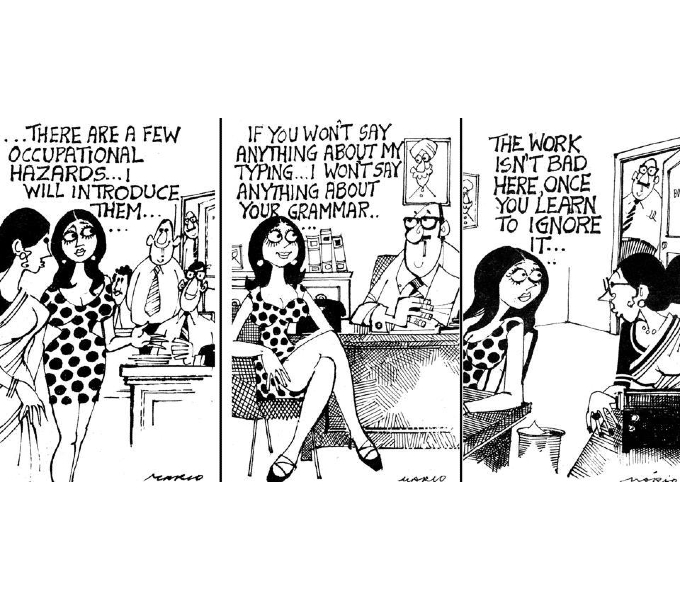
“For repressed Maharashtrians and Indians like me, Jesus Christ, this was where heaven began!” declared the late Kiran Nagarkar in Paromita Vohra's charming short film Where’s Sandra?, which addresses the precise question of what the office-going Bandra girl represented to the rest of the city. One of the real 'Sandras from Bandra' that Vohra tracks down makes the crucial point that the Christian girl was the object of Indian male fantasy also because women from most other urban Indian communities weren't allowed to go out to work. The Christian secretary in the form-fitting dress became embedded in the collective Indian psyche, with even such pillars of the Goan community as cartoonist Mario Miranda essentially reinforcing the stereotype with his polka-dotted Miss Fonseca.
The dress-wearing Goan Christian secretary was immortalised by cartoonist Mario Miranda in the busty figure of Miss Fonseca.

Of course, the stereotype of the Christian girl as open in her morals didn't quite fit the facts. Bombay Balchao is full of Catholic boys bemoaning their fate while the Catholic girls they're dating scratch them for trying to sneak a kiss. In Vohra's film, too, the late poet and professor Eunice D'Souza argues with efficiency that the Christian family and school-going milieu could be as orthodox as the non-Christian ones, policing female sexuality with just as much middle class paranoia. Dress-wearing was no marker of (im)morality. 

Not all Christians wore dresses, either. For instance, the Portuguese insistence “that converts adapt to the European style of dressing” led to such innovations as the pano bhaju, which Borges calls a “middle ground” created by orthodox Brahmin women. Now 'traditional' when dancing to sad Konkani love songs called mando, this particular Goan Christian outfit consists of a sarong-like lower garment (pano), worn with a loose gold-embroidered blouse (bhaju) and a stole called the tuvalo. The hybridity is India at its best: the pano draws on the South Indian lungi/mundu/veshti, the bhaju is Portuguese, while the gold thread work owes something to the Mughals. 

One of the pleasures of Borges' book is its mini-ethnography of Bombay's different Christian communities. The Goans and East Indians express disdain for the Mangaloreans as calculating, not so comfortable with English, not good dancers or good at Western music. The Mangaloreans, meanwhile, saw the Goan absorption of Westernised mores as a cop-out, too easy a surrender to their colonial masters. Mangalorean rebelliousness, not surprisingly, was expressed most vividly in their women's clothes: the community may have converted to Christianity, but the women still wore their heavily embroidered sarees and jasmine venis (floral garlands) in their buns – rather than floral dresses and bouffants.

Beyond Bombay, too, the dress-clad Christian working girl was the focus of Hindu male anxiety: think of the Anglo-Indian Edith, who becomes the heroine Arati's office colleague and then friend in Satyajit Ray's Mahanagar. For the two Calcutta women, lipstick marks a bond between them. For the Hindu husband waiting edgily at home, the same lipstick becomes emblematic of the 'corruption' of his wife. Clearly, as non-Christian women ventured tentatively into the workforce, the dress-wearing Christian girl was now a terrible threat. For on what women wear, as always, the whole burden of civilisation comes to rest. 

Thankfully, as Vohra suggests, Sandra the stereotypical good-time girl doesn't have a reason to exist anymore. Because we all a have a bit of Sandra in us now. Something to think about each time you wear a dress – and can even let the camera see you in it, unlike Bhagyashree.