Showing posts with label The Fairy Queen. Show all posts

3 December 2008

Queen of the Rails

FAVOURITE THINGS: THE FAIRY QUEEN

Trisha Gupta finds the grand old lady of Indian Railways can still set hearts aflutter.

In 1837, Victor Hugo wrote a mournful letter to a friend about how going anywhere by train made it impossible to actually see the countryside you were travelling through: “The flowers by the side of the road are no longer flowers but flecks, or rather streaks, of red and white; there are no longer any points, everything becomes a streak…”.

But we human beings are quick to adapt. By 1885, the steam-fuelled journey that Hugo found so impossibly fast had already become a certified way of looking at the landscape. Robert Louis Stevenson immortalized the experience of seeing the countryside unfurl as a succession of tableaux, in his ‘From a Railway Carriage’, a poem whose tempo perfectly reproduces the steady rhythm of the train itself:
“…Here is a child who clambers and scrambles,
All by himself and gathering brambles;
Here is a tramp who stands and gazes;
And here is the green for stringing the daisies!
Here is a cart runaway in the road
Lumping along with man and load;
And here is a mill, and there is a river:
Each a glimpse and gone forever!”

By the time I took the Fairy Queen from Delhi Cantonment to Alwar in 2002, this steam locomotive (of Hugo and Stevenson vintage) felt impossibly slow. But slowness, of course, was what I had come in search of. Standing out on the engine, next to the driver and his coal-shovelling assistants, I could see everything we passed with a clarity that no Rajdhani journey had ever provided: the vivid yellow of a girl’s odhni, the piles of onions being sorted by the roadside, even faces in the curious crowds that gathered to see our quaint contraption trundle by.

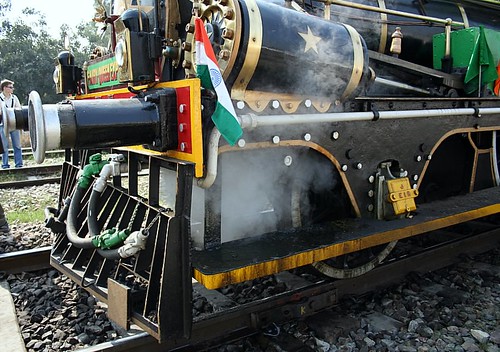
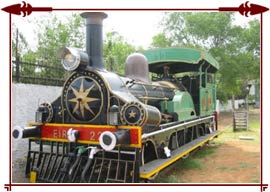
Built in 1855, the Queen was probably fast enough in the 50+ years she ran on the Howrah-Raniganj line of the Eastern Indian Railway. In 1971 she became the first exhibit of the National Rail Museum, in whose grassy environs she stayed happily parked until 1996, when she was dragged out of retirement and given a successful makeover by the Perambur workshop of the Southern Railway. The little green engine now tows a 60-seater passenger car on a seven-hour 143 km journey from Delhi to Alwar, every weekend from October to March. As the world’s oldest functioning locomotive (certified by the Guinness Book of World Records), the Queen is now “a living legend, much older than the Titanic”, which (gushes the website hopefully) “could attract visitors… like the Taj Mahal or Eiffel Tower”.

When she’s not chugging along devouring vast quantities of coal (250 kg per km), you can find the Queen back at the Rail Museum, where her now gleaming exterior seems almost out of place amidst the general air of 1970s torpor, the peeling black and white photos of Khrushchev’s visit to Chittaranjan. Then you read the faded orange sign that begins, “We must innovate. We must constantly improve. Today’s… powerful and sleek locomotives hurtle along the countryside faster than ever before…”. You can almost hear the Queen chuckle.

Published in Outlook Traveller magazine, October 2008

8 August 2008

Fairy Grandmother


It's not far from Delhi to Alwar, unless you take the world's oldest serving locomotive

Photo: Ramesh Lalwani

It’s not the Palace on Wheels but they’re still selling the Maharaja idea. Or so it seems. There is a turbaned waiter with tea and coffee, a reception committee complete with marigold mala and tilak, and a red carpeted anteroom in which to wait for the train’s departure. We are met by the coordinator of the journey from the Ministry of Railways, an eager-beaver type. He informs me that he has received countless letters from NRIs in Boston and immigration officials in England, to say how very much they enjoyed their trip. As if on cue, the NRI computer engineer from Dallas, on the train en famille, announces that he “simply loves train journeys”. The train guard tells me how he has to push back the milling crowds of humanity that congregate at the water-filling stations to see the 150-year-old steam engine puffing into the platform. The build-up is complete. The stage is set for a long, leisurely – and inevitably anticlimactic – journey on the Fairy Queen.

I learn, for starters, that the Queen was never a princely train. She began her career on the Howrah to Raniganj line of the East Indian Railway in 1855. Which figures, because at Gurgaon Station our imperialist engine makes an unscheduled stop for the sole firang passenger, who seems to have missed the train. He arrives, bemused and breathless, poor man, having been taken first to New Delhi Station and then the Rail Museum. Eventually we move on. Lunch is served. Sweet corn soup with cheese straws. Slight controversy about the cheese straws being picked up by hand by the serving waiter. NRI family unhappy. I gobble down my kaali dal and mixed sabzi because I want to get off at the next station and travel in front with the driver, on the engine. I stand there, two Mother Dairy mishti dois in hand, feeling awkward. Finally I persuade the driver and Assistant No 1 to take them. Assistants No 2, 3 and 4 continue to shovel coal into the red-hot insides of the engine, and the smoke emerges, billowing past my nose to form a no-doubt picture-perfect image, as we chug steadily through the mustard fields. The feeling is exhilarating.

In the distance, a rusty tubewell emits a steady stream of water into the green genhu field. A girl in a vivid yellow odhni stands on tiptoe to reach up into a tree with a twig. Women sort freshly dug-up onions by the side of the tracks. Thelas piled high wait at level crossings, a herd of goats runs helter-skelter at the shrill sound of the whistle. At every station where we stop to fill water (which must be heated by burning coal, to create steam that will then push the pistons of the engine) there is the ritual cleaning to be gone through. As Girish put it, it’s like trying to go on a long journey with a baby elephant. You have to pet it and feed it and groom it and coax it…the cajoling takes the form of six grown men, some getting underneath the engine to clean up the constantly accumulating muck, some climbing on top to polish the dark metal to gleaming glory.

The stations in Rajasthan don’t have very much water, and the Queen’s underslung water tank needs regular refilling. At one station, Khairthal, the hose pipe is dragged to a house facing the tracks…and there’s a line of people all along the route. The men are in front, the boys elbow each other out of the way, the girls stand a little apart from the crowd, curious but hesitant to push their way in.

We arrive at Alwar Station to be swept into a waiting bus. After having endured the tremendous discomfort of a non-air-conditioned train ride, we must, of course, be compensated by being shepherded into a freezing AC coach, complete with disco bhangra. Main puttar Punjab da, tu Punjab di rani… (to which she says, in rolling American accent “Give me a break!”) “Is this Rajasthani music, then?” ventures the British tourist. “Quite…energetic, isn’t it?”

Published in Outlook Traveller magazine, Feb 2002 issue.