Showing posts with label Hindutva. Show all posts

28 April 2020

Fictional motherlands, real relationships

My Mirror column:

Some recent fictions illustrate how totalitarianism thrives on turning on real people into mythical enemies – and pitting an attachment to family and friends against the love of an imaginary nation


A still from the 2019 film Jojo Rabbit
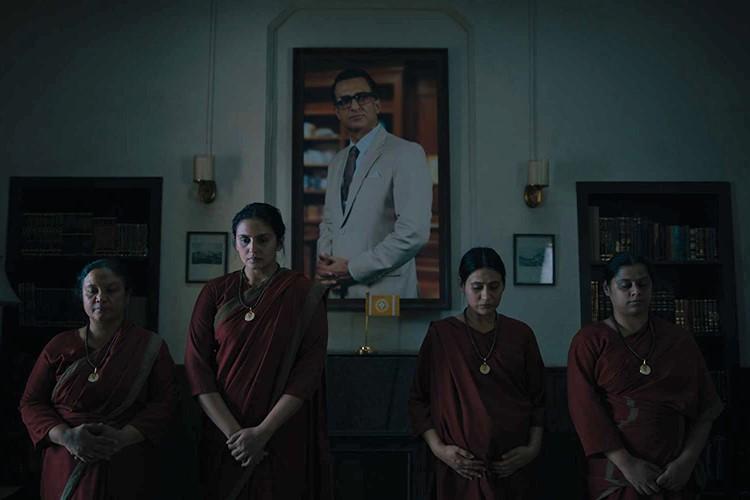
A third of the way through the sadly aborted Leila, the series’ protagonist Shalini (Huma Qureshi) finally manages to trace her lost daughter to a school that looks like a prison. Her fake ID gets her past the gun-toting security-men into a cavernous grey interior, where stiffly-dupatta-ed girls are learning the call-and-response of new nationhood. “Hum kaun hain?” demands the teacher. “Aryavarta ke nanhe sipaahi!” comes the response. As Shalini’s anxious gaze travels along the children and finds Leila’s familiar features, her face uncreases into a joyful smile. Almost unconsciously, her feet begin to move towards the child she thought she might never see again.

But is this really the same child as the one who was abducted from her parents’ arms, only two years before? “My name is not Leila, my name is Vijaya,” the little girl says to a stunned Shalini. She pronounces the words carefully, like she’s learnt them by rote. The scene’s emotional kicker comes when a big car draws up, with a woman in it that Shalini knows well from a previous life, and Vijaya runs to embrace her – this time, with an unrehearsed “Mummy”. But as the finale of Leila makes indubitably clear, that woman is only a placeholder. The entity that has really replaced Shalini is so powerful that there is no way a mere human even try to compete - the nation-state. To quote the slightly dubious gendering chosen by Leila’s makers, “Tum meri maa nahi ho. Aryavarta meri maa hai.”

The idea of a nationalism that pits children against their parents is one that has appeared in another Indian webseries, Ghoul, where the ultimate betrayal of a parent is committed by an adult protagonist who has tragically learnt to trust the nation-state over and above family. I was reminded of these shows this week, as I watched Taika Waititi’s 2019 film Jojo Rabbit, currently free to stream, in which a single mother (Scarlett Johansson) has to deal with her only child being indoctrinated by a state she isn't exactly enamoured of.

Instead of a chilling dystopian future, though, Jojo Rabbit takes us on a madcap fantasy ride into the past. Ten-year-old Johannes Betzler is as cuddly a protagonist as you could ask for. He is also an incipient Nazi, who spends a lot of time talking to his imaginary best friend Adolf: a goofball version of Hitler who's alternately sulky and encouraging. Right from the opening sequence, which splices its fictional boy hero's frenzied self-motivation for a Jungvolk training weekend with historical black and white footage of Hitler's screaming youthful fans to the Beatles iconic anthem I Wanna Hold Your Hand, you know this film isn't traditional fare. Jojo's repeated 'Heil Hitlers', getting louder and crazier as he bursts out of his front door and careens in faux-aeroplane mode through his small-town streets, aren’t scary so much as ridiculous. The same could be said of the cast of characters that have assembled to turn the town's little boys into men and little girls into women – the hipflask-swigging Captain K, demoted from active wartime service by the avoidable loss of an eye, and the pudding-faced Fraulein Rahm, who seems a little young to have had “eighteen children for Germany”.

Waititi ups the tenor of ridiculousness even further when it comes to Nazi indoctrination against Jews. The descriptions proffered by the camp leaders, complete with chalk sketches, reminded me of Roald Dahl's checklist for witches in The Witches. Jews look deceptively like human beings, but they have horns under their hair and scales on their bodies and they smell like Brussels sprouts.


But of course, the film's whole point is that Jojo – like the entire brainwashed German nation -- believes in this mythology. So when, in a nice doffing-of-the-hat to Anne Frank, a teenaged Jewish girl turns out to be hiding behind the wall of his dead sister’s room, Jojo is baffled when she doesn’t fit the criteria. In return for keeping her secret, Jojo demands of Elsa (Thomasin McKenzie) a detailed insider's account of Jewishness, taking notes as she speaks. Their evolving relationship lets us walk the tightrope fantasy does, between wish-fulfilment and danger. An illustrated ‘expose’ full of ‘facts' about Jews, fictitious letters from a boyfriend who may or may not exist – these are the flip side of a real world in which Elsa can only survive if she can successfully parade her dead classmate’s papers.But it is in Jojo’s relationship with his mother Rosie that the film's heart lies. Johansson is pitch-perfect as the single mum who can blacken her face and turn into an imaginary ‘Daddy’ to indulge her little boy’s demand for his missing father – but who also refuses to let him avert his eyes from the bodies of ‘traitors’ strung up in the town square. She is happy to let him be part of the masquerade of Nazi boyhood, but draws the line at a real gun. Jojo Rabbit, like Rosie, knows the magical power of fiction, but also knows exactly when reality counts.

22 March 2020

Fear Eats the Soul

My Mirror column:

Kamal Haasan's Hey Ram, released twenty years ago this February, is a complex, unresolved film about India's unresolved inner life. 


A man returns to the Calcutta building in which his wife was raped and murdered in a riot. He stands in the street, looking up at their old balcony, and she appears there, beckoning him as she used to. When he climbs up the stairs, the new occupant mistakes the name he mentions for that of the person he is looking for. 

Mr. Nair: “All the tenants here are new. What's the name again?”
Saket Ram: “Saket Ram.”
Mr. Nair: “When did you see him last?”
Saket Ram: “Whom?”
Mr. Nair: “Saket Ram.”
Saket Ram: “A year ago, exactly.”
Mr. Nair: “A year ago there was a massacre. Many of the people in this building died. Maybe your friend also... Sorry.
Saket Ram: “It's alright.”
Mr. Nair: “What was your relationship to this Saket Ram?”
Saket Ram: “Like that of the body to the soul. We were very good friends.”

It is a moment typical of Hey Ram: the visuals dense with imagery, the dialogue packed with associations, a certain excess that seems ready to leap off the screen. Our Tamil protagonist's lovely Bengali first wife Aparna -- played by Rani Mukherjee, her character's name a nod to Sharmila Tagore as Apu's wife in Satyajit Ray's Apur Sansar, a cinematic emblem of perfect young marital domesticity and early death -- is dead. But she haunts her living husband, appearing everywhere – in the balcony of what was her own home, but also writhing in a pool of blood in his new wife's bathroom, or smiling in the faces of other women, or assuming the form of a goddess. Meanwhile, Saket Ram (Kamal Haasan, his character carrying the old poetic name for Ayodhya) lives through the trauma of Aparna's death, but in his acquiescence to Mr. Nair's words, we hear a tacit acknowledgement that perhaps he is not quite alive. Did Saket Ram's soul die with Aparna that Direct Action Day, leaving his body to wander the streets, available for possession by more devious spirits?

It seems no coincidence that Haasan's Saket Ram first encounters the film's other Ram in those very Calcutta streets, in a moment that has the two men literally mirroring each other, in name and in gesture. But Saket Ram is a man in trauma, speaking of surrendering to the police to confess about the Muslim men he has just killed, only one of them the actual rapist and murderer of his wife: he carries the stains, literally, on his white kurta. Shriram Abhyankar (Atul Kulkarni) is a RSS-influenced Hindu fundamentalist, who has covered over an old wound with a new skin of pure hatred. “There is no punishment for doing one's duty. If killing is a crime then so is war, isn't it?” asks Abhyankar. And when Ram protests that he is a mere civilian, Abhyankar counters smoothly: “This is civil war.”

And it is certainly no coincidence that the film's other reference to body and soul is when Abhyankar, finding himself paralysed waist downwards in a riding accident, tells Ram that he must now “be his body” and carry out their mission of assassinating Gandhi, whom Abhyankar and his ilk believe a traitor to the so-called Hindu cause, because of Gandhi's sustained support to the idea that the Muslims have as legitimate a claim to live in India as the majority community does.

Haasan's film is among the most detailed filmic depictions we have of the Hindutva mindset -- not just the admiration for Hitler and the distaste for Gandhi, but how that maps onto an eroticised masculinity in which violence and nationalism come together with a reworked Hindu renunciatory ideal. But there is great confusion in this mindset. In one of the film's most honest, most complicated scenes, Ram imbibes an opium drink given to him by Abhyankar, and it is in that opium-induced haze that he both finally feels the stirrings of sexual attraction to his new young wife Mythili, and agrees, in effect, to leave her side. When he makes love to her, he fantasises about a giant gun. To become a warrior for Hindutva, Ram must take a pledge to “renounce bondage and relationships”. We see him touch, in one seamless gesture, the picture of his unseen dead mother and the map of India, both of which he can only love as abstractions – and leave the house, abandoning for his grand masculine mission all the real, maternal figures he knows, including the newly-pregnant Mythili (Sita to match Ram).

In a directorial sleight-of-hand that makes fine use of both melodrama and coincidence, Haasan ensures that this would-be Godse suddenly finds himself being defended from suspicious Muslims somewhere near Jama Masjid by his trusted old Muslim friend Amjad (Shah Rukh Khan) – and then, in a matter of minutes, defending Amjad and all the other Muslims holed up in the nicely-named Azad Soda Factory.

There is a great deal more that can be said about Hey Ram, but let me end here on the note that Amjad does. In a dying declaration to the police trying to identify the armed Hindu assailant whose entry into the curfew-bound Jama Masjid area set off the bloodbath, Amjad is asked if he had ever seen Bhairav before. Bhairav is the name Ram had assumed on that excursion, and also the name of Lord Shiva's destructive form. “I have never seen that animal before,” says Amjad. “I only know Ram, my brother. He saved my life.”

24 December 2019

Do weep for Salim the lame

My Mumbai Mirror column:

Salim Langde Pe Mat Ro
won two National Awards in 1989. Thirty years later, its fierce indictment of the working class Muslim experience emerges as chillingly prescient -- right down to the police.


There are many things in Salim Langde Pe Mat Ro that would have been recognizable to the mainstream Hindi film audience in 1989. There's the family thrown upon difficult times when the father loses his long-time job; the mother who takes on small-time tailoring work to augment the household income; the sweet-faced, dearly beloved younger sister who is 'of marriageable age'; the hero's turn to illegality placing him in conflict with his law-abiding father – as well as the remembered, almost hallowed figure of his elder brother. Also, as in so many commercial films, the hero is the leader of a trio, with him and his bumchums going everywhere together; and his love interest is a tawaif at the nearby brothel.

But Saeed Mirza's award-winning film – it won National Awards for Best Film and Best Cinematography in 1989– also contains a great deal that would have felt unfamiliar to Hindi film watchers. Or at least unfamiliar on screen, though perhaps deeply familiar from life. For instance, though the film doesn't actually take us into the mills of Bombay, it evokes the socio-economic world that existed around them, and the stark instability of Indian working class life in the late '80s. Salim's father has lost his job after decades of service, and is sitting at home, unable to find another. His son Javed, an electrician at a factory, is dead; killed in a tragic labour accident. Salim, the less academically inclined son, dropped out of school early on, because the family didn't have enough money to educate both sons. There is no mention of their younger sister Anis having been sent to school at all – though her suitor Aslam raises local hackles by pushing for the education of girls from the community.

The dialogue between Salim and Aslam is, in many ways, at the core of the tale Mirza wants to tell about poor urban Muslims. Salim and his mates, who are essentially all illiterate, have fallen early into a life of small-time crime: collecting hafta from local tailors and shopkeepers, conducting small and occasionally larger thefts, and acting as henchmen for local big men. Their fantasies of school and college are just that, fantasies -- as made memorable in a scene where Peera and Ahmad (played by theatre director Makarand Deshpande and filmmaker Ashutosh Gowarikar) perform a hilarious little spontaneous skit about how they imagine college girls and boys behave with each other.

Meanwhile the studious Aslam cannot find a job except as a poorly paid proofreader, because his MA was in Urdu literature. As he says, “Urdu zabaan ka istemaal hi kucch kam ho gaya hai.” Salim, appalled at his salary, initially rejects Aslam as a husband for his sister. His own ambitions are much grander: he and his friends dream of becoming as rich and well-connected as the local toughs who have risen to run illegal empires. As we watch Salim guiltily leave Aslam's book-filled room, we see little children unloading boxes. In fact Mirza's film, which thanks “the residents of Dongri, Do Tanki, Nagpada and Bachoo-Ki-Wadi”, is filled with working children in the background.

But it's Aslam's defense of Muslim girls' education that brings local men angrily to his doorstep. Salim shoos them away, but then asks Aslam why he's going against their religion. The ensuing conversation is a powerful one. Through Aslam, Saeed Mirza indicts Muslims for letting fear and ignorance keep them in a vicious cycle, while using Salim's experience to underline the poor urban Muslim's harsh experience of life in post-independence India: “Aa ke dekho, kaise log Musalman log ko nafrat karte hain! Kachra samajhte unko. Daraate hain, hamesha khallaas karne ka baat karte hain.”

Mirza's perspective on the causes of Hindu-Muslim violence, from Partition to the Bhiwandi riots that form the backdrop to the film, is simple -- and tragically, still entirely valid. “Why did this Partition stuff happen?” asks Salim. “So that powerful people on both sides could have a hissa to rule over,” responds Aslam. Later, a filmmaker who shows up in the area to screen his documentary on the Bhiwandi riots makes the distraction argument -- that high communal feeling and the threat of violence only serve to keep people from asking why they don't have education, food, shelter.

Shockingly, thirty years after Salim Langde Pe Mat Ro, we have elected a government that has made such deliberate distraction their full-time occupation. But only one side is being successfully distracted. One hopes they will open their eyes, before it is too late.

Mirza's film does not depict police brutality, but it doesn't shy away from referencing the systemic communalisation of the system. Early on, we see a police officer on the phone. “Yes, it's a Muslim area, but we'll control it, sir,” he says easily. “Maar-maar ke khaal kheench lenge. They only understand the language of the stick. And if there is a problem, we'll impose Section 144.” A little later, we see another cop catch hold of Salim and his friends, heading home late, while Section 144 is officially still imposed in their area. “Are you planning a riot?” says the cop. “Nahi sahib. Aap hain na,” he responds, almost bantering. In December 2019, after all that has happened in Jamia, Aligarh, Lucknow and Mangalore – and possibly many other places whose news is still to reach us – it is impossible to summon up a laugh.

19 November 2019

Dispatch from Dharamshala – 2

My Mumbai Mirror column:

Films about animals at this year's edition of the Dharamshala International Film Festival had powerful things to say about the state of our humanity
 

The monkey as metaphor: a still from Prateek Vats's film Eeb Allay Ooo

You can never watch all the films at a film festival. What you can do is to make your choices, whether based on frontbencher commitment (read high-intensity googling of film titles) or a more backbencher attitude (what the lady in the loo queue seems excited about) and hope that the darkness of the auditorium will end up illuminating something you haven't quite seen before.
 
One of the things this year's DIFF threw into focus for me was age and ageing. There's no single model of the good life, but observing old people throws up possibilities to aspire to – or guard against. Archana Phadke's stunning documentary portrait of her grandparents and her parents, About Love, is as brutal as it is affectionate, letting us see these long-term relationships as the simultaneous safety nets and shackles they are. The bent, ancient fisherman of Kazuhiro Soda's Inland Sea smiles wryly about how the years can sneak up on you: “I thought I was still 50 or 60, turned out I had turned 90.” 

The other theme that seemed to me to emerge serendipitously from DIFF 2019 was animals. Zooming in on the non-human seemed, in film after film, to be a way of 
opening up the human condition. Sometimes the association felt subtle, like the gleaming night hauls of fish in Inland Sea that the old man disentangles from his net and tosses into the boat's watery hold, so they might live a little longer. The persistent slippery toughness of their bodies, leaping for life even at death's door, struck me as akin to their captor. 

Elsewhere, the weight of the beastly allegory seemed too much for the narrative to bear. The acclaimed Malayali director Lijo Jose Pelissery was at DIFF with his latest, Jallikattu, in which a buffalo due for slaughter runs amok, destroying plantations and shops in its wake. As the village men set off in pursuit, armed with nothing but ropes and their egos, it becomes clear that the film is only ostensibly about the buffalo.  

Pelissery's last two films, Angamaly Diaries and Ee Ma Yau,  demonstrated a talent for richly orchestrated set pieces, but Jallikattu feels more like a runaway display of that ability than a controlled experiment. For most of the film's running time, we watch men with flaming torches tramp through acres of hilly woodland and splash through streams, yelling, leaping, tearing at each other, with increasingly less rational cause. The buffalo seems almost forgotten as long-held internecine rivalries bubble up. The energy of the crowd is both majoritarian and masculine – “We will take it! There are more of us!” The thrill of the hunt, the performative frenzy of competition, the adrenaline and the testosterone – these, Jallikattu drills into us, are what drive humanity at its basest. And somehow, humanity at its most primitive is signified by animality. 

“Even now, with us here, this place belongs to animals,” says a goggle-eyed old man in Jallikattu. The sentiment is echoed at one point in Prateek Vats's stellar feature debut, Eeb Allay Ooo!, when Mahinder the monkey repeller of seven generations declares to the befuddled new recruit Anjani (Shardul Bhardwaj) that he has been asked to help train: “This is the neighbourhood of Raisina, traditionally ruled by monkeys.”  

But neither Pellisery nor Vats seem actually interested in our relationship with the animal world. What Vats's film does brilliantly is to use the monkey as metaphor, creating a multifarious web of associations that traverse the distance between animal and god – but elude the human. The bonnet macaque monkeys of Lutyens' Delhi, as elsewhere in India, have exploded as a population partly because they are worshipped and fed as a form of Hanuman – and as a bit of video footage in the films repeats, “The gods become pests.” 

Combining real locations and non-actors with a sharp script and a core of trained actors, Eeb Allay Ooo! follows the travails of a Bihari migrant who is hired to shoo away monkeys from the national capital's most grandly symbolic architectural corridor. There are several interwoven strands that combine to make this such a scathing indictment of the state of the nation: the humour of a young man's masculinity seemingly pitted against monkeys, the deeply unfair conditions of contractual labour, the absurdity of bureaucratic rules that defeat all of Anjani's innovations on the job. Meanwhile, the performative masculinity of the state at both the lowest level: Anjani's security guard brother-in-law being forced to wield a rifle that he can barely carry – and the highest: the Republic Day parade – emerge as equally farcical. 

It is only when the man pretends to be an animal – in a man-sized monkey costume, in blackface imitation of the lion-tailed macaques of Karnataka's R-Day tableau – that he manages to scatter the monkeys. We watch him wander through the streets, a modern-day Hanuman in his own sad Ramleela. 

His success is because the monkeys cannot tell the difference between a real langur and a fake one. Mahinder's real death at a mob's hands goes unmourned. Meanwhile, towards the film's end, the real rifle ends up in a costume tailor's shop, its value as limited to the performative as the fake costume. When, in the last scene, the jobless Anjani joins the parade of Hanuman impersonators, we know acche din has made monkeys of us all.

Published in Mumbai Mirror, 17 Nov 2019. 

3 November 2019

Poetry in stealth mode


Fifty years after its release, Saat Hindustani feels both like a time capsule and a swinging pendulum: showing what has changed forever, and what we seem doomed to repeat. 

(The second of a two-part column.)


Last Sunday, a week after Amitabh Bachchan’s 77th birthday, I wrote about his first film as an actor, Saat Hindustani, and how he landed that role. KA Abbas, who wrote and directed his debut, has written of how the tall, thin Amitabh matched his personal imagination of the character, who was modelled on an old Aligarh mate of his.

But watching the film, one has a sense that there was more to the casting. As the real-life son of a poet, Amitabh had cultivated the art of recitation. He was likely better equipped to play one than most debutante actors. His father Harivansh Rai Bachchan was a highly-regarded Hindi poet from Allahabad. Saat Hindustani's fictional Anwar Ali was an Urdu poet from a little further east: Ranchi, a city then in Bihar and now in Jharkhand.

The idea of poetry is crucial to the film. Syeda Hameed, co-editor of Abbas’s voluminous writings, has pointed to his abiding relationships with poets, and the importance of lyrics in his films. “The best poets of the 1960s and ’70s wrote for Abbas’s films, and that too for very little money: Ali Sardar Jafri, Kaifi Azmi, Majrooh Sultanpuri and Prem Dhawan, to name a few,” Hameed writes. The lyrics of Saat Hindustani were by Kaifi Azmi, and it was Azmi’s words that Amitabh spoke on screen as the sensual, lanky Anwar Ali.

Quite early in the narrative, six of the seven Hindustanis board a train headed to Goa to provide secret support to the Goan freedom struggle. A young and purposeful Amitabh shuts the compartment window as instructed, then turns to his companions with a marvellous air of having something to say, and declaims:
“Aandhi aye ya toofaan koi gham nahi,
Hai abhi aakhiri imtehan saathiyon.
Ek taraf maut hai, ek taraf zindagi,
Beech se le chalo kaarwaan saathiyon.”

A half-smile flutters at the corner of his lips, and he looks pleased as punch. It was at that moment that I realised that although this was an ensemble cast, Amitabh was as close to being the film’s hero as possible. But what an unusual hero he was. The youngest and tallest of the assembled men – but also the one least capable of handling a gun, the one who hopes there will be no killing involved, who goes into shock when the security of the mission demands that a spy actually be eliminated. Weeping, Anwar actually has to be held back and comforted by the kindly Jogender (played, in Abbas’s anti-stereotype casting scheme, by Utpal Dutt). Traditional masculinity dies a quick death.

There are times in Saat Hindustani when the nazaakat of the North Indian gentleman-poet is served up for mockery – such as the laughter when Amitabh turns to the group and complains that the truck driver who has just dropped them off on the Goa border is “namakool” because he has just turned around and driven off “without even saying khuda hafiz”.

But later, captured by the Portuguese, Anwar is tortured and taunted by a faintly comic interrogator who has been informed of the young fellow’s diary: “Achha toh tum poet hai, kya kehta hai use, shaayar?” Hands and legs tied, Amitabh narrows his eyes disdainfully. “Hamare mulk mein har shaks shaayar hai.”

Abbas knew, though, that that mulk of poets, of possible empathetic connections across communities, was already threatened. In one scene set in the late 1960s present, an older Anwar Ali hears his house has been burnt down by anti-Urdu fanatics. Like his creator KA Abbas, who could simultaneously laugh at “jaw-breaking” Hindi and see it as a language a Tamilian Dalit might use as a way of entering the nation, the optimistic Anwar Ali immediately wants to write to his old comrade-in-arms, the Hindi campaigner Sharma. But his hope for civility is quickly dashed when his wife points him to a virulently anti-Muslim editorial by Sharma, directing all Urdu speakers to Pakistan.

In his more considered moments, Abbas presents an unusually calibrated idea of what constitutes leadership – and what courage might mean. The Gandhian model of non-violent resistance, satyagrah, is of course at the film’s muddled heart. But there’s more here than non-violence. For one, there is a clarity of goals, over and above a declared ideological arsenal of means: one man can be murdered if it means saving the lives of seven. For another, neither action nor leadership is to be trumpeted. No one is appointed to a position of permanent captaincy; members of the team are its “commanders” turn by turn. 

And crucially, what has to be done is done, preferably without announcement. When the selected men set out from the satyagrah camp, their departure is not flagged, they simply melt away. What will everyone at camp think of us, they ask their trainer. “That you are cowards who have run away,” he responds. "But the mission will succeed."

In that world, it was preferable to be thought of as a coward and succeed, than proclaim one’s heroism from the rooftops and fail. The past truly was another country.

Published in Mumbai Mirror, 27 Oct 2019.
 

24 June 2019

Grave New World

My Mirror column: 

The new webseries Leila is uneven in its language, its storytelling and its politics, but it offers plenty to think about. 

(Second of a two-part column)


In Prayaag Akbar’s 2017 book Leila, which is in English, the use of Hindustani words is limited but specific: the unconscious use of the appellations “Abbu” and “Ammi” nearly gets Riz and his brother Naaz caught as being from ‘the wrong sector’. In the Netflix show, Shalini meets Riz’s parents and calls them Abbu and Ammi – but the subtitles flatten the words into “Dad” and “Mom”. Other world-building coinages by Akbar – the thuggish army of Repeaters, or the hierarchical division of society into Categories 1-5 – are allowed to remain in the show’s English subtitles, but necessarily translated into Hindi in the spoken version, sometimes losing specificity and power – eg “Paltan” for the Repeaters – and sometimes gaining it: “Panchakarmi” has far greater punch than Category 5.


There are other times when the Hindi dialogue is as nuanced as it is possible to be, delineating minute shades of meaning that then amplify the narrative. One instance not present in the book is when Shalini (Huma Qureshi) happens to witness the police raiding a professor’s study. “Yahan toh Sen wali kitaab bhi hai,” one cop announces triumphantly to his senior. 

“Politics? Aap politics sikhaate hain?” the senior cop demands of the professor. “Sikhata nahi, padhaata hoon,” he replies sharply. That almost pedantic distinction, even on the verge of being arrested, fits the character’s academic persona. But that difference between “sikhana” and “padhaana” also makes a subtle point about this anti-intellectual universe, in which politics can only be understood as a skill – not as a subject of study. And as is already becoming true in our present, it is not a skill that the establishment wishes students to have.

There is another funny detail in the scene. The nameplate outside H. No. 1/20, a mid-sized bungalow of the sort that a Delhi University professor might currently occupy, says “Dr. Nakul Chaubey, MA, M.Phil, PhD”. Given that a PhD implies having all the previous degrees, the nameplate’s recitation of degrees might be intended as humour. But it might also be read as signifying a world in which even visitors to an academic’s house are not assumed to know what a PhD is. As many degrees as possible must be listed on an intellectual’s door, and even that listing is not sufficient armour against the barbarians at the gates. As we – and Shalini – watch in silent horror, the knot of heckling protestors shouting “Nakul Chaubey murdabad” swiftly becomes a lynch mob kicking and punching the unarmed white-bearded man, now fallen to the ground.

The targeting of intellectuals in a Hindutva-driven dystopia has appeared in a previous Netflix India original series, Ghoul (2018), whose writer-director Patrick Graham shares writing credits on Leila with Urmi Juvekar and Suhani Kanwar. In Ghoul, that aspect is more frontally addressed: the protagonist Nida Rahim (Radhika Apte) is the daughter of a retired academic called Shahnawaz Rahim (SM Zaheer). Nida is part of an anti-terrorist force, and much of the narrative tension emerges out of the father and daughter’s starkly different positions on the state’s role in citizens’ lives.

The elder Rahim’s criticism of an authoritarian government is seen by his daughter as seditious. Father and daughter are both Muslim, but the daughter has internalised that second-class status as involving a greater need to prove her loyalty to the state.

That idea of a generational shift is also a shaping influence in Leila, which contains several scenes involving the brainwashing of children – and the attempted reformation of adults – by the new state of Aryavarta.

The show’s vision of Aryavarta feels almost programmatic in its symbolic combining of historical Fascism (a two finger ‘Jai Aryavarta’ salute, for instance) with a recognisable version of the Indian present (a leader called Joshiji whose name appears on every broadcast and every poster). Schoolchildren recite “Aryavarta is my mother” while doing martial exercises; babies are addicted to animated videos about Junior Joshi, whose heroic exploits evoke Bal Narendra.

More disturbing is the use, in the episodes directed by Mehta, of variations on existing Hindu rituals – rolling on the floor, for instance, or the marriage of a woman to a dog – as punishments imposed on women who break the rules of Aryavarta. In times like ours, it seems to me more necessary than ever to distinguish our criticism of the socio-political vision of Hindutva from what feels like a too-easy mockery of Hindu practice. To imagine existing religious practices as future forms of social torture is to display a lack of both imagination and empathy.


Leila also occasionally suffers from feeling like an Indian version of The Handmaid’s Tale, the web adaptation of Margaret Atwood’s novel. Akbar’s novel did contain the core idea of a regime that slut-shames and drugs recalcitrant women into submission, but the Netflix version has replaced the workaday dullness of Shalini’s office-cleaning and one-room-kitchen-attached-bath with a dark, shared dormitory for women who must undergo various forms of abasement, including bathing in dirty water, polishing shoes and being guarded by eunuchs. It also seems to adopt wholesale from Atwood the vision of categories of women dressed in different colours who serve different roles in society (the handmaids, the Marthas and the Wives). 

Still, these categories do provide the show’s most fertile ground for self-examination by the class of Indians likely to be watching Leila. I was excited by the show’s foregrounding of what is a more subterranean strain in the novel, the mistress-maid reversal. But the execution of that reversal, crunched into two years instead of the novel’s sixteen, is too quick to be credible. It allows for no interiority on the parts of either mistresses or maids. And if Shalini doesn’t see how her unearned privilege is part of what has led her world to this point, how will we?

Published in Mumbai Mirror, 23 June 2019. (The first part is here.)

31 May 2019

In the name of Gau Mata

My Mirror column:

A stark new film by Amit Madheshiya and Shirley Abraham documents the normalisation of Hindu vigilantism.


Gyandev Ahuja, ex-BJP MLA (best known for his remarks about condoms in JNU), appears in the documentary at the head of a troupe of gau rakshaks. 
“When the public lynches in daylight, they make videos of it,” says the man. “It happened at night. Had it happened in daylight, there would have been a video of him.”

The man speaking is a family member of Rakbar Khan, a 28-year-old cattle farmer from Nuh, in the Mewat region of Rajasthan, who was murdered while bringing home two cows one night in July 2018. He is speaking of the circumstances of Rakbar's death, as part of a new documentary called The Hour of Lynching, directed by independent filmmakers Amit Madheshiya and Shirley Abraham, which was released for public view on The Guardian website yesterday.

We live in surreal times, and the more surreal things get around us, the less we seem able to see them for what they are. An increasingly thick ideological smokescreen seems to stand between us and the violence of post-2014 India: violence against solitary or small groups of Dalits and Muslims, invariably committed by larger groups of upper caste Hindu men.

But perhaps if you pause and simply listen again to that line I quoted, you might hear the madness echo, even through the blur of allegations and counter-allegations that is our new soundscape. Here is what I heard in it: that in the India in which we now live, so many incidents of “mob lynching” have taken place that there is now an accepted public understanding of the practice, and that public understanding includes, first and foremost, the fact that lynchings are public events, mostly conducted in broad daylight. They are recorded, sometimes by bystanders but quite often by the lynchers themselves. (The most well-known instance of such self-recording was in Una, Gujarat, in 2016, when four members of a Dalit family were stripped, paraded and thrashed by upper caste men who had come upon them skinning a dead cow.)

Rakbar Khan is one of the 47 people killed in cow-related hate crimes since 2014. The government does not keep records of cow-related violence, but the website https://lynch.factchecker.in/ documents 127 incidents of violence centred around the transportation of cattle and/or meat that is rumoured to be beef. Almost all of them have been against Muslims and Dalits, with the frequency of attacks rising steeply since 2014, across both BJP- and non-BJP-ruled states.


A still from Amit Madheshiya & Shirley Abraham's The Hour Of Lynching (2019) 

The cow has been seen as sacred in India for centuries, but it was only under conditions of colonial modernity, in the late 19th century, that it became a symbolic rallying point for the organisation of Hindu identity. Swami Dayanand Saraswati, founder of the Arya Samaj, set up the first sanctuary for cattle in 1879, and also began the first gaurakshini sabha in 1881 in Agra. 

The banner of cow protection slowly grew into a countrywide campaign against cow slaughter. Akshaya Mukul’s exemplary work on the Gita Press documents the history of the movement, which was preoccupied enough with the cow to be organising an anti-cow slaughter day on August 10, 1947 – five days before independence. Over the next three decades, the banner of cow protection united various non-political Hindu organisations, including the Rashtriya Swayamsevak Sangh, with orthodox elements within the Congress. Such Congress figures as Seth Govind Das, Purushottam Das Tandon and Thakur Das Bhargava opposed Nehru's position on the matter, even defying the Congress party whip on occasion.

In September 1966, various cow protection groups came together to form the Sarvadaliya Goraksha Maha Abhiyan Samiti (SGMS), whose supreme council had members from the Hindu Mahasabha, the RSS, the Arya Samaj and various religious groups alongside the Congress and the Jana Sangh, the predecessor of the BJP. In November 1966, a massive gathering assembled in Delhi before a stage that included MS Golwalkar, Gita Press's Hanuman Poddar and the Jana Sangh's Atal Bihari Vajpayee, turned violent. At the end of a police lathi-charge, as Akshaya Mukul writes, “The movement for non-violence against the cow had led to widespread violence in the heart of New Delhi with eight dead and several more injured.”

I offer this distilled and necessarily incomplete history of cow protection to draw attention to something that will certainly strike you if you watch The Hour of Lynching: the bitter irony of violence committed in the name of non-violence. 

“Look closely at Mother Cow,” says Gyan Dev Ahuja, a BJP ex-MLA (who had hit national headlines for saying “thousands of condoms were found on the Jawaharlal Nehru University campus in New Delhi daily”.) “You will see that she is deserving of compassion [“daya ka paatra”]”. He goes on to speak of “cow smugglers” as people of “rakhshas vritti”, and painting the battle between this imaginary enemy and his army of gau rakshaks as that between Ravan and Ram.

A little later in the film, we watch as another BJP politician is cheered resoundingly for exhorting the crowd to heed the call of Gau Mata, take out their swords and behead the heathens (“dussahasi vidharmiyon ka [sar] kalamkar do”). “You mere 200 million Muslims, we are 1 billion Hindus. If we lose our minds, we will sacrifice you 200 million – and the country will be cleansed.”
On May 23, the country gave Narendra Modi’s government another resounding electoral mandate. We can only hope that this #Tsunamo will not involve such cleansing.

19 June 2018

Worship, motherhood, lust

My Mirror column:

A close look at two of last year’s most ‘controversial’ films – S Durga and Nude – reveals the same demons in the mirror. The first of a two-part column.


At first glance, there seems little in common between S Durga and Nude. The first, a Malayalam film directed by Sanal Kumar Sasidharan, is a surreal, often chilling road movie, featuring a couple who’re forced to hitch a ride with a carful of men somewhere in Kerala. The second, a Marathi film directed by Ravi Jadhav, is about a poor, illiterate woman who takes up a job as a nude model at the JJ School of Art in Mumbai.

When both films were barred at the last minute from the Indian Panorama screenings at last year’s International Film Festival of India in Goa, I hadn’t seen either. What seemed to unify them, then, was the mere fact that their titles – S Durga had been called Sexy Durga until the CBFC insisted on tweaking the name – spoke of the body. This May, though, both films were screened at the Habitat Film Festival in Delhi. And as I watched them, in close proximity to each other, some similarities swam to the surface.


One should start with the disclaimer that in terms of treatment, the two films couldn’t be more different. Sexy Durga had no bound script. The film was improvised during a 20-day low-budget shoot, from an idea that had been with Sasidharan from after the December 2012 gang rape in Delhi. “We did not have high-end equipment and we used to tie the cameraman [Prathap Joseph] to the vehicle,” he told The Week. Jadhav, meanwhile, worked from a screenplay by Sachin Kundalkar, a novelist and filmmaker himself. Nude is carefully plotted -- although it seems to me to fluctuate between a preexisting set of emotional/cinematic cliches and a desire to confront the certainties of our gaze. But of that, more later.

Jadhav’s film opens in a village, where Yamuna (Kalyanee Mulay) is suffering both insult and injury in her marriage. Her husband is carrying on a full-fledged affair with another woman. When his assault and public humiliation reach unbearable limits and he starts to rob her of even the meagre income she earns from rolling bidis, Yamuna decides to take her young son and run away. She arrives in Mumbai, seeking shelter under the roof of a woman she calls Chandra Akka (Chhaya Kadam).

Yamuna’s early days in the city are finely etched – the initial timidity with which she approaches the feisty Chandra as well as strangers, the exhaustion of walking the streets asking for work and the slow, dramatic uncovering of the secret of Chandra’s job. Mulay’s mobile, expressive face is put to marvellous use as she transitions from shock to moral censure to acceptance -- and eventually, the courage to follow Chandra into the art classroom and shed her clothes for money.

Rather than starting with a dogged ideological defence of nudity – couched either as personal freedom or as aesthetic choice – the film offers the potentially resistant viewer a way in, through empathy with Yamuna. The film’s portrayal of her -- first as blameless battered wife and then as self-sacrificing mother –makes it impossible to cast moral aspersions on her choice.

The really interesting metamorphosis is still to come. Slowly, Yamuna transitions -- from the hapless woman who is only doing this job to educate her son to someone who now treats herself and her body with the same dignity with which this new world of artists treat her.

But dignified distance is one thing and sensual self-control another. It is only as Mulay’s Yamuna begins to acquire a quiet new confidence, sometimes sneaking admiring glances at the students’ depictions of her body, that we remember that Kundalkar’s screenplay has thoughtfully provided us an early glimpse of her potential sensuality: the film’s first scene, where she leaves the clothes she is washing by the riverside and leaps into the water, watching from the sidelines in frank yearning as another woman revelled in her husband’s attentions.

Whatever her inner desires, though, Yamuna in her public persona allows herself no pleasures. She guards her chastity fiercely, as she assumes she must. Her primary sense of self remains tied to motherhood. As her son acquires more expensive tastes -- for cigarettes, the cinema and art school -- she takes up private modelling assignments to cater to his growing monetary demands.

The aching gulf between Yamuna’s fluid, ever more sensual presence on canvas and her tightly wound-up persona in daily life is something the film suggests visually, but does not push enough. But this, I want to suggest, is the crux of the problem both Nude and S Durga are trying to grapple with: when might we accept women as sexual beings without tarring them as “available”? Can Indian women ever escape the stifling double-bind of worship and lust?

(The second part of this column is here.)

7 June 2018

State secrets, secret states

My Mirror column:

Raazi successfully inserts itself into existing Bollywood narratives — on Indo-Pak ties, Muslims, nationalism and womanhood — and makes subtle departures from them.


Bollywood’s fascination with the Indo-Pak relationship has tended to produce two kinds of cross-border narratives. The first is the nationalist we-will-go-across-and-kill-the-terrorists plot, the standard elements of which are intelligence agencies, secret identities, and wish-fulfilment — and given that we’re talking of India and Pakistan, increasingly coded in the Hindi film universe as Hindu and Muslim, that wish-fulfilment can involve both revenge and romance. I’m talking here of films like Ek Tha Tiger, Agent Vinod, Baby and Phantom. The second type of Indo-Pak film builds on the baseline assumption that individual citizens of both countries are capable of forging a warm human connection, despite all the obstacles placed in their way by politics, religion and highly-policed state borders.

As I noted in these pages in 2016, this second kind of Indo-Pak film has frequently involved a very specific plot device: in which a primary character is stuck on the wrong side of the border, and must be rescued or helped to return to the right side. Veer-Zaara might be the epic romantic version of this (though we must acknowledge the complicating presence here of Gadar: Ek Prem Katha). In recent years, the romantic cross-border rescue plot has been replaced by other comic variants: Nitin Kakkar’s 2014 film Filmistaan centres on a goofy Indian abductee with a Hindi cinema obsession; in 2015’s Bajrangi Bhaijaan, it is a mute Pakistani child who is mistakenly left on the Indian side; in 2016’s Happy Bhag Jayegi, Diana Penty’s runaway bride from the Indian side of Punjab finds herself in the hands of a genteel bunch of Pakistanis.


Meghna Gulzar’s Raazi — a spy thriller set against the backdrop of the 1971 Indo-Pak war — ticks many boxes that would seem to place it in the first category. What makes the film hard to classify purely as a nationalist wishfulfilment narrative is that it is based on Calling Sehmat, Harinder Sikka’s retelling of the real-life story of a Kashmiri woman who married a Pakistani army officer with the express purpose of gathering classified information for Indian intelligence agencies.

What makes the film even more interesting is that elements of the second Indo-Pak narrative are mixed in with the first kind — the human connection, as well as the eventual cross-border rescue. The plot is as follows: a Kashmiri man (Rajit Kapur), who has earned the trust of aPakistani brigadier by supplying him with nearly-true but harmless Indian information, decides that winning the Bangladesh war requires an Indian secret agent working out of Pakistan. He would do the job himself, but he is dying of a “tumour” (the use of this unspecific term for a terminal illness may seem odd now but propels the film correctly into a ’70s universe). So, he decides to send his college-going daughter, Sehmat, instead, after arranging for her to receive a crash course as an Indian secret agent.

The marriage of Sehmat (a wonderfully well-cast Alia Bhatt) to the Pakistani brigadier’s son (Vicky Kaushal in a small but effective role) is one of the film’s core set pieces, both visually and symbolically. The heroine’s innate, almost unquestioning devotion to her father is both an entirely believable South Asian emotion and an unspoken stand-in for her loyalty to the nation. The marriage works as metaphor at another level, too: the beti leaving her babul’s home for her sasural here is also leaving her country for the enemy nation. And if one might be allowed the privilege of a gender-related speculation here, the deep otherness of Sehmat’s new home can be read as a subversive coded comment on the otherness of all sasurals for all new bahus.

The bahu-as-spy is a perfect set-up in terms of the film’s action, too. The doll-like figure of Alia Bhatt, with her porcelain beauty, works perfectly as the unsuspected mole planted into the most intimate inner circle of the Pakistani military establishment. Her lessons in surveillance, signalling, code language, shooting are, of course, essential to her success as a secret agent, and to watch the soft-hearted young woman, who would once risk her life to save a squirrel and couldn’t stand the sight of blood, transform into a ruthless creature with nerves of steel gives Raazi some of its most thrilling moments. But what stayed with me long after the film is the image of the sweetly-smiling dulhan at her father-in-law’s breakfast table, eavesdropping on conversations he has with his army officer sons, or gaining access to senior army officers’ homes through their wives and children to gather intelligence. The female spy is so fetishised precisely because the seductive and nurturing aspects of femininity are placed secretly in the service of cold strategy — and yet in the end, that larger cause is to be understood as an undeniable good.

The most significant ways in which Raazi subverts the Hindutva zeitgeist are also the simplest. In a cinematic milieu in which the burkha-clad female silhouette has either been a source of comic disguise (for heroes and heroines alike) or a symbol of oppressed Muslim womanhood who needs to be liberated, there is something quietly radical about a heroine in a mauve burkha. This is a burkha-clad figure who needs no saving, and her stealth and determination are harnessed to a nationalist cause. That this is a Kashmiri girl is, of course, no accident — from Kajol in Fanaa (2006) to the child in Bajrangi Bhaijaan to Haider, Bollywood returns repeatedly to Kashmiri femininity as the test site for nationalism. Sehmat passes the India test, with flying colours, but the film’s coda allows for something like love across enemy nations — based on a respect for each other’s nationalism. It is a fascinating new spin on the idea that we are essentially alike.


Published in Mumbai Mirror, 3 June 2018.