Showing posts with label Gandhi. Show all posts

12 April 2021

Home on the Train

My column for TOI Plus/Mumbai Mirror:

What the 1956 Ava Gardner starrer Bhowani Junction tells us about the British, Anglo-Indians and the railways in colonial India 

In last week's column, I drew on Awtar Kaul's film 27 Down to evoke the way that India's train network can sometimes stand in for the country itself. But of course, the Indian Railways were not always so Indian. Along with cricket and the English language, trains are often spoken of as one of the 'gifts' of British colonialism. Such imperialist phrasing remains fiercely debated, as it should be, given that the British certainly didn't create the railway network to connect Indians with one another, or even primarily for passengers. The railways were built to help transport raw materials and finished goods, to speed up the opening of the Indian market to the colonial economy -- and British private investors were guaranteed returns by the government, based on Indian revenues.

But what was created was something that endured, and became the lifeline of the empire. It isn't surprising, then, that the British colonial imagination identified deeply with the railways. One of the films to display this most vividly was the 1956 MGM extravaganza Bhowani Junction, directed by George Cukor (Gaslight, The Philadelphia Story, My Fair Lady) and based on a bestselling 1954 novel of the same name by John Masters.

Masters, who had served in the British Indian army, set his narrative just before Independence, crafting a classic colonial story in which the noble British are only trying to pull out peacefully while the Congress leadership is intent on the non-violent but continuous disruption of peace, and a violent Indian Communist organiser is trying to make sure there is a “bloodbath” when the British leave – so that “Moscow” can take over. And fascinatingly, almost all the action in the film revolves around trains. Some sequences make only incidental or dramatic use -- such as a passing train hiding a murder. But in most, the railways have a starring role: The action involves either letting a train through (to rescue dangerous explosives), rescuing victims from a deliberate train accident (caused by the villainous Communist straw man), or preventing a train from blowing up with Gandhi on board (an artfully colonial postcolonial narrative, in which it is a British colonel who keeps the great Indian alive).

Whatever one thinks of this portrayal of India (with not a single Indian in the primary cast, of course, and white actors in blackface spouting a bizarre range of accents), Masters had enough experience of India to get some things right. He knew that colonial policy had staffed the railways, especially at the lower rungs, with Anglo-Indians – a mixed-race community that was equally a creation of empire. And so Bhowani Junction's heroine is an Anglo-Indian. Played by the striking Hollywood star Ava Gardner, Victoria Jones makes her cinematic entry getting off a train -- in uniform, but on leave. After four years at headquarters in Delhi, she's coming home – to her sleepy old town, her Anglo-Indian engine driver father and her waiting Anglo-Indian boyfriend Patrick, who also works in the railways.


But 'home' seems harder and harder to define. The British are preparing to leave India for good, leaving the Anglo-Indians vulnerable to both political and social upheaval. Their unspoken position in the social hierarchy is articulated in the film in Patrick's rather sad sense of racial superiority -- below the colonial masters, but striving to be somehow above the vast mass of Indians. Meanwhile, there are European villains -- British men who see Anglo-Indian girls as fair prey game; Western in tastes and dress, but not deserving of the same moral niceties as a genuine English memsahib. Victoria – despite her unsurpassably colonial naming for the late queen -- doesn't identify with the British, but she doesn't feel Indian either. So she spends much of the film trying to become 'truly' Indian, which seems to involve exchanging her skirts for diaphanous saris and contemplating conversion to Sikhism to marry her seriously dull suitor.

Victoria doesn't succeed. But what's incredible is how much Bhowani Junction, despite its impeccable Hollywood credentials, feels like an Indian melodrama. The slipping sari pallu, of course, but also a film told entirely in flashback by the hero – on a train; and sequences like the one in a gurdwara, where Gardner's character, with a dupatta on her head, has a dizzy spell while replaying all the film's previous important dialogues loudly inside her head, complete with imaginary echoes, in a way that would have fitted right into Kahani Ghar Ghar Ki.

Running (literally) from this crisis of identity, where does our Anglo-Indian heroine go? She turns up at the railway yard, to fall gratefully into the arms of her estranged engine-driver father – whom she calls Pater – and climb into the driver's cab with him. Like 27 Down's Sanjay, 20 years later, Victoria is a child of the railways. The trains she once childishly imagined as taking her to England, are now her safe space. India may be complicated, but the railway is home.

Published in TOI Plus/Mumbai Mirror, 11 Apr 2021.

3 November 2019

Poetry in stealth mode


Fifty years after its release, Saat Hindustani feels both like a time capsule and a swinging pendulum: showing what has changed forever, and what we seem doomed to repeat. 

(The second of a two-part column.)


Last Sunday, a week after Amitabh Bachchan’s 77th birthday, I wrote about his first film as an actor, Saat Hindustani, and how he landed that role. KA Abbas, who wrote and directed his debut, has written of how the tall, thin Amitabh matched his personal imagination of the character, who was modelled on an old Aligarh mate of his.

But watching the film, one has a sense that there was more to the casting. As the real-life son of a poet, Amitabh had cultivated the art of recitation. He was likely better equipped to play one than most debutante actors. His father Harivansh Rai Bachchan was a highly-regarded Hindi poet from Allahabad. Saat Hindustani's fictional Anwar Ali was an Urdu poet from a little further east: Ranchi, a city then in Bihar and now in Jharkhand.

The idea of poetry is crucial to the film. Syeda Hameed, co-editor of Abbas’s voluminous writings, has pointed to his abiding relationships with poets, and the importance of lyrics in his films. “The best poets of the 1960s and ’70s wrote for Abbas’s films, and that too for very little money: Ali Sardar Jafri, Kaifi Azmi, Majrooh Sultanpuri and Prem Dhawan, to name a few,” Hameed writes. The lyrics of Saat Hindustani were by Kaifi Azmi, and it was Azmi’s words that Amitabh spoke on screen as the sensual, lanky Anwar Ali.

Quite early in the narrative, six of the seven Hindustanis board a train headed to Goa to provide secret support to the Goan freedom struggle. A young and purposeful Amitabh shuts the compartment window as instructed, then turns to his companions with a marvellous air of having something to say, and declaims:
“Aandhi aye ya toofaan koi gham nahi,
Hai abhi aakhiri imtehan saathiyon.
Ek taraf maut hai, ek taraf zindagi,
Beech se le chalo kaarwaan saathiyon.”

A half-smile flutters at the corner of his lips, and he looks pleased as punch. It was at that moment that I realised that although this was an ensemble cast, Amitabh was as close to being the film’s hero as possible. But what an unusual hero he was. The youngest and tallest of the assembled men – but also the one least capable of handling a gun, the one who hopes there will be no killing involved, who goes into shock when the security of the mission demands that a spy actually be eliminated. Weeping, Anwar actually has to be held back and comforted by the kindly Jogender (played, in Abbas’s anti-stereotype casting scheme, by Utpal Dutt). Traditional masculinity dies a quick death.

There are times in Saat Hindustani when the nazaakat of the North Indian gentleman-poet is served up for mockery – such as the laughter when Amitabh turns to the group and complains that the truck driver who has just dropped them off on the Goa border is “namakool” because he has just turned around and driven off “without even saying khuda hafiz”.

But later, captured by the Portuguese, Anwar is tortured and taunted by a faintly comic interrogator who has been informed of the young fellow’s diary: “Achha toh tum poet hai, kya kehta hai use, shaayar?” Hands and legs tied, Amitabh narrows his eyes disdainfully. “Hamare mulk mein har shaks shaayar hai.”

Abbas knew, though, that that mulk of poets, of possible empathetic connections across communities, was already threatened. In one scene set in the late 1960s present, an older Anwar Ali hears his house has been burnt down by anti-Urdu fanatics. Like his creator KA Abbas, who could simultaneously laugh at “jaw-breaking” Hindi and see it as a language a Tamilian Dalit might use as a way of entering the nation, the optimistic Anwar Ali immediately wants to write to his old comrade-in-arms, the Hindi campaigner Sharma. But his hope for civility is quickly dashed when his wife points him to a virulently anti-Muslim editorial by Sharma, directing all Urdu speakers to Pakistan.

In his more considered moments, Abbas presents an unusually calibrated idea of what constitutes leadership – and what courage might mean. The Gandhian model of non-violent resistance, satyagrah, is of course at the film’s muddled heart. But there’s more here than non-violence. For one, there is a clarity of goals, over and above a declared ideological arsenal of means: one man can be murdered if it means saving the lives of seven. For another, neither action nor leadership is to be trumpeted. No one is appointed to a position of permanent captaincy; members of the team are its “commanders” turn by turn. 

And crucially, what has to be done is done, preferably without announcement. When the selected men set out from the satyagrah camp, their departure is not flagged, they simply melt away. What will everyone at camp think of us, they ask their trainer. “That you are cowards who have run away,” he responds. "But the mission will succeed."

In that world, it was preferable to be thought of as a coward and succeed, than proclaim one’s heroism from the rooftops and fail. The past truly was another country.

Published in Mumbai Mirror, 27 Oct 2019.
 

16 October 2018

The Chairman and the Mahatma

Walter Bosshard’s photographs of Gandhi and Mao at the Kiran Nadar Museum of Art offer a provocative contrast between the leaders of different mass movements
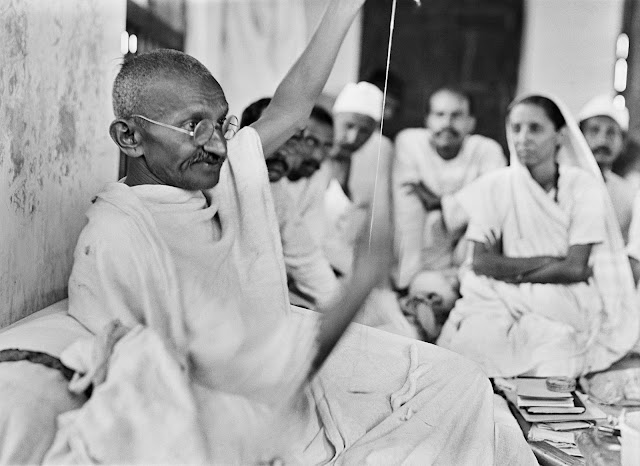
 Gandhi spinning at Dandi, April 2018. (Photo Courtesy: Fotostiftung Schweiz/Archiv fu.r Zeitgeschichte and Kiran Nadar Museum of Art)

Gandhi and Mao are not names often spoken together. So dissimilar do these giants of Asia seem, as men and leaders, that even thinking of them as contemporaries demands an imaginative leap. Luckily, Walter Bosshard met them both, and his pictures live to tell the tale.

Peter Pfrunder, co-curator of 'Envisioning Asia', the first-ever Indian showing of Bosshard's photojournalism, cheekily suggests in his brochure essay that "Bosshard himself could be seen as the link between Gandhi and Mao". Certainly, the 51 photographs and one silent film on show at Delhi's Kiran Nadar Museum of Art (KNMA) make clear that both men "welcomed this foreign photojournalist with open arms", at shaping moments of their careers. Bosshard met Gandhi in 1930 at Dandi, after the Salt March. In a piece of historical serendipity, he also met Mao after a march: in 1938, when he journeyed six days from the provisional capital of Hankou to Yan'an, the closely-guarded 'Red Capital' where Mao had withdrawn after the Long March.
Yan'an City Gate, entrance to China's Red Capital, 1938. (Photo Courtesy: Fotostiftung Schweiz/Archiv fu.r Zeitgeschichte and Kiran Nadar Museum of Art)

Unlike his legendary subjects, Bosshard never marched the length and breadth of a country to mobilise his people. But if we set aside for a moment his position as a white man in an imperialist world, Bosshard's own travels are quite impressive. A Swiss primary school teacher from 1908 to 1912, he studied art history in Zurich and Florence and did military service in Italy during World War I. Bosshard's life after 1919 would be the envy of any experience-hunting millennial: he worked on a plantation in Sumatra, as a gem dealer in East Asia, and as a merchant in India and Thailand. In 1927-28, he was a photographer on a German expedition to Central Asia. By 1930, he had so established himself that the Munich Illustrated Press sent him to India on a 'study trip'. Between February and October, Bosshard travelled over 20,000 km, gathering enough material for his 1931 book, Indien Kampft! (India Fights!).
Preparation at Congress Headquarters for 'Boycott Week', Mumbai 1930 (Photo Courtesy: Fotostiftung Schweiz/Archiv fu.r Zeitgeschichte & KiranNadar Museum of Art

The highlight of Bosshard's India trip, though, was reaching Dandi in time to shoot the coming of Gandhi. With 78 volunteers, Gandhi had walked for 24 days along the coast, crowds joining him to protest the British monopoly on salt. The power of these pictures is still undeniable: hundreds wading into the water to pick up salt; a child walking jauntily off with a cloth bundle of dripping, salty mud. The presence of women is striking. In one great image, Bosshard captures rural women marchers mid-stride, one end of their white saris wound over their heads, the other end hoisted up to reveal their calves. Here is the female Indian form cast for once as a labouring body in political action, unselfconscious and thus, unfetishisable. There are also women leaders: a stoic Mithuben Petit at an anti-alcohol protest in Navsari; Sarojini Naidu, the poet and Congress leader, who had urged Bosshard to visit Gandhi at Dandi, saying "he will have time".

It appears Gandhi did. In Bosshard's images, the 60-year-old fighting the world's most powerful empire appears utterly relaxed: grinning at a satirical The Times of India editorial, spinning, eating onion soup, cackling with uninhibited laughter, shaving. "At this stage of his career in 1930, he is the only world leader who treated the camera like a confidant of his inner circle, to be trusted, silently," co-curator Sinha said in an email interview. "There is a heartwarming naturalness and spontaneity in these pictures. By the time Margaret Bourke-White or Kanu Gandhi were to shoot Gandhi at the charkha or in public meetings, he was much older, much more studied before the camera." In the KNMA brochure essay, Sinha argues that these images also highlight Gandhi's "most pronounced areas of reflection and engagement": his astute grasp of the media, his obsession with diet and the body, spinning the khadi as integral to his idea of swarajya (self-rule). Whether it was the photographer or the Mahatma who determined its elements, Bosshard's pictures established a Gandhi iconography that still holds sway.


1938: Mao in front of the Red Academy (Photo Courtesy: Fotostiftung Schweiz/Archiv fu.r Zeitgeschichte and Kiran Nadar Museum of Art)
The Yan'an images are a stark contrast to the Indian ones. Whether it's a young, serious Mao Zedong standing scrupulously straight before the camera, the cold mountainous expanses through which the Eighth Route Army marches, or simply the short hair, trousers and jackets both men and women wear, Bosshard's 1938 visuals reveal how China and India's paths diverged. "China broke from an older civilisation in a way India did not," says Shilpa Sharma, a PhD scholar in Delhi University's department of Chinese Studies. "Also, Gandhi was responding to a bureaucratic state, where there was law and order. China's many bloody wars meant ahimsa (non-violence) could not have emerged there. Mao standing strong physically in pictures was part of a show of strength needed to win," she adds.
Despite differences, "these were mass leaders who led their illiterate, poor societies out of feudal and colonial oppression," says Hemant Adlakha, who teaches Chinese Studies at the Jawaharlal Nehru University. "There is comparable poverty, a shared idealism, the instruction of followers," says Sinha. "[Both had] a vision for change for their countries."


Nearly 90 years later, both India and China have diverged greatly from these men's visions.

'Envisioning Asia: Gandhi and Mao in the photographs of Walter Bosshard' runs at the Kiran Nadar Museum of Art from 1 to 30 Oct 2018.

30 January 2018

Finding Our Freedom


On 30 January 1948, Gandhi was assassinated for trying to stop the killing of Muslims in the new Hindu-majority nation. Seventy years later, Lalit Vachani's documentary might help us look at ourselves in the mirror.

A still from Lalit Vachani's documentary film, The Salt Stories (2008).
On 13 January 1948, distressed by ongoing violence against Muslims in the capital of the free nation for which he had struggled his whole life, Gandhi began what would be his last political fast. On 18 January, a Central Peace Committee – including members of the RSS, the Jamiat-ul-Ulema and Sikh organisations -- came to him with a declaration that said “we shall protect the life, property and faith of Muslims and that the incidents that have taken place in Delhi will not happen again”. Gandhi agreed to break his fast. Two days later, on 20 January 1948, a Punjabi refugee called Madan Lal threw a bomb at him during his prayer meeting at Birla House in Delhi. The device exploded a little away from Gandhi – luckily, no one was killed. Gandhi continued his work, holding meetings and talking to visitors, including angry Hindu refugees.

On 26 January, at his prayer meeting, Gandhi spoke of his sorrow at what the first few months of freedom had been like. He hoped, however, that the worst was over, and that Indians would work for the equality of all communities and creeds – “never the domination and superiority of the majority community over a minor...”. Four days later, on 30 January 1948, he was shot dead.His two most influential followers, Vallabhbhai Patel and Jawaharlal Nehru, responded with grief and resolve. Nehru appealed to Indians to stand against “that terrible poison of communalism that has killed the greatest man of our age”. “We did not follow him while he was alive; let us at least follow his steps now he is dead,” said Patel, appealing to people to carry his message of love and non-violence.

Seventy years after Gandhi's assassination, we are a country that has not just forgotten his message but turned actively towards that of his murderer. Nathuram Godse's stated reason for killing Gandhi was his “constant and consistent pandering to the Muslims”. That destructive falsehood has now become the common sense of our time.

Among the few films that have caught our devastating transformation on camera is Lalit Vachani's 2008 documentary The Salt Stories. Looking for Gandhi in Narendra Modi's Gujarat, Vachani decided to follow the route of the 1930 Salt March, when Gandhi walked 390 km from the Sabarmati Ashram in Ahmedabad to the coastal village of Dandi. There thousands would peacefully break a colonial law that barred Indians from making their own salt. Among Vachani's first stops is the village of Navagam, where he meets a self-proclaimed old Gandhian. He speaks admiringly of Gandhi's role in social reform. Then, having ascertained that there are no “Mohammedans” in Vachani's crew, the 'Gandhian' proceeds to describe the Muslim community as “raakshas”.


A dismayed Vachani moves on to Dabhan, where Gandhi caused a stir by bathing at a Harijan well. The well has been built over; it is now part of a woman's house. Her first reaction is to deny any knowledge of Gandhi's visit. When one old lady says she remembers her grandfather telling her of it, the woman snaps: “Were you there? Then stop your jabbering.” It takes some reassuring from the filmmaker for her to express her fears openly – when Vachani said he had come on Gandhi Kooch, she was instantly worried that her house would be torn down. Now she changes her tune. “I feel fortunate that I live on the place where Gandhi bathed. It's as if my home is in his heart. But if my house is broken down, what will I do?”

Across the road from the Harijan settlement was a dharamshala where Gandhi had stayed the night. Now a Patel function is in progress there. “We broke the old place down and made a Party Plot,” a man tells Vachani. The filmmaker's enquiries appear to have led two men to bring in a stone plaque on which the fact of Gandhi's 1930 visit is engraved. It looks like it might be a slab from the old building, a building that no longer exists.

Vachani's journey proceeds, acquiring a droll tenor as he encounters a series of Gandhi temples with oddly deformed depictions of Gandhi. At all these supposed shrines, the Mahatma is locked away behind bars, cobwebbed or broken, quite clearly never visited. In Surat, where Gandhi had his largest public meeting during the Dandi March, no one has any memory of the event. But the park is host to the Mahatma Gandhi Laughing Club, whose waves of terrifying hysterical laughter break upon a silent statue of Gandhi.

Earlier in the film, Vachani stops to chat with a group of teenaged boys outside a temple. Modi is their favourite leader, they tell him, and what he did was a good thing. Why, asks Vachani. Because the Hindu religion lived in fear before, comes the instant reply. “And now, do the Muslims live in fear?” asks Vachani. “Yes, they are scared. They fear,” comes the reply. “And do you think fear is a good thing?” Vachani asks. “Yes,” say the boys. “Someone or other must always feel fear.”

That is the distance that India has travelled from Gandhi. It's a long road back – and many may never want to walk it. But for those who do, perhaps we can start by ensuring that our definition of courage is not to make others feel afraid.

Published in Mumbai Mirror, 28 Jan 2018.

1 September 2017

Blood on our hands

My Mirror column: the fourth column in my series on the Hindi hits of 1957

V Shantaram's Do Aankhen Barah Haath (1957) used a prison reform experiment to think about freedom - and that message still bears repeating.


The titling of V Shantaram’s Do Aankhen Barah Haath involves a series of hand-prints being made. Each time a hand is lifted off the screen, it leaves adark impression – and a printed title appears at its centre. The hand-prints obviously make a reference to the film’s name – literally ‘Two Eyes, Twelve Hands’. But whose hands are we speaking of, and why do they matter?

Shantaram lets the mystery linger for a little while, even as he takes us directly into his milieu, opening with a sequence of theatrical excess that involves a jailer kicking prisoners. The symbolic humiliation of placing bootclad feet violently on the back of another human being is particularly great in an Indian context where the feet are believed to be the most impure part of the body – you are brought up to apologise if your feet touch someone by mistake, and you only touch another’s feet voluntarily as a way of emphasising your social inferiority in relation to the other person.

After this temporary focus on feet, Shantaram slowly and deliberately returns us to hands. Hands are, by their very nature, a stand-in for action – and in the case of the criminal offenders whom Shantaram places at the centre of his film, those actions are violent ones. When the junior prison official Adinath (played by Shantaram himself) gets permission to launch an experiment in prison reform, he chooses six men convicted of particularly grisly crimes. He uses the cinematic medium to great effect as they are introduced, overlaying the almost comical excess of these gruff, hefty men with their own memories – memories in which they used their hands to take lives. Now those same powerful hands, Adinath decides, are to be put to honest labour. The man who once lifted a boulder to murder his wife is told to build a dam with enormous stones; another who had committed his crime with an axe is told to clear the shrubs with one.

Hand-prints, of course, are also tied to personal identification, in a context of assumed illiteracy as well as one of modern policing. By the mid-20th century, fingerprinting had been around as a technique of criminal forensics for at least fifty years, and Shantaram plays with the way that humans had internalised that knowledge. When Adinath, trying to establish a rapport with the men, asks their names, they respond by silently making hand impressions on a piece of paper. “If we run away, it is our handprints that you will find useful to trace us – not our names,” says one. It is as if we were to introduce ourselves with our Aadhaar numbers.

Shantaram in 1957 was already a veteran, with the founding of Prabhat Film Company and pioneering films like Manoos, Kunku and Shevari behind him. For Do Aankhen, he chose to depart from the technicolour seductiveness of Jhanak Jhanak Payal Baje (a dance-heavy drama which had been the third biggest Hindi hit of 1955) for an almost Expressionist black and white. Do Aankhen unfolds at a deliberate pace, with dramatically staged set pieces and several weepy moments.

But alongside the high drama is a goofy brand of humour, exemplified for instance in the scene where the six men, all hulking moustachioed brutes, prop up a dismantled barbed wire fence so as to view an attractive woman safely from behind it. It is as if the charms of Champa, a toy-seller played by Shantaram’s third wife Sandhya, are such that they prefer to lock themselves up.

The scene may be comic, but it is in fact of a piece with the film’s view of masculinity, of violence – and of freedom itself. The large patch of barren land where the convicts settle is named Azaad Nagar – Freedom Town. On their very first night there, they find themselves so discomfited by the prospect of sleeping in an unlocked room that they chain their feet together, weighing the chains down with their agricultural implements.

Months later, in what is the final test of their reformation, they promise Adinath that they are capable of selling their fresh-grown vegetables in the local sabzi mandi without being roused to violence. When they get there, however, the low prices they are selling at make them the target of the local middleman and his goons, who attack them in full public view.

Shantaram pegs his climax on the men’s transformation from brutish hulks – who had been quick to snatch another’s food when hungry, or react to perceived injustice with the threat of violence – to mute sufferers even in the face of one-sided beatings. This is a film made ten years after Indian independence, and it sends out a message about ahimsa that is strongly in synch with the Gandhian position on non-violence. The true exercise of collective freedom involves curtailing our baser instincts – not setting our worst selves free to roam. It is a lesson we could all do with in Modi’s India.

13 February 2017

Picture This: Modern is as modern does

My BLink column this month:

An evocative new documentary explores the faltering first steps of India’s architectural modernity.


“Some like it, some dislike it. It is totally immaterial whether you like it or not. It is the biggest job of its kind in India. That is why I welcome it,” said Pandit Jawaharlal Nehru of the new city whose conception he had initiated. “It is the biggest because it hits you on the head, because it makes you think. You may squirm at the impact, but it makes you think and imbibe new ideas. And the one thing that India requires in so many fields is to be hit on the head, so that you may think.”
Chandigarh — for that was the subject of Nehru’s dream of newness — was not just a city; it was a new design for living. Or, as the makers of a new documentary called Nostalgia for the Future put it, it was the place where Indian modernity hoped to start erasing the divides between our various homes: the body, the community, the country. In Rohan Shivkumar and Avijit Mukul Kishore’s cinematic essay, Chandigarh’s starkness was designed to place the body naked against the sky, without the covering of community.
Kishore and Shivkumar glide elegantly between various conceptions of domestic modernity in India. At the Lukshmi Vilas Palace in Baroda, built as a home in 1880 by the late Maharaja Sayaji Rao Gaekwad, we linger over fountain-filled courtyards and European-style classical statues. But we also see the freestyle mix-and-match that characterised this 19th-century monarch’s conception of the self and the home: European stained-glass with Indian faces and bodies etched on them, or Raja Ravi Varma paintings where our Puranic characters received Western-style artistic treatment — and fair skins. The voice-over pronounces that imitation might be the necessary origin of modernity. It is, I think, a provocative reversal of the usual critique of tradition — it is traditional ways of being and creating that are, in Western modernity, dismissed as merely imitative. Modernity is supposed to grant us the great gift of originality. And yet, we in the colonised non-West, how were we to become modern except by performing modernity as told to us?
The dilemma of performance and truth lies, of course, at the centre of much anthropological thinking — not just about being modern, but about being human. Doesn’t the external performance of something — be it grief as expressed in the ritual mourning of death, or an event like Moharram, or gender as expressed in clothes — help produce it internally?
Kishore and Shivkumar do not quite go there, but their interest in the home as a sort of costume (poshaak) for the self allows for one of the film’s clever dancing segues: as we speak of Sayaji Rao’s contribution to Indian modernity, we move to Dr Bhimrao Ambedkar, who was educated at the Maharaja’s behest, and from there to Ambedkar’s homes: the BIT chawl in what was then Bombay, and the Western-style home in Dadar Hindu colony. The Western was for this Dalit man, as it would be for many others who followed, a way of escaping the oppressive clothing of caste — and the film moves seamlessly from his home to his conscious public adoption of the Western-style suit (an unusual clothing statement for an Indian politician, even today).
But the film is by no means a purely analytic essay: it is a poetic and cinematic meditation on form that itself takes form seriously. Right from the opening credits, which are a series of ‘Films Division presents’ titling shots, it both borrows and subverts the form of the traditional documentary.
Shivkumar, who is an architect and academic, wrote the script for this collaboration between him and Kishore, which Kishore then rendered into a Hindi that is superbly evocative of the old school Doordarshan voice-over, while departing from the pedagogic certainties that it would lead us to expect. “The burden we began with is that of the architect: that he knows,” said Shivkumar after a screening of the film at Delhi’s India International Centre. “But most of the time, we just pretend to know, because that’s what is expected of us.”
Nostalgia for the Future, happily, is not a film that pretends to know. Instead it delights in unexpected associations and encounters, between words and images, between thoughts. The engineering mindset comes to us via the jaunty figure of Sunil Dutt, his white shirt “like the moon on a dark night”. Alongside shots of post-Partition refugee housing in Delhi, we see black-and-white photographs of Kishore’s own childhood home(s), sometimes with himself in them. In the usual playful but quiet tenor of Kishore’s work, no attention is drawn to this important fact.
At another moment, the use of “poshaak” in the voice-over pre-empts a neat cut to Gandhi taking off a piece of clothing, and the idea of Gandhi’s body as the source of both sinfulness and sainthood. His power, as we all knew instinctively, was based on his control of his own body. And that was what satyagraha was meant to grant us: all we had was control of our bodies, and exercising that would somehow set us free.
As Shivkumar said during the discussion, “architecture is one of those strange disciplines that has the job of creating betterness. So it bears the burden of hope.” The nostalgia of the film’s title is for that hope of Nehruvian citizenhood: the unmarked modern Indian citizen that architecture was meant to mould us into, but that we never became.
Published in the Hindu Business Line, Sun 12 Feb 2017.