Showing posts with label Biblio. Show all posts

25 November 2015

The World as Picture: Book Review

A book review published in Biblio's Sep-Nov 2015 issue:


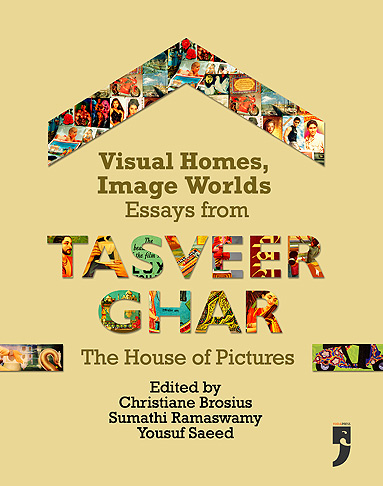
Visual Homes, Image Worlds: Essays from Tasveer Ghar -- The House of Pictures
Ed. Christiane Brosius, Sumathy Ramaswamy 
and Yousuf Saeed.

Yoda Press, 2015.

Allow me to start this review with a triptych of images — since Tasveer Ghar, as the name suggests, is all about pictures. An online database initiated in 2006 for collecting, digitising, and documenting the popular visual culture of South Asia, Tasveer Ghar has generated exciting conversations among scholars and arts practitioners, around the social, political and performative lives of images. The beautifully produced Visual Homes, Image Worlds is a collection of essays generated by the Tasveer Ghar network (and first published online).

The images I want to discuss appear in different essays in the book. But to me they seemed to speak to each other across the pages. The first picture is the frontispiece of Richard H Davis’s superb, succinct essay on “God posters for and of worship”. It features a smiling sari-clad woman in side profile. Holding an aarti thaali, her head covered respectfully, she raises her eyes to something we cannot see. Beyond the scalloped window arch in which she is framed, a series of South Indian-style temple gopurams and coconut palms are silhouetted against the evening sky. The caption reads: ‘A Hindu Devotee Prays.’

'A Hindu Devotee Prays' -- Calendar Poster, printed by Oriental Calendar Manufacturing, mid-20th century 
Davis points out that the Calcutta Art Studio, one of the first companies to issue chromolithographs of Hindu deities, swiftly realised that the Indian public wanted images of the gods, but “single prints... for worship, not bound volumes for leisurely perusal”. The recognition led commercial publishers and companies to produce calendars, posters and other visual material that could cater to this demand. But slowly, as Davis shows, images produced for worship were joined by images of worship. The incipient form of these was the Lakshmi or Ganesh with a plate of prasad and/or lit diyas painted at their feet, thus incorporating the intended puja samagri (items used for worship) into the image itself. The image I’ve described could be said to be a more advanced version, where not just the puja samagri, but the worshipper is mirrored within the image. In this particular poster, there is no deity at all. But there is a temple, and a human devotee who contemplates the divine. 


The second picture I want to point out seems to me to echo the first in some ways, and differs from it in others. The first image was dated mid- 20th century, while this dates to the late 19th or early 20th century. It is a beautifully illustrated textile label, included in Catherine B Asher’s article “Fantasizing the Mughals and Popular Perceptions of the Taj Mahal”. Here, too, there is a human figure in the left foreground, framed within an arch and looking out into the distance. The object of contemplation here is the Taj and its reflection, not a deity or a temple. The young man stands with his back to us, wearing a kurta and dhoti, as well as a fetching red turban and a red sash around his waist. Asher describes him as “overwhelmed by the building’s significance, or perhaps smitten with love”. There is no obvious religiosity here, but the old mendicant in red robes, seated to the right of the image, may be said to provide a hint of the spiritual.

The third image dates to the present day: 2010, to be precise. It is a ‘beautification mural’ on Chennai’s Anna Salai, made by the artist JP Krishna, and reproduced as part of Roos Gerritsen’s essay on the gradual replacement of political and film hoardings along the city’s major arteries by murals meant to signify “Tamil culture and heritage”. On the right hand side are two Mamallapuram temples, their stone carved outlines reproduced in almost photographic detail. On the left, again with their backs to us, are two figures admiring the grandeur of the buildings. Like the woman in the first image and the young man in the second, these viewers stand in for us — the real-life viewers, standing outside the frame. And in this case, they’re tourists.

'Beautification' mural by artist JP Krishna, Chennai

These three images are drawn from three very different time periods, and for very different purposes — calendar art for Indian consumers, a commercial textile label to be sent abroad, and a street-side mural created by municipal fiat to project a new aspirational ‘global’ urbanity. And yet, in incorporating the viewer’s gaze into the image itself, I see these images as being very clearly in conversation. Looked at together they open up a whole range of thoughts about the aesthetics of looking: whether the contemplation of beauty is the same when the subject is perceived as divine, as spiritual, or as ‘world heritage’. At one level, it is a conversation that emerges from the old Benjaminian chestnut about the loss of aura, but in terms of these specific images, it could only have unfolded within the pages of this book.

And this is no accident. Through the essays here, popular visual culture in India emerges as an under-explored “bin of history”. Rummaging through it is both a way to produce an alternative archive, and challenge tightly-policed notions of genre. As the editors point out in their Introduction, the Tasveer Ghar archive is a place of cross-fertilisation. Indian images that were mass-produced, “be they greeting cards, god posters, patriotic prints, street art, advertisements or cinema hoardings”, journey through various sorts of worlds, and as they do so, “develop complex biographies and relations with other images”. Single images (or a constellation of them) often freely criss-cross any boundaries that might exist between public and private, ‘local’ and ‘global’, religious and secular (often more like sacred and profane), and finally, citizenship and consumer-hood.

Patricia Uberoi’s essay ‘Good Morning – Welcome – Svagatam’, suitably for the first Indian anthropologist to take mass-produced visual culture seriously as a subject of study, is placed at the start of the book, and helps locate calendar art within the dense matrix of tradition and modernity, ‘Indian’ and ‘Western’. “Stylistically and technologically, calendar art is a modern art form born of the Anglo-Indian colonial encounter, though it obviously has roots in several indigenous traditions also,” Uberoi writes. “Thus the recourse to ‘tradition’ in calendar art is both a reaction to, and is matched by, the appeal and prestige of westernized modes of representation.” She offers many illustrations of this, including a semiotic reading of goddesses and actresses saying “Welcome”, or “ILU ILU” and “Aum Sweet Aum” as hybrid appropriations of the coloniser’s language. 

Yousuf Saeed’s essay, which follows Uberoi’s, offers another example of hybrid appropriation in the form of Eid cards, which were likely to have been inspired by Christmas cards, and often actually used “blank picture cards imported in bulk from Europe [featuring] photographs of locations and objects as alien to Indian Eid as Greek and Italian sculptures and monuments, ... besides European cinema and theatre stars of the time!”. Saeed also traces the transformation of images on Eid cards. While early 20th-century cards – those created in India – contained ‘modern’ objects like aeroplanes, cars and multi-storied buildings, and no Muslim-cap-wearing boys, cards from the late 1980s “are dominated by images of Mecca, Medina, Quranic calligraphy, crescent- and-star icons, pious praying women and babies, and occasionally, romantic rose bouquets”.

The book is divided into sections thematically rather than by age or region or type of visual material. So, for instance, Christiane Brosius’s partly ethnographic meditation on Valentine’s Day cards is not placed alongside Yousuf Saeed’s, but in the section ‘On Love, Land and Landscapes’. Brosius’s subject is a fascinating one – how Archies’ Gallery helped create a ‘language of love’ for post-liberalisation India – but her insights sometimes seem rather obvious, and her analysis of the actual images sometimes lopsided. For instance, she insists that the scooter [on a card] cannot be an aspirational marker because it is tied to “lower-class mobilities, small-town aspirations, and a ‘Nehruvian’ petit bourgeoisie”, seeking to establish its present-day association with freedom using An Evening in Paris (1967) — really a rather old cinematic reference point! All of this ignores the basic fact that Archies’ clients are almost all school and college students, and for most of these, a two-wheeler certainly remains an aspirational thing.

JFK and Nehru with Kruschev watching,
magazine illustration by K. Madhavan, ca. 1960
Collection: S. 
Marieswaran
In the same section, Sumathi Ramaswamy looks at another profoundly familiar form of visual culture that has been crying out to be studied: the mapped form of the nation in popular prints. “In the artful mapping of the bazaar,” she successfully shows, “bodies appear to matter more than boundaries, the affective more than the abstract.” But Ramaswamy’s surprise at what she sees as these free, demotic appropriations of cartography, seems surprising: surely one genealogy for 20th-century Bharat Mata ‘maps’ lies within pre-colonial cosmological traditions of map-making, whether 18th-century Rajasthani images like that of Krishna as Visvarupa, containing the cosmos within the divine body, or Nathdwara Pichhwais of pilgrimage routes.

Kajri Jain’s essay on monuments, landscapes and romance in popular imagery is a wonderful example of how cross-fertilisation works in Indian visual culture. Drawing on religious/ mythological prints, calendar art and cinema-inspired paraphernalia, Jain argues that the framing and staging of romantic couples – whether legendary folk lovers like Sohni and Mahiwal, mythical ones like Visvamitra and Menaka, Hindi film couples or real-life ones – consistently represents them “in and for the public: outdoors and facing the viewer rather than or as well as each other”.

Between Rosie Thomas's analysis of the very particular Orient peddled by early Indian cinema (Arabian Nights, the Wadia version of Aladdin, Alif Laila, and so on), Sabina Gadihoke's tracing of film history through Lux ads, and Vishal Rawlley's painstaking delineation of the types of 'sexy ladies' on Bhojpuri music album covers, the 'At the Movies' section takes in a wide swathe of the film world.

In the ‘Consuming Images’ section, Philip Lutgendorf’s analysis of tea advertisements deals with familiar terrain in a fascinating, thorough fashion. I enjoyed Abigail McGowan’s tour of the ‘modern’ home, and her argument about the erasure of labour from these depictions of urban women. I was less persuaded by her pitting her visual archive against cherry-picked literary sources from a previous era: in particular, the comparison of mid-20th century calendar art with The Bride’s Mirror (an Urdu classic from 1869) seems strange.

The section ‘Of Gods and Cities’ bridges two rather different themes. Beginning with the Richard Davis piece discussed above, we move to Annapurna Garimella’s discussion of grihani (housewife) aesthetics, as expressed in Dasara doll-displays in South Indian households. The theme of images that are used to perform identity in public segues nicely into Shirley Abraham and Amit Madhesiya’s “Gods on Tile”’, which explores – somewhat repetitively – an urban phenomenon we’ve all seen: the use of religious icons to prevent people peeing in public space.
The deliberately engineered transformation of public space is also the subject of Roos Gerritsen’s “Chennai Beautiful”, mentioned earlier. Gerritsen’s analysis of ‘Tamil heritage’ as enshrined in Chennai’s new murals is detailed and interesting, but a less entrenched ideological perspective might be better able to unpack the contents of what is currently lumped together under the too-easy rubric of “neo-liberal globalisation”, “neo-liberal nostalgia”, and “neo-liberal middle class publics”. How do we understand, for instance, the fact that many of these 'sanitised' murals are by the same artist who made the now-removed political hoardings?

Stephen Inglis’s essay on the hugely popular artist K Madhavan – who made the original banners for SS Vasan’s legendary film Chandralekha (1948) – is a revelation, and again, demonstrates powerfully the way that cinematic imagery, product advertising, religious iconography and political propaganda flow in and out of each other. Madhavan’s vast and fascinating body of work (of which only a fraction is yet in any archive) makes clear, once and for all, that the study of visual cultures is truly fecund terrain, in which all of India’s obsessions can come together. May Tasveer Ghar's many interminglings continue to bear ever richer fruit.  

Published in the literary review journal Biblio, Sep-Nov 2015. 
15 February 2015

Book Review: Nebulous Narratives


She Will Build Him A City
Raj Kamal Jha
Rs. 599
Bloomsbury, 2015.
In the Jan-Feb 2015 issue of Biblio, I reviewed the latest Delhi novel:

Raj Kamal Jha's new novel is not an easy read. The prose is often lyrical, and the images vivid and strange, like dreams. But there are all sorts of factors that make this book difficult to enter into, and perhaps even to think of as a novel. For one, its structure is deliberately elliptical, starting somewhere in the middle and looping back and forth in wayward whorls. Then there's the fact that the central characters are deprived of proper names: we must learn to live with them under the annoyingly precious titles of 'Man', 'Woman' and 'Child'. Each chapter in the book is devoted to the world of one of these characters, with a subtitle – for instance, 'Man: Highway Mynahs', Woman: Lecture Notes', or 'Child: Traffic Signal'. If there is a chapter that doesn't feature any of the three, it comes with the tag 'Meanwhile'. (The 'Meanwhile' chapters are my favourite parts of the book, perhaps because it felt as if the author had freed me from the pressure to connect them up to a central narrative.) Given the number of characters and sub-narratives we're dealing with, of course, it's not quite clear whether there is a central one. And Jha's propensity for surreal flights of fancy – sometimes in the authorial voice, sometimes his characters' – doesn't make comprehension any easier. I would have described the book as a jigsaw puzzle—except that having reached the end, I'm still not certain that I've pieced it together.

Still, I shall attempt to provide what hazy outline I can. 'Woman' is the only character to speak in the first person, addressing not us but her absent daughter (who goes from being a breathless “eight years nine years old” to a taciturn young woman with a secret). 'Child', in true Dickensian style, is a baby left at the doorstep of an orphanage and named Orphan. The book's epigraph is from Oliver Twist, so one assumes this is homage. Orphan does not speak. The updated Dickensian cast of Orphan's carers starts off as the most convincing thing in the book (and they have real names, too). There's the poor trainee nurse Kalyani Das, the publicity-hungry orphanage director Mr. Rajat Sharma, the memorable media-anchor turned potential-adoptive-mother Priscilla Thomas. But I stopped going along when a street dog called Bhow joins the list, speaking like a human being. And later we must meet a ghost-like old lady called Violets Rose (her name is an anagram of 'Love Stories') who lives inside a multiplex, and after she takes charge of Child, it becomes unclear if Child is real, or a composite figment of different people's desires.

Finally, there's 'Man', who is introduced to us in this somewhat theatrical fashion: “He is going to kill and he is going to die. That's all we know for now, let's see what happens in between.” The “all we know” suggests a narrative contract into which the author-narrator wishes to bind us – except since he knows full well what's going to happen, and we (readers) don't, it feels rather precious.

Even so, Man is arguably the book's most arresting, because most shocking, figure. We first meet him on the Delhi Metro, making his way from Rajiv Chowk to Gurgaon, which Jha insists on calling New City. (Again, it's not quite clear what's achieved by mixing the named and unnamed: there is practically nothing about New City that wouldn't be true of Gurgaon. But more on that later.) Within less than a page of meeting him, we have been inserted into Man's disturbing, often inchoate fantasy world: “The station is crowded, he closes his eyes, sees everyone naked and bruised... He feels an erection coming. He opens his eyes, his heart aches, and a drowsy numbness pains, John Keats.”

Over the next few pages, Man quotes Gieve Patel at us, reminisces poetically about a barium sulphate examination he underwent as a child, and describes the horrific Diwali murder of a dog, carried out by him and his friends. For the rest of the book, every time Man appears, the sense of menace is palpable. When he takes a street child ('Balloon Girl') and her mother back to his impossibly plush home in 'Apartment Complex, New City', we remain on tenterhooks, waiting for the violence we are sure will follow. But Jha will not fulfil that voyeuristic desire/fear so easily; instead he gives us a succession of sequences where it is never quite clear what is really happening and what is inside someone's head. The book thus steers clear of graphic violence. But it often seems in danger of aestheticizing it.

She Will Build Him A City comes with front-cover (Neel Mukherjee) and back-cover (Jeet Thayil) recommendations that describe it as revelatory about the “New India”. Certainly, the text is spiked with moments that are meant to reveal the yawning abyss between the rich and the poor, like a game played by the four young dog-killers, where they put the price of everything they see in brackets: “Arsh flicks his cellphone (Rs. 41,245), records the explosion, its aftermath.” Or later, describing the situation outside Man's apartment: “There are six security guards huddled at the gate, forced to wear long-sleeved shirts and ties in this heat. Two are from Bihar, the other four from Uttar Pradesh, all leaving behind fathers with cancer, mothers with TB, wives with uterine cysts, children who have dropped out of school, all waiting for Rs. 4,000 to come every month.” And all sorts of underprivileged people get their five minutes of fame, labelled with capitalised names by Jha, as if they were some strange sea creatures that have floated up out of the depths: 'Bandage Baby', 'Mortuary Man', 'Taxi Driver', 'Driver'.

In contrast to these gimmicky, flash-like glimpses into the heads of Others, our access to Man's interiority is total. The main thing we need to know about Man is that he's rich. He is so rich that he orders Chinese takeaway from the Leela. But the great sign of his absolute separation from the masses is his near-pathological inability to deal with the heat and dust and grime they must inhabit. Whole passages are devoted to his desire for freezing air-conditioning, his olfactory sensitivities, his compelling of unwitting future victims to scrub and clean and deodorise themselves. (And yet, we are also expected to believe that he “loves the Metro from the bottom of his heart”, so much so that on some nights, he deliberately abandons his car and takes it, despite the fact that people in it smell “like rotting vegetables, bread and bananas gone bad”.)

For a book so invested in newness, and in the depiction of the new, it is odd that what Jha's 'Man' most reminds me of is a figure of Victorian lineage. It was 19th century London that produced the powerful myth of the really well-to-do man who went out into the city anonymously and committed unspeakable sexual, sadistic crimes against poor women and children. If WT Stead's journalistic expose, 'The Maiden Tribute of Modern Babylon', reworked the Minotaur myth to paint London as a modern-day Labyrinth in which thousands of “the daughters of the people” were “served up” nightly “as dainty morsels to minister to the passions of the rich”, the sensationalist speculative coverage of the Jack the Ripper murders a few years later cemented this vision: the purveyor of unnatural lust who preyed on the poor. This anonymous elite villain took fictional form in RL Stevenson's Dr. Jekyll and Mr. Hyde – Stevenson wrote the book in the summer of 1885, soon after his friend WE Henley had eagerly forwarded him the instalments of the 'Maiden Tribute'.

The subliminal basis of Jha's book (both the Man and Child sections) doesn't seem that different from the one that emerged from that Victorian melange of tabloid melodrama and urban danger: a city in which the rich feed on the poor. And metaphorically accurate though it might be, somehow the execution of the idea left me dissatisfied. Neither the experimental quality of Man's grisly hallucinations nor Child's surreal surroundings could keep the central theme from feeling hackneyed. Similar effects have been achieved with much greater success by others, in the specific context of Delhi, the Hindi writer Uday Prakash's 'Dilli ki Deewar' and 'Mangosil' come to mind.

The Woman sections of the narrative feel fresher, evoking both her long-ago marriage and her relationship with her daughter with all the power of memory. Rendered mostly as incidents and conversations sharply recalled, there is plenty here that captures the irrational sweetness and bitterness of childhood joys and fears. Jha seems genuinely interested in children. Other than Woman's daughter, he gives us short but fascinating portraits of the lives of two very different eleven-year-olds, both old beyond their years: a boy whose extraordinary sensitivity reverses our pervasive fear of a new generation stunted by technology, and a girl whose responsibilities to family and work have forced her to stifle her own childish desires.

Jha's book adds itself to the growing list of volumes 'about' the Indian city, and especially, in recent years, Delhi. But what Jha attempts here with Delhi has been done much better with Bombay in Altaf Tyrewala's No God in Sight (2005): a slim, sparkling little novel that Kiran Nagarkar described as “an unsettling relay race, in which the baton is passed on from one character to another... till you come full circle.” It is clear that Jha's aim, too, was for his million little pieces to make up the shape of the city. But while there are plenty of 'scenes' that work, the whole does not cohere. Many elements, and the connections between them, remain indistinct and fuzzy. What we end up with is not a planet, but a nebula straining to be one.

5 January 2015

Book Review: Museum of Cinema

A review of the biggest book I've ever read. In the year-end issue of the book review journal Biblio:


Project Cinema City
Edited by Madhusree Dutta, Kaushik Bhaumik and Rohan Shivkumar
Foreword by Arjun Appadurai
Design by Sherna Dastur
Tulika Books, New Delhi, in association with Majlis and Goethe Institute, 2013, Rs. 3500 (HB)

If you can imagine a book that combines the experience of an art exhibition, an archive, a seminar and a guided city walk -- all going on at the same time – then you've pretty much imagined Project Cinema City. This book, which won the Printed Book of the Year award at the first edition of the Publishing Next Industry Awards (September 2014), seems to want to redefine what a book might be. It is huge, a massive hardback potha that runs into more than 550 pages, and heavy – larger and heavier than any coffee table book I've seen, and with a hundred times more reading material, too. It is capacious, filled with many kinds of voices. It might be useful to think of them as multiple guides on that walk through the city of cinema: some have gone far ahead of you, and are describing the view from up there; some are telling long and complicated stories (which are fun in parts, but sometimes all you want to do is sit down); some are recording and taking pictures so you can later 'remember' what really happened, and some, inevitably, are talking above your head.

A less bulky (but no less stimulating) volume has previously come out of the Cinema City project and goes by the stylish no-caps name of dates.sites. I reviewed that, too, in these pages (Biblio, Nov-Dec, 2012). But while that was more a compendium of fascinating information that one felt no obligation to read at a stretch from cover to cover, this book is guilt-inducing from the word go. The Contents pages inform us that the book is divided into three sections, all with titles made up of terrifyingly vague buzzwords: 1. 'Mapping Imaginations: Terrains, Locations', 2. 'Performing Labour: Bodies, Networks', and 3. 'Viewing Limits: Narratives, Technologies'. As with most buzzwords that seem to settle and fatten on the meaty intersection of academia and art, there's nothing particularly wrong with each word on its own. But put them all together like this, and most people – I'd venture, even many potential enthusiastic readers of this book – will be longing to sit down.

Also, with apologies to the editors, who presumably thought long and hard about the categories and where each contribution fits, I confess I do not see why Meena Menon's piece on mill workers goes into 'Terrains, Locations' rather than 'Performing Labour', or why Paromita Vohra's piece is in “Performing Labour' rather than 'Terrains, Locations', or why one of the most enjoyable (and readable) things in the book – interviews with women film spectators who live in Bombay-- is divided into three sections. There are also some pieces in here that are not about Bombay, or not about its cinema, and (even if they're fabulous pieces of work) I don't quite see why they're here. I must also mention that after I said I would review this book, I realised that it includes the work of at least three people I'm on friendly terms with. This is the trouble with multi-contributor books. In any case, instead of puzzling over these matters any more, I'm just going to use the space I have here to discuss a few of the pieces I found interesting.

Avijit Mukul Kishore's 'Notes on Technology: At the Time of Going to Press' is a lovely, detailed account of shooting a documentary called Kumar Talkies (dir. Pankaj Rishi Kumar) in the year 1997, which was “a major cusp in the history of film technologies”, with 16mm on its way out and digital video (DV) the new chosen medium. Kishore and Kumar set out to make a film that would marry both forms, and also had some old 8mm home movies they wanted to include. The piece describes the unbelievably complicated journey that followed with more warmth and clarity (and yes, inevitably, some nostalgia) than I've ever read anyone writing about technology with.

'Manufacturing Cinema: Control, Dispute, Workers' Rights', by Shikha Pandey provides a rare longue durée view of the film industry with reference to an aspect of it that we usually hear very little about: unions and the regulation of workers' rights. Pandey's piece is packed with fascinating nuggets about the industry's organisational history, and how the state's policy on popular cinema shaped the industry, creating artificial booms and busts and shaping labour supply in ways that we don't often think about. If you've ever been curious about the number of Bengalis who made their way to Bombay to work in Hindi cinema, for example, you might be interested in the ban on Indian films in East Pakistan in 1962, which led to a decline in Bengali cinema across the border in West Bengal, which in turn was part of the reason for an increased migration of talent from Calcutta to Bombay. For those who've followed the recent attempts by Bollywood screenwriters to organise fr better terms, it might be of interest that the Film Writers Association, formed in 1954 by Qamar Jalalabadi, Ramanand Sagar and Sahir Ludhianvi, was the first film workers' collective to be registered under the Trade Union Act, with a majority of its initial members affiliated to “the communist-led All India Progressive Writers' Association (PWA) and Indian People's Theatre Association (IPTA)”.

There are remarkable insights into how cinematic output is influenced by material conditions. Pandey tells us about the government's freeze on building new cinema theatres through the 1960s, and how the ban-induced scarcity of exhibition infrastructure made film producers dependent on exhibitors' whims for bookings. Exhibitors began to demand 'saleable' plots, making demands for particular stars. Payments to stars rose, growing to anywhere between 31% and 50% of the total production budget. When the ban on new theatres was revoked in 1969, Pandey points out, film production exploded: 199 films released in 1970, as compared to 89 in 1969.

Pandey's research into industry organisational practice is revealing. In the 1980s, the apex body for cine workers, the Federation for Western Indian Cine Employees (FWICE), formed in 1958, joined with the apex producers' body to form a Joint Dispute Settlement Committee (JDSC), to solve disputes in the film industry “internally”. Pandey demonstrates how the JDSC defends and maintains the industry's feudal basis, using the discourse of “outsiders” versus “film fraternity” to prevent cine workers from going to court. She also points out how in the 2000s, the secular, non-party affiliated FWICE has been challenged by the rise of a parallel cine workers union, affiliated to the militant right-wing Maharashtra Navanirman Sena. But the scenario is changing with the entry of corporate finance, international studios, and more foreign workers. Having broached this subject, though, the piece leaves us hanging: one wishes there was a more concerted effort to describe the kinds of conflicts that are currently ongoing.

A very different perspective on workers' organisations is provided by Meena Menon's lucidly written, semi-autobiographical account of the mills of Bombay. Menon is persuasive when she argues that much of the feted “spirit” of Bombay -- a hard-working place where public transport ran till late, large numbers of women went to work, and were safe on the streets and trains -- came out of the working class culture at the city's core. Migrant workers, mostly Marathi, built themselves a home in the city through organised networks of community – the gaokari mandals, the bhajan mandals, the khanawals, and of course, the labour unions. Menon's account is important for its succinct synthesising of the city's transformation, from the perspective of what was once an influential leftist working class: one which sees itself as having lost “one generation to the mafia, and the next one to the Shiv Sena.” The Bombay mafia and later, the political class that emerged partly out of it, have of course found representation in mainstream Hindi cinema. So has the police, and its strong connections with both. But an interesting thing that emerges from Menon's piece is the absence of mill workers from the city's cinema – or any depiction of the deep-seated class and familial links between mill workers and mafia members, between mill workers and police.

There is a richness that the intelligent, honest personal memoir is able to achieve, especially with regard to portraying a neighbourhood: a layering in lived time that the research paper, however impeccable, almost never manages. Paromita Vohra's memoir of becoming “permanently temporary” in Andheri East displays her usual flair for puncturing the platitudes that tend to gather around forms of life and community in this country. She manages to wield a sharp scalpel that spares neither the 'safe' middle-class family life, nor visions of the alternative non-bourgeois one. Vohra has a talent for turning anecdotes into symbolic bookends, and she does this very effectively with the Aarey milk booths and subway tunnels of Andheri. Seemingly random stories of encounters she's had over the course of two decades are carefully structured to produce a narrative about what the two Andheris mean in terms of the film world.

There are many, many images in the book: some leaping out at you, some skulking behind the door until you decide to notice them. It is absolutely impossible to do any justice to them here, but I particularly like Sameer Tawde's Slum Cinema photographs and Kalpit Ashar and Mamta Murthy's map-plus-photograph meditation on cine bazaars in Mumbai. There is also a plethora of images from The Calendar Project, under which 33 artists produced 56 date-calendars of different years in the twentieth century, mostly using found images and print from the public culture of that moment in the past.

Perhaps what is eventually most valuable about the book is the way that different parts of it are invisibly, chaotically in conversation with each other. To cite just one example: Bishakha's Datta's astute, thought-provoking essay 'F**kland Road' speaks to Ashar and Murthy's visuals, as well as to the Parsi lady who grew up on Foras Road, and tells a tale of a drunken man outside Silver Talkies who thought she was a sex worker – and so “pinched her chest”.

So long as you don't try to read this book from cover to cover, it's a wonderful mad museum of cinema. A single orderly visit will never be enough.

Published in Biblio.

22 October 2013

Book Review: A Matter of Rats

My review of Amitava Kumar's most recent book, in Biblio.

A Matter of Rats—A Short Biography of Patna
Aleph Book Company,
144 pages, Rs 295


The first book I read by Amitava Kumar was Bombay-London-New York (2002). I read it in New York, where I spent nearly four years as a graduate student: a Bombay-born Dilliwali wondering if it was possible to turn oneself into a New Yorker. My conclusion: it was possible, but not what I wanted. I thrilled every day to the unmatchable urban sparkle of New York, but it wasn't home. And I had long ago made a subconscious decision that I would go back home.

Perhaps it is easier to go home to Delhi than to Patna.

In Bombay-London-New York, Amitava Kumar described his journey out of Patna, and the journeys of other Indian writers in English, such as VS Naipaul. These literary journeys provided the occasion for a series of watchful autobiographical vignettes. It is an acutely perceptive book about books, but also a deeply affecting meditation on place: on leaving home and coming back, trying to belong and refusing to belong. And yet, though it traverses the three cities of its title and more, the subtitle -- “A literary journey” -- made clear that it was really about travelling (or staying put) in one's head.

A Matter of Rats, Kumar's most recent book, comes with the beguiling subtitle 'A Short Biography of Patna', leading one to expect a book about place. But this is more a book about people: those who live in Patna, and those, like Kumar, in whom Patna lives.

As a writer, Kumar has always been an attentive listener, and yet also put himself into his narratives in ways that risk our judgement. I think, for instance, of his description (in BLNY) of his first meeting with Mausaji and Saras Aunty, an uncle and aunt who had left Patna for the US when he was two. When they first show up at his door in an American university campus, he is “delighted”; he seems to mark how young and elegant they look, how foreign. Later, he realizes that they have spent a 'successful' life in America by freezing themselves and India at the moment that they left it: they have never been back in two decades, and yet they only watch Hindi films from the 1950s and 60s. He describes Saras Aunty saying that when she closed her eyes, she could see India. Writing about this, Kumar confesses he had the unkind desire to say to his aunt, “You need to open your eyes.”

In A Matter of Rats (henceforth AMOR), Kumar has properly become the NRI. A very different sort from his aunt and uncle, no doubt – a successful writer in a post-liberalisation world, whose work and connections bring him back to India oftener than they could have dared imagine. But an occasional returnee nonetheless. If in BLNY, Patna is remembered with astonishing candour as the site and shaper of a sexually-repressed male adolescence, in AMOR it is almost entirely a place that has been left behind. Even when he does place himself in the narrative now, as for instance in a school reunion of Patna old boys held in Delhi, he seems to want to displace his presence amid the scandalous reminiscences and “the luxury that surrounded us” by constantly looking at the face of the waiter behind the bar, “the only one not drinking”. The waiter remains impassive. The past seems dimmer, and the shape of the present is difficult to discern.

It is a strangely tentative book, and somehow the less satisfying for it. To provide just one example: in 2002, when Kumar described “the paltry evidence in my life of the aesthetic”, or “[T]he absence of all matters literary”, he was characterising not just his own childhood in Patna, but something of the city itself. In 2013, even though he zeroes in (quite rightly) on “the explosion of coaching institute culture” as “one of the true stories of Patna”, Kumar allows himself a mere line of speculation on whether it marks “the end of education”. He does not take this further. Instead, his narrative leapfrogs across a whole city full of ordinarily desperate tuition centres and lands on a much-feted Patna success story – IIT coach Anand Kumar and his Super 30: thirty students handpicked from poor, rural families whom he provides with free board and tuition. As Kumar himself points out, the amazing IIT enrolment levels of Anand's Super 30 are well known in Patna and beyond, a story has even appeared in the New York Times. This does not by any means make it ineligible for comment. But I would have liked to hear more about the teaching space beyond a one-line reference to the legendary “shed with a corrugated roof”. I would like more about Anand's teaching style, and much more from the students themselves. We do hear brief tales of struggle from two or three students. But barring the unforgettable phrase “meow-meow English”, which Anand uses to caricature the sort of IIT aspirant who might ordinarily make his poorer, more Hindi-speaking students feel insecure, we get no sense of their inner lives. Later, Kumar closes off his own incipient criticism of rote learning by blandly quoting Muslim students at a Super 30 spin-off called Rahmani Super 30 on their desire to represent their community.

But why end the story as it always ends, with the imagined 'fulfilment' of the IIT dream? What about the experience of those who have actually gone on to the IITs? Has life had for them the rosy afterglow promised by “the flag of fulfilment” on which Kumar closes his tale? If this sort of reporting is an unfair demand, I would at least have liked to hear what Kumar, an avid Hindi film watcher, made of Aarakshan, a big-budget 2011 Bollywood film about SC/ST reservation and the commercialisation of education, centred around a fictionalised version of Anand Kumar played by Amitabh Bachchan. Bachchan reportedly learned “teaching skills in mathematics” from Anand for this film directed by Prakash Jha. Jha is a Bihar-born filmmaker who is indubitably among the state's most influential cultural representatives, having made several star-studded Bollywood films, most dealing with the crises of a non-specified Bihari present. The fact that he only gets a mention in AMOR for his earliest work, Damul, other than being dismissed by a leftwing poet for having built “Patna's first and only mall”, makes me wonder. Especially from Kumar, who has written so astutely of the relationship between cinema and life in India in his novel Home Products, this sort of absence feels like a deliberate cop-out.

Sadly, this is a book full of absences.

Caste, which whether we like it or not is the engine of most social, political and economic life in Bihar, is foregrounded only in the first chapter about the Musahars, an 'untouchable' caste whose very name marks them out for disdain as 'rat-eaters'. Kumar's earliest memory of meeting a Musahar does involve the recognition that his upper-caste grandmother would not allow a Musahar child into the house in Patna even as a servant. But we hear almost nothing of the upper-caste consciousness of caste – which is, if anything, likely to be stronger than among the Musahars who would like nothing better than to shed it. There are two moments when we get a glimmer of how real conversation in Patna is imbricated in caste – one where the aforementioned left-wing poet is described disparagingly by an unnamed sociologist friend as “an upper caste Bhumihar poet who has only written two-and-a-half poems”, and another when a doctor at Patna Medical College laughingly explained a patient's injury as the result of the doctor concerned being Scheduled Caste. But Kumar chooses to move on quickly. There is nothing in this book to indicate how caste networks now operate at the high and middle levels of the system, driving everything from marriage and jobs to political alliances and the cash-flows of corruption.

For a book about a city, we get alarmingly little sense of neighbourhoods, or even how the broad geographical contours of the city map onto the social. Names like Gandhi Maidan and Boring Road appear and disappear, but there is no neighbourhood that comes to life. The only time the reader experiences the street life of Patna, it is via a Hindi short story called 'Ath Miss Tapna Katha' in which we see a young woman's journey to college through the eyes of a character called Nimmo. It feels ironic when Kumar writes, however accurately, of “[h]ow many mohallas and how many lives disappear inside one wretched column written by an outsider in The Daily Telegraph.” And somehow Kumar's awareness of “his outsider's eye” does not help matters. The crazy excesses of Bihar's present appear in parenthesis, as if they are cruel jokes: the invigilating nun asked how she can call herself a Christian if she doesn't show compassion for the cheat, or the book about Patna's antiquity which, translated into Hindi, becomes 'authored' by senior bureaucrats. A whole chapter about the leftwing poet's marital life is perhaps meant to gesture to a Patna masculinity, but one aches for something less glancing, less oblique.

It is not necessary to inhabit a place to understand it. But unlike Home Products or BLNY, where Kumar's thoughts from afar were embedded in a richly developed compost of the past, AMOR (even while often drawing on passages from BLNY) offers thin pickings. Where Kumar does succeed occasionally is in giving us some sense of his changing relationship to his own past. “I told stories about Patna because they were part of my shame at having come from nowhere,” he writes. “It took me time to learn that what I thought of as honesty, the honesty required of a writer, was also a rejection of who I was.” In a superb discussion of the Naipaul brothers and their “wilful negation” of their imagined Indian past, Kumar writes, “Such an act of complete rejection, sparing no one, can be life-giving... You are free to speak your mind.”

One wishes, then, that Kumar had decided to stop hanging on to quasi-insider status. Some day, perhaps, there will be another Patna book in which he will feel free to speak his mind.

Published in Biblio (Sep-Oct 2013).

17 December 2012

Book Review: dates.sites, a publication of PROJECT CINEMA CITY

This review was published in the Nov-Dec 2012 issue of Biblio.


dates.sites
Project Cinema City 
Bombay/Mumbai         

Tulika Books, 2012.
Rs. 995 
              

Bombay was where the cinema made its first appearance on the Indian subcontinent, when the Lumiere Brothers’ ‘Living Photographic Pictures in Life-Size Reproductions’ were shown at the Watson’s hotel in Kala Ghoda in 1896. Since that originary moment, the city of Bombay/Mumbai has been irrevocably linked to the cinema -- as an industry that supports thousands of people, as ‘its most adored public institution’ and perhaps most significantly, as the lens through which the city acquires its visual primacy in the imagination of the rest of India (and the world).

One of the outcomes of a artistic-cum-archival project called Project Cinema City conducted by the arts initiative Majlis, dates.sites takes this fundamental connection between the city and cinema as the basis for a decade-by-decade account of events that might constitute a ‘cinematic history’ of 20th century Bombay/Mumbai. It calls this a “timeline” – a word chosen precisely, Madhusree Dutta tells us, for its 21st century Facebook-and-Twitter-inflected connotation of stitching things from various sources into a personalised narrative of the self.

At first glance, it is a book that seems straightforward in its aims – a historical ready-reckoner, a vast compendium of facts about the city and its film industry, arranged chronologically. And it is that, at one level. But as you spend more time with it, it begins to reveal itself as a quirkier creature: an artifact in its own right, a space where facts about the transformation of land and labour, law and life in the city can share the page with cinema history, inflected by chatty, opinionated commentary – a list of ‘Archetypal Urban Characters of the 70s’ ends with “Mother of all Indian men: Nirupa Roy in Deewar”; Mahesh Bhatt’s Arth (1982) receives the somewhat catty three word description “Bollywood on Bollywood”.

A page from the book
With a narrative as unconventional as this, there are as many ways to ‘read’ it as there are people. Some might want to dip into it at random, or pick a decade they’re interested in. Someone else might choose to be guided by the cornucopia of images. The visuals in the book are of two kinds. There are found images, often in fragmented form – old photographs, postcards, advertisements, logos, letters and telegrams, magazine images, paintings – and also a series of 100-odd ‘calendars’ created by several artists as a contemporary homage to the long popular history of calendar art in India. Both kinds act as triggers to the imagination, sending the brain off in all sorts of associative directions. Most are anything but illustrative, working instead as a tangential narrative that can open up the text in new ways. On p.19, for instance, there is a series of images of sea and ships – what looks like a picture postcard, a stamped envelope dated 5-9-1972, a technical drawing of a ship. These bear no actual relationship to the early 1900s timeline on that page, but they do somehow alter one’s appreciation of the fact that the foundation of Alexandra Dock was laid in 1905 “to meet rising traffic of goods and traders”. Other images are more strictly historical. For instance, Abeer Gupta’s calendar for 1949, ‘Liberty’, is a faux-advertisement for Liberty Cinema: ‘Showplace of the Nation’, with the Indian flag flying above it and the theatre-front displaying a poster of Mehboob’s Andaz, which was indeed the first film shown at Liberty when it opened in 1949 as the first airconditioned theatre in Bombay that was devoted to Hindi films.

It is a volume that lends itself to randomness. Playing conscientious reviewer, though, I decided to go from beginning to end. I paused often, arrested by a particular constellation of facts or images, but resisted the temptation to skip ahead. As I went through the sequence of events in chronological order, however, I kept finding myself wanting to draw diagrams that would somehow link up events in 2000 with events in 1914, or 1973, on a thematic basis: real estate, or land reclamation, the history of the labour movement or the history of popular performance – or create a map that would somehow contain, in the name of a neighbourhood – say ‘Pila House’, or ‘Girangaon’ – everything that it had ever been.

“A description of Zaira as it is today should contain all Zaira’s past. The city, however, does not tell its past, but contains it like the lines of a hand, written in the corners of the streets, the gratings of the windows, the banisters of the steps, the antennae of the lightning rods, the poles of the flags, every segment marked in turn with scratches, indentations, scrolls.”

So wrote Italo Calvino in his now-classic Invisible Cities, a book even more strange and wondrous than the one under review. Like the mythical Zaira, “city of memories”, Bombay/Mumbai cannot tell its past; it can only contain it “like the lines of a hand”. dates.sites might be seen as a Calvinoesque effort to make that past visible, by mapping -- in the words of Invisible Cities -- the “relationships between the measurements of its space and the events of its past”.

Certainly the text is sensitive to space in a way that few historical timelines are. Whether describing communal and caste riots, the newsreels shot after Tilak’s death, or the arrival of migrants to the city, the timeline takes every opportunity it can to double up as a ‘spaceline’. So we learn that from 1904 to 1910, Sunni Tolawalas and Bohra shopkeepers clashed over the route of the Muharram procession in Bhendi Bazaar. We learn that newsreels of Tilak’s funeral procession on 13. 02. 1920 shot it from Crawford Market to Chowpatty. We learn that Tamil migrants to the city in the 1920s mostly worked at construction sites or at tanneries in Dharavi, and later that Sikh refugees after Partition were accommodated in camps in Sion Koliwada and many of them started automobile workshops in the Opera House area, resulting in both areas later developing “a distinct Punjabi flavour”.

The book’s history of cinema in the city – its production as well as its consumption – is equally attentive to local geography. Iconic places might get a whole explanatory paragraph, like in a dictionary: eg. “Pila House—hybridization of Play House—a cluster of theatres staging Parsi theatre plays and Tamasha performances – bordered on the east by red light area of Kamatipura (names after the Telugu-speaking community of masons) , and on the west by migrant courtesans and other entertainment artists at Congress House (named after the office of the Congress Party nearby—is at its peak at the turn of the century.” But it is the visible revelling in anecdote that lifts the book from a staid recounting of facts into a storied, personal, almost gossipy register. So a typescript entry for 1975 reads: “The queue for buying [Sholay] tickets at Minerva Theatre, showing the 70mm print of the film, extends to a bus stop 3 kilometres away”, followed by the ‘handwritten’ note: “prompting the bus stop to be renamed as Sholay stop”.

dates.sites is a real goldmine of stories, allowing itself the luxury of the suggestive anecdote: the sparkling, free-floating detail unbound by the ponderous footnote. The text continually throws up real-life characters whose mythification in urban lore was immortalised by the cinema. The most well-known are mafia dons whose lives have been the source of endless film plots: Karim Lala, Haji Mastan, Varadarajan Mudaliar onwards, down to the post-textile-mills era which saw the rise of Arun Gawli, Arvind Dholakia, Rama Naik and so on. The book also digs up more minor figures, like an Inspector Bhesadia whose crusade against hath bhatties (crude breweries) in Dharavi Creek in the 60s was apparently the inspiration for Amitabh Bachchan’s originary demolition of the illegal liquor den in Zanjeer (1973). (Bachchan, of course, went on to demolish many liquor addas, in other cities as well – I remember the one on the outskirts of Delhi in Trishul.) 

My pick for the most fascinating real life character, though, comes from a much earlier era: “Flamboyant Tamasha artiste” Patthe Bapurao, whose first appearance in the timeline is in 1927, when he visits Ambedkar “flanked by two women dancers dressed in finery” and offers to contribute the proceedings of eight Tamasha shows to the Mahar Satyagraha Fund, a campaign for the entry of Dalits into temples. “Ambedkar rejects the offer on moral grounds.” The second reference to Patthe Bapurao is in 1941, when he “dies in poverty”. It is in this entry that we are told that he was born a Brahmin (Shridhar Krishnaji Kulkarni) and underwent “caste conversion in order to work in Tamasha and … married a Mahar woman”. A biographical film was made on his life by Raja Nene in 1950, and Falkland Road in Pila House was renamed Patthe Bapurao Road after independence. Most tantalizing of all is this tidbit: “His persona influences several significant tragic poet-hero characters in later films such as Devdas, Pyaasa.” Since Devdas was based on a 1917 Bengali novel by Sarat Chandra Chattopadhyay, one must treat the Bapurao connection as a suggestive supplement at most.

But however provisional it might declare itself to be, a timeline is not the sort of text in which arguments can really be incorporated. So an entry for 1933 tells us that “Music director Madhav Lal used Chinese and Japanese singers from Safed Gulli (White Lane) (demarcated area for prostitutes with fairer skin than Indians) to create a ‘Far East ambience’ in Hatimtai”. It has been suggested by other writers that Safed Gali acquired the name not from its prostitutes but from its customers: it emerged to cater to white soldiers. But a timeline, no matter how playful, does not allow the space for both possible interpretations to be included.

On the other hand, a timeline enables unexpected juxtapositions, creating fertile ground for suppressed histories and new thoughts to emerge, just by being on the same page. On p. 118-119 for instance, we learn that comedian Johnny Walker’s “urban actor-character-actor prototype in the tramp mould” and Raj Kapoor’s Awara date to the same year: 1951. Both were responses to Chaplin, sure – but how often do we credit Johnny Walker with creating the Indian tramp persona? Another example connected with the influence of foreign cinema: Italian neo-realist films shown at the first International Film festival of India (1952) are credited with influencing Bimal Roy’s Do Bigha Zameen (1953), while on the same spread we learn that Sohrab Modi’s Technicolour extravaganza Jhansi ki Rani (1953) was shot on an ‘imported on rent’ camera by Ernest Heller, cameraman of Gone With the Wind. The juxtaposition of these two facts, which might otherwise have been neatly boxed into two very different histories, produces a vivid sense of the multiplicity of world cinematic style, and how Bombay filmmakers negotiated their places within that world.

Sometimes a juxtaposition serves as comment. For example, AIR’s highhanded attitude to Hindi film music (leading to the rise of Binaca Geetmala on Radio Ceylon from 1953 onwards) is presented without judgement. But then you read of KA Abbas’s daring effort to make a song-less film (Munna) crashing at the box office in 1954, and it is quite clear that the nation-state’s battle against the market can only be a losing one.

Walter Benjamin and Siegfried Kracauer, both theorists of the urban mass culture that emerged in Europe in the early part of the twentieth century, pioneered the study of cultural fragments and surface phenomena as unconscious revelations of the epoch. “[T]he quotidian landscapes of life – posters on the wall, shop signs, dancing girls, bestsellers, panoramas, the shape, style and circulation of city buses – are all surface representations of the fantasy energy by which the collective perceives the social order,” writes anthropologist Brian Larkin in a wonderful essay on the materiality of cinema theatres in the Nigerian city of Kano. dates.sites is a Benjaminian archive of the materiality of cinema in Bombay/Mumbai. Accessible, joyful and packed with possibility, this is a book every film-lover should have on her shelf.

Published in Biblio.

5 May 2012

Book Review: The Butterfly Generation

A book review published in Biblio:

Skimming the Surface

The Butterfly Generation: A Personal Journey into the Passions and Follies of India’s Technicolour Youth -- by Palash Krishna Mehrotra. 
Rain Tree/Rupa Publications, New Delhi, 2012, 264 pp., Rs 450
Palash Krishna Mehrotra’s non-fiction debut is described as “part memoir, part travelogue, part social commentary… the first book about New India to be written from an insider’s perspective”.

In the first section, ‘One-on-One’, each chapter is ostensibly a sketch of one of “India’s technicolour youth”. The much-touted “insider’s perspective” seems to serve mainly to assemble a cast of desperately uninteresting characters – bankrupt photographers, girls from “the local theatre scene”, a dancer on her way to the US, even a cosmetic dentist who “makes a bomb decorating the teeth of wealthy white women” – whose only reason to be in the book is that they have all shared narcotic substances with the author. “That week there’s some MDMA floating around at house parties. Aditi and I do some together with a bunch or friends.” Or: “I know Gaurav. We’ve dropped acid together.” Or again: “We’re running out of hash. Prateek calls me saying we need to score.” This is no reason to condemn them or him, but unfortunately these chapters contain zero insights, and there’s only so much of other people tripping that a reader can take. Sample: “The star has given me energy, dollops of it. Also a sexual vibe. Naked exgirlfriends dance in front of my eyes… All they want to do is to make me happy, give me pleasure, massage my cock with their lips.”

Even the sole non-PLU person in here, an auto driver from Dehradun called Nandu, is only known to Mehrotra because he doubles up as a dealer. And so even in this chapter we must spend at least part of the time hanging out with Mehrotra and Nandu as they get stoned. “Nandu passes me the joint and claps his hands excitedly. There’s a tweeting sound from the ceiling every time he claps. It’s something he picked up in a Chinese goods store in Calcutta – the Singing Bird Electric Lantern. It’s quite something.” We get it. A great part of the ‘New India’ is getting stoned. So what?

It doesn’t help that Mehrotra seems content to merely skim the surface of these lives. There’s Anita, 24, for example, a corporate lawyer who “treasures her independence” and lives alone in an apartment in Bombay but – the ‘but’ is implied everywhere in this piece, even if it isn’t articulated – is hunting for “The One” based on her mother’s instructions to settle down. She “lets [him] explore her breasts” but doesn’t want to kiss, she dances raunchily to a Bollywood item song for Mehrotra’s benefit, but wants him to sleep on the couch. One gets the feeling that she would have made for a fascinating chapter, if Mehrotra had only been willing to listen. But he decides that another night on the couch is not for him, and leaves abruptly, leaving the reader, too, with a sense of incompleteness.

When he does stay with someone a little longer – and stops talking about himself – he is capable of making the interesting observation that makes or breaks one’s sense of a character. Captain Andy the pilot, who prefers alcohol, gets a few wryly memorable lines of this sort: “If it’s an expensive cognac he leaves it in his car, making a trip downstairs each time he wants a refill. He drinks expensive liquor and says he can’t afford to share it. Besides, people can’t really tell the difference and it would be wasted on them.” Bits of the chapter on Bombay scriptwriters are fascinating — like the café called Pop Tate’s where they hang out, where the television is always tuned to a 24-hour Bollywood news channel. “What might pass as light entertainment elsewhere is hard news here in Versova, the heart of the Hindi film industry.” But Mehrotra then carries on about Pop Tate’s for three paragraphs.

That’s the thing about this book. Most of the time, Mehrotra seems like he can’t be bothered, either with people or with writing about them in any detail. At other times, he belabours a point so much that you no longer feel it’s the slightest bit insightful, or meanders on endlessly about something he’s already discussed several times. This should not surprise us, perhaps. In a previous avatar, Mehrotra was the sort of journalist who, when he wanted to explain the popular Hindi acronym KLPD (Khade lund pe dhokha) in his column for the news weekly Tehelka, produced a four-line-long piece of doggerel instead: “I was hard and erect/ and ready to flow/the signals were all green/ oops! where did she go?” This stellar piece of poetry is now available to us again, since that Tehelka column has become a chapter in the book, under its ridiculous original title, ‘Inside the Sari’.

This second section of the book – ‘Wide Angle’ – is where Mehrotra really comes into his element, holding forth on pretty much everything he wants to, without feeling the slightest need to back up his throwaway assertions with anything that might be called research. In ‘Inside the Sari’, for example, he’s out to “crack” the “codes” that govern “relationships, sex, the dirty business of love and life” in India. He assures us that reading Indian women’s magazines in English – Femina, Cosmopolitan and Women’s Era – will explain a great deal. While magnanimously granting in one sentence that there are “different magazines, different types of Indian women, multiple codes”, in the next sentence he feels able to airily assert that “Indian women used to sit demurely, legs crossed sideways, whenever they rode pillion on a two-wheeler. Now they sit with their legs confidently astride, toned arms gripping their boyfriend’s sixpack.” Which women? Where in India? Of what class background(s)? How old? None of this matters to Mehrotra, who has already moved on to his next pronouncement – “Yes, the sexual revolution is finally underway in India” – based on a few sentences about condom ads and morning-after pills on primetime TV.

This is followed by yet another unbacked assertion: “homegrown chicklit sells in the thousands”. One may wonder: Which books is he talking about? And why does the selling of chick-lit suggest a sexual revolution? But questions are futile. Mehrotra is up and away, with nearly four pages worth of conversational snippets reproduced from a call-in radio show called ‘Between the Sheets’, and hey presto, end of chapter. A chapter as ridiculous as this can only lead us to the conclusion that none of Mehrotra’s intended readers are Indian women. Oh, you are one? And you want to know how to “crack” the codes that govern Indian men? Well, Mehrotra’s message is clear: for that you don’t need to go to men’s magazines – you have Mehrotra himself.

In another chapter called ‘I Love My McJob: The Birth of India’s English-speaking Working Class’, Mehrotra announces that “the average Indian’s attitude to work has changed”. “In the showrooms of global capitalism”, it seems, there is “a newfound respect for physical labour” and nametags that bear only first names erase all signs of caste so that “centuries of prejudice are instantly wiped out”. The ludicrous wishful thinking of this apart, Mehrotra does not even bother to reconcile one set of observations with another: a few chapters later, in a chapter called ‘Servants of India’, he spends a paragraph telling us that “middle class Indians are generally averse to menial work. If they could, they’d hire toilet attendants to wash their bums. A young banker can’t be seen with a broom; an upwardly mobile young woman can’t be seen doing household chores”. In one of his few useful observations in ‘Inside the Sari’, Mehrotra points to the fictive world of Cosmopolitan which discusses the division of such household chores as washing up and cooking, knowing full well that most Indian readers will go home to a house with a live-in servant. So which is it: is the Indian middle class’ inherent hierarchical-ness alive and well, or has liberalisation freed us all from oppressive structures and nasty things like caste? And if the answer is that it’s complicated, it really would be nice if Mehrotra gave some thought to addressing that complexity, rather than giving us contradictory generalisations.

In the third and final section, ‘Here We Are Now, Entertain Us’, the “insider perspective” essentially seems to justify Mehrotra spending what feels like aeons trawling through his long-drawn and boring memories of growing up in pre-liberalisation India — boring not just because pretty much any upper middle class reader over 30 in India remembers those years of Doordarshan and cassette-buying often in as much detail as Mehrotra does, but because he has almost nothing insightful or new to tell us about that shared experience.

This final section does contain the only chapters that seem like they’re based on a combination of immersion and research: several about the emerging music scene (including such gems as our invention of “sitdown rock ‘n’roll”, and one analysing the emergence of reality TV in India, a reasonably interesting subject except that one must deal with a fresh stream of Mehrotraisms, such as “Rarely will Indian couples interact with each other as individuals. Everything about a person is passed through the filter of Bollywood…”.

This book is especially disappointing because it comes from Mehrotra, who can write taut, thoughtful, even arresting prose when he puts his mind to it. Eunuch Park, his book of short stories, which I happened to review (Biblio, May-June, 2009) did contain glimpses of Mehrotra’s now ceaseless desire to shock and provoke, but it was written with greater empathy and greater attentiveness than he seems to provide a single one of his subjects here. From the lazy, slipshod arguments, flat descriptions and self-indulgence on every page of The Butterfly Generation, one can only conclude that Mehrotra thinks nonfiction needs neither research, nor commitment — nor editing. He has proved himself devastatingly wrong.

Published in the March-April 2012 issue of Biblio