26 January 2011

Not quite the belly of Delhi: No One Killed Jessica review


THERE’S A MOMENT in No One Killed Jessica when a girl — someone we’ve never seen — watches the candlelight vigil scene in Rang De Basanti, comes out of the cinema and sends out an SMS calling for a similar vigil for ‘Justice for Jessica’. The scene is spot-on. Without saying a word, it shows you how the news media, cinema and mobile phone technology came together to create a new kind of middle-class activist public, the outrage of its thousands of SMSes amplified by the power of television, leading to the eventual reopening of the Jessica Lall murder case.

Unfortunately, the film doesn’t often manage such verbal economy. It opens with a scene we know well from newspaper accounts: the late-night party at which the feisty young bartender, Jessica, is shot by a loutish customer who doesn’t like the idea of a do take ki model having the gall to refuse him a drink. But the quiet tension of this sequence — displaying some of the taut pacing of director Rajkumar Gupta’s controversial previous film, Aamir — swiftly disintegrates as Gupta decides to milk the idea of the decadence (and hypocrisy) of Delhi’s Page Three elite for all its worth, teetering dangerously over Madhur Bhandarkar territory and finally falling into a morass of easy lecturebaazi (“Sabrinaji, yeh kaise logon ke saath uthti-baithti hain aap?”).


NOKJ also fails miserably as a Delhi film. Every film set in Delhi doesn’t have to devote itself to the city. But we’re told constantly this is a story about Delhi. Sadly, it never goes beyond the clichés — Mumbai = paisa, Delhi = power; “Everybody is a somebody here” — and even these are lamely served up in a voiceover. There is the intermittent well-done cameo — example Bubbles Sabharwal as the socialite restaurant-owner swinging between self-absorption and hand-wringing helplessness. But Mumbai high society cannot pass off as Delhi’s: clothes, accents and intonations betray most characters. Worse still, none of the three principals — newcomer Myra as pretty Delhi girl Jessica who doesn’t take shit from men, Vidya Balan as her supposedly dowdy, stoic sister Sabrina, or Rani Mukherjee as hard-boiled star reporter Meera — look or sound like Delhi women. Balan puts in an admirable performance (largely wordless, thus easier in the context of this film) while Mukherjee struggles to give her shrieky, sloppily-written character something like a graph. The only thing Delhi about this film is Amit Trivedi’s zippy Dilli anthem.

From Tehelka Magazine, Vol 8, Issue 3, Dated Jan 22, 2011

17 January 2011

Twist in the Wedding

Why the shaadi is still a staple of Bollywood romance


Bittoo Sharma first meets Shruti Kakkar at a wedding. She’s rude to him, but he’s quite taken with her. He borrows his friend’s video camera to shoot her dancing, turns up in her U-special the next day to present her with a DVD exclusively devoted to her performance. The opening of Band Baaja Baraat makes one think you know exactly where it’s going. The girl seen by the boy at a shaadi, the wooing that ensues, leading up to the couple’s own wedding — it’s among the oldest tropes in the Hindi movie universe. And Band Baaja Baaraat’s opening scene is a clear tribute to Yash Chopra’s own contribution to the genre: Chandni (1989), where Rishi Kapoor first sees Sridevi at a wedding, starts photographing her in secret, and later, in one of the dramatic high points of the 1980s filmi romance, reveals a roomful of pictures he has taken of her.

The Indian wedding has always been a traditional mating ground. It was a rare, socially sanctioned space where young women of marriageable age were on display, for matchmaking aunts — and potential husbands. (Ask around in any north Indian family and you’ll find at least one uncle and aunt who got married because he saw her at his brother/ cousin/ friend’s wedding and set his heart on her.) The shaadi ka ghar, with its dressing-up and dancing and suggestive songs, was the natural setting for romance, a place where banter between young men and women was laughingly condoned and flirtation was almost traditional.

These days, one might think, urban young people don’t need the socially sanctioned space of the shaadi to meet a potential partner, either on screen or off it. The CCD-mall-multiplex generation should have no time for wedding movies. The days of Hum Aapke Hain Kaun...! (1994) are over.

Yet it seems that the 2000s — after Karan Johar’s K3G (2001) — were when the choreographed Bollywood sangeet really became de rigueur, first in movies and then in weddings across the country and the diaspora, and I can think, off the cuff, of three Hindi films in the past few years where the hero first properly sees the heroine at a wedding: Saathiya (2002), Love Aaj Kal (2009) and Rab Ne Bana Di Jodi (2008). And at least three 2010 films derive much of their energy from weddings — Aisha, Do Dooni Chaar and Band Baaja Baraat.

Do Dooni Chaar
is least obviously preoccupied with the wedding — it serves mainly to kick-start the plot, which is really about the middle-class family’s desire for a car. And yet there is a way in which, despite all their travails and tribulations in getting to it — the borrowing of the car, the cost of the wedding present, the potential theft, the potential exposure — the wedding itself has the power to create a generally celebratory mood, successfully drawing in the glum father and the teenage cynic alike.

Aisha — which sets Jane Austen’s Emma in contemporary Delhi — is possibly the most traditional of the three, in that it opens with a shaadi where we first see the heroine, Aisha, and ends with Aisha’s own wedding. But the hero already knows the heroine, so the wedding is not the setting for their romance. On the other hand, it sets in motion a definite trail of matchmaking — only the matchmaker in question is the heroine herself. Almost the whole of the film is taken up with pairing off young people who appear in the original wedding scene, culminating in the final wedding, where we have the pleasure of seeing them all matched up (in more ways than one, since this is the most alarmingly colour-coordinated wedding you’ll ever see).

The film that really takes the wedding movie theme and runs with it, though, is Band Baaja Baaraat. It seems to play by the old rules — introducing the heroine and the hero at a wedding, following their relationship and culminating in their own wedding — but, in fact, it brilliantly subverts both the genre and our expectations by making them wedding planners. Shruti refuses Bittoo’s romantic overtures. She accepts his DVD and, later, his partnership, only on condition that he isn’t going to line maaro her. She arranges weddings, and she’s going to have an arranged match herself. She has Plans — and love isn’t part of them.

Yet, as we watch the two of them lean laughingly into each other at wedding after wedding, complementing each other perfectly in the exaggeratedly comic flirtation-rejection of the wedding song, we know that the shaadi movie will have its way. It’s as if the well-done north Indian wedding — with its glitter, its banter, and, crucially, the zippy song that gets the whole family on its feet — casts a kind of spell, temporarily erasing the rules of the ordinary world and making romance seem somehow inevitable. Much like the well-done Hindi film.

The writer is a Delhi-based writer and anthropologist.

Published in the Indian Express, Friday Jan 14, 2011.

12 January 2011

The Dark Knight: Akira Kurosawa


Kurosawa's cinema may seem to be about heroic action, but heroes, in the end, are merely human.

One of my most vivid cinematic memories involves a stocky little Asian man and a suited-booted white man frantically cutting wild grass, while the sun threatens to set behind them. I was six or seven, and understood nothing of the film. But the elemental power of that single scene never left me: the vast, bleak grassland, the eerie light, the wind beginning to howl, and the knowledge – somehow contained wordlessly in the furious cutting of the grass – that life depended on it.

Fifteen years later, I learnt that the film was called Dersu Uzala (1975), which was also the name of its memorable protagonist: an old Goldi hunter who knows the cold forests of the Russian Far East like the back of his hand, but loses his eyesight and is forced to go live in a town. Its world-renowned Japanese director, Akira Kurosawa, had been offered the project by the Soviet studio Mosfilm in 1973. It was a time of great tumult in Kurosawa’s life: his attempt to break into Hollywood with Tora Tora Tora had gone horribly wrong, his experimental venture Dodesukaden (1970) had received a lukewarm reception in Japan and he was unable to get funding. In Dersu’s profound bewilderment – that he, who was so attuned to the wilderness, can no longer survive in it – one senses an echo of Kurosawa’s own feelings about cinema in those years.

In 1973, Kurosawa had already been directing films for thirty years. Identified in the West with his superlative samurai films – Yojimbo, Seven Samurai, Rashomon, Sanjuro and The Hidden Fortress (which inspired Star Wars), he was seen as a master of the dramatic action narrative. Dersu Uzala is, by comparison, a slow film. But it contains many long-term Kurosawa preoccupations: the individual striving to surmount all odds (seen most powerfully in Ikiru (To Live, 1952), where a minor bureaucrat’s life is transformed by the discovery that he is going to die); relationships between younger and older men (Seven Samurai (1954), where a newbie samurai apprentices himself to an older one, and Red Beard (1965), about an old doctor and an arrogant intern); and the connection between man and nature.

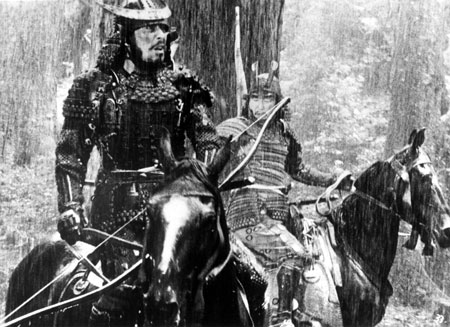
Kurosawa was deeply concerned about human hubris. He once said, “People today have forgotten they’re really just a part of nature. Yet, they destroy the nature on which our lives depend. They always think they can make something better...” There is something magical about his rendition of the landscape in Dersu; the wind, the rain, the sun seem almost to conspire to make the two men lose their way. Then you watch the two warriors befuddled by the forest in Throne of Blood (1957), and you realize that Kurosawa has thought of nature in this way for a long, long time. Transposing Macbeth to medieval Japan, he takes the Birnam Wood of the prophecy (“I shall not be afraid of death or bane, till Birnam Wood come to Dunsinane”) and makes of it an eerie presence more powerful than the strongest warrior: the Cobweb Forest. Even in Seven Samurai, the heroism of the samurai is ephemeral – it is the land and the peasant’s link to it that is forever. Kurosawa was known for his larger-than-life dramas. But what makes his cinema truly epic is the profound sense that there is something larger than the heroic human life.

Published in UTV World Movies magazine, Dec 2010.

1 December 2010

Delhi: Postcards from the Last Century

On a photography exhibition:


Images courtesy of Alkazi Foundation for the Arts

The Alkazi Foundation’s newest exhibition of vintage photographs is an ambitious one: it takes as its subject a much-photographed city, while limiting itself to images from a time that ensures that very few visitors to the show will recognize that city as one they know. 'Historic Delhi: Early Explorations of the Camera c. 1860-1950', showing at the National Gallery of Modern Art, consists almost entirely of photographs from the last century of colonial rule. But under that broad rubric is a variety of pictures.

There are memorable – if strangely empty – images of Delhi’s monuments after 1857 for example, created by pioneering photographers like Samuel Bourne and Felice Beato, and there are high-quality photographs, often of the same monuments, taken for documentary purposes by the Archaeological Survey of India. There are photographs by the famous pre-independence studios, like Lala Deen Dayal, documenting with aplomb such grand affairs as the Delhi Durbars of 1903 and 1911, or showing troops being dispatched along the Grand Trunk Road, a cloud of dust rising around the horses’ feet. There are a few lovely, carefully chosen pictures from the 1940s and 1950s, mostly taken by the news photographer couple Maneckshaw and Homai Vyarawalla – these include some haunting images of Ramlila performers. And finally, there are the anonymous images – annotated, if we’re lucky, with a year and a subject.

In some ways, it is these last that are the most interesting, because they fit less easily into any preconceived category in our heads. Looking at an image like ‘Miss Azijan of Delhi, c.1905’ – a young and pretty woman, photographed without purdah and alone, in 1905 – one imagines she must be a courtesan. But not knowing the photographer or his purpose – British or Indian, old or young, official or tourist, admirer or anthropologist – sharpens our interest. One’s eyes linger longer on Miss Azijan’s carefully arranged pose: one knee placed perfectly upon another, the self-possessed finger on her chin, and the face that remains somehow towards the camera – even as her gaze turns intriguingly away.

Sometimes, of course, a mere caption is enough to slot the image: a shy looking young girl with large earrings, dressed in gypsy fashion, can never escape the words, ‘Delhi Dancing Girl, c. 1905’. It was Jean-Luc Godard who once pointed out that the photograph is “physically mute”. “It talks,” he said, “through the mouth of the text beneath it.” Sometimes, I suppose, that can be a good thing. There are certainly moments when this exhibition comes to life through the inscriptions. Not contemporary curatorial ones (though those are informative enough), but old inscriptions that mark the image, conjuring up with great immediacy the past that lies congealed within it. A postcard with an image of the Mutiny Memorial that bears an exceptionally clear Leighton Buzzard postmark for May 23, 3pm (though the year was illegible to me) – and this laconic message: “Dear Flo, This place was put up by comrades of the men who died in the mutiny.” Closer to the bone is the image of Bara Hindu Rao, with a handwritten inscription as follows: “Our main picquet during the siege. Very hard fighting all round this place.”

Whether the past you’re looking for lies in the stately and studiously composed archival image, or in the postcard accidentally discovered, this is an exhibition worth visiting.

(Published in The India Tube)

9 November 2010

Bringing Back the Funk


Are our films fixated on the 70s? Or just on that decade's cinematic style? And why the 70s anyway?

This year’s big-ticket Diwali release, Action Replayy, starring Akshay Kumar and Aishwarya Rai, is billed as a “science fiction romantic comedy”. But judging by the posters, on which both stars cavort on a scooter or an ambassador (ooh, retro!), with an abundance of flowers (on vehicle, behind hero’s and heroine’s ears) and a greater abundance of polka dots (on shirts, skirts and background) further signifying the retro-ness of a particular decade, it seems that the filmmakers expect commercial success to ride less on the “science fiction” or the “romantic comedy” part than on the thing at the forefront of their marketing: Bollywood’s ’70s fascination.

The Hindi film industry’s announcement of this love affair with the ’70s goes back to another Diwali release, exactly three years ago: Farah Khan’s Om Shanti Om (2007), casting Shah Rukh Khan as a junior film artiste in the 1970s. Some might argue that it goes back yet another Diwali, to Farhan Akhtar’s remake of the Bachchan thriller drama Don (2006) — or to Sriram Raghavan’s deliciously ramped-up noir, Johnny Gaddar (2007). Whichever one favours as its starting point, it seems pretty clear that we’re currently in the middle of a full-fledged romance — this year’s love offerings so far have been Milan Luthria’s Once Upon a Time in Mumbaai, and — very differently — Abhinav Kashyap’s Dabangg. But more on those later.

First, the obvious question: why the ’70s? Why are the ’70s the decade of choice, the decade that the Hindi film industry in the 2000s seems keenest to recreate? One answer, of course, is that it isn’t. Hindi cinema isn’t the slightest bit interested in conjuring up what the 1970s — in India or elsewhere — were really like. What it is interested in, though, is as flamboyant a recreation as possible of what it retrospectively identifies as the cinematic style of that decade — especially the fashion and the music.

The Hindi cinema of the 1970s provides, for some reason, the cinematic ancestry that today’s directors wish to claim as their own. A reason often provided in interviews is that these were the films that today’s directors grew up on — so that even an otherwise English-speaking, deeply PLU Farhan Akhtar (who once said in an interview that he didn’t know what “chamkeele” meant until his father Javed put it in the lyrics of Dil Chahta Hai) reminisces about watching the super-cheesy Don over and over as a child. But there is more to it, I think, than a simple generational coincidence.

The ’50s and early ’60s are at too great a distance, the ’80s and much of the ’90s have been dismissed as distasteful and violent by today’s more urbane and sanitised standards. The 1970s, then, remain as the awkward but endearing dehati caterpillar past, which the slick, globalised, glittering creature that’s 2010 Bollywood is able to look back on fondly.

Within that broad spectrum, different films seek to do very different things. Farhan Akhtar may remake Don, but he is far from recreating cheesiness. If anything, Akhtar’s revamping is self-conscious, stylish and contemporary. In an odd way, Akhtar’s Don fits better within the larger circuit of Bollywood nostalgia — the drawing room-ification of once rambunctious film poster art, the creation of a “golden age” of “classics” by popular histories, exhibitions and programming ranging from Videocon Flashback to Lata Mangeshkar’s Shraddhanjali recordings, and the opulent, colour-drenched remaking of minimalist B&W “classics” from Devdas and Parineeta to Sahib, Biwi aur Ghulam — than does something like Om Shanti Om.

A gloriously over-the-top tribute to every Hindi film cliché there ever was, OSO also put Shah Rukh Khan (in double role!) at the centre of a take on of Subhash Ghai’s 1980 reincarnation drama, Karz. Here, the desire to laugh at ourselves — or rather, at our tradition of romantic melodramas, goes hand in hand with a we-can’t-help-ourselves love of the genre. The same goes for Johnny Gaddar — except with reference to the Vijay Anand crime capers of the ’70s. And Once Upon a Time in Mumbaai, while ostensibly telling the tale of real-life Mumbai gangster Haji Mastan, actually reprises a million cinematic retellings of that tale, starting of course with Deewar (1970). Ajay Devgn’s Robin Hoodish gangster, his stylish white shirts, the deliberately overblown dialogue — all of these are intended more to echo the Bachchan films of the ’70s than the ’70s themselves.

The most interesting ’70s tribute, though, is Dabangg, which brings back the hero’s traumatic childhood as explanation for his future cinematic journey — a la Amitabh — and places parental relationships at its core. It also contains a moustachioed hero and a heroine who actually fills out her ghagra-choli. Like the heroes and heroines of the ‘70s, who may have worn outrageous clothes, but who still seemed a little more like us. Perhaps the key to more substantive cinematic nostalgia is to go a little deeper than the surface. As a British Asian album called Bollywood Funk announced as its project back in 2000 — “We have to take it back... to the days before bad lipstick and airbrushing gripped the world of Bollywood and there was another force. The force was funk... Bollywood Funk.”

The writer is a Delhi-based writer and anthropologist.

Op-ed piece published in the Indian Express, November 5, 2010.

The Power of the Photograph: Historic Delhi

A review essay on the 'Historic Delhi' photography exhibition at the National Gallery of Modern Art, in The Caravan.


The Jama Masjid during the Delhi Durbar of 1877
Roland Barthes once wrote that photography started out by photographing the notable, but soon it decreed notable whatever it photographed. Almost all the images in Historic Delhi: Early Explorations of the Camera c. 1860-1950, the Alkazi Foundation’s newest exhibition of vintage photographs, belong to that truly early era, when the camera was still understood as something meant only to capture the momentous, the monumental or, at the very least, the exotic. Which is probably why, to our jaded 21st-century eyes, these pictures seem, at first glance, somewhat dull. As Susan Sontag already understood in On Photography (1977), “[t]he image-surfeited are likely to find sunsets corny; they now look, alas, too much like photographs.”

It is a difficult task to imagine in 2010 how magical it must have been to see, circa 1880, the Jama Masjid as one saw it every day from Dariba Kalan, or the Red Fort on a wintry morning, captured in silver and grey, frozen into permanent two-dimensional form. It is particularly difficult at a time when the many channels of the ceaseless image-production machine—hoardings, tourist brochures, newspaper supplements, television channels—bombard us (or at least those of us who live in Delhi) with images of these very structures, almost challenging the eye not to see them as clichés.

And yet, if one gives them a chance, some of the Historic Delhi images can make the same things appear utterly fresh. Sometimes it is the mental doubletake as the eye recognises some element that has remained constant in a space otherwise almost entirely transformed. Sometimes it is the starkness of the composition, the frame empty of everything except the building — a building we may have seen a million times, but never without people. The gleaming whiteness of the Hazrat Nizamuddin dargah in Samuel Bourne’s image from 1865, or Humayun’s Tomb in an Archaeological Survey of India (ASI) photograph from 1923-4, for example, appear almost eerily unmarked by human presence—or time.

What is the visual pleasure one might get from such an image? It is the opposite of that which one usually derives from old things — rather than presenting us with the comforting patina of age, the old photograph magically strips away layers of time to reveal an object that is almost unbelievably pristine.

This ability to conjure up a slice of the past, to make it seem as concrete, as specific, as real as everything we see around us in the present — this is the unique power of the photograph. But it is a double-edged sword. Photography constantly seeks to capture the present, but by virtue of having captured it, imbues that present with pastness. And like modernity itself, while it seeks to preserve what is past, it is irrevocably embroiled in the disappearance of that past.

The history of early photography everywhere is entwined with the history of vanishing peoples and customs. Sontag puts it sharply, as always: “From the start, photographers not only set themselves the task of recording a disappearing world, but were so employed by those hastening its disappearance.”

If colonial era anthropologists everywhere, from the Americas to Africa, saw it as crucial to photograph the traditional life-worlds they were studying, urban photography in the 19th century sought to enshrine a fast-changing Paris and London. In the Indian context, of course, photography was hardly independent of the colonial apparatus. Much has been written about its connections to the machinery of military and administrative expansion, as well as the fixing of colonised identities into a frozen ethnographic present — even as the world being fixed in images was being transformed by the same colonial processes.

There is now also a growing body of writing that examines photography’s role in the recording and preserving of historic buildings. The legendary French conservationist Eugene Viollet-le-Duc commissioned a series of daguerrotypes of Notre Dame Cathedral before he began his controversial restoration in 1842. In colonial India, too, accurately depicting the extent of decay — the pre-restoration photograph — was seen as the first step in bringing a building’s state to wider notice, and thus preserving it. There was also the post-restoration photograph. Official records were thus created in what we might now refer to as ‘Before and After’ mode.

The Alkazi exhibition presents us with at least three such images from the ASI, all immaculately composed, and bereft of people: the impressively Ozymandias-like ‘Entrance to Purana Qila before restoration, Delhi, 1914’; the earlier mentioned ‘Humayun’s Tomb with restored Tank and Gardens, Delhi, 1923-4’ and ‘Tomb of Illtutmish, c.1915,’ showing the interior in splendid detail. There are also images here that belong to a related tradition, ‘the picturesque.’ An artistic style that evolved in 18th-century Europe and became a staple of colonial representation, the picturesque composition involved landscapes with classical buildings, preferably in a state of ruin, preferably overrun by vegetation, and—unlike the scientific architectural photograph, which was almost always devoid of people — a few human figures visible at a distance, preferably ragged. The famous photograph of Flagstaff Tower, Delhi, taken in 1858-9 by Felice Beato and included in this exhibition, is in this mould. Although it is too soon after the 1857 revolt for the building to be overgrown, there are visible cannon holes in the wall and doors and a boundary wall swiftly turning to rubble — well as three carefully positioned natives, their faces in shadow.

It has been argued that such images, with their emphasis on a glorious past and a ruinous present, worked to legitimise a colonial narrative of civilisational transition. Whether you find this convincing or not, it is impossible to ignore the startling emptiness of these frames, and the strangely controlled human presence. In the first of three Chandni Chowk images, a moustachioed man looks calmly into the camera. In the second, taken by Samuel Bourne, the three men mid-frame have clearly been told to stay there and stand still. The third is the oddest: the shadows are strong and the streets deserted, except for a single figure perched on a buffalo. An odd image to create, surely, of what had to have been the busiest bazaar in the city?

Chandni Chowk, photographed by Samuel Bourne
But perhaps all this is barking up the wrong tree, and all that the picture testifies to is the shimmering heat of a Delhi summer afternoon, people hiding from the sun which glints off the buffalo’s back. And there are, indeed, simpler pleasures to be derived here. One smiles happily to oneself at the bamboo trellises around planted saplings and cement enclosures around them, their concrete particularity turning this unfamiliar black and white city into one we know.

An ASI image of the Diwan-i-Khas, circa 1880, shows the fort shorn of all its splendid lived grandeur—there are none of the furnishings that must have existed even 25 years previous. This is cleverly juxtaposed with an image from 1913-4, called ‘Recreated Mughal Room, Khwabgah,’ which marks an experiment where Mughal palaces in Delhi, Lahore and Agra were restored and refurbished under the ASI’s John Marshall. In a different part of the exhibition is a photograph from an in-between decade: the Red Fort lit by electric lights, looking incongruously like a ballroom— apparently taken just before the arrival of the guests at Curzon’s Delhi Durbar, 1903.

A preliminary thought that might bear considering: the colonial-era images we see here seem to contain either the rigidly controlled two or three locals, or else move full scale into the realm of the crowd. The most impressive of these crowd pictures is of people gathered outside the Jama Masjid during the 1877 Durbar: a vast assemblage of humans surrounded by their camel carts, bael gadis and innumerable buffaloes, and the mosque rising up at the back, every available parapet overflowing with people.

One whole section, in fact, is devoted to the three Delhi Durbars of 1877, 1903 and 1911. Most of these images—the vast tent cities, or the king and queen on an elephant—are staid depictions of the notable, a la Barthes. But there are exceptions. One such is the photograph of the Begum of Bhopal arriving at the 1911 Durbar, which is arresting for many reasons. First, it is among the few images in the exhibition with a person in the foreground, occupying at least a third of the frame. But more than that, it is that the woman striding purposefully toward us is completely veiled. All eyes are upon her, within the frame and without, but her expression, even the look in her eyes, will forever remain a mystery. In ‘Elephant Being Howdahed, 1911-2,’ a huge crowd of attendants is gathered around the poor patient beast, with only two men actually involved in fixing the howdah. It is a sharp visual commentary on the vast scale of (probably largely unnecessary) labour that kept the Raj running.

The mid-20th century section is relatively dull, redeemed only by some splendid photographs taken (separately) by Homai and Maneckshaw Vyarawalla. While Homai’s ‘Christmas Day Celebrations, 1947,’ with its grinning crowds in Connaught Place, satisfies one’s latent desire for a celebratory post-Independence moment, it is Maneckshaw’s lovely Jantar Mantar image from 1945 that seems to offer the perfect response to the constrictedness of all the earlier monument images. Two women in ghunghats descend the Jantar Mantar staircase, while at the far end of the lawn two figures in sola topis — policemen? — walk away from us. The monument is still very much centre-stage, but the women are neither dwarfed nor alienated by it. It is not a space they are likely to have been in before, and neither the building nor the stately rows of palm trees offers any shade from the sun—yet they seem, somehow, entirely at home.

Published in The Caravan.