6 December 2008

A house full of TVs: thoughts on Oye Lucky Lucky Oye


An edited version of this was published in the Indian Express, Dec 6, 2008.

India's fault lines, explored in a film about a Delhi thief.

Fifteen minutes into Dibakar Banerjee’s new film, a bunch of lower middle class Delhi boys are beating up a private school kid whose one refrain is a pleading “Jaan de bhai, extra class hai”. They don’t stop. But at one point, the gangly teenaged sardar pauses in his pummelling to make the padhaaku kid answer a crucial question, “Yeh greeting card mein likha kya hota hai?”


The greeting card is just one of the motifs that Banerjee uses, brilliantly, to allude to the fault lines of class and language upon which the shaky foundations of post-liberalisation India rest. Having figured out that there’s something about greeting cards that makes girls happy, the turban-clad young Lucky makes a pilgrimage to the nearest Archies Gallery, shyly wooing the franchise owner’s daughter by taking her for a ride “from Tilak Nagar to Rajouri” on a “borrowed” motorcycle. Lucky’s bid for the girl’s affections is foiled by a smarmy waiter (and the fact that the card he’s brought her reads “Get Well Soon”) but the greeting card appears repeatedly in the film as an object of desire – and as an object that symbolizes desire.

For Oye Lucky Lucky Oye is, more than any Hindi film till date, a film about the cycles of desire set into motion by the shiny new world of malls and Mercedes which lies just across the road from the ration ki dukaan. Across the road, and tantalizingly behind the glass – as the achingly apt lyrics of one song go, “Jugni charhdi AC car, jugni rehndi sheeshe paar”. But what is seemingly beyond one’s reach is not necessarily so. As Lucky says belligerently, having expressed some new outlandish aspiration to his friends, “Kyon? Main nahi kar sakta kya?”

But clearly, the path to the good life, for someone like Lucky, isn’t exactly made accessible by treading the straight and narrow. And so Lucky is a thief. He’s the most charming thief you’ve ever met, saying namaste to unsuspecting old Chaijis before driving off with their son’s cars and persuading young girls that the music system he’s carrying away is being replaced with an even better one by Papa.

Cars, music systems, colour tvs, carved furniture, framed pictures: these are the objects that Lucky steals, time and again. Partly the stealing is a lark, a response to the dare – “Main nahi kar sakta kya?” It’s also a passport – the only one he can get – to the murky yet luminous lives of Delhi’s rich: as the song declares, “ABCD chahida mainu, DVD vi chahida mainu…” (In one of the film’s most audacious early scenes, asked to organize a car as a “gift” to a politician’s bratty son, Lucky drives away from a posh wedding with a guest’s shiny red Merc. But when the brat expects him to play submissive chauffeur, and he’s refused entry to a discotheque the brat has just entered, an enraged Lucky charges into the hotel boutique and acquires two identical black velveteen suits for himself and his friend Bangaali – and sure enough, now there’s no problem walking in. The scene is funny, but also a sadly accurate depiction of the entirely taken-for-granted “what you wear is what you are” class politics upon which the everyday life of our cities is founded.) Finally, the objects Lucky steals aren’t merely a way to make money. Stacked in ever-increasing piles in his flat, those TVs and music systems create a claustrophobic mise en scene of middle class consumption gone crazy: a strange excess that somehow simultaneously stands in for the security of home.

Despite its unerring eye for our disparities, Oye Lucky admirably takes no moral high ground. Every character has a context, a location, a reason for being who they are. The women, particularly, are superbly observed studies in class and morality: the slinkily-clad, foul-mouthed Dolly, who dances in parties for a living but keeps a vrat every Tuesday; her quiet college-going sister Sonal, who “doesn’t touch Dolly” when she comes home drunk, but happily goes on holiday with her burglar boyfriend. Best of all, the gaze is reversed often enough to prevent any easy identification with one character: if the giggling South Delhi schoolgirls in the cafĂ© make Sonal uncomfortably conscious of her lack of coolth, her disapproval of their short skirts is unequivocal (another angle on “what you wear is what you are”).
The film’s subtle but clear message is that the ostensibly legal, respectable world isn’t all benign, just as the illegal world isn’t unmitigated evil. The smooth-talking Dr. Handa is the perfect personification of Bangaali’s warning: “In gentry wale logon se bach ke rahiyo, yeh bolte English hain, karte desi.” Amid the careless blacks and whites with which so many urban commentators paint large swathes of our cities, Oye Lucky provides a caressing, careful shade of gray.

An edited version of this was published in the Indian Express, Dec 6, 2008.

5 December 2008

Sorry Bhai - Film Review

Advertised as a love triangle – two brothers in love with the same girl – Sorry Bhai is actually a film about the new Indian family – siblings who want different things from life, yet share a special bond; a young woman cut off from her family who wants to adopt her boyfriend’s; the intense mother-son relationships that lie just below the laid-back, urbane, upper middle class surface. If it did nothing else, Sorry Bhai would still deserve our gratitude for giving Shabana Azmi her first real Ma ka role – a superbly-written part that draws on (and cleverly tweaks) the Hindi film mother persona, with all its emotional overload, while simultaneously allowing Shabana to channel her inner superbitch.

Moving smoothly from bantering with her husband Navin (Boman Irani, absolutely spot-on as the relaxed, jokey father) to making things just slightly uncomfortable for her bahu-to-be, Shabana plays the hard-to-please Gayatri to perfection. It’s a slim plot, and a lot depends on the performances. Shabana and Boman, of course, are exceptional actors, and share an easy camaraderie that gives the film its most endearing moments. Sharman Joshi, too, delivers a top-notch performance as the absent-minded physics professor who finds himself falling for his brother’s bride. Sanjay Suri does alright as Harsh, the clean-cut elder brother who’s so preoccupied saving his client from a stock market crash that he can’t see that it’s his fiancĂ© who really needs handholding, while Chitrangda Singh makes an effortlessly sexy Aaliyah, (making Sharman’s predicament seem quite understandable), and brings an edgy vulnerability to her scenes with Shabana.

But since many will watch this film for Chitrangda’s “comeback”, it must be said that her character is its weakest link. She’s introduced as a bookworm, but never seems like one; her sudden attraction to Sharman seems inexplicable, and the scenes where she’s confiding in her friend are dismal. (How bad our “sensitive” male directors are at creating credible girl-talk scenes – first Rock On, and now this.) Add to this Chitrangda’s Hindi. Her accented, slightly stiff delivery may have passed muster in Hazaaron Khwaishen Aisi, where she was meant to have grown up abroad, but here, mouthing lines like, “Tum apne hone wale pati se pyaar karti ho!” as she looks in the mirror, it’s a disaster. But this is a malaise that afflicts many of the cool new breed of films about cool young people: conversations conceptualized in English (like the one at the jazz bar here) sound stilted in Hindi – partly it’s bad translation: these dialogues have none of the colloquial fluency of real speech; but partly its because the people called upon to deliver them probably never say anything important in Hindi in real life.

For Tehelka magazine, Dec 2008

Taj Mahal - Book Review

There can’t be too many pieces of architecture in the world that deserve a book to themselves more than the Taj Mahal. And when a building is as mythologized in the popular imagination as the Taj is, the best thing a book about it can do is to incorporate those myths into the telling. Giles Tillotson does this with consummate skill – never depriving us of the pleasures of a juicy story, while all the while unerringly sifting fact from fiction in a surprisingly easy style. Thus, we get a memorably wry account of the familial politics of the Mughals, locating the Taj spendidly and accurately within a web of personal and cultural histories, while not refraining from the occasional jibe – eg. Aurangzeb’s “outrageous display of crocodile tears” upon hearing of the death of his imprisoned father.

As a historian of South Asian art and architecture, Tillotson is clearly in a position to trace the building’s architectural form to its variously Timurid, sultanate and Indian roots. He also deals summarily with the historical and artistic controversies that have plagued the Taj since the nineteenth century, laying to rest such persistent ghosts as the duplicate-black-Taj-across-the-river theory, or the suggestion that the Taj’s craftsmanship, and more perniciously, its chief architect, were of Italian origin. Extracts from gushing travelers, grudging colonial historians and ranting Hindutva “historians” are woven expertly into a persuasive, measured narrative that pays as much attention to the building itself as it does to the reasons why it has been seen so differently by different people.

Finally, Tillotson provides a fascinating account of attempts to recreate the Taj Mahal in painting, photography and architecture, and a crucial chapter about the monument’s conservation, detailing the indignities it was subjected to by Jat marauders and British picnickers alike, the repairs and additions undertaken by Curzon and the more recent threat posed by the “Taj Heritage Corridor” project.

A slightly edited version of this review was published in Outlook Traveller magazine, December 2008 issue.

Court Martial

Swadesh Deepak’s 1970s play about caste in the army remains as searing as ever, finds Trisha Gupta

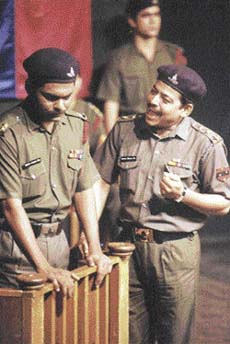
In the true tradition of the courtroom drama, the action of this now-classic play takes place almost entirely within four walls. The plot revolves around the trial of one Sawar Ramchandar, who is accused of having opened fire on two superior officers, Captains Kapoor and Varma. Only Kapoor survived and is now a witness in the court martial proceedings against Ramchandar.

The play opens with Ramchandar’s act of violence being treated by all concerned as unprovoked and inexplicable. Some time is spent on establishing that as the soldier on duty at the post, he could have – but had not – challenged the two senior officers in standard military fashion (by shouting out “Tham, kaun hai?”). Then the interrogation of the army doctor (a great potential cameo utterly wasted by Rahul Batra) brings to light a past incident when Ramchandar had reported sick, but been compelled to report for a hockey match based on Kapoor’s intervention (“These johnnies are always shamming”). Ramchandar had then collapsed on the field. As Bikash Rai, the righteous, sarcastic defence lawyer (decently played by Bajrang), begins to probe into these seemingly insignificant details, we are drawn deeper into the past relationship between Ramchandar and Kapoor, and an ugly tale of caste prejudice and violence emerges.

Asmita’s production has many flaws – the long-winded opening monologue by Deepak Ochani as Colonel Surat Singh, for instance, is often unintelligible because he speaks much too fast, and the “flashback” sequences, which invariably involve a bunch of shouting men running onto stage, are markedly amateurish in execution. But Swadesh Deepak’s tightly-structured script is both important and courageous, because it manages to convey how caste prejudice still simmers just below the surface of relationships in contemporary urban India, and because it does so by setting the action in a context which is itself deeply hierarchical – that of the Indian army.

The only weak link in the script is the character of Captain Kapoor, who is shown as nothing short of a monster: apart from being feudal and unremittingly casteist, he’s also an alcoholic who beats his wife. Such overkill can only detract from the play’s effect. As with any villain, you stop perceiving him as a regular guy – which is unfortunate, because this play could have demonstrated precisely how regular people, in regular jobs, regularly treat other human beings as inferior on the basis of their birth. Court Martial overstates the case – then again, perhaps this is an issue that can do with reiteration.

Time Out Delhi, 2007

Dramatic Effect: Lokesh Jain

Trisha Gupta finds out where Lokesh Jain would like to take theatre when he's taken it out of Mandi House.

“Structure, like speed, can be very masculine,” said Lokesh Jain. “There is a need for structure, but also a need to break that structure at times.” Jain has always been interested in breaking strict boundaries, whether they’re those of form, class or community. His current solo performance based on Sharankumar Limbale’s autobiography, Akkarmashi, emerged out of a long engagement with theatre as a social art. “Theatre does not evolve in isolation. There is no theatre without social conflict,” stressed Jain, who began his involvement with drama through street-level interventions in Delhi after the anti-Sikh riots of 1984.

Jain may have been a theatre artist for 17 years, but he’s been a Dilliwala all his life. He grew up in Old Delhi, and still lives in the family home near Dilli Gate. His khadi kurta and scraggly beard may be completely at home in the comfortably arty environs of Triveni Tea Terrace, but Jain is deeply invested in taking theatre out of Mandi House and into the city’s schools and streets. He is a founding member and creative director of Jamghat, an organisation of and for street children in Delhi. He has been associated with the NGO Pravah for six years, and is also part of a collective of artists and development professionals called Mandala, whose Theatre-in-Education wing does plays and workshops for children. “We have taken well-known pieces like Ferdinand the Bull to different spaces, through theatre workshops in an orphanage near Jama Masjid,” said Jain.

Armed with an advanced diploma in acting from the Living Theatre Academy, where he trained in the early 1990s under Ebrahim Alkazi, Jain has long been experimenting with theatre that draws on local cultural forms. “You know, people in Manipur go on tiptoe to catch fish in the water – and that movement is incorporated in the region’s theatrical forms. And I count myself a murid [disciple] of Ratan Thiyyam, who is a master [of this sort of thing].” Jain’s realisation of the need to “explore one’s own roots” led to a consciousness that even urban settings have cultural conglomerations that are quite specific. “In Old Delhi, where I live, for instance, there is a composite culture, with Hindus and Muslims; there is an elite culture as well as a working class culture,” Jain said, describing how his interest in Delhi grew while researching an exhibition, “Shadow Uncensored”, in 1995-56. This interest led him to be part of KLOD-B (Knowing Loving Delhi Better), an organisation that he began with a group of friends in 1997-98 to explore the city on foot.

Jain’s concerns extend beyond the urban environment, though. He once evolved a version of Macbeth drawing on contemporary experiences “in the jungles of Assam”. Similarly, Akkarmashi, on this fortnight at The Attic, is based on the harrowing account of a childhood in a Maharashtrian village by the Dalit activist, writer, editor and critic Limbale. Caste made an appearance even in Premchand stories, Jain pointed out, “but a first-person narrative is different, it is painful for the audience and for me”. For Jain, this one man’s story describes “a 5,000-year-old history of suffering”, which he feels is getting lost in the current political climate. “I am not on any side. Party politics is all vested interests. Mine is simply a reaction to the violence that existed.

Time Out Delhi, 2007

Stamboul train: Mohan Maharishi's play 'Main Istanbul Hoon'

Published in the theatre pages of Time Out Delhi, Oct 2008: 

Trisha Gupta finds Mohan Maharishi travelling in time. Again.


Mohan Maharishi has never been to Istanbul. But he visits it all the time, in his mind. This fortnight, when his new production, Main Istanbul Hoon, opens its doors to the public, you can travel some of the way with him. It’s likely to be a complicated journey, moving not just from Delhi to Istanbul, but looping and whorling backwards in time, first to the mid-twentieth century and then the sixteenth. Maharishi hopes to conjure up something of the splendour and melancholy of another grand old city for Delhi’s audiences. “I’m interested in the resonances between Delhi and Istanbul. When I read histories of Ottoman Istanbul, I am reminded of Ghalib trudging knee-deep in blood, from Delhi to some place of sanctuary, in 1857,” he told us. “Both places have the same kind of division between Old City and New. In Delhi, there is also the third, which I sometimes call the ‘Ugly Delhi’, ever-spreading…”

Drawing on works by the celebrated Turkish writer Orhan Pamuk, Main Istanbul Hoon has as its central character a crotchety, cynical old man called Resat Ekrem Kocu, a popular historian of Istanbul who spent much of his life writing historical columns for newspapers. Kocu appears in Pamuk’s Istanbul: Memories of a City, a somewhat eccentric figure, forever torn between his fascination with “the oddities, the weirdness of life in the margins” and his admiration for grand Western classificatory systems. The product of this conflict was his greatest labour of love: an anarchic encyclopaedia devoted to Istanbul, on which he spent 20 years, only to finally abandon it 11 volumes later, having reached the letter G.

Maharishi takes this fascinating – and all-too-real – character, and builds around him a theatrical web of fantasy. Gathering material for the 12th volume of his encyclopaedia, Maharishi’s Kocu travels to the sixteenth century, where a complicated love story is playing itself out (with more than a nod towards My Name is Red). A talented painter falls in love with his first cousin. Unable to deal with the wrath of her father, his uncle Usman, the painter leaves the city. Returning from his travels after 12 years, he is shocked by how much Istanbul has changed. “There is so much more traffic, noise, people…” Maharishi smiles at how this sixteenth-century reference is an indicator of our own times.

The creator of Einstein and Vidyottama discovered a long time ago that the stage offers unlimited creative possibilities if you want to play with time. “The old unities of time, place and character are not necessary. If you move convincingly between centuries, the audience will move with you,” he said. He reminisced about Einstein, possibly his best-remembered play, in which three Einsteins meet – the school-going child, the youthful one and the old professor in Princeton, very famous but marginalised. “No one questioned it,” Maharishi said. “The audience enjoyed the sensation. The young Einstein is excited. He’s going to propose to Mileva today; he’s full of her. The old one turns and says, ‘Mileva died today’. There is drama in this, drama created by time.”

Created for the National School of Drama’s golden jubilee celebrations and performed by the NSD’s highly competent repertory, Main Istanbul Hoon is simultaneously a love story set in sixteenth-century Istanbul and a paean to the city that lives on. It is also a tribute to Orhan Pamuk. “Pamuk writes about how, when he abandoned an architectural career, his mother was very angry. There’s a scene in my play, when his mother says, ‘You probably think you’re somewhere in Europe, where you say the word Picasso and the water freezes. But this is not Europe. This is Turkey, and who cares about art here?’” There are resonances here too. Maharishi can only hope that Delhi audiences will recognise them.

Time Out Delhi
, Vol 2 Issue 15 (Oct 17 - Oct 30, 2008)