Hindi: chhoti haziri, vulg. hazri, 'little breakfast'; refreshment taken in the early morning, before or after the morning exercise. (Hobson-Jobson: A Glossary of Colloquial Anglo-Indian Words and Phrases, 1994 [1886])
27 November 2008
Book Review: Dreams for the Dying
Sketch Of A Murder
CK Meena’s jigsaw-like novel turns the reader into a participant.
Dreams for the Dying is a disquieting read — and not because it’s a murder mystery. It’s not the sort of book whose world you sink into, grateful for the respite from your own. There is a world — and a deftly imagined one — but CK Meena revels in providing teasing glimpses of it; it’s a provocative sketch that forces you to imagine the rest, rather than the careful portrait you linger over.
There is a locale, middle-class Chennai, but no elaborate urban geography — just an apartment building where the murder takes place, and the bare bones of a neighbourhood: the daily clamorous din of a popular local restaurant, and the comings and goings of maids, watchmen and residents. The focus is on interior space: the insides of rooms and minds. The central character, Uma, with her deliberate vagueness, is difficult to pull off, especially when the only aid is a diary that mystifies more than it explains, but Meena knows her characters. She has a flair for the unexpected detail that brings a minor character to life: like telling you that the neighbour, Mr U Nathan, is a “stylishly clipped” version of Ulugunathan, or having him imagine a bahala bhath (“Good for those with BP also”) when he passes a waiter on the stairs.
Segments of lives past and present are scattered carefully amid the minutiae of a murder investigation. But this isn’t an ordinary murder mystery. The narrative isn’t chronological, and there are several characters whose role in the “story” is tangential — they exist solely for the reader’s benefit. The book has many of the “types” that populate crime fiction universes, but it subverts some and generously expands others. There is a police team, the methodical Mageshwaran and his head constable Ponnusami, but they are neither hard-boiled heroes nor the buffoons Indian popular cinema loves so much. Instead, we get two ordinary South Indian men into whose interaction is woven every possible police station dynamic: age, class, ribald humour, competitive masculinity.
Meena’s language is comfortingly at home with Indianisms: “When Manja was in third standard…” sounds perfectly right. Her frequently overdone analogies are harder to digest, and she isn’t very good at handling strong emotion — “jealousy towards one woman and rage towards another tore him in two”. But this isn’t a book you should look to for felicitous turns of phrase — it’s an intriguing jigsaw puzzle that’s fun to put together.
From Tehelka Magazine, Vol 5, Issue 46, Dated Nov 22, 2008
Column: Raat ka Reporter
The third instalment of a column for Time Out Delhi, about books set in Delhi.
Signs of the Times
Nirmal Verma’s novel Raat ka Reporter, set in Delhi during the Emergency, was published in 1989. Unimaginable as it may seem, that Delhi was a city where it was easy to be completely alone. Not just on the ridge beyond Jhandewalan, where Verma’s protagonist Rishi goes running every morning, but in the midst of the city. The very emptiness of the city’s streets gives Verma his perfect milieu: he couldn’t have found a better metaphorical locale for Rishi’s slow descent into paranoia than New Delhi’s deathly calm.
An atmosphere of menace is established almost before anything happens: Rishi is watching a young girl rolling a tyre down the road when she suddenly disappears from view. “This sort of thing happened often in some parts of New Delhi. Something could be seen for a moment, a clerk riding a bicycle, a slow-creaking cart, an odd crippled beggar, but before the eye could register it, it would vanish, swallowed by some dark lane, and the street would be desolate and lifeless as always, as if it were impossible for an event or an accident to take place there.”
In this portrait of a vast, silent city, there are occasional glimpses of peace, of normalcy. As long as Rishi is running, the world seems to pass by in a yellow haze, punctuated only by the sound of distant bullock carts or the bells of Birla Mandir: as Verma so pithily puts it, “Nothing can go wrong with the life of a man who can go for a run in the morning”. But it’s clear that the running is an escape into routine, from an outside world whose certainties are beginning to crumble under the burden of suspicions and half-truths. The Gole Dakkhana church signboard, on which a new Biblical quotation appears every day, seems to Rishi an augury. The interrupted ring of the telephone, the kites hovering in circles over Urdu Bazar, “like dark rumours” – everything is a sign. The city is transformed into a series of hidden inscriptions, a text whose meaning he must decode in order to survive.
The uncanny thing about this cityscape is how much of it is still with us – the nightly thhak-thhak of the watchman’s stick, the sudden nip in the autumnal air, the sharp, acrid smell of burning leaves – these are as familiar to us from last week as they were to a Delhi resident of the 1970s. There are new signs, too, if we wish to read them – the eerie neon glow of hoardings at night, the gleaming outlines of BRT bus lanes, the blast of air-conditioned air when the automatic mall doors open. What we seem to have lost, in fact, is our capacity for disbelief – and with it, any ability to perceive the city that lies pulsing beneath this thick coat of signs.
Rishi lived in strange times: even as he sank deeper into a morass of unnamable fears, he became more convinced that every report written “is a proof, not of their truth, but of your lie”. But our time is stranger still. We believe everything we read, or pretend to. The fear has become part of our skin, we wear it as armour, proudly.
Raat Ka Reporter, by Nirmal Verma, Rajkamal Prakashan, Rs 125
Translated as Dark Dispatches, by Alok Bhalla, HarperCollins,Rs 70
Back of the Book, Time Out Delhi, Vol 2 Issue 17, Nov 14-27, 2008
Nirmal Verma’s novel Raat ka Reporter, set in Delhi during the Emergency, was published in 1989. Unimaginable as it may seem, that Delhi was a city where it was easy to be completely alone. Not just on the ridge beyond Jhandewalan, where Verma’s protagonist Rishi goes running every morning, but in the midst of the city. The very emptiness of the city’s streets gives Verma his perfect milieu: he couldn’t have found a better metaphorical locale for Rishi’s slow descent into paranoia than New Delhi’s deathly calm.
An atmosphere of menace is established almost before anything happens: Rishi is watching a young girl rolling a tyre down the road when she suddenly disappears from view. “This sort of thing happened often in some parts of New Delhi. Something could be seen for a moment, a clerk riding a bicycle, a slow-creaking cart, an odd crippled beggar, but before the eye could register it, it would vanish, swallowed by some dark lane, and the street would be desolate and lifeless as always, as if it were impossible for an event or an accident to take place there.”
In this portrait of a vast, silent city, there are occasional glimpses of peace, of normalcy. As long as Rishi is running, the world seems to pass by in a yellow haze, punctuated only by the sound of distant bullock carts or the bells of Birla Mandir: as Verma so pithily puts it, “Nothing can go wrong with the life of a man who can go for a run in the morning”. But it’s clear that the running is an escape into routine, from an outside world whose certainties are beginning to crumble under the burden of suspicions and half-truths. The Gole Dakkhana church signboard, on which a new Biblical quotation appears every day, seems to Rishi an augury. The interrupted ring of the telephone, the kites hovering in circles over Urdu Bazar, “like dark rumours” – everything is a sign. The city is transformed into a series of hidden inscriptions, a text whose meaning he must decode in order to survive.
The uncanny thing about this cityscape is how much of it is still with us – the nightly thhak-thhak of the watchman’s stick, the sudden nip in the autumnal air, the sharp, acrid smell of burning leaves – these are as familiar to us from last week as they were to a Delhi resident of the 1970s. There are new signs, too, if we wish to read them – the eerie neon glow of hoardings at night, the gleaming outlines of BRT bus lanes, the blast of air-conditioned air when the automatic mall doors open. What we seem to have lost, in fact, is our capacity for disbelief – and with it, any ability to perceive the city that lies pulsing beneath this thick coat of signs.
Rishi lived in strange times: even as he sank deeper into a morass of unnamable fears, he became more convinced that every report written “is a proof, not of their truth, but of your lie”. But our time is stranger still. We believe everything we read, or pretend to. The fear has become part of our skin, we wear it as armour, proudly.
Raat Ka Reporter, by Nirmal Verma, Rajkamal Prakashan, Rs 125
Translated as Dark Dispatches, by Alok Bhalla, HarperCollins,Rs 70
Back of the Book, Time Out Delhi, Vol 2 Issue 17, Nov 14-27, 2008
Labels:
books,
cities,
Delhi,
Emergency,
Nirmal Verma,
Raat ka Reporter
3 November 2008
Roadside Romeo Review
FILM » ROADSIDE ROMEO
DIRECTOR » JUGAL HANSRAJ
STARRING » SAIF ALI KHAN, KAREENA KAPOOR, JAVED JAFFREY, SANJAY MISHRA
Footpath-Breaking?
TRISHA GUPTA
A TILED ROOFTOP on a moonlit night. Our hero, enchanted by the unknown voice wafting down to the street below, climbs up to find out more — and falls instantly in love with the pretty girl who’s singing. He takes her in his arms, matching his steps to hers, and when the dance is over, leans forward expectantly for a kiss. At which point she turns away, mid-pout, flutters her eyelashes and says, “Main vaisi ladki nahi hoon.”
Would you be disappointed to find out, at this point, that our hero is a dog called Romeo and his love interest a ‘girl dog’ called Laila? You shouldn’t be. Because this is a Yash Raj film, and there is not the slightest difference between dogs and human beings — or rather, Bollywood beings. Every self-respecting dog here struts on two legs, and the super-curvaceous Yash Raj bitches could give most item girls a run for their money. Romeo’s coolth is really all Saif, while the coy Laila is the worst of Kareena poured into canine form.
Even if one grants that successful animation films, especially Walt Disney productions, have traditionally anthropomorphised the non-human species they depict, Roadside Romeo isn’t a patch on recent achievements like the superb futuristic Wall-E (2008) or such doggie classics as Lady and the Tramp (1955), even in the animals-aswindow- into-human-world department. It’s probably a comment on our times that Romeo’s plot inverts that of Lady and the Tramp, where Lady, a spoiled, upper-crust dog who runs away when her owners have a baby, is saved by a Butch, a tough dog who shows her the possibilities of a free life without constraining leashes. In Jugal Hansraj’s world, the pampered upper-class dog has nothing to learn from the street dogs. It’s the poor, unsophisticated goons who need lessons in grooming from Romeo. Even Anna Charlie, the don of the dog world (voiced with gusto by Javed Jaffrey), can’t win Laila’s heart — not because she has a problem with what he does, but because he’s fat and bespectacled. In fact, the film turns on the premise that girls only fall for guys who look ‘cool’. For a film that a lot of parents are likely to take their children to, that’s a bit of a pity.
But the locales are generally well-realised (despite a suspiciously New York-like skyline), there’s some funny dialogue for Anna’s sidekick Chhainu (voice: Sanjay Mishra) and some smileable references to Ek Duje Ke Liye and DDLJ. With those, we shall have to be content.
From Tehelka Magazine, Vol 5, Issue 44, Dated Nov 08, 2008
19 October 2008
Film Review: Hello

Grim Greeter
The Take
FILM » HELLO
DIRECTOR » ATUL AGNIHOTRI
STARRING » SALMAN KHAN, AMRITA ARORA, SHARMAN JOSHI, GUL PANAG, ISHA KOPPIKAR
MY ENTHUSIASM for India’s first call-centre rom-com was quite high until I learnt Salman Khan was in it. In my book, Salman Khan stopped being cute a long time ago. Pretty much after Maine Pyaar Kiya. Since then, the tears have gotten faker, the one-liners lamer. The Prem persona has become a sad parody of itself. So it seemed like a good thing that Hello opened with Khan descending godlike to earth in a helicopter. As he strode onto stage, purposefully bare-chested as always, to sing, “Bang-bang zamana bole boom-boom-boom,” I thought, great — it can only get better from here, right?
Wrong. Chetan Bhagat’s lines are lamer than anything Khan’s scriptwriters ever wrote. Often, he’s too lazy to even translate: “Great news aur grating news mein farak hota hai.” And, in predictable book-to-movie fashion, people keep verbalising stuff we should see: Amrita Arora’s shrewish mother-in-law is described four times, but the one time we see her, she’s wasted.
Any efforts by the actors to redeem their cardboard characters are doomed by their supremely unconvincing locale. A dimly-lit hall with six desks does not a call-centre make. While an office empty of people does enable our protagonists to have loud private conversations mid-corridor, there’s no getting away from the bad-sitcom-movingweirdly- into-haunted-house feel — appropriate for a film where the supernatural is represented by a squeaky-voiced red devil (Sharman Joshi’s Bad Me) and the most disappointing God in cinematic history.
A potentially non-judgmental take on a generation of independent young women is diluted. The career-minded Isha (Isha Koppikar) gets her comeuppance, while Gul Panag’s Priyanka, radically shown having consensual sex with her boyfriend (Joshi), is derided as starting a “nari mukti andolan” when she urges a mistreated bahu (Arora) to confront her in-laws. When she proposes to Joshi on bended knee, calling herself a “cold insensitive b***h”, he responds, “Self-assessment achhi hai.” Then there are the anti-goraisms. The formula is 35=10: a 35-year-old American is mentally the same as a 10-year-old Indian. (The formula’s truth is proved by showing us Americans who’ve screwed the top off an oven to fit a large dish) It’s hard to laugh at this sort of racist patriotism-lite, but Hello’s final answer to First World supremacy is so ludicrous that I promise you’ll be rolling in the aisles.
From Tehelka Magazine, Vol 5, Issue 42, Dated Oct 25, 2008
30 September 2008
Theatre Review: Tyagpatra
Rajinder Nath's theatrical adaptation of Jainendra's novel Tyagpatra: my review.
Tyagpatra is based on Jainendra Kumar’s classic novel of the same name, masterfully adapted for the stage by Delhi theatre veteran Rajinder Nath, founder and director of the theatre group Abhiyan. Tyagpatra is not the first novel that Rajinder Nath has worked with – he directed an NSD student production of Dharamvir Bharati’s 1950s novel Suraj Ka Saatvaan Ghoda in 1975, and staged Nirmal Verma’s Raat Ka Reporter in 2003.
The current production, however, is possibly more difficult to bring to life for a contemporary audience. Published in 1937, the play centres around a woman called Mrinal and her struggle to find a space for herself and her desires within the constricted contours of traditional society. The story is told by Mrinal’s nephew Pramod, now a middle-aged and highly-regarded judge, who has just received news of her death. The older Pramod is played by seasoned actor Banwari Taneja, whose narration superbly evokes the self-reflexive complexity of Jainendra’s character – nostalgic, angry and guilt-ridden by turns.
The first third of the play – the weakest portion – focuses on the child Pramod’s closeness to his aunt, the adolescent Mrinal (movingly played by Mallika Taneja). But this blissful shared childhood is cut short for good when Mrinal first gets romantically involved with a friend’s brother, and when the affair is discovered, is hastily married off to an uncouth middle-aged widower (V.K. Bindu in a nice cameo). This is the point at which the play stops being a rather predictable tale of oppressed Indian womanhood. Nothing so far has prepared us for what happens next – Mrinal’s disillusionment with marriage, her failed efforts to found her marriage on honest foundations and her final radical break with middle class morality. The two main scenes where Pramod (Ishwar), now a young man, seeks unsuccessfully to confront his Mrinal Bua, who has cut herself off from “civilized society,” astutely plumb the depths of middle class schizophrenia, and gain a great deal from Suchitra Gupta’s sharp-edged portrayal of an older, embittered Mrinal.
Like all Abhiyan productions, sets are minimal, and lighting is used sparingly. The play’s primary achievement is its credible revival of a story that must certainly have been shocking in 1937 – although what is really revealing is how much its candour can still surprise us today.
Published in Time Out Delhi, March 2007
Tyagpatra is based on Jainendra Kumar’s classic novel of the same name, masterfully adapted for the stage by Delhi theatre veteran Rajinder Nath, founder and director of the theatre group Abhiyan. Tyagpatra is not the first novel that Rajinder Nath has worked with – he directed an NSD student production of Dharamvir Bharati’s 1950s novel Suraj Ka Saatvaan Ghoda in 1975, and staged Nirmal Verma’s Raat Ka Reporter in 2003.
The current production, however, is possibly more difficult to bring to life for a contemporary audience. Published in 1937, the play centres around a woman called Mrinal and her struggle to find a space for herself and her desires within the constricted contours of traditional society. The story is told by Mrinal’s nephew Pramod, now a middle-aged and highly-regarded judge, who has just received news of her death. The older Pramod is played by seasoned actor Banwari Taneja, whose narration superbly evokes the self-reflexive complexity of Jainendra’s character – nostalgic, angry and guilt-ridden by turns.
The first third of the play – the weakest portion – focuses on the child Pramod’s closeness to his aunt, the adolescent Mrinal (movingly played by Mallika Taneja). But this blissful shared childhood is cut short for good when Mrinal first gets romantically involved with a friend’s brother, and when the affair is discovered, is hastily married off to an uncouth middle-aged widower (V.K. Bindu in a nice cameo). This is the point at which the play stops being a rather predictable tale of oppressed Indian womanhood. Nothing so far has prepared us for what happens next – Mrinal’s disillusionment with marriage, her failed efforts to found her marriage on honest foundations and her final radical break with middle class morality. The two main scenes where Pramod (Ishwar), now a young man, seeks unsuccessfully to confront his Mrinal Bua, who has cut herself off from “civilized society,” astutely plumb the depths of middle class schizophrenia, and gain a great deal from Suchitra Gupta’s sharp-edged portrayal of an older, embittered Mrinal.
Like all Abhiyan productions, sets are minimal, and lighting is used sparingly. The play’s primary achievement is its credible revival of a story that must certainly have been shocking in 1937 – although what is really revealing is how much its candour can still surprise us today.
Published in Time Out Delhi, March 2007
Labels:
acting,
adaptation,
class,
gender,
Hindi,
Hindi literature,
Jainendra,
Rajinder Nath,
theatre,
theatre reviews,
Tyagpatra
Sea of Stories: Dastangoi in Delhi
A theatre preview piece for Time Out Delhi:
Audiences aren't flocking to watch dastangoi just because it's a lost art. It's supremely entertaining as well.
Mahmood Farooqui’s first exposure to dastans was through his father, who often told him to read the single volume of the Dastan-e-Amir Hamza which they had at home “to improve his Urdu”. Farooqui was arrested by the fluidity and beauty of the language and by the richly-peopled world of the dastans, where Amir Hamza (uncle of the Prophet Mohammad) sets out to conquer evil, having adventures involving demons, magical beings and tricksters of all sorts on the way – but neither he nor his father imagined that the lost art of dastangoi would be revived in performance by Mahmood himself. “It started when I got an Independent Fellowship from Sarai, a research initiative at the Centre for the Study of Developing Societies (CSDS), to study the Dastan-e-Amir Hamza. The Urdu version printed in the 1890s, is in 46 volumes, and the only person who has the complete collection is the Urdu scholar SR Farooqui, who happens to be my uncle,” said Mahmood. “But it was a research project. In fact, in March 2005, I was planning a lecture based on my research at the India International Centre, when the IIC people said, why don’t you do a lec-dem? It struck me that the best way of demonstrating the power of the form was to actually perform the dastans. The text demanded to be read aloud.”
Farooqui had little to go by, because almost nothing is known about the conditions in which traditional dastangos showcased their art. It is possible that they had musical accompaniment, and also that large illustrated panels were held up behind the dastango, but what they wore, whether they sat or stood or moved about is unknown. But that first performance at the IIC, which Farooqui did in collaboration with his friend Himanshu Tyagi, was a great success. “It was an invited audience, so there were a lot of Urduwallas, but also regular IIC types and people from Sarai. We weren’t expecting much, but there was a lot of wah-wahi, people were very forthcoming with feedback, and the IIC invited us back to its festival later that year,” Farooqui reminisced. After Tyagi moved to Mumbai in early 2005, Farooqui found a new partner in Danish Husain.
“I remembered Danish from Habib Tanvir’s play Agra Bazar,” said Farooqui. Husain, on the other hand, remembered watching Farooqui and Tyagi perform in Dehra Dun in October 2005. “I was awestruck by the form,” he said, “but when Mahmood asked me to perform with him, I was unsure that I had the capability.” He was persuaded, however, and the duo did their first show together in March 2006. “Traditionally, the dastango performed alone, but I think the idea of two performers is a coup. It breaks the monotony for the audience, and it helps the actors – the moment one is tired, the other steps in,” said Husain.
“And we complement each other: one man is frail and elegant, the other is rotund and rustic. Mahmood is more poetic, eloquent. I’m more rough, more theatrical, like a bhaand. This doesn’t mean that I can’t recite poetry, or that Mahmood can’t be funny, but that’s how things tend to get divided.”
The Farooqui-Husain team has now done at least 30 shows together, mostly performing sections from a single chapter of the Dastan-e-Amir Hamza called the “Tilism-e-Hoshruba”. “The title has been translated as “An Enchantment that Steals Away the Senses”, but tilism is virtually untranslatable. It can mean an enchantment, a magical effect, but also an alternative world created by that effect,” said Farooqui. Tilism, however, is only of the four elements of the traditional dastan: the others are razm (warfare), bazm (the world of music, dancing and seduction) and aiyyari (trickery or disguise). Fantasy is thus an integral part of the tales, but they’re also an incredible fund of realistic depictions of Indian life. Magical forests coexist with cities afflicted by famine and fire, shape-shifters walk cheek-by-jowl with miserly banias and flirtatious women.
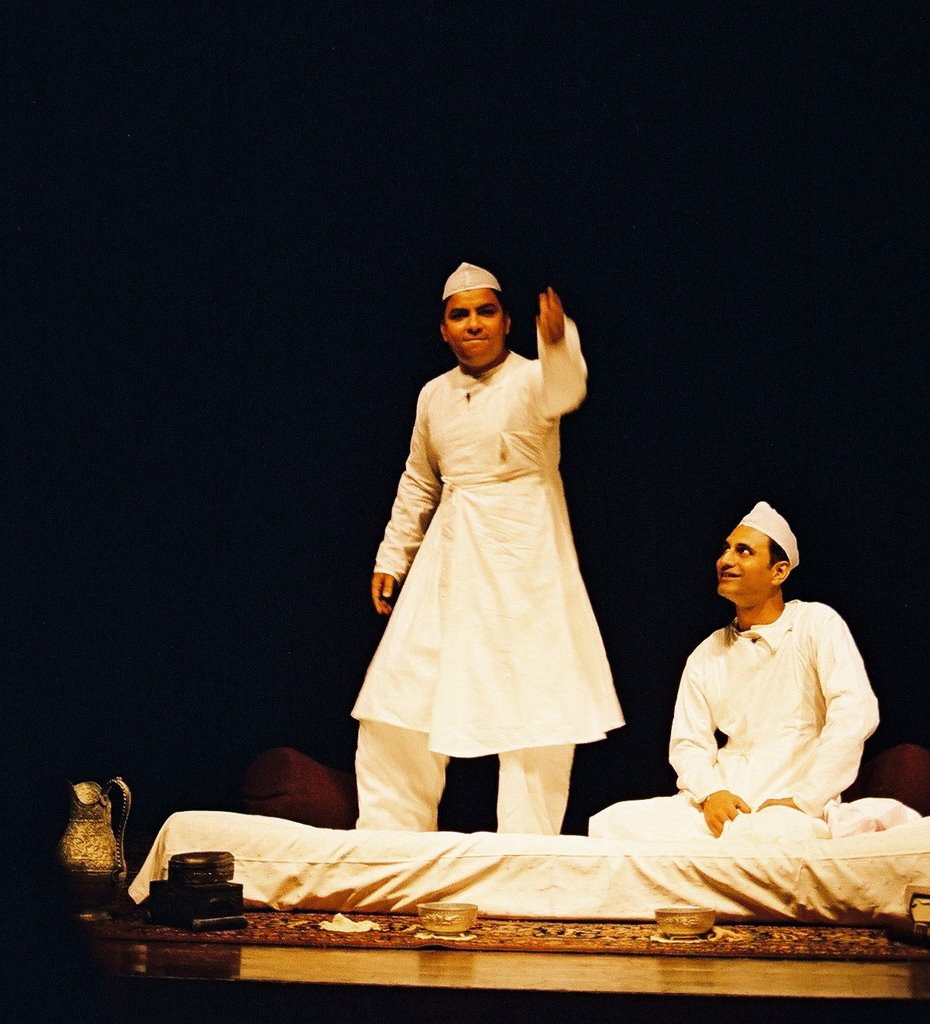
Has the fantastical quality of the tales made them difficult to appreciate for contemporary urban audiences? Or do people in Delhi and Lahore and Mumbai approach dastangoi through a nostalgic lens – assuming that one can be nostalgic for something one has never known? “Well, certainly there is some nostalgia about two men in Lucknawi attire sitting with a masnad and telling stories in Urdu. I’m uncomfortable with that, but I also know that people’s enjoyment doesn’t rest on nostalgia. Nostalgia may keep them there for 10 minutes, but after that they’re getting into the stories. And if the story is working for you, if it has enough to keep you entertained, it is connected to your world, it has become contemporary,” Farooqui said. “I have felt some pressure to contemporanize the dastans. And yes, these are magical stories, you could go anywhere, you could be in Bushland and in Baghdad at the same time. But if people enjoy, say, classical music today, then it is already contemporary, it doesn’t need to be ‘updated’.”
Though happy with the reaction they’ve got so far, Farooqui is clear that dastans have it in them to go much further. “They straddle the elite and the popular, they invoke Islamicness in a very secular mould, one purely driven towards entertainment. I would like to take the form beyond theatre-going audiences.”
(Time Out Delhi, Sep 2007)
Audiences aren't flocking to watch dastangoi just because it's a lost art. It's supremely entertaining as well.
![]() |
Photograph: Abhinandita Mathur
|
Farooqui had little to go by, because almost nothing is known about the conditions in which traditional dastangos showcased their art. It is possible that they had musical accompaniment, and also that large illustrated panels were held up behind the dastango, but what they wore, whether they sat or stood or moved about is unknown. But that first performance at the IIC, which Farooqui did in collaboration with his friend Himanshu Tyagi, was a great success. “It was an invited audience, so there were a lot of Urduwallas, but also regular IIC types and people from Sarai. We weren’t expecting much, but there was a lot of wah-wahi, people were very forthcoming with feedback, and the IIC invited us back to its festival later that year,” Farooqui reminisced. After Tyagi moved to Mumbai in early 2005, Farooqui found a new partner in Danish Husain.
“I remembered Danish from Habib Tanvir’s play Agra Bazar,” said Farooqui. Husain, on the other hand, remembered watching Farooqui and Tyagi perform in Dehra Dun in October 2005. “I was awestruck by the form,” he said, “but when Mahmood asked me to perform with him, I was unsure that I had the capability.” He was persuaded, however, and the duo did their first show together in March 2006. “Traditionally, the dastango performed alone, but I think the idea of two performers is a coup. It breaks the monotony for the audience, and it helps the actors – the moment one is tired, the other steps in,” said Husain.
“And we complement each other: one man is frail and elegant, the other is rotund and rustic. Mahmood is more poetic, eloquent. I’m more rough, more theatrical, like a bhaand. This doesn’t mean that I can’t recite poetry, or that Mahmood can’t be funny, but that’s how things tend to get divided.”
The Farooqui-Husain team has now done at least 30 shows together, mostly performing sections from a single chapter of the Dastan-e-Amir Hamza called the “Tilism-e-Hoshruba”. “The title has been translated as “An Enchantment that Steals Away the Senses”, but tilism is virtually untranslatable. It can mean an enchantment, a magical effect, but also an alternative world created by that effect,” said Farooqui. Tilism, however, is only of the four elements of the traditional dastan: the others are razm (warfare), bazm (the world of music, dancing and seduction) and aiyyari (trickery or disguise). Fantasy is thus an integral part of the tales, but they’re also an incredible fund of realistic depictions of Indian life. Magical forests coexist with cities afflicted by famine and fire, shape-shifters walk cheek-by-jowl with miserly banias and flirtatious women.
Has the fantastical quality of the tales made them difficult to appreciate for contemporary urban audiences? Or do people in Delhi and Lahore and Mumbai approach dastangoi through a nostalgic lens – assuming that one can be nostalgic for something one has never known? “Well, certainly there is some nostalgia about two men in Lucknawi attire sitting with a masnad and telling stories in Urdu. I’m uncomfortable with that, but I also know that people’s enjoyment doesn’t rest on nostalgia. Nostalgia may keep them there for 10 minutes, but after that they’re getting into the stories. And if the story is working for you, if it has enough to keep you entertained, it is connected to your world, it has become contemporary,” Farooqui said. “I have felt some pressure to contemporanize the dastans. And yes, these are magical stories, you could go anywhere, you could be in Bushland and in Baghdad at the same time. But if people enjoy, say, classical music today, then it is already contemporary, it doesn’t need to be ‘updated’.”
Though happy with the reaction they’ve got so far, Farooqui is clear that dastans have it in them to go much further. “They straddle the elite and the popular, they invoke Islamicness in a very secular mould, one purely driven towards entertainment. I would like to take the form beyond theatre-going audiences.”
(Time Out Delhi, Sep 2007)
Labels:
Danish Husain,
dastangoi,
Delhi,
fantasy fiction,
history,
language,
Mahmood Farooqui,
North India,
performance,
popular culture,
Sarai,
theatre,
theatre previews,
Time Out Delhi,
Urdu
Subscribe to:
Posts (Atom)